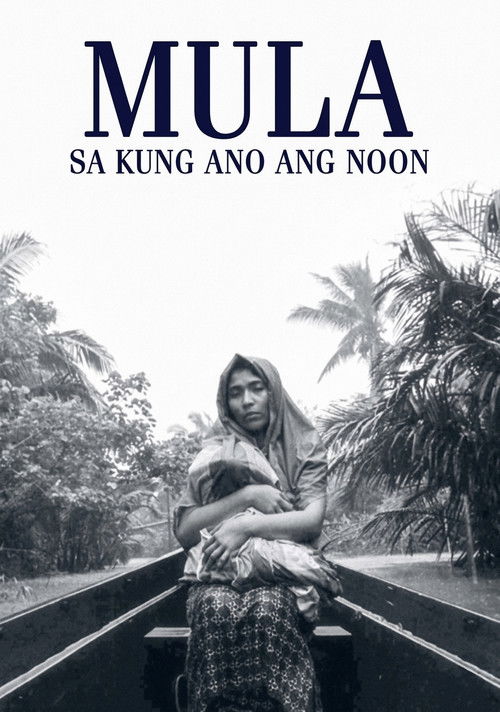
From What Is Before
2014 · Lav Diaz
For when you want a film as a pilgrimage — a long, demanding, haunting sit that stays with you for weeks. Definitely challenge, not comfort; save it for a day you can give it entirely.
What it's about
A remote Philippine barrio, 1970–72. Unexplained things begin to happen: wailing from the forest at night, cattle hacked dead, a man bleeding at a crossroad, houses burning. The villagers reach for spirits and curses; into that fear steps a military detachment offering protection — as the country drifts toward Ferdinand Marcos's declaration of martial law.
The experience
Hypnotic and slowly dread-filled — five-plus hours of black-and-white stillness in which menace gathers like weather. It doesn't argue or explain; it accumulates, until the political horror feels less announced than inevitable.
The craft
Shot in stark black and white across 338 minutes, it builds its history lesson entirely out of atmosphere: long fixed takes, natural sound, rain and treeline and rumor. The craft is in how patiently it lets superstition, fear, and opportunism hollow out a community before a single decree is spoken.
Why it matters
Winner of the Golden Leopard at Locarno in 2014, it stands as one of the major cinematic reckonings with the Marcos era and cemented Diaz's stature at the top of world cinema's long-form tradition.
Snapshot
Mula sa Kung Ano ang Noon is a 338-minute black-and-white chronicle of a remote Philippine barrio in the two years leading to 21 September 1972, when Ferdinand Marcos placed the country under martial law by Proclamation No. 1081. Nothing in the film argues; everything accumulates. Cows are found hacked open, a man bleeds out at a crossroad, wailing carries out of the treeline at night, houses burn. The villagers reach for the explanations available to them — spirits, curses, the sins of neighbors — and in that interpretive vacuum a military detachment arrives offering protection. By the time the proclamation is spoken aloud, the barrio has already been hollowed from within, and the decree merely ratifies a dispossession that was well under way.
The film took the Golden Leopard at Locarno in August 2014, widely reported as the first Filipino feature to win that festival's top prize, and it remains the clearest single statement of Lav Diaz's central historical thesis: that the Marcos dictatorship was not an interruption of Philippine life but a condition the country had been rehearsing. It is also, by Diaz's own account, his most directly autobiographical work — he was born in 1958 in Maguindanao, in Mindanao, to public school teachers among the resettlement communities, and was fourteen when martial law was declared.
Industry & production
Diaz works outside every conventional industrial apparatus, and From What Is Before is a textbook instance. It was made through his own production outfit, Sine Olivia Pilipinas, with a crew small enough to move on foot, on a budget that has never been publicly itemized in any reliable form — as with most of his features, no meaningful production-cost or box-office figures exist, and none should be assumed. The economics are simple and severe: no completion bond, no distributor pre-sale, no theatrical model that could recoup a five-and-a-half-hour black-and-white film in Tagalog.
This is a deliberate position, not a limitation Diaz is trying to escape. He came up through the Philippine studio system in the late 1990s — his early features were made under commercial auspices and were cut against his intentions — and the digital turn of the early 2000s let him leave it. Batang West Side (2001) ran five hours; Evolution of a Filipino Family (2004) ran roughly nine and a half and was assembled over the better part of a decade. By 2014 the working method was settled: shoot with a handful of actors and a skeleton crew, own the camera, cut on a laptop, finance from festival funds, prizes, teaching, and the sale of prior work, and let the festival circuit serve as the distribution system.
Notably, From What Is Before came immediately after Norte, the End of History (2013), Diaz's most conventionally resourced film — in color, with a credited cinematographer and a producing team including Moira Lang, and a Cannes Un Certain Regard premiere. From What Is Before reads in part as a corrective: a return to monochrome, to self-shot images, to durations no commercial partner would sanction. Its exhibition life has been almost entirely festivals, cinematheques, museums, and retrospectives; specialist home-video and streaming access has been intermittent and territory-dependent.
Technology
The film is a product of the cheap-sensor era. Diaz's practice from roughly 2005 onward depends on digital acquisition that is light enough to carry into a forest, quiet enough to run for a full magazine-free take, and cheap enough per minute that duration costs nothing. The specific camera package used here has not been reliably documented in the public record, and it would be wrong to name one; what matters is the class of tool — prosumer digital, available light, no grip package, no track, no dolly.
Three consequences follow directly. First, the take length is unbounded: a scene runs until the dramatic event finishes or fails to arrive, not until a roll expires. Second, the crew shrinks to the point where a village can be filmed without the village being visibly transformed into a set — no lighting units, no marks, no visible apparatus. Third, monochrome becomes a deliberate act rather than a stock choice; the image is desaturated in post to a dense, silvery grayscale that flattens the tropical foliage into masses of tone and pushes rain, smoke, and fog toward abstraction. Digital black-and-white in Diaz's hands is not nostalgia for celluloid but a way of stripping the picturesque out of the landscape — the Philippine countryside as it is habitually photographed is lush and saturated, and removing color removes the tourist gaze.
Technique
Cinematography
Diaz shot the film himself. The grammar is nearly invariant: a locked-off camera, a wide or extreme-wide framing, and a take that continues long past the point at which conventional coverage would cut. Human figures are small in the frame and frequently enter from off-screen, cross, and exit, leaving the composition to hold on empty ground. Depth is used as a dramatic instrument — an action begun in the far background may take a full minute to reach the foreground, and the wait is the point.
Camera movement is rare enough to register as an event when it occurs; the default is stasis. There are few close-ups and essentially no shot/reverse-shot construction, so faces are read at a distance and performance is carried by posture and gait. Light is what the location provides: doorways as the only source in interiors, overcast flatness outdoors, and night scenes that surrender genuinely to darkness rather than being blue-lit into legibility. Rain — heavy, continuous, tropical — recurs as both a visual texture and a structuring inconvenience, and Diaz treats weather as a collaborator rather than a scheduling problem.
Editing
Diaz cuts his own films, and the editing logic is architectural rather than rhythmic. Shots are set end to end like panels; there is no accelerando toward crisis, no cross-cutting for suspense, no elision of transit. Characters walk the road, and we watch them walk the road. The film's several strands — the man raising a foundling boy, the sisters whose seizures are read as a healing gift, the wine-tapper drifting through his own fugue states, the priest whose chapel barely holds, the soldiers — are braided by alternation across enormous intervals, so that a thread can vanish for a long stretch and return changed.
What the cutting produces is a specific temporal experience: the viewer stops anticipating the next narrative beat and begins registering weather, season, decay, and repetition. Duration here does the work that exposition does elsewhere. The horror of the film is not any individual atrocity but the fact that atrocities keep arriving at the same unhurried tempo as meals and errands, and only editing at this scale can make that equivalence felt.
Mise-en-scène / staging
The barrio is staged as a set of fixed stations — a hut, a chapel, a crossroad, a shoreline, a path through forest — revisited from the same camera positions until they acquire the weight of a map. Because the framings repeat, change becomes legible: an emptied house, a new absence in the composition, a burn scar where a structure stood.
Blocking is theatrical in the best sense. Actors are given the whole width of a wide shot and long unbroken stretches of it, and Diaz stages confession, humiliation, and violence in single sustained setups that refuse the relief of a cutaway. Props and costume are minimal and worn — the material poverty of the barrio is not dressed but simply present. The forest functions as an offscreen antagonist: sounds emerge from it, people disappear into it, and the camera almost never follows.
Sound
There is no non-diegetic score. The soundtrack is location ambience — insects, wind, rain on nipa and iron, surf, footfall on mud — recorded with the same austerity as the image and left largely unmanipulated. Silence in the conventional cinematic sense does not exist here; the tropics are never quiet, and the density of that natural noise becomes the film's continuous ground.
Against it, three sonic events stand out. First, the wails from the forest: unattributed human sound that the barrio must interpret, and cannot. Second, diegetic song — the songs the characters sing to themselves and to each other, which carry the film's only lyric consolation. Third, broadcast speech. The declaration of martial law enters the film as mediated voice, the state arriving in the barrio as sound before it arrives as force. That the most consequential event in the film is something heard rather than seen is the whole design in miniature.
Performance
Diaz works with a small repertory company, and From What Is Before draws on it heavily: Perry Dizon, Hazel Orencio, Roeder, Karenina Haniel, Joel Saracho, Mailes Kanapi and others, several of whom recur across his films of this period. The acting register is naturalistic and de-dramatized, calibrated to survive a wide shot held for minutes — no punctuating gesture, no push toward a cut.
Two demands are unusual. One is stamina: performers must sustain a state across takes long enough that any falseness would be exposed. The other is opacity. Diaz withholds psychological explanation, so actors must play people whose interiors we are not given, and the film's most disturbing performances — the wine-tapper's dissociations, the caretaker's exploitation of her sister's afflictions — work precisely because they are never diagnosed for us.
Narrative & dramatic mode
The film is chronicle rather than plot. It has protagonists but no protagonist's arc; it has an ending but no resolution. The organizing mode is the mystery that will not be solved: the mutilated animals, the burnings, and the bleeding man at the crossroad are presented as facts and never given a confirmed author within the diegesis. That withholding is not coyness. It reproduces the epistemic condition of a rural population under a state that has learned to manufacture the threat it then offers to suppress — the historical practice of destabilization as pretext, which is the film's argument about 1972.
Formally, the mode is closer to the realist novel than to the screenplay: parallel lives, long durations, a community as the true subject, and a slow revelation that private guilt and public catastrophe share a grammar. Diaz's literary allegiances — Dostoevsky and Tolstoy above all, made explicit a year earlier when Norte rewrote Crime and Punishment — are structural here rather than adaptive. The film thinks in chapters even when it does not mark them.
Genre & cycle
It sits in three overlapping categories. As slow cinema, it belongs to the international durational tendency that criticism consolidated in the 2000s and 2010s around Béla Tarr, Tsai Ming-liang, Wang Bing, Pedro Costa and Diaz himself — though Diaz has consistently resisted the label's Eurocentric framing, attributing his durations to a Malay relationship to time and to the freedom digital gave him rather than to any arthouse lineage.
As Philippine political cinema, it is a late entry in a tradition running from Lino Brocka and Ishmael Bernal through the post-Marcos reckoning, and it is unmistakably a martial-law film — the genre Diaz has effectively made his own. Within his filmography it belongs to a long cycle: Evolution of a Filipino Family (2004), which opens in 1971 and runs to 1987, is its most direct antecedent; Death in the Land of Encantos (2007) and Melancholia (2008) extend the trauma forward; A Lullaby to the Sorrowful Mystery (2016) reaches back to the 1890s revolution for its origins. From What Is Before is the prologue in that arrangement — the film about the eve.
Authorship & method
Diaz is the author in an unusually literal sense: writer, director, cinematographer, and editor, and he has frequently taken on production duties as well. There is no composer credit because there is no score. Below-the-line credits on his self-produced films of this period are thinly documented in accessible public sources, and it would be irresponsible to assign specific sound or production-design attributions without them.
The collaborators who matter most are therefore in front of the camera and adjacent to production. Hazel Orencio is central to Diaz's work of this decade both as a lead performer and in producing and production-management capacities across several of his films; Perry Dizon and Roeder anchor his repertory. Diaz has also worked repeatedly with the cinematographer Larry Manda on the films where he does not shoot himself — the contrast with Norte's color, credited camerawork illuminates what he chooses when he shoots alone.
His method is famously improvisational within a fixed architecture: scenes are conceived and often written on location, shooting happens in short intense bursts spread over long periods, and the film is discovered in the edit. He has described the process as something closer to painting or writing than to producing — one person, extended time, no committee. That the resulting films are among the most rigorously constructed in contemporary cinema is the productive paradox of the practice.
Movement / national cinema
The film is a keystone of the Philippine independent movement that digital video made possible after 2000 — the same conditions that produced Brillante Mendoza, Raya Martin, Khavn De La Cruz, John Torres, and others. Diaz is the movement's senior figure and its most uncompromising: where some of his contemporaries moved toward international co-production and shorter, more circulable forms, he went the other way.
The national dimension is inseparable from the aesthetic. Diaz has argued for decades that Philippine cinema was deformed by a colonial and commercial inheritance — Hollywood-derived genre product, imposed running times, an audience trained to expect narrative closure — and that a genuinely Filipino cinema would have to be built on Filipino duration and Filipino silence. From What Is Before is that thesis executed without compromise, and its Locarno win gave the argument institutional weight it had not previously carried.
Era / period
Two eras are in play. The depicted period is 1970–72, the terminal phase of Marcos's second term: rural poverty and internal migration, a weakening Church, insurgency and counter-insurgency in the countryside, and a president constitutionally barred from a third term who solved the problem by suspending the constitution. The film's insistence that the barrio was already unraveling before the decree is a specific historical claim about how authoritarianism is preceded and prepared.
The production era is equally legible. 2014 is peak digital-independent: sensors cheap, editing software commoditized, festival programming actively hospitable to extreme duration, and a critical discourse — in Cinema Scope, Sight & Sound, and the festival press — primed to receive a five-and-a-half-hour black-and-white Filipino film as major cinema rather than as an eccentricity. Ten years earlier, Evolution had struggled to be seen at all. And in the years since, the film has acquired an unintended second life: as Marcos-era revisionism gained ground in Philippine politics, culminating in the 2022 election of Ferdinand Marcos Jr., Diaz's insistence on remembering 1972 stopped being retrospective.
Themes
Complicity. The film's most devastating turn is its refusal to locate evil outside the community. The barrio contains exploitation, superstition weaponized for profit, and buried guilt long before the soldiers arrive; the dictatorship finds a prepared ground.
Interpretation and its failure. Confronted with inexplicable violence, the villagers produce readings — spirits, punishment, the sick girl's visions — and every reading is wrong. Diaz stages the manufacture of belief under uncertainty, which is also the mechanism by which the state will govern.
Faith and its remnants. The chapel, the healer, and the folk cosmology coexist and none is adequate. Diaz treats Catholic and animist frameworks with equal seriousness and equal skepticism.
Land, water, and departure. The road and the shoreline are the film's two exits, and displacement — leaving the barrio, or being emptied out of it — is the recurring physical fact.
Duration as ethics. Underneath all of it: the claim that historical suffering cannot be honestly represented at feature length, that compression is itself a falsification, and that a viewer who will not give the film five hours has not been asked for much compared to what the depicted people gave.
Reception, canon & influence
The Golden Leopard at Locarno in 2014 was the decisive reception event — a top prize at a major European competition for a 338-minute black-and-white film with no market prospects, and a substantial elevation of Diaz's international standing. Beyond the festival circuit, engagement has been concentrated in specialist criticism rather than the general press, which is the standard shape of a Diaz release: extended treatment in the critical journals and festival dailies, retrospective programming at cinematheques and museums, and effectively no wide theatrical footprint. Critical consensus among those who wrote about it treats it as among his strongest works and the most lucid articulation of his historical project; the durable dissent is the durable dissent about all of Diaz — that the durations are ascetic to the point of coercion, and that the aesthetic austerity buys less than it costs.
Backward. The literary inheritance is Russian — Dostoevsky and Tolstoy — filtered through the Filipino tradition of the social novel and the nationalist inheritance of Rizal. The cinematic ancestry Diaz himself acknowledges is more Filipino than European: Brocka and Bernal as the political precedent he departs from formally. His own Evolution of a Filipino Family is the direct precursor in both period and method. The frequently drawn comparison to Tarr and to European slow cinema is real as a critical context but, by Diaz's own repeated account, not a source.
Forward. The film consolidated Diaz's position at the moment his international ascent accelerated: A Lullaby to the Sorrowful Mystery took the Alfred Bauer Prize at Berlin in 2016 at roughly eight hours, and The Woman Who Left took the Golden Lion at Venice later that same year. That two-year run made him the most decorated Southeast Asian director of his generation and materially widened what festival competitions would accept in terms of running time. Its influence on Philippine independent cinema is less a matter of imitation — few have attempted films of this length — than of demonstrated permission: proof that a filmmaker could own the means of production entirely, refuse every commercial parameter, and still reach the top of the international system. And as a work of historical memory, its stature has grown as the political conditions it anatomizes have returned, which is the bleakest possible form of vindication.
A Deleuzian reading
A figure enters at the left edge of a wide gray frame, walks the road, and leaves at the right.
The full Deleuzian reading of From What Is Before →
Reception
It premiered at Locarno 2014 and took the Golden Leopard — the moment the wider festival world stopped treating Lav Diaz as a fringe endurance test and started treating him as a major filmmaker. It's since settled in as one of the peaks of his filmography and of 2010s slow cinema.
How From What Is Before was received, from release to now →
How to watch From What Is Before: what to notice on a first viewing
- Watch a locked wide shot outlast the action inside it. Diaz holds a fixed frame long after a figure has crossed and left it, letting empty ground, rain, and light take over the shot. The image keeps offering itself for looking after the story has moved on.
- Listen for the total absence of any music. The whole soundtrack is location ambience: insects, rain, wind, surf, and footfall, left unmanipulated for the length of the film. The tropics carry their own soundtrack, so nothing here is telling you what to feel.
- Notice the same few places the camera keeps returning to. A hut, a chapel, a crossroad, a shoreline, and a forest path recur from identical camera positions until they read like a map of the barrio. Once a place is memorized, any change in it becomes visible on its own.
- Watch how the camera stops at the tree line. Sounds and people go into the forest, but the camera almost never follows them in, leaving what happens there to your ears alone. What you cannot see becomes exactly as real as what you can.
- Watch how rarely the camera moves close to a face. Diaz reads his actors through posture and gait in a wide shot rather than through close-ups, so performance survives being held at a distance for minutes. You read character the way you would read a stranger walking toward you.
The whole guide to watching From What Is Before, with the keys for a rewatch →
Influences: the films it descends from and the films it influenced
- Maynila: Sa mga Kuko ng Liwanag (1975) — Established the Philippine social-realist practice Diaz builds from and then strips: location shooting in real working-class spaces with non-star faces and direct sound, which Diaz keeps while discarding Brocka's cutting rhythm and dramatic climaxes for the locked-off wide.
- Manila by Night (1980) — The braided ensemble chronicle — a dozen unranked characters alternating in short returning strands with no single protagonist and no resolving arc — is the structural template for Diaz's rotation among the barrio's figures across the rainy season.
- Himala (1982) — Bernal and Sergio Lobo's extreme wide shots of figures crossing a barren rural expanse, with mass hysteria carried by unseen offscreen wailing rather than score, is the exact staging-and-sound grammar Diaz reuses for the village and Joselina's cries from the treeline.
- Mababangong Bangungot (Perfumed Nightmare) (1977) — The precedent for total single-person authorship in Philippine cinema — Tahimik shot, cut, produced and narrated on scavenged 16mm over years outside any industry — which is the production model Diaz literalizes as writer/DP/editor/producer shooting in intermittent bursts.
- Jeanne Dielman, 23 quai du Commerce, 1080 Bruxelles (1975) — Invented the repeated fixed station: the camera returns to identical frontal setups at identical distances across days so that duration and micro-deviation carry the drama, which is precisely how Diaz films the same hut doorway, the same path, the same well.
- Batang West Side (2001) — Diaz's first extreme-duration work (315 min), where he discovered that an unresolved investigation could be built from braided testimony strands rather than plot — the novelistic architecture he later applies to a whole barrio instead of one death.
- Ebolusyon ng Isang Pamilyang Pilipino (2004) — The direct precursor in period and method: a decade-long shoot on monochrome video tracking a rural family into martial law, and the source of the radio-broadcast voice as a structuring sound device — the serial drama and news bulletins that mark time offscreen while the fixed frame holds.
- Death in the Land of Encantos (2007) — Established the practice of shooting a devastated real landscape as found production design in available-light monochrome DV — the typhoon fields of Bicol as an environment the camera merely stations itself within — and cemented Roeder as a repertory anchor.
- Melancholia (2008) — Consolidated the mature toolkit — digital black-and-white, static extreme-wide framings held past the exit of the actors, no score, and Perry Dizon's de-dramatized delivery of long expository speeches within a single unbroken take.
- Sátántangó (1994) — Convergent rather than derived (Diaz disclaims it as a source): the same solution of monochrome, rain-soaked deep-staged long takes and a repeating-village structure in which the mud and the treeline function as the antagonist, arrived at independently.
- Storm Children, Book One (2014) — Same-year documentary application of the identical apparatus — locked-off monochrome wides, location ambience only, no narration or score — proving the method needs no fiction scaffolding to organize a devastated landscape.
- Hele sa Hiwagang Hapis (A Lullaby to the Sorrowful Mystery) (2016) — Extends the forest-as-antagonist staging to eight hours and to the 1896 revolution: characters enter the treeline at fixed stations and are lost to it, with the same repertory (Hazel Orencio) and Larry Manda's monochrome carrying the deep-staged wides.
- The Woman Who Left (2016) — Takes the available-light monochrome night exterior to its limit — figures readable only as silhouettes at the edge of practical sources in Manda's frames — and converts the unresolved chronicle into a Tolstoy-derived revenge structure that still refuses a climactic cut.
- Ang Panahon ng Halimaw (Season of the Devil) (2018) — Restages the same martial-law militia material at the same fixed wide stations with the same repertory, but replaces the seed's absent score with unaccompanied a cappella singing delivered straight to the locked-off camera — the no-score principle inverted rather than abandoned.
- Tie Xi Qu: West of the Tracks (2002) — The parallel case for one-man digital video as historical witness at nine hours: ambient-only sound, no commentary, no score, and a tripartite braided structure that lets duration itself register the erasure of a place.
- Tropical Malady (2004) — Makes the forest an offscreen antagonist through sound alone — a dense insect-and-canopy ambience that does the work a score would, with the threat always just outside frame — the same acoustic strategy Diaz uses for the woods that swallow the barrio's people.
- Colossal Youth (2006) — Fixed, deep-staged digital compositions lit only by available light, performed by a standing repertory of non-professionals playing refracted versions of themselves across successive films — the identical relationship Diaz maintains with Dizon, Orencio and Roeder.
- Norte, the End of History (2013) — The immediately preceding counter-experiment: color, a credited cinematographer in Larry Manda, and a Dostoevsky armature — the deliberate control against which the monochrome, self-shot austerity of the following year defines itself.
- Magellan (2025) — Closest formal cousin: black-and-white, no-score, location-ambience period reconstruction staged in depth across rural Philippine terrain, with performance pitched to restraint inside the wide frame.
Similar films
- Evolution of a Filipino Family (2004) — influence & lineage
- Batang West Side (2001) — influence & lineage
- Satantango (1994) — influence & lineage
- Manila in the Claws of Light (1975) — influence & lineage
- Tropical Malady (2004) — influence & lineage
- Norte, the End of History (2014) — shared sensibility
- Magellan (2025) — shared sensibility
- Kisapmata (1981) — shared sensibility