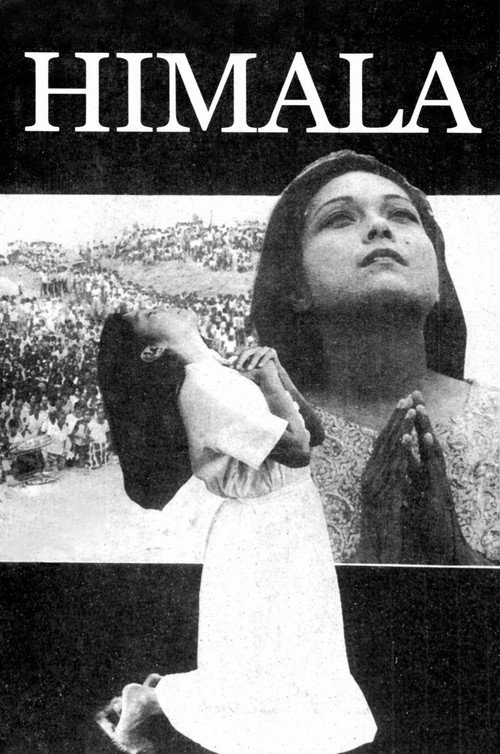
Miracle
1982 · Ishmael Bernal
For when you want a big, serious film that wrestles with faith, poverty, and mass belief — the kind you watch with full attention and talk about afterward. This is challenge viewing, and worth it.
What it's about
On the sun-flattened dunes of a poor village in the northern Philippines, a plain young orphan named Elsa announces she has seen the Virgin Mary — and then begins to heal the sick. Her barren hometown erupts into a boomtown of pilgrims, hucksters, faith healers, and a documentary crew, and the film follows what the miracle does to everyone it touches: the desperate, the opportunistic, and Elsa herself.
The experience
Slow-burning and hypnotic, with the scale of an epic and the sting of a social exposé. It builds a mounting sense of fever — crowds, heat, need — while keeping a clear, unsentimental eye, and it lands with real force.
Performances
Nora Aunor, the Philippines' 'Superstar,' gives a performance of astonishing stillness as Elsa — she barely raises her voice and holds the frame like an icon, letting the crowds swirl around her unreadable calm.
The craft
Ishmael Bernal stages the story on stark sand dunes under a merciless sun, turning a real landscape into something close to parable, while Ricky Lee's screenplay anatomizes an entire village — believers, profiteers, filmmakers — without losing the human beings inside the frenzy. The crowd scenes have a documentary charge that a big screen amplifies.
Why it matters
The first Filipino film to compete at the Berlinale, it has since been voted the greatest Filipino film ever made in multiple polls — a national landmark made under the Marcos regime yet cutting against everything official culture wanted to believe.
On the sand dunes of Ilocos Norte, under a sun that flattens everything to parable, a plain young woman named Elsa sees the Virgin Mary — and her barren village becomes a boomtown of pilgrims, hucksters, faith healers, and a documentary crew. Ishmael Bernal, later named a National Artist of the Philippines and one of its great queer filmmakers, directs Ricky Lee's screenplay as both religious epic and clear-eyed social anatomy, made under the Marcos regime's own film agency yet cutting against everything official culture wanted to believe. At its center is Nora Aunor, the country's 'Superstar,' giving a performance of astonishing stillness — she barely raises her voice, and holds the frame like an icon. The first Filipino film to compete at the Berlinale, it has since been voted the greatest Filipino film ever made in multiple polls, and in 2008 won CNN's viewers' choice as the best Asia-Pacific film of all time. Its final sequence, staged with a cast of thousands on those dunes, is among the most famous in Southeast Asian cinema.
Reception
A box-office and festival event in the Philippines on release, it went from national sensation to certified world-cinema classic — capped when a 2008 CNN/Asia Pacific Screen Awards viewers' poll named it the greatest Asia-Pacific film of all time, and a 2012 restoration premiered at Venice.
How Miracle was received, from release to now →
Influences: the films it descends from and the films it influenced
- The Passion of Joan of Arc (1928) — Establishes the visionary-peasant-woman rendered almost entirely through held, unblinking close-ups, the template for Nora Aunor's near-immobile 'iconic stillness' as Elsa.
- Ordet (1955) — Stages an actual on-screen miracle demanding a slowed, austere, near-liturgical camera that refuses spectacle — the formal problem Bernal inherits in filming faith without editorializing it.
- The Song of Bernadette (1943) — Supplies the exact narrative machine of a poor girl's Marian apparition drawing pilgrim crowds while clergy and authorities investigate — the religious-epic scaffold Himala inverts into critique.
- L'Amore (The Miracle) (1948) — Neorealist staging of a peasant woman's conviction that she carries the divine, met by village mockery curdling into hysteria — the documentary-textured 'holy delusion' Bernal expands to a barrio scale.
- Nazarín (1959) — Choreographs failed miracles and processions of the destitute following a holy figure, modeling the anatomy of desperate faith trailing after a supposed healer.
- Viridiana (1961) — Assembles a cast of the poor as a satirical social specimen through which charity and devotion collapse — the coldly diagnostic 'social anatomy' lens Bernal turns on his pilgrims.
- The Devils (1971) — Choreographs mass religious hysteria as convulsive collective spectacle across a crowd, precedent for Himala's staging of a whole town's faith-frenzy as bodily contagion.
- Medium Cool (1969) — Embeds a camera-operator observer inside real political turmoil, blurring reportage and fiction — the documentary-within-film reflexivity of Bernal's filmmaker character recording the apparitions.
- Breaking the Waves (1996) — Centers a female visionary whose absolute faith is validated by an ambiguous literal miracle, extending Himala's refusal to confirm or deny the supernatural into martyr melodrama.
- Silent Light (2007) — Reprises Ordet's resurrection-miracle with a non-professional community cast and durational, sun-struck landscape framing — the same Dreyerian-realist fusion Bernal practiced.
- Lourdes (2009) — Observes a faith-healing pilgrimage with a detached, clinical camera that leaves the cure's authenticity deliberately unresolved — Himala's ambiguous-miracle skepticism made formally cool.
- Norte, the End of History (2013) — Extends the Bernal-Brocka project of long-observation Philippine social anatomy as political critique, treating a whole society's moral condition as the true subject.
- Ma' Rosa (2016) — Carries the Philippine New Wave's handheld, documentary-textured realism into contemporary sun-glare slums, descending directly from Bernal's observational anatomy of a community under duress.
- Barber's Tales (2013) — Centers a whole provincial community's political and moral crisis on one quiet woman's transformation, using slow-burn restraint over melodramatic peaks — the register Domingo's Marilou inherits.
- From What Is Before (2014) — Bernal and Sergio Lobo's extreme wide shots of figures crossing a barren rural expanse, with mass hysteria carried by unseen offscreen wailing rather than score, is the exact staging-and-sound grammar Diaz reuses for the village and Joselina's cries from the treeline.
- Insiang (1976) — Defines the Philippine New Wave's sun-flattened, non-professional-dense social realism under Marcos, the same regional grammar of poverty and heat Bernal deploys in the drought barrio.
- Bona (1980) — Builds an entire film on Nora Aunor's watchful, contained stillness as a vessel of obsessive devotion — the same performance register Bernal weaponizes for Elsa.
- Moral (1982) — Shares screenwriter Ricky Lee, whose talky, socially diagnostic dialogue and woman-at-the-center architecture drive both films in the same year.
Similar films
- Nazarín (1959) — influence & lineage
- Breaking the Waves (1996) — influence & lineage
- Manila in the Claws of Light (1975) — shared sensibility
- Viridiana (1962) — shared sensibility
- Baraka (1992) — shared sensibility
- El Norte (1983) — shared sensibility
- From What Is Before (2014) — shared sensibility
- Magellan (2025) — shared sensibility