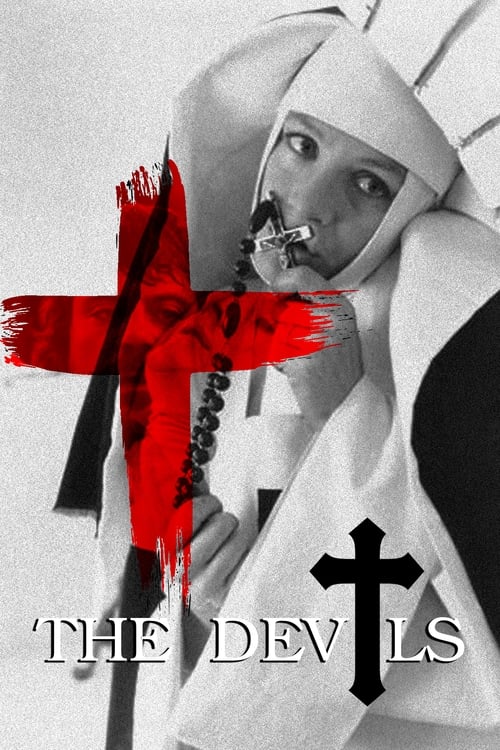
The Devils
1971 · Ken Russell
When you want cinema as a full-contact experience — provocative, extreme, and furious about power. Absolutely not a comfort watch; reach for it when you want to be shaken.
What it's about
In 17th-century France, a proud, worldly priest is all that stands between Cardinal Richelieu and the demolition of the self-governing walled city of Loudun. When a convent prioress's erotic obsession with him boils over into accusations of witchcraft, church and state seize the pretext — and a whole city is dragged into possession hysteria, show trials, and fire.
The experience
Ferocious and deliberately overwhelming: grotesque, blasphemous, blackly funny, and finally shattering. It plays political horror at full volume, and fifty years on it has lost none of its power to appall.
Performances
Oliver Reed gives the performance of his life as Grandier — sensualist, egotist, and finally something like a martyr — opposite Vanessa Redgrave, unforgettable as the twisted, yearning Sister Jeanne.
The craft
A young Derek Jarman designed Loudun as a gleaming white-tiled anachronism — part fortress, part asylum — one of the great sets in British film, and Russell stages the hysteria with operatic, go-for-broke abandon. Banned, cut, and condemned for decades, its scale and shock both demand the biggest screen you can find.
Why it matters
The most scandalous film ever released by a major studio — X-rated on both sides of the Atlantic, censored for decades — and now widely reclaimed as Ken Russell's masterpiece and a landmark of political horror.
Seventeenth-century Loudun: a proud, worldly priest stands between Cardinal Richelieu and the demolition of his self-governing walled city, until a prioress's erotic obsession curdles into possession hysteria — and the state finds the pretext it needs. Ken Russell, British cinema's great vulgarian-visionary, drew on Aldous Huxley's The Devils of Loudun and John Whiting's play for what remains the most scandalous film ever made by a major studio: an X on both sides of the Atlantic, condemned, cut, and banned, its infamous 'Rape of Christ' sequence excised for decades. Yet the outrage obscured the rigor. Oliver Reed gives the performance of his life as Grandier, sensualist and martyr, opposite Vanessa Redgrave's twisted Sister Jeanne; the young Derek Jarman designed the city as a gleaming white-tiled anachronism, part fortress, part asylum bathroom, making the past feel like a horrific modern machine; Peter Maxwell Davies supplied the shrieking score. Beneath the delirium is a coldly lucid political film about how power weaponizes faith. Warner Bros. has never granted the uncut version a proper release — the suppression now part of the film's meaning.
A Deleuzian reading
The walls of Loudun are tiled.
The full Deleuzian reading of The Devils →
Reception
Savaged in 1971 as blasphemous filth — X-rated, banned outright in several countries, and hacked apart by censors — it's now widely regarded as Ken Russell's masterpiece and one of the great films about religious and political hysteria.
How The Devils was received, from release to now →
Influences: the films it descends from and the films it influenced
- The Passion of Joan of Arc (1928) — Establishes the ecstatic female-martyr trial in relentless facial close-up — the beatific-suffering register Russell borrows for Grandier's torture and burning.
- Häxan (1922) — Pioneers rendering demonic possession and inquisitorial torture as grotesque, quasi-documentary spectacle, the writhing-hysteria tableau Russell amplifies in the convent's mass frenzy.
- Day of Wrath (1943) — Frames a theocratic witch-hunt as a machinery of accusation and confession under torture, the church-as-persecutor structure Russell dramatizes in Grandier's show trial.
- Mother Joan of the Angels (1961) — Adapts the identical Loudun possession case with austere, high-contrast convent staging — the restrained treatment Russell deliberately inverts into baroque excess.
- Black Narcissus (1947) — Renders cloistered sexual repression erupting into hysteria through hothouse color and expressionist design; Russell, a Powell devotee, transposes its convent-in-crisis into the Ursulines' collapse.
- Marat/Sade (1967) — Stages collective madness as choreographed Artaudian theater-of-cruelty ensemble, the model for Russell's orgiastic 'Rape of Christ' set-pieces performed as writhing crowd spectacle.
- Simon of the Desert (1965) — Weaponizes anticlerical blasphemy, treating sanctity and carnal temptation as absurd grotesquerie — the desecration impulse behind Russell's mockery of ecclesiastical hypocrisy.
- Witchhammer (1970) — Extends the witch/possession trial into an overt study of political power liquidating a target through a rigged tribunal, foregrounding the show-trial-as-allegory Witchhammer keeps period-clad.
- The Wicker Man (1973) — Stages a British folk collision of faith and state authority climaxing in ritual martyrdom by fire, extending Russell's power-and-belief pageant into pagan horror.
- Sebastiane (1976) — Jarman, The Devils' set designer, turns director to fuse homoerotic sensuality with religious martyrdom — sanctified suffering as ecstatic bodily spectacle.
- Jubilee (1978) — Carries Jarman's anachronistic design method from The Devils' white-tiled Loudun into a punk-era collage that collapses historical periods into one transgressive frame.
- Possession (1981) — Pushes possession-hysteria into extreme full-body performance (Adjani's subway convulsion), extending Redgrave's contorted ecstasy into pure physical derangement.
- Caravaggio (1986) — Perfects the anachronistic production design seeded in The Devils — modern objects intruding on a period tableau — as deliberate art-historical dislocation.
- Benedetta (2021) — Revives the convent-hysteria subject with lesbian ecstasy and church-power intrigue, provoking outrage in the same Loudun-era territory of faith weaponized for political control.
- Nosferatu (2024) — Channels psychosexual obsession into convulsive female religious hysteria — the body as the site where repression returns, a precedent for Ellen's seizing, eroticized possession.
- Altered States (1980) — Russell's own operatic religious-ecstatic visual grammar — crucifixion and ecstasy imagery staged as transgressive sensory assault — carried directly into the film's regression visions.
- The Devil's Backbone (2001) — Fuses Catholic iconography, bodily horror and political-historical atrocity into a single transgressive register — the conviction that religious imagery is the proper language for institutional violence.
- Miracle (1982) — Choreographs mass religious hysteria as convulsive collective spectacle across a crowd, precedent for Himala's staging of a whole town's faith-frenzy as bodily contagion.
- Suspiria (2018) — Art-horror of collective female hysteria and matriarchal/religious body horror staged as transgressive institutional spectacle, precedent for the coven's ecstatic ritual violence.
- Queen Margot (1994) — Model for anti-decorous religious-war cinema: sectarian massacre and mass hysteria staged as operatic bodily frenzy rather than tasteful costume-drama pageant.
- La Religieuse (1966) — A literary convent adaptation banned by the church-state for depicting institutional cruelty toward a trapped woman — the same censorship collision The Devils provoked.
- Witchfinder General (1968) — Grounds English historical persecution in brutal, unromantic torture of the accused across a hostile landscape, the transgressive-period-horror lineage Russell shares.
- Women in Love (1969) — Russell's own transgressive literary adaptation starring Oliver Reed, testing censorship (male nude wrestling) — the immediate authorial precursor to The Devils' provocations.
- The Music Lovers (1970) — Russell's baroque biographical delirium, using hallucinatory montage and operatic hysteria — the same fevered visual grammar carried directly into The Devils.
- Salò, or the 120 Days of Sodom (1975) — Composes power and cruelty as formal tableaux of institutional sadism, sharing The Devils' suppressed-cut censorship history and its indictment of authority's obscenity.
Similar films
- Mother Joan of the Angels (1961) — influence & lineage
- Häxan (1922) — influence & lineage
- The Passion of Joan of Arc (1928) — influence & lineage
- Possession (1981) — influence & lineage
- Day of Wrath (1943) — influence & lineage
- Caravaggio (1986) — influence & lineage · often watched together
- The Last Temptation of Christ (1988) — often watched together
- In the Realm of the Senses (1976) — often watched together
All the films related to The Devils →
Watch it with: curated runs of related films
- Mutilated Masterpieces — Watch these monumental silent-era and epic behemoths together — each one butchered by a studio or a censor and only later reclaimed as a monument — when you want cinema at its most ruinous, obsessive, and grand.