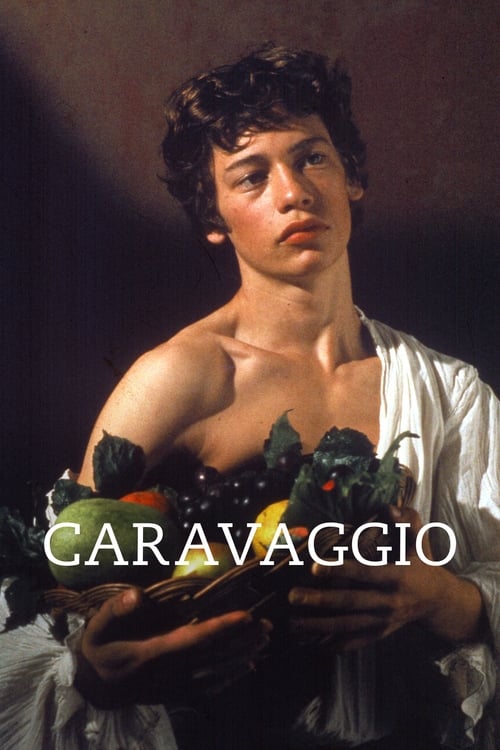
Caravaggio
1986 · Derek Jarman
When you want something bold and painterly to sink into — art-house viewing for a night when you're up for a challenge and would rather be haunted by images than carried by a story.
What it's about
The life of the Baroque painter Caravaggio, told as a fevered deathbed reverie rather than a tidy costume biography. It follows the artist through Rome's underworld — street toughs, lovers, patrons, cardinals — as the same beautiful, dangerous people who share his bed become the saints and sinners in his paintings. Desire, faith, violence, and art keep collapsing into each other.
The experience
Dreamlike and deliberately artificial — scenes glow like candlelit canvases, then a typewriter or a motorcycle intrudes and jolts you out of the period. It's sensual, provocative, and moody rather than plot-driven; you drift through it the way you'd drift through a gallery at night.
Performances
An early, magnetic Tilda Swinton and a smoldering Sean Bean as the lovers orbiting the painter — Swinton in particular announces herself as a screen presence unlike anyone else.
The craft
Shot almost entirely inside a converted warehouse, it conjures the seventeenth century from darkness, gold leaf, and candle flame, freezing the actors into living recreations of Caravaggio's actual compositions. The deliberate anachronisms — modern jackets, calculators, engine noise — are a running dare. The lighting alone is worth seeing on the best screen you have.
Why it matters
A landmark of British art cinema and queer filmmaking that launched Tilda Swinton's career and cemented Derek Jarman as one of the era's most fearless independent voices.
Snapshot
Caravaggio is Derek Jarman's chamber-scale biography of the Baroque painter Michelangelo Merisi da Caravaggio, staged not as costume spectacle but as a fevered deathbed reverie. Confined almost entirely to a single converted warehouse, the film dispenses with Italianate locations and instead conjures the seventeenth century out of pools of darkness, gold leaf, candle flame, and the bodies of street toughs and lovers posed into living versions of the painter's canvases. Its governing conceit is the tableau vivant: again and again the action freezes into a recognizable Caravaggio composition, then breaks back into motion, collapsing the distance between the life and the work. Equally central is Jarman's deliberate, mischievous anachronism — typewriters, motorcycles, pocket calculators, electric lamps, and modern jackets intrude on the period world, refusing the illusion of historical reconstruction and insisting on the painter as a contemporary, even a self-portrait. The result is one of the defining works of the 1980s British art film, the picture that introduced Tilda Swinton to the screen, and a meditation on the entanglement of art, money, desire, and violence that doubles as Jarman's most sustained statement on the artist's vocation.
Industry & production
Caravaggio was among the most protracted gestations in Jarman's career. He had been drawn to the painter for years, drafting and redrafting the screenplay across roughly the late 1970s and early 1980s as financing repeatedly fell through; the project's long limbo became part of its legend, and Jarman's published diaries and the production book he assembled around the film document the frustration of chasing money for an uncommercial subject. The film was finally realized under the aegis of the British Film Institute Production Board, with Sarah Radclyffe and Nicholas Ward-Jackson among the producing figures who brought it to the screen on a notably modest budget. (The frequently cited budget figure should be treated cautiously here; what is firmly established is that the film was made cheaply by feature standards and that its economy dictated its single-set, studio-bound aesthetic rather than the reverse.)
That economy was turned into method. Rather than disguise the lack of resources, Jarman embraced a wholly artificial, theatrical mode of production: the entire film was shot on constructed sets inside a warehouse space in London's docklands, with no recourse to Italian locations. The constraint freed the production from any obligation to verisimilitude and allowed Jarman, a trained painter and former production designer, to control every surface within the frame. The shoot was correspondingly compact, and the picture's intimacy — its sense of a closed, hothouse world — is a direct consequence of the conditions under which it was made.
Technology
Technically Caravaggio is a conventional 35mm production, and Jarman's interest lay not in novel apparatus but in the oldest of cinematic and pictorial technologies: controlled artificial light. The film's most important "technology" is essentially the lighting rig and the blacked-out studio, which permitted the painter's chiaroscuro to be reproduced photographically — single sources, deep falloff, figures emerging from enveloping shadow. This is a film made by subtraction of light rather than addition. Jarman's own background as a Super-8 diarist and experimental filmmaker informs the work's comfort with a handmade, low-tech surface; even shot on professional 35mm stock, Caravaggio keeps faith with the textural, painterly image that runs through all his cinema. The anachronistic props — adding-machine, typewriter, motorbike — function less as a statement about technology than as a Brechtian device puncturing period illusion.
Technique
Cinematography
The photography by Gabriel Beristain is the film's most celebrated technical achievement and the engine of its argument. Beristain lights the warehouse interiors to mimic the painter's tenebrism: hard, raking key light isolates a face, a shoulder, or a still life of fruit and wine against impenetrable black, so that the screen image continually rhymes with the canvases on the walls. The palette favors earth tones, candle-gold, flesh, and oxblood reds. Crucially, the camera holds compositions long enough for the eye to recognize them as paintings before they animate, making the spectator complicit in the act of looking that the film is about. The work was recognized internationally, and the film's cinematography is routinely cited as a high point of 1980s art-house image-making.
Editing
George Akers's editing organizes the film as associative memory rather than linear biography. The structure is recursive: the dying Caravaggio, attended at his bedside, summons fragments of his life out of order, and the cutting moves between the deathbed present, scenes of youth, the rise to patronage, and the love triangle that turns fatal. Transitions are frequently motivated by image or theme — a gesture, a pose, a color — rather than chronology, so that the editing itself performs the painter's way of seeing the world as a series of compositions. The freezes into tableaux are managed at the level of cutting and performance together, the actors holding still as the edit lingers.
Mise-en-scène / staging
This is the film's heart, and the area where Jarman's identity as a painter and designer is most visible. Every set is a constructed, frankly artificial space; the staging organizes bodies, props, and light into deliberate quotations of specific Caravaggio works, so that the film becomes a gallery brought to life. Street boys, prostitutes, cardinals, and assassins are arranged into the painter's known iconography of beautiful, dirty-footed models drawn from the Roman underclass. Into these meticulously period-styled tableaux Jarman inserts his pointed anachronisms — a critic clacking at a typewriter, a calculator totting up a patron's accounts, the growl of a motorbike — staging the collision of past and present as a formal principle. The effect is to present history as something made, curated, and inhabited from the present, not recovered intact.
Sound
Simon Fisher Turner's score is spare and atmospheric, favoring drones, sacred-sounding vocal and instrumental textures, and ambient unease over conventional period pastiche; it became the start of a long working relationship with Jarman. The soundtrack works with the film's hushed, enclosed acoustic — the close sound of a studio interior — and against the imagery's stillness. Voiceover is structurally central: the painter's reflective, first-person narration frames the action as remembered and confessed, giving the film a literary, elegiac register that complements its visual silences.
Performance
Performance in Caravaggio is deliberately stylized, pitched between portraiture and theater. Nigel Terry plays the adult painter with a watchful, saturnine gravity, his voice carrying much of the film through narration. Sean Bean, in an early major role, is the swaggering, dangerous street fighter Ranuccio, and Tilda Swinton — making her screen debut and beginning her foundational collaboration with Jarman — plays Lena with a still, luminous opacity that the camera treats like a painted subject. The triangulated desire among these three drives the drama. Supporting players, including the cardinals and patrons who buy and sponsor the painter, populate a world where bodies are continually being posed, bought, and looked at; the acting style foregrounds that condition of being seen.
Narrative & dramatic mode
The film is structured as a deathbed retrospection. From his final illness, Caravaggio narrates and re-lives his ascent from poverty to the patronage of the Church and the Roman cardinalate, and the destructive love triangle binding him to the model-fighter Ranuccio and to Lena. The dramatic mode is anti-naturalistic and frankly elliptical: rather than dramatize a continuous historical biography, Jarman selects emblematic scenes — the discovery of a model, the negotiation with a patron, an act of violence, the making of a picture — and lets the gaps speak. The narration lends the whole a confessional, poetic interiority. Causality is emotional and thematic more than factual; the film is candid that it is an interpretation, a portrait of the artist filtered through Jarman's own preoccupations, not a documentary reconstruction.
Genre & cycle
Nominally a historical biographical drama with a central romance, Caravaggio belongs more truly to the cycle of the painter-film or "artist's biopic," a genre Jarman radically reworks. Where the mainstream artist biopic dramatizes genius for a wide audience, Jarman's film sits within the 1980s British art-cinema tendency — alongside the work of Peter Greenaway and the broader Channel 4 / BFI–supported wave — that treated history as a site for formal experiment and contemporary critique. It is also a queer film, placing homoerotic desire at the center of the painter's life and art, and in that respect it forms part of Jarman's larger body of queer historical reclamation that runs from Sebastiane through Edward II.
Authorship & method
Caravaggio is among the most fully authored films of the period precisely because Jarman (1942–1994) brought to it a painter's eye, a designer's control, and a poet's voice. Trained at the Slade School of Fine Art and seasoned as a production designer — notably for Ken Russell on The Devils and Savage Messiah — Jarman approached the film as a painter staging his own canvases, and he wrote the screenplay himself over many years of revision. The film is the work of a tight band of collaborators whose contributions are inseparable from its identity: cinematographer Gabriel Beristain, whose tenebrist lighting realizes the painterly conceit; composer Simon Fisher Turner, whose atmospheric score begins a lasting partnership with Jarman; editor George Akers, whose associative cutting builds the memory structure; and a company of actors — Nigel Terry, Sean Bean, and the debuting Tilda Swinton — used almost as living pigment. Jarman's method here crystallizes his lifelong fusion of fine art and film: the movie is at once a biography of a painter and a self-portrait of a filmmaker who never stopped being one.
Movement / national cinema
The film is a landmark of 1980s British independent and art cinema, made within the publicly supported ecology — the BFI Production Board and the surrounding culture of Channel 4–era funding — that briefly sustained ambitious, non-commercial British filmmaking. Jarman stands as the leading figure of a British avant-garde that connected the experimental and underground traditions to feature production, and Caravaggio, with its studio-bound artifice and intellectual seriousness, is often paired with Greenaway's contemporaneous work as evidence of a distinctly British painterly cinema. It is equally central to the history of New Queer Cinema's antecedents, prefiguring the explicitly political queer filmmaking of the early 1990s.
Era / period
Set in the Italy of around 1600 — the world of Counter-Reformation Rome, ecclesiastical patronage, and the Baroque revolution Caravaggio helped ignite — the film was made in mid-1980s Britain and is saturated with that moment's concerns. Jarman's anachronisms collapse the two eras deliberately: the seventeenth-century painter is reimagined through the lens of a contemporary gay artist working under Thatcher-era austerity and the gathering shadow of the AIDS crisis. The film thus occupies two periods at once, and its power comes from refusing to keep them separate.
Themes
The film's abiding subjects are the inseparability of art and money — the patron's purse always present, the sacred image always also a commodity — and the entanglement of desire, creation, and violence. Caravaggio paints what he wants and whom he wants; the same passion that produces the canvases produces the jealousy and bloodshed that destroy him. Jarman explores the ethics of looking: the models are beautiful, poor, and used, and the film never lets us forget the transaction beneath the masterpiece. Sacredness and blasphemy intertwine, as street people become saints and the body becomes the only true altar. Underlying all of it is a reflexive theme of the artist's vocation and cost — Jarman reading his own situation into Caravaggio's, and asking what it means to make beauty out of one's own desire and danger.
Reception, canon & influence
Caravaggio was Jarman's widest critical breakthrough, the film that consolidated his reputation beyond the underground. It was received as a major work of British art cinema and was honored on the international festival circuit, where its cinematography in particular drew praise; the film is associated with recognition at the Berlin International Film Festival. Critics admired its audacity and visual intelligence while some found its tableau method static or hermetic — a debate that has followed it since. Its influences run backward to the painter himself and to the European tradition of the painterly art film, as well as to Jarman's own apprenticeship in the heightened, design-driven cinema of Ken Russell. Looking forward, its legacy is substantial: it launched Tilda Swinton's screen career and inaugurated a Jarman–Swinton collaboration that would run through the rest of his life; it advanced the case for a self-consciously painterly, anti-naturalistic historical cinema; and it stands as a foundational queer film whose fusion of art history, homoeroticism, and political subtext helped clear the ground for the New Queer Cinema of the following decade. Within Jarman's own filmography it is frequently regarded as his central achievement, the fullest meeting of the painter and the filmmaker he always was.
A Deleuzian reading
A street boy lies on a bare mattress, one shoulder turned to a single candle, his head tipped back and his wrist gone slack.
The full Deleuzian reading of Caravaggio →
Reception
Warmly received in 1986 — it won the Silver Bear at Berlin and was hailed as Jarman's most accessible film after years of struggling to get it financed — and it has only grown in stature since, now sitting comfortably as a cornerstone of queer British cinema and the usual entry point into Jarman's work.
How Caravaggio was received, from release to now →
Influences: the films it descends from and the films it influenced
- The Devils (1971) — Jarman was its production designer, and the film's design-driven, anti-naturalistic stylization of a baroque-religious past is the apprenticeship from which Caravaggio's staged-canvas method directly descends.
- The Color of Pomegranates (1969) — Stages tableaux vivants of paintings in static, lit-as-canvas frames, the 'moving-painting' aesthetic Pomegranates canonized for art-cinema.
- The Hypothesis of the Stolen Painting (1978) — Candlelit tableaux vivants freeze models mid-gesture to compose Caravaggio's canvases in-camera, extending Ruiz's low-key painterly light and held-pose staging.
- Orlando (1992) — Built around the Swinton screen presence Caravaggio launched, it sustains the painterly-tableau-plus-anachronism historical idiom for queer-inflected period cinema.
- Basquiat (1996) — A painter-turned-director's biopic of a painter, treating the artist's life as a series of composed images — the painter-filmmaker self-identification Caravaggio modeled.
- Girl with a Pearl Earring (2003) — Its entire visual scheme reconstructs a single painter's tenebrist palette as cinematography, the mainstream descendant of Beristain and Jarman's painted-light biopic.
- Portrait of a Lady on Fire (2019) — Jarman stages scenes as explicit recreations of Caravaggio's canvases, making the painter-model relationship and the question of who controls the image the film's central drama while simultaneously reclaiming the artist as queer historical subject — the combined inheritance of painting-as-narrative-mirror staging and queer historical revision that Portrait takes up.
- Before Night Falls (2000) — Jarman, himself a painter, models the queer artist-biopic as a series of painterly tableaux-vivants lit and composed like the subject's own canvases, with frank anachronism standing in for documentary fidelity.
- Love Is the Devil: Study for a Portrait of Francis Bacon (1998) — The governing model of the painter anti-biopic: dramatize the artist via tableaux vivants that recreate the canvases' chiaroscuro compositions and gesture, rather than ever showing the act of painting.
- The Merchant of Venice (2004) — Jarman's painterly tableaux stage Renaissance light-dark contrast as moral framing — figures emerging from blackness in Caravaggesque pools of light — anticipating the film's chiaroscuro historicizing of its world.
- The Passion of the Christ (2004) — Dramatizes Caravaggio's tenebrist chiaroscuro as single-source-lit living tableaux, the painterly lighting method Deschanel adapts for the film's caravaggesque tenebrism.
- Marie Antoinette (2006) — Plants modern objects inside the period tableau as visible, unapologetic intrusions (the pocket calculator, the motorbike) rather than errors — the precedent for Coppola's pair of Converse in the shoe montage and for the film's general refusal to hide its own present tense.
- Savage Messiah (1972) — Another Russell film Jarman designed — a biopic of the sculptor Gaudier-Brzeska that models the artist-life-as-heightened-tableau template Caravaggio reworks for a painter.
- Mamma Roma (1962) — Its closing dead-son composition quotes Mantegna's foreshortened Dead Christ outright, the precedent for Jarman building shots as recreations of specific Old Master canvases.
- The Gospel According to St. Matthew (1964) — Pasolini frames sacred history after Quattrocento and Caravaggesque painting and casts non-professionals as 'living pigment,' the figural-staging and casting logic Jarman adopts.
- Ivan the Terrible (1944) — Its extreme low-key chiaroscuro and frozen, sculptural tableaux establish the stylized portraiture — faces and gestures arrested as painting — that Jarman pushes toward tenebrism.
- Day of Wrath (1943) — Dreyer lights interiors after Dutch/Flemish painting, modeling faces in pools of darkness — the cinematographic tenebrism Gabriel Beristain realizes for Jarman.
- Le Testament d'Orphée (1960) — Cocteau's poet-filmmaker self-portrait, with its deliberate anachronism and painter's mise-en-scène, is the model for Jarman folding autobiography and art-historical reverie into a biographical frame.
- Black Narcissus (1947) — Its frankly artificial, studio-built painterliness is the British art-cinema lineage of anti-naturalist design Jarman extends against location realism.
- Death in Venice (1971) — Visconti's slow, pictorially composed tableaux fusing an artist's decline with art-and-decadence prefigure Caravaggio's static painterly compositions and theme of art-and-money.
- Andrei Rublev (1966) — A painter's biography told in elliptical, non-chronological fragments that withhold the art until the end — the associative, anti-biopic structure Jarman's memory editing echoes.
- The Draughtsman's Contract (1982) — A sibling of British art cinema that makes the act of pictorial representation its very subject and stages scenes as composed images, parallel to Jarman's painting-as-structure.
- A Zed and Two Noughts (1985) — Greenaway and Sacha Vierny light tableaux explicitly after Vermeer, a contemporaneous instance of the cinema-as-Old-Master-painting project Caravaggio shares.
- Edward II (1991) — Jarman's own extension of the method — deliberate anachronism and queer political subtext staged in stripped tableaux, again starring Tilda Swinton.
Similar films
- Orlando (1992) — influence & lineage
- Andrei Rublev (1966) — influence & lineage
- Basquiat (1996) — influence & lineage
- The Devils (1971) — influence & lineage · often watched together
- Blue (1993) — often watched together
- Only Lovers Left Alive (2013) — shared sensibility
- Love Is the Devil: Study for a Portrait of Francis Bacon (1998) — shared sensibility
- Suspiria (2018) — shared sensibility
All the films related to Caravaggio →