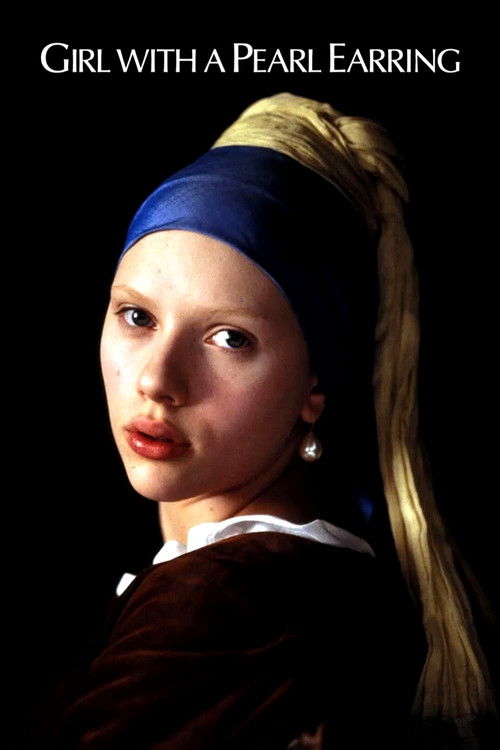
Girl with a Pearl Earring
2003 · Peter Webber
For a quiet, candlelit evening when you want something beautiful and restrained — a simmering almost-romance to soak in rather than race through. Comfort viewing for the patient; slow for anyone craving plot.
What it's about
Delft, the 1660s. A young maid enters the crowded, cash-strapped household of the painter Johannes Vermeer and turns out to have an instinctive eye for light and color. As she's drawn into his studio — first grinding pigments, then quietly shaping his work — a wordless intimacy grows between them, watched by his pregnant wife, his shrewd mother-in-law, and a town where a servant's reputation is all she owns. It imagines how his most famous painting might have come to be.
The experience
Hushed and slow-burning — a film of glances, held breaths, and things unsaid, where the tension between two people who barely touch becomes almost unbearable. It asks patience and repays it with atmosphere.
Performances
Scarlett Johansson, then very young, carries the film almost without dialogue — everything happens in her eyes and posture. Colin Firth plays Vermeer as a man both magnetic and maddeningly unreachable.
The craft
Every frame is lit like a Dutch painting — the film essentially recreates Vermeer's world in his own palette, all window light, pearls, and deep interior shadow, and the cinematography was rightly celebrated for it. Watch it on the best screen you have; it's one of the most gorgeous period films of its decade.
Why it matters
It proved a bestselling novel about a single painting could work as intimate cinema rather than stuffy costume drama, and it marked Johansson's arrival as a serious dramatic presence.
Snapshot
Girl with a Pearl Earring is a chamber drama of looking and being looked at, set in the household of the Delft painter Johannes Vermeer around 1665 and built around the invention of how his most enigmatic image — the "tronie" of a girl in a turban and luminous pearl — might have come to be made. Adapted from Tracy Chevalier's 1999 bestselling novel, the film follows Griet (Scarlett Johansson), a young Protestant maid placed in the Catholic Vermeer household after her father, a tile-painter, is blinded in a kiln accident. Her instinctive eye for color and composition draws the painter (Colin Firth) into a charged, largely wordless intimacy that threatens the fragile economy of the house, presided over by his pregnant wife Catharina (Essie Davis) and shrewd mother-in-law Maria Thins (Judy Parfitt), and shadowed by the predatory patron Van Ruijven (Tom Wilkinson). The film is best understood as an exercise in visual translation: a self-conscious attempt to render Vermeer's optics, light and stillness in moving images. It marked the feature debut of British director Peter Webber and was a key early international showcase for Johansson and for composer Alexandre Desplat. It received three Academy Award nominations — cinematography, art direction and costume design — winning none.
Industry & production
The film was a European co-production assembled around British producers Andy Paterson and Anand Tucker (working through Archer Street), with backing that included Pathé and the UK Film Council's premiere fund, alongside Luxembourg and other continental financing — the kind of mid-budget, prestige literary adaptation that the British industry produced steadily in this period through a patchwork of public subsidy and pan-European co-production money. The project's commercial logic rested on a recognizable property (Chevalier's novel had sold strongly internationally) and the durable art-house appetite for "painterly" period drama.
Olivia Hetreed wrote the screenplay, compressing Chevalier's first-person interior narration into a drama that must externalize Griet's perceptions through behavior and image rather than voice-over. Casting was central to the film's marketing: Colin Firth, then strongly associated with period and romantic roles, played Vermeer, while the casting of the very young Johansson as Griet — opposite an older, established lead — foregrounded the age and class asymmetry that drives the story. 2003 proved a pivotal year for Johansson, who also appeared in Sofia Coppola's Lost in Translation; the two performances together established her as a major presence. The supporting bench is notably strong for a modest production: Wilkinson, Parfitt, Davis, and a young Cillian Murphy as Pieter, the butcher's son who courts Griet.
The precise budget and box-office figures I will not assert, as I cannot verify them from memory; the film was, however, a modest-scale production that performed respectably on the specialty circuit rather than as a wide commercial release. Much of the interior shooting was done on built sets in Luxembourg, with location work in and around Delft and the Netherlands grounding the exteriors — a common arrangement that let the production access European subsidy while reconstructing 17th-century domestic interiors under controlled conditions.
Technology
The film was shot photochemically on 35mm, the standard for prestige production in 2003, several years before digital capture displaced film in this tier of filmmaking. The central technical problem was not novel hardware but the simulation of a specific historical optics: Vermeer is widely associated with the use of the camera obscura and with effects — soft "circles of confusion" on highlights, a particular fall-off of focus, the pearlescent rendering of light on surfaces — that the production sought to evoke. The film's craft is therefore better described as an act of photographic interpretation of painting than as technological innovation; its tools were conventional, its ambition was to make the camera "see" the way scholars believe Vermeer's eye (and perhaps his lens) saw. There is no claim to special-effects spectacle here, and I am aware of no notable proprietary technology associated with the production.
Technique
Cinematography
The cinematography, by the Portuguese-born Eduardo Serra — already Oscar-nominated for The Wings of the Dove (1997) and known for refined, low-key period work — is the film's defining achievement and the basis of its Academy Award nomination. Serra and Webber pursued a deliberately Vermeer-derived palette: cool blues and ochres, lead-white and lapis, light entering from the left through leaded windows and modeling faces against shadow. Interiors are frequently lit to resemble the source paintings, with single-source window light, deep falloff and carefully controlled reflections. The camera is patient and often static or slow, privileging composition and the act of looking; the recurring motif of framing — windows, doorways, the camera-obscura "screen" through which Vermeer shows Griet the world inverted and softened — makes the photography itself thematic. The film's images consistently quote the visual grammar of Dutch genre painting: the maid at the window, the tiled floor in perspective, the still life of bread and pewter.
Editing
Cutting is unhurried, matching the film's contemplative register. The editing (by Kate Evans, per the production record) favors held shots and the rhythm of glances — the cinema of who is looking at whom — over conventional dialogue coverage. Suspense is generated through duration and withholding rather than pace: the slow approach to the painting's creation, the protracted, almost unbearable scene of the ear-piercing, the charged silences between Griet and Vermeer. The film trusts the audience to read meaning in pauses.
Mise-en-scène / staging
This is the film's richest dimension. Production designer Ben van Os — a Dutch designer with a distinguished pedigree in painterly cinema, including work for Peter Greenaway and Sally Potter's Orlando — reconstructed the Vermeer household and the Delft of the 1660s with scholarly attention to domestic texture: scullery, studio, the social geography of a house in which a servant's body must occupy the margins. The staging encodes class and power spatially: Griet moves through thresholds she is not permitted to cross, and the studio becomes a charged interior where the household's hierarchies are suspended. Costume design by Dien van Straalen (also Oscar-nominated) differentiates station through fabric and restraint, and the celebrated turban-and-pearl ensemble functions as both narrative object and the film's iconographic destination. Both the art direction and costume design received Academy Award nominations, recognition of how completely the film's meaning is carried by its physical world.
Sound
The soundscape is intimate and domestic — the grinding of pigments, the scrape of a palette knife, footsteps on tile, water, the hush of rooms — used to heighten the sensory, near-tactile quality of Griet's labor and perception. Against this, Alexandre Desplat's score is the dominant aural presence. It is restrained, melancholic and texturally delicate, leaning on strings and woodwinds and on a recurring melodic figure that lends the largely interior drama its emotional throughline. The film was among the scores that brought Desplat to wider international attention shortly before his run of major Hollywood and prestige work; he received awards-season recognition for it, though I would not state specific wins I cannot confirm.
Performance
The performances are calibrated to the film's economy of speech. Johansson plays Griet almost entirely through watchfulness, posture and the management of expression — a performance of withheld interiority, since the character cannot voice what the novel's narration made explicit. Firth's Vermeer is similarly guarded, his absorption in his work and his attraction to his subject conveyed through attention rather than declaration; the relationship is built on looks and proximity, never consummated, which is precisely the film's subject. Wilkinson supplies overt menace as Van Ruijven, throwing the central restraint into relief, while Parfitt's Maria Thins embodies the household's cold economic calculation. Johansson's work here, alongside Lost in Translation, was widely noted in the 2003–04 awards season.
Narrative & dramatic mode
The film operates in a quiet, observational realist mode organized around suppression and the unspoken. Its drama is one of glances, proximity and prohibition: nearly every significant development is a matter of perception — what Griet sees, what she is permitted to see, who watches her, what cannot be said across lines of class and marriage. The structure is teleological in the gentlest sense, moving toward the making of the painting, so that the famous image becomes both the narrative's climax and its justification. Conflict is domestic and economic as much as romantic — the jealousy of Catharina, the maneuvering of Maria Thins, the threat of Van Ruijven, the precariousness of a servant whose value to the household lies dangerously close to scandal. The mode is elliptical and restrained; the film resists melodrama, locating its tension in stillness.
Genre & cycle
The film belongs to the prestige literary period drama and, more specifically, to the small cycle of "artist's-life" and "painting-into-film" pictures. It sits in dialogue with a tradition of British and European heritage cinema, and within a strand of films self-consciously built around the visual world of painting — works that treat the canvas not as decoration but as the organizing visual principle. Its closest kin are films that dramatize the genesis or world of an artwork and that use cinematography to "become" a painter's vision. It also overlaps the romance genre, though it is a romance defined by non-fulfillment.
Authorship & method
Peter Webber directed from a background in television and documentary, and Girl with a Pearl Earring was his feature debut; his approach is restrained and image-led, deferring to the visual program rather than imposing a flamboyant directorial signature. The film is in a real sense a collaborative authorship of image-makers: Serra's photography and van Os's production design are co-equal authors of its meaning, with Hetreed's screenplay providing the disciplined externalization of an interior novel and Desplat's score supplying emotional continuity. This distribution of authorship across the craft departments — cinematography, design, costume, music — is itself characteristic of the painterly period film, where the "look" is the argument. Webber would go on to direct Hannibal Rising (2007) and Emperor (2012), neither of which matched this film's acclaim, which has tended to keep critical attention on Girl with a Pearl Earring as a debut realized largely through the strength of its collaborators.
Movement / national cinema
The film is best placed within British heritage/prestige cinema as practiced in the late 1990s and 2000s, financed and produced through the pan-European co-production system and shaped by Dutch design talent and a Portuguese-French cinematographer — a genuinely transnational European art film with British creative leadership. It is not affiliated with any avant-garde movement; its lineage is the tradition of the tasteful, design-intensive literary adaptation. At the same time, its subject matter ties it to a Dutch cultural patrimony — the Golden Age, Delft, Vermeer — that the production treats with curatorial seriousness, drawing on Dutch design expertise to reconstruct that world.
Era / period
Made in 2003, the film arrives at the tail end of the photochemical era of prestige filmmaking and within a sustained early-2000s vogue for refined period adaptation. It is also a document of a particular moment in the careers it touched: Johansson's emergence, Desplat's pre-Hollywood ascent, Cillian Murphy early in his career. Its diegetic period — Delft, c. 1665, the Dutch Golden Age — is rendered with attention to the social and material specifics of a mercantile, religiously divided society in which a Protestant maid serves a Catholic household.
Themes
The film's governing theme is vision — seeing as knowledge, intimacy and power. To be looked at is to be exposed and possessed (Van Ruijven's gaze is predatory; Vermeer's is creative but also appropriative), while to see as the painter sees is a forbidden form of intimacy and a kind of liberation for Griet. Bound up with this are class and labor: Griet's artistic sensibility is real but socially illegitimate, and her body and time are not her own. Desire and its suppression structure the central relationship, which is consummated only in the image, never physically — the pierced ear and the borrowed pearl standing in for what cannot happen. The film also meditates on art and its human cost: the painting endures, but it is extracted from a relationship that cannot survive it, and from a woman who will be remembered only as an anonymous face. Finally, there is a thread of religion and household economy, the Protestant/Catholic divide and the financial precarity that governs every decision.
Reception, canon & influence
Critical reception was generally favorable and concentrated, predictably, on the film's visual achievement. Reviewers widely praised Serra's cinematography and the production and costume design as a near-perfect evocation of Vermeer, and singled out Johansson's restrained performance; the most common reservation was that the film's very composure could tip into the static or the merely beautiful — that it was, for some critics, more exquisite tableau than fully dramatized story. The awards record reflects this balance of admiration: three Academy Award nominations (cinematography, art direction, costume design) without a win, with comparable recognition at the BAFTAs and other ceremonies, and awards-season attention for Johansson and for Desplat. I will not cite specific aggregate scores or grosses I cannot verify.
The influences on the film run backward to Vermeer himself and to Dutch Golden Age genre painting, to Chevalier's novel and its speculative reconstruction of the painting's origin, and to the broader heritage-cinema tradition of treating painting as a cinematographic model. Its legacy forward is twofold. As a craft exemplar, it stands as a frequently cited reference point for how to translate the optics and palette of a specific painter into film — a touchstone in discussions of "painterly" cinematography and of the camera-obscura aesthetic. As a career hinge, it contributed to the trajectories of several of its makers, most consequentially Johansson and Desplat. Its more diffuse cultural influence lies in helping sustain interest in the speculative-artwork-origin film and in popularizing Vermeer's image for a broad audience. The film has not generated a large scholarly literature of its own, and on that point the record is genuinely thin; its standing rests less on critical canonization than on its durable reputation as one of the most visually faithful "painting films" of its era.
A Deleuzian reading
Vermeer leads the maid to a wooden box, drapes a black cloth over both their heads, and on a pane of ground glass the courtyard appears — inverted, the hard Delft daylight pooled into something softer, closer to paint than to world.
The full Deleuzian reading of Girl with a Pearl Earring →
Reception
A respectable arthouse hit in 2003 with three Oscar nominations for its craft, it's since settled into memory less as a prestige contender and more as a time capsule of Scarlett Johansson's breakout year — and a poster child for the mid-budget adult drama people now say Hollywood stopped making.
How Girl with a Pearl Earring was received, from release to now →
Influences: the films it descends from and the films it influenced
- Barry Lyndon (1975) — Established the template of composing frames directly after period genre-painting and lighting interiors from a single window or candle with available light, the exact optical program Eduardo Serra reverse-engineers for Vermeer.
- Days of Heaven (1978) — Néstor Almendros's available-light, magic-hour photography treats each shot as a canvas, modeling the practice of subordinating drama to painterly composition that the film inherits.
- Tess (1979) — Cloquet and Unsworth's diffuse natural-light pastoral tableaux made the painterly period landscape a cinematographic argument in itself, a direct precedent for image-led heritage cinema.
- The Draughtsman's Contract (1982) — Builds its drama around the artist's gridded drawing-frame as a literal optical apparatus, foregrounding the camera-obscura/act-of-representation motif central to the seed.
- Caravaggio (1986) — Stages the artist biopic as a sequence of living chiaroscuro tableaux lit from a single hard source, fusing single-source light with the painter's own technique.
- Babette's Feast (1987) — Northern-European still-life framing and tactile diegetic textures of labor and food, with emotion held in restraint rather than dialogue — the diegetic-tactile, withheld-interiority lineage.
- La Belle Noiseuse (1991) — Renders the artist-and-model dyad in real-time long takes where the duration of looking and posing is the suspense, the long-take/cinema-of-the-gaze blueprint.
- The Age of Innocence (1993) — Encodes withheld desire entirely in surfaces, objects, and the disciplined gaze, demonstrating elliptical restraint as a heritage-drama method.
- The Remains of the Day (1993) — Choreographs class-coded thresholds and below-stairs space around a servant's suppressed interiority, the staging grammar the film transposes to Vermeer's household.
- Mr. Turner (2014) — Dick Pope's cinematography literally reconstructs the subject painter's own palette and atmospheric light, advancing the practice of filming a specific artist's optics.
- Carol (2015) — Ed Lachman shoots withheld interiority through glass, reflections, and obstructed framing, sustaining the cinema-of-the-gaze and desire-by-restraint tradition.
- Phantom Thread (2017) — Single-source window light over a master craftsman, with the tactile diegetic sound of fabric and craft standing in for an obsessive, near-silent interior life.
- Tulip Fever (2017) — Reconstructs the Dutch Golden Age painting-world with a Vermeer-adjacent palette and single-window interior light, extending the speculative-artwork period film directly.
- Portrait of a Lady on Fire (2019) — Makes the artist-and-model gaze and candle/single-source light the entire dramatic engine, treating painting itself as the cinematographic model — the purest extension of the seed's craft.
- Harry Potter and the Deathly Hallows: Part 2 (2011) — Showcase of cinematographer Eduardo Serra's painterly low-key, desaturated photochemical compositions, the same eye he brought to Part 2's muted, ash-toned imagery.
- The New World (2005) — Extends available-light cinema-of-the-gaze and elliptical narration, building meaning from looked-at faces and ambient sound rather than plot exposition.
- Atonement (2007) — A heritage drama of withheld desire and the unreliable, charged gaze across class lines, with meticulous period reconstruction as emotional architecture.
- Girl, Interrupted (1999) — Makes literal the Vermeer-iconography staging that Girl, Interrupted quotes — composing figures in soft window-light against still, painterly interiors — showing the same source (Dutch-master framing of a watchful young woman) driving cinematography in a period female-centered chamber film.
Similar films
- Portrait of a Lady on Fire (2019) — influence & lineage
- Atonement (2007) — influence & lineage
- Tess (1979) — influence & lineage
- Carol (2015) — influence & lineage
- The Piano (1993) — shared sensibility
- The Portrait of a Lady (1996) — shared sensibility
- The Hours (2002) — shared sensibility
- Lost in Translation (2003) — shared sensibility