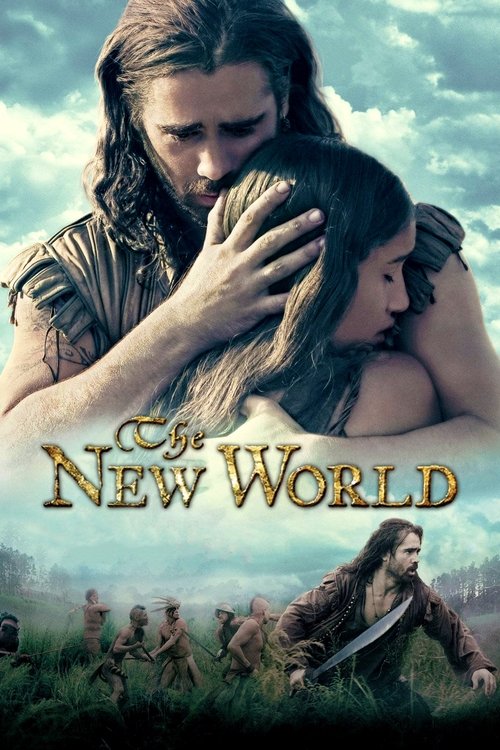
The New World
2005 · Terrence Malick
For a contemplative evening when you want beauty and feeling over plot — something closer to a poem or a piece of music than a story. Patience required, but the reward is a genuine sense of awe.
What it's about
Virginia, 1607. English ships arrive at what will become Jamestown, and the soldier John Smith is drawn into the world of the Powhatan people — and into a transforming bond with a young woman whose story will carry her all the way to England. Terrence Malick films this founding American encounter not as costume drama but as first contact between two ways of seeing the world: the wonder, the misunderstanding, and the loss.
The experience
Dreamlike and unhurried — more a flow of images, whispered thoughts, wind, and water than a conventional plot. If you give yourself over to its rhythm it's rapturous and quietly heartbreaking; if you fight it, it will feel slow. It's a film you sink into rather than follow.
Performances
Q'orianka Kilcher, just a teenager and unknown at the time, is luminous — she carries the film's entire emotional arc with almost no dialogue, mostly through gesture and gaze. Colin Farrell and Christian Bale play the two very different men in her life with unusual restraint.
The craft
Shot largely in natural light in real Virginia wetlands, it contains some of the most beautiful nature photography ever put in a fiction film — grass, rivers, and sky treated with the same attention as faces. The elliptical editing and drifting voiceover build meaning through images rather than scenes, and it demands the biggest screen and best sound you can give it.
Why it matters
Initially divisive, it has been steadily reclaimed as one of the great films of its decade — a high-water mark of Malick's intuitive, image-first method and a model for treating history as sensory experience rather than pageant.
Snapshot
The New World is Terrence Malick's fourth feature in a career then spanning more than three decades, and his most sustained attempt to render a foundational historical encounter as lived sensory experience rather than narrative event. It dramatizes the 1607 arrival of English colonists at what would become Jamestown, Virginia, and the entanglement of the soldier-adventurer John Smith (Colin Farrell) with a young Powhatan woman — the historical Pocahontas, though the film pointedly never speaks her name — played by the then-unknown Q'orianka Kilcher. The story carries forward to her marriage to the planter John Rolfe (Christian Bale) and her journey to England, where she encounters the "new world" of the title in reverse. Malick treats this material less as costume drama than as a meditation on perception, paradise, and loss, filtered through whispered interior voiceover and a camera that seems perpetually astonished by light, water, and grass. The film is widely regarded as a pivotal work in the second phase of Malick's career — the bridge between the relative narrative legibility of The Thin Red Line (1998) and the dissolved, associative style of The Tree of Life (2011) and after.
Industry & production
The project had unusually deep roots. Malick is generally understood to have conceived a Pocahontas screenplay in the 1970s, in the years around Days of Heaven, making The New World one of the oldest unrealized ideas in his filmography, finally executed nearly thirty years later. The film was produced by Sarah Green, a long-term Malick collaborator, with New Line Cinema distributing — a notable pairing, since New Line was then best known for the Lord of the Rings trilogy and represented a comparatively commercial home for an avowedly uncommercial filmmaker.
Production design was led by Jack Fisk, Malick's collaborator since Badlands (1973), who oversaw the construction of a full-scale Jamestown fort and Powhatan settlement. Shooting took place on location in Virginia, including sites on the Chickahominy and James Rivers near the historical events, lending the film a documentary specificity of place uncommon in the genre. The production consulted with descendants of the Powhatan and with linguists; an effort was made to reconstruct and speak the Virginia Algonquian language, which had been extinct for centuries, with reconstruction work associated with linguist Blair Rudes. The casting of Native American and First Nations actors — including August Schellenberg as Powhatan and Wes Studi as Opechancanough — reflected a deliberate move away from the genre's history of non-Native casting.
The film's release history is itself part of its story. Malick assembled a roughly 150-minute version for a brief awards-qualifying run in late December 2005, then revised the film to approximately 135 minutes for its wide theatrical release in January 2006. A substantially longer "extended cut" of around 172 minutes was later released on home video. These multiple versions are not mere marketing variants but reflect Malick's well-documented practice of continuous re-editing; the existence of three meaningfully different cuts complicates any single account of "the film."
Technology
The New World was photographed largely on photochemical film by Emmanuel Lubezki, in an era when digital capture was beginning to encroach on prestige production. Sources indicate the film used 35mm photography with selected sequences in large-format 65mm; precise technical breakdowns vary in the available record, so the exact distribution of formats is best stated with caution. What is not in doubt is the production's commitment to natural and available light. Lubezki and Malick pursued an aesthetic in which scenes were shot at "magic hour" and under overcast or directional daylight, with minimal supplementary lighting, demanding fast lenses, sensitive stocks, and a willingness to organize the shooting day around the sun rather than the schedule. The film is frequently cited as a key staging ground for the natural-light, wide-angle, handheld grammar that Lubezki and Malick would refine across their subsequent collaborations.
Technique
Cinematography
Lubezki's work here earned an Academy Award nomination for Best Cinematography and is among the most influential of the 2000s. The visual signature is a roaming, often handheld camera using wide-angle lenses held close to faces and bodies, so that figures are embedded in landscape rather than framed against it. Light is treated as the film's true subject: sun flaring through trees, the silver of overcast skies, reflections breaking on river water. The camera repeatedly tilts up into canopy or out across reeds, and actors are caught in unguarded gesture — touching grass, wading, looking. This approach refuses the stable, classically composed tableaux of conventional period film in favor of an immersive, first-person sense of presence. The aesthetic is so distinctive that it became, in retrospect, a template widely imitated and parodied.
Editing
The film credits multiple editors — Richard Chew, Hank Corwin, Saar Klein, and Mark Yoshikawa — a reflection of Malick's method of generating enormous quantities of footage and discovering the film in the cutting room over many months. The editing is associative rather than continuity-driven: scenes are built from fragments, glances, and elliptical jumps, and dialogue is frequently displaced from the image, with voiceover floating free of the speaker. The presence of several distinct theatrical and extended cuts is the clearest evidence of how much the film's meaning was determined at the edit rather than fixed in the screenplay.
Mise-en-scène / staging
Fisk's design grounds the abstraction in tactile reality: the muddy, precarious palisade of the English fort, decaying and disease-ridden, set against the open, woven, organic spaces of the Powhatan world. Staging favors a loose, semi-improvised choreography in which actors move through real environments and the camera follows rather than dictates. Costuming and the reconstructed Algonquian language contribute to a strong sense of material authenticity, even as the overall mode remains lyrical rather than realist.
Sound
Sound is among the film's most carefully constructed elements. The dense natural soundscape — wind, water, birdsong, insects — is layered into an almost continuous ambient presence, often foregrounded over dialogue. Multiple characters carry interior monologues delivered in hushed, fragmentary voiceover, a Malick signature here used to convey wonder, doubt, and longing as private states. The musical choices are crucial: the film opens and returns to the Vorspiel (Prelude) of Wagner's Das Rheingold, whose slow swelling E-flat chord evokes a world coming into being, and it makes prominent use of Mozart's Piano Concerto No. 23. James Horner contributed an original orchestral score that is woven among these pre-existing works.
Performance
Performance style is naturalistic and frequently wordless, built from physical presence rather than declamation. Q'orianka Kilcher, only a teenager during production, anchors the film with a performance of remarkable openness, charting her character's arc from instinctive freedom to displacement and composure. Colin Farrell plays Smith with a brooding interiority, and Christian Bale brings a gentle steadiness to Rolfe. Christopher Plummer, August Schellenberg, and Wes Studi lend gravity to the surrounding roles. Because Malick shoots so much and cuts so freely, performances emerge as much from selection in the edit as from individual takes.
Narrative & dramatic mode
The film's mode is lyric and impressionistic rather than dramatic in the conventional sense. Plot points — the colonists' arrival, Smith's capture and reprieve, the starving winter, Pocahontas's exile and marriage, the voyage to England — are present but deliberately underweighted, often elided or rendered as fragments. The connective tissue is mood, voiceover, and recurring motif. The story is organized less around cause and effect than around a structure of paradise found and lost: an Edenic encounter, its corruption, and the bittersweet accommodation that follows. The three-part movement (Smith, Rolfe, England) gives the film an almost musical shape of theme and variation.
Genre & cycle
Nominally a historical romance and epic, The New World sits aslant every genre it touches. It belongs loosely to the lineage of the colonial-encounter and "first contact" film, and inevitably enters dialogue with prior screen treatments of Pocahontas, including Disney's animated Pocahontas (1995). But Malick systematically strips away the genre's adventure mechanics and triumphalist framing. It is closer in spirit to the art-cinema epic than to the Hollywood costume picture, and within Malick's own work it forms part of an ongoing cycle of films about innocence, nature, and the American landscape.
Authorship & method
The film is, in the fullest sense, a Malick film — written and directed by him, and bearing his characteristic method at every level. That method is by now well documented: extensive scripting that is then treated as raw material; vast quantities of footage captured under natural light; performances coaxed through improvisation and unscripted observation; and a long, exploratory edit in which structure and voiceover are discovered after the fact. The key collaborators are central to understanding the work. Emmanuel Lubezki's photography defines its visual language and inaugurates one of the most consequential director-cinematographer partnerships of the era. Jack Fisk's production design supplies the tactile historical ground. The four credited editors embody the film's compositional process. And the musical authorship is shared between James Horner's original score and Malick's chosen passages of Wagner and Mozart, the latter arguably doing more to shape the film's emotional architecture than any conventional score could.
Movement / national cinema
The New World is a work of American cinema that operates by the logic of international art film. It has no neat movement affiliation, but it can be situated within a strand of contemplative, landscape-driven filmmaking that values duration, atmosphere, and perception over plot — a sensibility with affinities to European art cinema even as its subject is the founding mythology of the United States. Within American film it stands somewhat apart, an auteurist outlier produced through the studio system but answerable to no commercial template.
Era / period
Made in the mid-2000s, the film arrives at a hinge moment when celluloid prestige production was nearing its transition to digital, and it can be read as a late high point of natural-light photochemical filmmaking. Its subject — the very beginning of permanent English settlement in North America — also gives it a reflexive charge: a film about the founding of a "new world" made at the threshold of a new technological era in its own medium. Coming seven years after The Thin Red Line and predating the more prolific later phase of Malick's output, it marks the point at which his style begins its decisive turn toward dissolution and abstraction.
Themes
The film's governing theme is the encounter between innocence and its loss — the dream of an unspoiled world and the inevitable arrival of knowledge, possession, and grief. Nature is rendered not as backdrop but as a presence the characters move within and ultimately fall out of harmony with. The title's irony is structural: the "new world" is new to the English, ancient to its inhabitants, and finally inverted when Pocahontas reaches England and beholds a manicured European order as strange and artificial. Other persistent concerns include the gap between the spoken word and inner experience (hence the displaced voiceover), the impossibility of fully translating between cultures, and a recurring Malickian tension between a fallen social order and an intimated grace. Colonial violence and dispossession are present but treated elegiacally rather than polemically, a choice that has drawn both admiration and critique.
Reception, canon & influence
Critical reception in 2005–2006 was sharply divided, as is typical for Malick. A significant body of critics regarded the film as a masterpiece — praising its photography, its sensory immersion, and its refusal of cliché — while others found it static, repetitive, or emotionally remote. Lubezki's cinematography drew near-universal acclaim and an Academy Award nomination. Over time, critical estimation has risen markedly; the film now appears on numerous lists of the best films of its decade and is frequently cited by critics as Malick's finest sustained work, with some advocating particularly for the extended cut. I would note that specific contemporaneous box-office figures and individual published quotations are beyond what I can responsibly reconstruct here without risk of error, so I leave those unspecified.
Looking backward, the film draws on a deep well of influence: the romantic tradition of nature as spiritual presence, the recurring American myth of the frontier and the garden, and Malick's own prior practice of voiceover and landscape developed across Badlands, Days of Heaven, and The Thin Red Line. Its use of Wagner consciously invokes a Romantic-sublime register, summoning a sense of cosmic emergence.
Looking forward, its legacy is substantial and concrete. The Lubezki–Malick collaboration codified here — wide lenses, natural light, roaming handheld camera, magic-hour shooting — became one of the most imitated visual styles of the following decade, recognizable across advertising, music video, and a wave of "Malickian" art films, and feeding directly into the duo's later, even more radical The Tree of Life. The film also marked a meaningful step in the slow correction of Hollywood's treatment of Native American history, through its casting, its language reconstruction, and its refusal of conquest triumphalism. Whatever its divisions of taste, The New World is now firmly established as a key text both within Malick's evolving authorship and within the broader history of how American cinema imagines its own origins.
A Deleuzian reading
A hand moves through tall grass.
The full Deleuzian reading of The New World →
Reception
Dismissed by many as a box-office flop and a beautiful bore in 2005, it's since become one of cinema's great reappraisal stories — now a fixture on best-of-the-21st-century lists and routinely called Malick's masterpiece.
How The New World was received, from release to now →
Influences: the films it descends from and the films it influenced
- Days of Heaven (1978) — Established Malick's magic-hour shooting and available-light naturalism (via Néstor Almendros) plus the floating, off-narrative voiceover that The New World refines into its primary structuring device.
- Badlands (1973) — Originated Malick's displaced first-person voiceover — a naive narrator whose words drift against, rather than describe, the images — the technique Pocahontas's and Smith's interior monologues directly extend.
- The Thin Red Line (1998) — Pioneered the multi-voice choral whisper-track and the script-as-raw-material method of long associative editing across many credited cutters that The New World inherits wholesale.
- Barry Lyndon (1975) — Its commitment to period light recorded with minimal artificial fill, and its painterly wide compositions of figures in landscape, is a foundational reference for the Lubezki natural-light aesthetic deployed here.
- Aguirre, the Wrath of God (1972) — Filmed a colonial incursion in real wilderness with handheld immediacy and tactile authenticity, modeling the on-location, weather-and-mud realism Jack Fisk's design and Lubezki's roaming camera pursue.
- Mirror (1975) — Codified the associative, memory-logic edit and the contemplative long take fused with murmured voiceover and elemental imagery (water, wind, grass) that Malick adopts as a poetic grammar.
- 2001: A Space Odyssey (1968) — Demonstrated the use of pre-existing Romantic/classical music to summon a sublime sense of cosmic emergence, the precise rhetorical function Malick's chosen Wagner and Mozart passages serve over conventional scoring.
- Tabu: A Story of the South Seas (1931) — Murnau's lyric-impressionistic 'paradise-lost' romance shot on location with non-actors prefigures Malick's Eden-and-fall framing of the colonial encounter as edenic innocence undone.
- Red Desert (1964) — Emmanuel Lubezki's saturated greens and golds shift in temperature with Pocahontas's emotional states—color functioning as authored psychological instrument rather than atmospheric description—achieving the systematic color-expressionism Antonioni pioneered in Ravenna at the scale of an American epic.
- The Mission (1986) — Malick films the European-indigenous first contact almost entirely in natural light with landscape as moral and spiritual presence, carrying forward the available-light colonial-encounter aesthetic The Mission codified.
- Meet Joe Black (1998) — Lubezki's natural-light, contemplative long-take method matured — the slow, patient image-making Joe Black's studio slowness anticipates before Lubezki fully committed to it with Malick.
- Dances with Wolves (1990) — Pushes the immersion-and-conversion contact story into pure sensory cinema — natural golden-hour light, subtitled/whispered Native-language presence, ethnographic attention to a culture rendered from the inside — an art-film radicalization of Dunbar's two-worlds crossing.
- The Tree of Life (2011) — The Malick–Lubezki method codified here — wide lenses, natural light, ceaselessly roaming handheld camera and fragmentary voiceover — is pushed to its radical extreme, with cosmic-emergence music carried over directly.
- The Revenant (2015) — Lubezki transplants the New World toolkit — natural light only, wide-angle near-subject handheld, real frontier wilderness — into a survival narrative, the visual style's most literal extension.
- The Assassination of Jesse James by the Coward Robert Ford (2007) — Roger Deakins explicitly adopts the magic-hour landscape photography and elegiac drifting voiceover to render an American frontier myth in the same lyric register.
- Meek's Cutoff (2010) — Extends the tactile-authenticity approach to the frontier — material hardship, real labor and terrain, refusal of expository drama — as a contemplative anti-Western.
- Beasts of the Southern Wild (2012) — Builds its style from the Malickian template: handheld natural-light immersion, a child's incantatory voiceover, and nature rendered as overwhelming sensory presence.
- Upstream Color (2013) — Adopts the associative, elliptical edit and sound-image displacement — meaning assembled from fragments rather than plot — as the inheritor of Malick's post-Thin Red Line montage.
- Embrace of the Serpent (2015) — Stages the colonial encounter as a river journey grounded in Indigenous language and perspective, mirroring Malick's tactile, non-triumphalist first-contact ethnography.
- A Ghost Story (2017) — Carries forward the contemplative-cinema patience, lyric voiceover fragments, and meditation on time and loss that mark the Malickian art-film lineage.
- Killers of the Flower Moon (2023) — Malick's staging of colonial encounter through contrasting interior spaces — Indigenous domestic warmth versus armored settler architecture — provides a visual grammar for power imbalance that Scorsese applies directly to Osage-settler household scenes.
- A Hidden Life (2019) — Pioneers the roaming handheld, wide-angle, available-light shooting with Lubezki's operating team — from which A Hidden Life's DP Jörg Widmer was directly elevated.
- The Promised Land (2023) — Colonial-settlement drama built from low-horizon widescreen frames and an ambient wind-and-nature sound design privileging landscape and labor over dialogue.
- Black Robe (1991) — Shares the commitment to reconstructed Indigenous languages and unromanticized first-contact ethnography, refusing conquest triumphalism in favor of mutual incomprehension.
- Dune (2021) — Shares the natural-light, restrained-performance immersion that Fraser cites as influence—bodies inside vast landscape rendered with ceremonial quietude.
- Girl with a Pearl Earring (2003) — Extends available-light cinema-of-the-gaze and elliptical narration, building meaning from looked-at faces and ambient sound rather than plot exposition.
- Master and Commander: The Far Side of the World (2003) — Shares the available-light naturalism and tactile period immersion that privileges weather, texture and process over conventional plot mechanics.
- Apocalypto (2006) — Contemporary pre-contact project pursuing indigenous-language authenticity and immersion in a doomed first-encounter world, the lyrical inverse of Gibson's kinetic treatment of the same historical threshold.
Similar films
- The Tree of Life (2011) — influence & lineage
- The Revenant (2015) — influence & lineage
- Embrace of the Serpent (2015) — influence & lineage
- Barry Lyndon (1975) — influence & lineage
- The Thin Red Line (1998) — influence & lineage
- Days of Heaven (1978) — influence & lineage
- Aguirre, the Wrath of God (1972) — influence & lineage
- Mirror (1975) — influence & lineage · same viewing thread
All the films related to The New World →
Watch it with: curated runs of related films
- Transcendental Style — A run for when you want cinema as prayer — faith, ritual, and the turning of seasons rendered in long takes and painterly stillness, where time itself becomes the subject rather than the story.