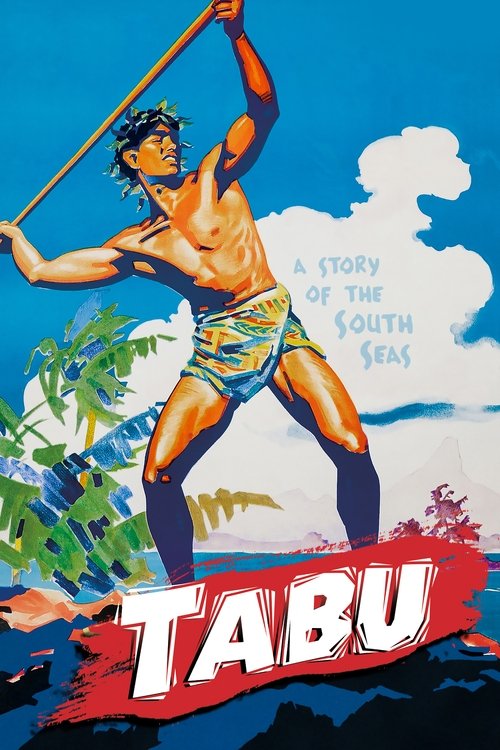
Tabu: A Story of the South Seas
1931 · F. W. Murnau
For a night when you want something old, beautiful and heartbreaking — a doomed-romance fable you can sink into like a myth. It's gentle to watch and quietly devastating, more a spell than a challenge.
What it's about
On Bora Bora, a young pearl diver and the girl he loves have their whole lives ahead of them — until a tribal decree names her a sacred maiden, untouchable by any man on pain of death. Rather than accept it, the couple flee toward the fringes of the colonized Pacific, where a different kind of trap is waiting. It's a silent film told in two chapters, an island paradise and its undoing.
The experience
Rapturous at first — sun, water, bodies in motion, pure joy shot like a dream — then a slow tightening of dread as the lovers run out of world to escape into. It plays without spoken dialogue and barely needs any; you feel it the way you feel a tide.
Performances
The cast is largely non-professional Polynesians, and that's the point: Matahi and Reri feel less like actors than like two people caught being young and in love, which makes the shadow falling over them land harder.
The craft
Murnau's last film, made on location in French Polynesia with documentary pioneer Robert Flaherty, and the collision of staged poetry and real place gives it a shimmer few studio films of the era have. The black-and-white photography of water, sail and skin is some of the most luminous of the silent era — it rewards the biggest, cleanest image you can give it.
Why it matters
Released just as talkies were burying silent cinema, it stands as the form's late masterpiece and Murnau's farewell — he died days before its premiere — and it's been a touchstone for filmmakers chasing beauty on location ever since.
Snapshot
Tabu is F. W. Murnau's final film, a silent feature released in 1931 at the very moment the silent form was being extinguished by the talkies. Shot on location in the islands of French Polynesia with a cast of largely non-professional Polynesian performers, it tells a deceptively simple fable — divided into chapters titled "Paradise" and "Paradise Lost" — of two young lovers, Matahi and Reri, whose union is destroyed when Reri is consecrated as a sacred maiden, declared tabu, and so forbidden to any man on pain of death. The film fuses Murnau's late, distilled pictorialism with the ethnographic location aesthetic of his collaborator Robert J. Flaherty, and the partnership between the two men — one a poet of staged light and shadow, the other an apostle of unscripted observation — is inseparable from both the film's beauty and its troubled making. Murnau died in a car accident on the California coast a week before the New York premiere, lending the work an elegiac aura it has never shed. Floyd Crosby's location cinematography won the Academy Award. More than nine decades on, Tabu remains a touchstone: a hybrid of documentary and melodrama, an Edenic idyll undermined by fatalism and money, and the last testament of one of cinema's supreme visual artists.
Industry & production
Tabu was conceived as an independent venture outside the studio system, an unusual circumstance for two filmmakers of Murnau's and Flaherty's standing. Murnau, who had come to Hollywood from Germany in 1926 and made Sunrise (1927), Four Devils (1928) and City Girl (1930) under William Fox, had grown disenchanted with studio interference, particularly as Fox's enthusiasm for sound reshaped production priorities and recut his work. Flaherty, the celebrated maker of Nanook of the North (1922) and Moana (1926), shared a romantic conviction that the South Seas offered subject matter uncorrupted by industrial filmmaking. The two formed a production partnership and set out for Tahiti and the surrounding islands, financing the expedition substantially out of their own resources after a planned arrangement with a studio fell through.
The collaboration soon strained. Flaherty favored a quasi-documentary method built on patient observation of indigenous life; Murnau insisted on a shaped dramatic narrative with a tragic arc. As the project advanced, creative and financial control consolidated in Murnau's hands, and Flaherty withdrew from active direction, though he retained a writing and story credit. Accounts of the breach vary in their emphasis and the historical record is colored by partisan memory on both sides, so the precise allocation of authorial responsibility is best treated with caution; what is clear is that the finished film is overwhelmingly Murnau's in conception and execution. With the production over budget, Murnau secured a distribution arrangement with Paramount, which released the film in 1931. The location shoot — far from laboratories, equipment supply, and the safety nets of a studio backlot — was logistically arduous, and the decision to use local nonprofessionals rather than imported stars was both an aesthetic choice and a budgetary one.
Technology
Tabu is a silent film made and released after the industry's wholesale conversion to synchronized sound, and this is its central technological paradox. By 1931 the silent feature was effectively obsolete as a commercial form in the United States, yet Murnau — committed to a purely visual storytelling and working far from sound-recording infrastructure — produced a film with no synchronized dialogue. It was distributed with a recorded musical score rather than as a true talkie, placing it among the last significant silent features released by a major American distributor. The location shooting depended on portable camera equipment and the considerable challenge of processing or safeguarding exposed film stock in a remote tropical environment, where humidity and the absence of nearby laboratories threatened the negative. The cinematography exploited the intense natural light of the equatorial Pacific, the reflective qualities of water and the contrast between sun-bright exteriors and shadowed interiors — resources available on location that no soundstage could replicate. The specific technical particulars of the expedition's equipment and film handling are not exhaustively documented in the popular record.
Technique
Cinematography
The photography, by Floyd Crosby, is the film's most celebrated technical achievement and won the Academy Award for Cinematography. Crosby's images render the islands with a luminous clarity — sunlight on skin and water, the gleam of the lagoon, the deep shade of palm groves — while serving Murnau's expressive ends. The camera finds plastic beauty in bodies in motion: divers, dancers, swimmers, the physical grace of the performers caught in long takes that let movement play out in real space. Murnau's hallmark sense of depth and compositional weight survives the shift from the controlled studio of Sunrise to the open Pacific; framing repeatedly organizes the screen around the lovers' bodies against vast natural backdrops, and the tonal modeling shifts decisively from the bright, open "Paradise" of the first half toward the darker, more enclosed and shadow-laden imagery of "Paradise Lost." The collaboration of Crosby's location sensibility with Murnau's pictorial control produced a style that is at once documentary in its specificity and lyrical in its arrangement.
Editing
The film's construction is built on its two-part structure, a fall from idyll to catastrophe announced by the chapter titles themselves. Murnau favors a measured, accumulating rhythm in the "Paradise" section — sequences of communal life, courtship and play that establish the lovers within their world — before the tempo tightens as the narrative closes its trap in "Paradise Lost." The cutting privileges clarity of action and the legibility of glances and gestures, in keeping with a silent film that must carry its drama without dialogue. The celebrated ending derives its devastating force from editing as much as from staging: the intercutting of Matahi swimming after the departing schooner with the implacable progress of the boat builds the tragedy to its inexorable conclusion through montage rather than words.
Mise-en-scène / staging
With real locations replacing constructed sets, Murnau's mise-en-scène becomes a matter of organizing performers, landscape and light rather than designed décor. He stages the lovers' world as a coherent physical environment — village, lagoon, reef, and later the colonial trading settlement — and choreographs bodies within it with the precision he had once brought to studio interiors. The recurring motifs of the consecration ceremony, the forbidden touch, and the sea as both playground and grave are realized through staging that loads ordinary spaces with symbolic charge. The arrival of the warrior Hitu, an emissary of inexorable custom, is staged as a darkening intrusion into the bright world, his appearances marked by encroaching shadow.
Sound
Tabu has no synchronized dialogue and is, in its conception and shooting, a silent film. It was presented with a recorded orchestral score composed by Hugo Riesenfeld, a prolific arranger of film music in the late silent and early sound periods, whose accompaniment underscores the shift from idyll to tragedy. The film's expressive burden falls almost entirely on image and music; the absence of spoken language is integral to its universality and to Murnau's lifelong belief in a "pure" cinema of pictures. Detailed scholarly analysis of Riesenfeld's score is comparatively thin relative to the attention paid to the film's images.
Performance
The cast was drawn largely from the islands rather than from professional ranks. Matahi played the young man and a performer credited as Anaïs/Anne Chevalier (often known as Reri, the name of her character) played the girl; Hitu embodied the old warrior who enforces the taboo. Murnau elicited from these nonprofessionals a naturalness and physical expressiveness that suits the film's documentary texture, while shaping their gestures to the demands of melodrama. The performances trade theatrical technique for presence, bodily grace and an unaffected directness of feeling — a casting philosophy continuous with Flaherty's ethnographic practice, here bent to Murnau's dramatic purposes.
Narrative & dramatic mode
The narrative is a tragic fable organized around a single fatal prohibition. In "Paradise," Matahi and Reri love freely within their island community; the turn comes when Reri is chosen as a sacred maiden consecrated to the gods and declared tabu, untouchable by any man. The lovers flee to a French colonial island where Matahi labors as a pearl diver, but the world of money and contracts proves another kind of trap, and the warrior Hitu pursues them to reclaim Reri. The dramatic mode is melodrama in the elevated, fatalistic register Murnau favored — closer to myth than to social realism — in which individual desire is crushed by an impersonal order, here doubled as indigenous custom and colonial economy. The structure's two-part fall, named outright by the intertitles, frames the story as a secular reenactment of expulsion from Eden, and the ending's inevitability is the point: there is no escape from the taboo, only the manner of its enforcement.
Genre & cycle
Tabu sits at the intersection of the romantic tragedy, the South Seas adventure-romance then fashionable in Hollywood, and the ethnographic film pioneered by Flaherty. The early sound era saw a recurrent appetite for Pacific island settings as sites of exotic spectacle and escapist fantasy, and Tabu both belongs to and transcends that cycle, replacing tourist exoticism with a tragic seriousness and a documentary attentiveness to indigenous life. Its hybridity — fiction grounded in observed reality, melodrama shot like a documentary — makes it a difficult film to classify within any single genre, and that very resistance to categorization is central to its enduring interest.
Authorship & method
The film is the work of two major authors in uneasy combination, but its realized form is Murnau's. F. W. Murnau (born Friedrich Wilhelm Plumpe, 1888) had risen to the front rank of world cinema with Nosferatu (1922), The Last Laugh (1924), Faust (1926) and the Hollywood masterpiece Sunrise (1927); Tabu extends his career-long pursuit of a wordless, image-driven cinema and his recurring theme of innocence destroyed. Robert J. Flaherty, credited on story and as collaborator, brought the location-and-nonprofessional method of Nanook and Moana, and the impulse to root the film in actual island life is his legacy even where the dramatic shaping is not. Floyd Crosby's Academy Award-winning cinematography is the indispensable technical partner to Murnau's vision; Hugo Riesenfeld supplied the score. The clash of methods — Flaherty's patient documentary observation versus Murnau's controlled dramatic design — is the film's productive tension, and the historical accounts of their disagreement, while partisan and incomplete, consistently locate final authorship with Murnau.
Movement / national cinema
Though made in the Pacific and released by an American studio, Tabu carries the imprint of German Expressionism and the broader Weimar art-cinema tradition from which Murnau emerged, transposed into a register of sunlight rather than studio shadow. It belongs to the cosmopolitan late-silent moment in which European masters worked within and against Hollywood, and it stands alongside Flaherty's films as a foundational instance of the ethnographic-fiction hybrid that would influence later documentary and location-based narrative cinema. It is not the product of a single national movement so much as a confluence: Weimar pictorialism, American studio distribution, and the Anglo-American documentary impulse meeting on Polynesian ground.
Era / period
Tabu is a film of transition, made precisely at the rupture between silent and sound cinema. Its release in 1931 places it among the final silent features to reach a wide audience through a major American distributor, a deliberate anachronism by an artist who believed the talkies betrayed the medium's pictorial essence. The period context — the Depression-era hunger for escapist exoticism, the industry's headlong commitment to sound, and the colonial frame through which the West then viewed the Pacific — all bear on the film, which both indulges and critiques the fantasy of an untouched paradise even as the economic realities of the colonial trading post intrude on the lovers' flight.
Themes
The film's governing theme is the fall from innocence: a love that is natural and free in "Paradise" is rendered impossible by the imposition of the taboo and the encroachment of a money economy. Desire and prohibition are bound together — the very sacredness that consecrates Reri is what forbids her. Fate operates as an inexorable force, indigenous custom and colonial commerce functioning as twin mechanisms of doom that leave the lovers no exit. Money, debt and the written contract appear as corrupting intrusions of "civilization" upon a pre-monetary world, while the sea recurs as the film's great ambivalent symbol — source of livelihood, medium of escape, and finally the agent of death. Beneath the romance runs Murnau's characteristic pessimism, a conviction that beauty and love are transient and that the world's order is indifferent to human longing.
Reception, canon & influence
Tabu premiered in 1931 under the shadow of Murnau's death in an automobile accident on the California coast roughly a week earlier, a circumstance that inevitably shaped its reception as a final testament. Critically, the film's visual splendor was widely admired, and Floyd Crosby's cinematography was honored with the Academy Award — its most concrete contemporary recognition. The influences upon the film run backward to two distinct sources: Murnau's own Expressionist and Hollywood work, with its mastery of light, composition and wordless storytelling, and Flaherty's ethnographic method of shooting real people in real places, whose hand is felt throughout even as the drama departs from documentary. Looking forward, Tabu has secured a permanent place in the canon of late silent cinema and is routinely cited as a landmark hybrid of fiction and documentary, an influence on subsequent traditions of location shooting, poetic realism, and the use of nonprofessional performers. Its reputation has, if anything, grown with time: scholars and filmmakers return to it as both the capstone of Murnau's career and a singular meeting point of two of the medium's foundational sensibilities. Where the historical record is genuinely contested — chiefly in the details of the Murnau–Flaherty rupture and the apportioning of credit — responsible accounts acknowledge the ambiguity rather than resolve it, and this dossier follows that caution.
A Deleuzian reading
A man swims after a boat he will never reach.
The full Deleuzian reading of Tabu: A Story of the South Seas →
Reception
Barely registered on release — a silent film arriving after talkies had taken over, overshadowed by Murnau's death days before the premiere — but decades of restorations and critical devotion have made it a consensus masterpiece of the late silent era.
How Tabu: A Story of the South Seas was received, from release to now →
Influences: the films it descends from and the films it influenced
- Nanook of the North (1922) — Established the staged-documentary method Flaherty carried directly into Tabu — casting real indigenous people as nonprofessional performers re-enacting their own lives on actual location.
- Moana (1926) — Flaherty's earlier Polynesian film supplied the South Seas ethnographic subject and the panchromatic location cinematography that renders island skin and foliage, both inherited by Tabu's island world.
- White Shadows in the South Seas (1928) — The aborted MGM project where Flaherty's documentary impulse first collided with studio romance prefigures the exact fiction/ethnography fault line that structures Tabu.
- Sunrise (1927) — Murnau's wordless, image-driven melodrama with mobile camera, expressive light, and a two-part fall-from-grace structure is the direct formal template Tabu extends.
- The Last Laugh (1924) — Pioneered the 'unchained camera' (entfesselte Kamera) and the telling of a complete story with virtually no intertitles — the wordless storytelling Tabu pushes further.
- Nosferatu (1922) — Source of Murnau's shadow-as-predatory-intrusion, the encroaching dark form that in Tabu becomes the old man Hitu's silhouette as the agent of taboo and fate.
- Faust (1926) — Expressionist chiaroscuro and in-camera light composition — the painterly control of luminance that Murnau and Crosby reapply to natural island light.
- Louisiana Story (1948) — Late flowering of the ethnographic-fiction hybrid: local nonprofessionals enacting a scripted poetic fable within their real bayou landscape, the Tabu formula matured.
- High Noon (1952) — Carries forward Floyd Crosby's stark, deep-focus, high-contrast naturalist cinematography — the Academy Award-winning Tabu visual ethic transplanted to the Western.
- The Saga of Anatahan (1953) — A late-silent-sensibility South Seas tragic fable told largely through stylized image and voiced narration over dialogue, extending Tabu's image-first, fate-driven mode.
- Walkabout (1971) — Treats landscape as fate and casts a nonprofessional indigenous performer, staging the clash of innocence and civilization entirely through real-location imagery.
- Aguirre, the Wrath of God (1972) — Pushes Tabu's location ethic to its limit — shooting in remote untamed nature with the environment itself as co-author and the instrument of inexorable doom.
- Days of Heaven (1978) — Inherits the natural-light location lyricism and the tragic pastoral fable told through image and gesture over dialogue, with the land's beauty made inseparable from the catastrophe.
- The New World (2005) — Murnau's lyric-impressionistic 'paradise-lost' romance shot on location with non-actors prefigures Malick's Eden-and-fall framing of the colonial encounter as edenic innocence undone.
- Que Viva Mexico! (1932) — Contemporaneous attempt to fuse ethnographic location footage of nonprofessional peasants with a mythic, poeticized narrative structure rather than straight documentary.
- Man of Aran (1934) — Flaherty's immediate post-Tabu return to the same method — nonprofessional islanders enacting a scripted struggle against a harsh natural environment shot wholly on location.
- Bird of Paradise (1932) — Hollywood's quick exploitation of Tabu's tragic interracial South Seas fable, lifting the doomed-lovers-and-volcano-sacrifice plot into studio romance.
Similar films
- The Last Laugh (1924) — influence & lineage
- Nosferatu (1922) — influence & lineage
- Faust (1926) — influence & lineage
- Walkabout (1971) — influence & lineage
- Limite (1931) — shared sensibility
- Sunrise: A Song of Two Humans (1927) — shared sensibility
- Pandora's Box (1929) — shared sensibility
- Woman in the Dunes (1964) — shared sensibility