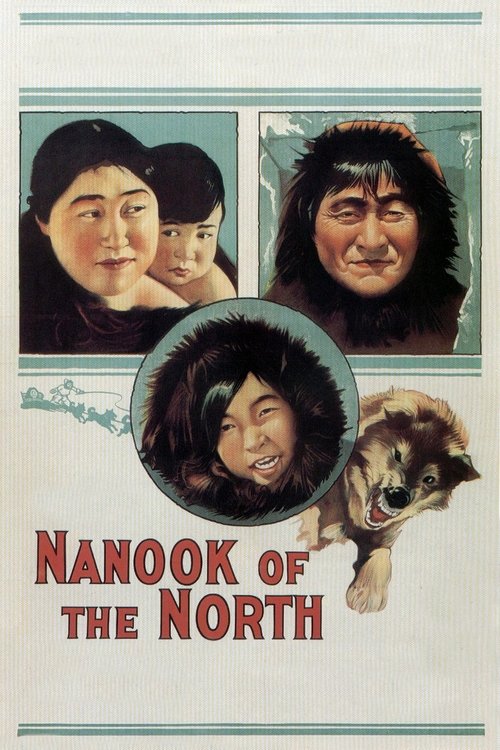
Nanook of the North
1922 · Robert Flaherty
For a curious, contemplative night — when you want to see where documentary began and watch human resourcefulness up close. Gentle viewing, with the caveat that hunting scenes are unvarnished.
What it's about
A year in the life of an Inuit hunter and his family on the shore of Hudson Bay in Arctic Quebec: trading furs, hunting walrus and seal, building an igloo from cut snow, riding out a blizzard. There's no plot beyond the oldest one — a family against an environment that offers no margin for error.
The experience
Surprisingly warm for a film about surviving the Arctic — Nanook's grin and ingenuity carry it, and a century on, the igloo-building and hunts still play with real suspense. It's silent-film pacing: patient, episodic, oddly soothing.
The craft
Robert Flaherty shot for over a year on Hudson Bay under conditions that destroyed equipment and film stock, and much of what looks caught was actually staged and rebuilt for the camera — which is exactly what makes it a landmark and a permanent argument about where documentary truth lies. The images of figures against endless ice remain genuinely beautiful.
Why it matters
Conventionally credited with inventing the feature documentary as a popular form: an unexpected worldwide hit in 1922 that gave nonfiction film a template — and an ethical controversy over staging — that the genre has argued with ever since.
Snapshot
Nanook of the North is the film conventionally credited with inventing the feature-length documentary as a popular form. Shot over roughly sixteen months on the eastern shore of Hudson Bay, in the Inukjuak region of Arctic Quebec, it follows a Inuk hunter Flaherty named "Nanook" through a cycle of seasonal subsistence: trading furs, hunting walrus and seal, building an igloo, weathering a blizzard. There is no plot in the dramatic sense, only the recurring contest between a family and an environment that wants them dead. Released by Pathé in June 1922 after the Hollywood studios passed on it, the film became an unexpected international success and gave the emerging nonfiction film a commercial and aesthetic template it would argue with for the next century. It is also, from its first frame, a film built on a productive contradiction: an "authentic" record of Inuit life that was extensively cast, staged, and reconstructed. Nearly everything that makes Nanook important — its narrative shape, its intimacy, its ethical scandals — flows from that contradiction.
Industry & production
Robert Flaherty came to filmmaking sideways, as a mining prospector and explorer working for the Canadian railway financier Sir William Mackenzie. On expeditions to the Hudson Bay region in the 1910s he carried a camera and accumulated footage of Inuit life. That first body of material — by Flaherty's own account some thirty thousand feet of negative — was destroyed when he dropped a cigarette onto the highly flammable nitrate film. The loss was formative: Flaherty concluded that his unfocused travelogue footage had failed because it lacked a human center, and that any successful film would need to organize itself around a single character and his struggle. Nanook was the deliberate second attempt.
The crucial industrial fact is its patron. After failing to interest established backers, Flaherty secured roughly $50,000 — a figure that appears in the standard accounts but should be treated as approximate — from the French fur-trading house Revillon Frères, a rival to the Hudson's Bay Company. Revillon operated the trading post at Port Harrison (Inukjuak) that appears in the film, and the sponsorship explains the film's early scenes of fur trading. This makes Nanook an early instance of corporate-sponsored cinema, though Flaherty retained unusual creative latitude. American distributors reportedly found the subject uncommercial; Pathé Exchange took it on, and the film's success abroad and at home vindicated the gamble. The precise box-office returns are not reliably documented and I will not invent them, but the film's popularity was sufficient to make "Nanook" a household name and to launch Flaherty's career — Paramount immediately financed his Samoan follow-up, Moana (1926).
Technology
Nanook is partly a story about equipment surviving the cold. Flaherty shot principally with Akeley cameras, hand-cranked instruments prized for their gyroscopic "pancake" tilt-and-pan head, originally designed for wildlife photography. That head let him execute smooth panning shots — following a sledge, sweeping a hunt across the ice — that were difficult with the locked-down tripods of the period, and it tolerated Arctic conditions better than many rivals. Flaherty's most consequential technical decision, though, was to bring a complete developing-and-printing outfit and a projector into the field. He processed his own footage on location and screened the rushes for his Inuit collaborators, who could see and respond to what they were making. This feedback loop — rare for the era — turned the production into something genuinely participatory and shaped the performances, even as it also let Flaherty direct retakes. The film stock was orthochromatic and the available light was the low, raking Arctic sun, conditions that inform the film's stark tonal contrasts between figures and snow.
Technique
Cinematography
Flaherty was his own cinematographer, and the film's visual signature is the dialogue between the human figure and immense white emptiness. He repeatedly places small dark bodies against vast undifferentiated fields of snow and sky, an austere graphic strategy that does the thematic work of the film — scale, isolation, endurance — without any intertitle having to state it. The Akeley head enables fluid reframing during action, while elsewhere Flaherty composes in patient long takes that let an event (harpooning a seal, hauling it through the ice) play out in real duration. He also pursued intimacy aggressively for the period: close shots of faces, especially Nanook's broad smile, and the famous interior scenes of the family. The cinematography is observational in feel but selective and composed in fact.
Editing
Flaherty edited the film himself, and the cutting is where the raw footage becomes drama. He organizes the material into discrete, suspenseful set-pieces — the walrus hunt, the seal hunt, the igloo construction, the blizzard — each with its own build, climax, and release, and arranges them into a seasonal arc that culminates in the family's struggle to reach shelter as a storm closes in. The editing manufactures tension through delayed payoff (the long wait at the seal's breathing hole) and through cross-cutting between the hunter and his prey or his endangered family. This narrativizing of nonfiction footage — imposing the rhythms of fiction onto observed reality — is precisely what later commentators meant when they spoke of documentary as a constructed rather than a transparent form.
Mise-en-scène / staging
Staging is the film's central craft and its central controversy. The most cited example is the igloo interior: a real snow house is too small and too dark to film inside, so Flaherty had an oversized igloo built and then cut away — a "three-quarter" structure open on one side to admit light, in which the family pantomimed waking and dressing while exposed to the cold. The hunts were likewise managed. By the 1920s the Inukjuak Inuit used rifles; Flaherty asked his subjects to hunt walrus and seal with traditional harpoons to depict a pre-contact way of life that was already passing or gone. The "Nanook" of the title was a man generally identified as Allakariallak, cast for the role; the women presented as his wives were not, by most accounts, actually married to him. These choices reflect Flaherty's method of reconstruction — restaging a culture as he imagined it had been — and have made the film a permanent test case in debates about documentary ethics and the representation of Indigenous people.
Sound
Nanook is a silent film and tells its story through images and intertitles. As was standard, it was exhibited with live or compiled musical accompaniment, and the specifics of any original 1922 score are not well documented; I will not attribute one. The film was later reissued in sound versions with added narration and music — a 1947 re-release is the best known — but those tracks are subsequent impositions, not part of the original conception, and they alter the film's tone considerably by overlaying a commentary the silent version pointedly lacks.
Performance
The performances are real people enacting versions of their own lives under direction, which gives them a quality unlike either professional acting or candid observation. Allakariallak's open, frequently grinning presence is the film's emotional engine; Flaherty deliberately built the picture around his charisma. Some sequences edge into performed comedy — most notoriously the scene in which Nanook bites a gramophone record as if baffled by the technology, a bit of business that flatters a primitivist fantasy of the "child of nature," since the Inuit of a working trading post were perfectly familiar with such devices. The performances are thus best understood as collaboration and self-presentation shaped toward Flaherty's romantic thesis.
Narrative & dramatic mode
The film operates in what John Grierson would later call "the creative treatment of actuality." It has no script and no fictional incident in the conventional sense, yet it is structured exactly like a survival drama: a protagonist, a family to protect, a hostile antagonist (the climate), escalating trials, and a climactic race against a blizzard. Flaherty's innovation was to discover that observed material could be shaped into the satisfactions of story without ceasing to feel true. This is the docudrama mode at its origin — neither pure record nor pure fiction, but a reconstruction organized for dramatic and emotional effect. The recurring tension in all later writing about the film concerns whether that shaping illuminates Inuit life or falsifies it.
Genre & cycle
Nanook sits at the headwaters of the documentary, but it grew out of an existing 1910s–20s appetite for expedition films, travelogues, and "scenics" that brought remote peoples and landscapes to metropolitan audiences. What distinguished Flaherty's film from the travelogue was its narrative concentration on one man and its dramatic architecture. It effectively founded the ethnographic film and the broader nonfiction feature, and it inaugurated a particular strain — the lyrical, romantic, character-centered documentary of the "vanishing" culture, often called the Flaherty tradition — that would run alongside and against the more analytical, social-problem documentary of Grierson and the materialist montage documentary of Dziga Vertov.
Authorship & method
Nanook is very nearly a one-man film: Flaherty directed, photographed, and edited it, and developed it in the field. His method has acquired a name of its own — long immersion in a place, casting nonprofessional subjects, collaborating with them through on-site screenings, and reconstructing an idealized traditional life rather than recording the present as found. The most important uncredited collaborators were the Inuit themselves, who built equipment, advised on technique, and in real measure co-authored the action; the politics of their effective anonymity (most prominently Allakariallak, named only as the fictional "Nanook") is part of the film's contested legacy. Flaherty's wife and frequent creative partner, Frances Hubbard Flaherty, is a continuing presence across his career and shared in shaping his films, though Nanook itself is overwhelmingly his solitary handiwork. There is no composer, screenwriter, or studio editor to credit in any meaningful sense — the authorial concentration is itself a defining feature.
Movement / national cinema
The film belongs to no national school at its making — it is an American-financed-then-French-sponsored production shot in Canada — but it became foundational to several. It is the acknowledged ancestor of the British documentary movement that Grierson organized at the Empire Marketing Board and GPO Film Units in the 1930s; it is a touchstone for ethnographic cinema and the later work of Jean Rouch; and, by a long historical irony, it stands behind the Inuit reclamation of their own screen image in films such as Zacharias Kunuk's Atanarjuat: The Fast Runner (2001). As a Canadian subject treated by an outsider, it also occupies a fraught place in discussions of Canadian and Indigenous national cinema.
Era / period
Nanook is a product of the early 1920s and the silent era's maturity: a postwar moment of expanding exhibition, hunger for the exotic and the "real," and confidence in technology's reach into the world's far corners. It predates synchronized sound, the codification of the documentary as a genre (the very word documentary in its modern sense postdates the film), and the institutional sponsorship structures that would later fund nonfiction film. It is, in short, a pioneer working before the category it founded existed.
Themes
The film's overt theme is survival — the dignity and resourcefulness of human beings wresting life from an implacable environment, dramatized as a contest between family and nature. Beneath that runs a powerful current of salvage romanticism: the desire to preserve on film a "pure," pre-contact way of life imagined as authentic and endangered, a desire that led Flaherty to edit modernity (rifles, the trading economy that in fact employed his subjects) out of the frame. The film thereby also encodes the colonial gaze — the metropolitan viewer's consumption of the "primitive" — and the ethical question of who is entitled to represent whom. Family, kinship, and the tenderness of domestic life (the children, the puppies, the morning routine) supply its emotional warmth and complicate any reading of the Inuit as mere specimens.
Reception, canon & influence
Nanook was an immediate and somewhat surprising popular success on release in 1922, traveling internationally and making its title character a recognizable name in popular culture. Critically, its lasting significance was crystallized a few years later when John Grierson, reviewing Flaherty's Moana in 1926, used the word "documentary" — and the discourse that built the genre took Flaherty's first feature as its origin point. The film entered the canon permanently: it was among the first titles selected for the United States National Film Registry in 1989 as culturally and historically significant.
Looking backward, the influences on the film were the expedition film and travelogue traditions, nineteenth-century romanticism about noble "primitives," and Flaherty's own failed earlier footage, whose lessons he absorbed. Looking forward, its legacy is enormous and double-edged. It established the feature documentary, the ethnographic film, and the participatory and reconstructive methods that run through Rouch's cinéma vérité and beyond; the "Flaherty tradition" of poetic, character-driven nonfiction remains a living lineage. At the same time, the film became the standing example in every debate about documentary truth, staging, and the ethics of representation — debates sharpened by the later report that Allakariallak died perhaps two years after filming (Flaherty attributed it to starvation on a hunt; other accounts suggest illness such as tuberculosis, and the record is genuinely uncertain). Later works have answered Nanook directly, from documentaries revisiting Inukjuak and its community's memory of the production to Inuit-authored cinema reclaiming the right to tell these stories. No film more fully demonstrates that the documentary was, from its very first masterpiece, a constructed art.
A Deleuzian reading
A man lifts a gramophone record to his mouth and bites it.
The full Deleuzian reading of Nanook of the North →
Reception
A genuine sensation in 1922 — sold worldwide as the first feature-length documentary — it's now impossible to discuss without the asterisks: staged hunts, a built-for-camera half-igloo, and a cast performing a way of life already partly in the past. It went from 'the birth of documentary' to the founding case study in documentary ethics.
How Nanook of the North was received, from release to now →
Influences: the films it descends from and the films it influenced
- In the Land of the Head Hunters (1914) — Cast Indigenous (Kwakwaka'wakw) nonprofessionals to reenact a pre-contact 'traditional' life that no longer existed, the direct precedent for Flaherty's reconstructive, idealized-past ethnography.
- The Great White Silence (1924) — Polar-expedition cinematography that isolates the human figure against featureless ice and snow, the visual grammar Flaherty inherits for framing Nanook against the Arctic blank.
- Workers Leaving the Lumière Factory (1895) — The actualité tradition of fixed-frame observation of real labor and movement, the raw documentary impulse Flaherty narrativizes into a feature.
- Tabu: A Story of the South Seas (1931) — Flaherty's own attempt to fuse his on-location reconstructed-traditional-life method with scripted drama, extending the docudrama hybrid he invented.
- Man of Aran (1934) — Pushes the staged-traditional-hunt to its extreme by having islanders relearn a long-abandoned basking-shark hunt purely for the camera—Nanook's salvage-romanticism intensified.
- Louisiana Story (1948) — Sustains the character-driven, nonprofessional-boy-protagonist poetic nonfiction Flaherty pioneered, structuring observation around a single idealized figure as with Nanook.
- Drifters (1929) — Grierson, who named the genre off Flaherty, applies narrativized set pieces and figure-against-element framing to North Sea herring fishermen, founding the British documentary movement on Flaherty's template.
- Night Mail (1936) — Carries Flaherty's dramatized-labor set piece into the Griersonian unit, choreographing real postal workers into a constructed, rhythmically edited 'day's work' narrative.
- The Plow That Broke the Plains (1936) — Adopts Flaherty's poetic, man-against-harsh-landscape lyricism for the American Dust Bowl, treating environment as antagonist in a narrativized nonfiction arc.
- Chronicle of a Summer (1961) — Extends Flaherty's participatory ethics—collaborating with subjects and screening footage back to them—into reflexive cinéma vérité, making the on-site-feedback method explicit.
- The Hunters (1957) — Structures a real Ju/'hoansi giraffe hunt into a suspenseful quest narrative, inheriting Flaherty's editing of the hunt-as-survival-drama set piece.
- Nanook Revisited (1990) — Returns to Inukjuak to interrogate the staging, naming, and colonial gaze of the original, the canonical reflexive 'answer film' to Flaherty's constructions.
- Atanarjuat: The Fast Runner (2001) — Inuit-authored reclamation that uses nonprofessional self-enactment of traditional Arctic life on the very terrain Flaherty filmed, inverting the colonial-gaze authorship of Nanook.
- Grizzly Man (2005) — Sustains the 'Flaherty tradition' of poetic, single-character nonfiction shaped by an authorial voice, building a survival-and-nature drama around one obsessive figure.
- Pompei: Below the Clouds (2025) — Founded the long-immersion place-portrait method Rosi consolidates — the lone filmmaker living inside a bounded community for an extended period and shooting its daily survival, with non-professional subjects performing their own lives to camera.
- Moana (1926) — Reapplies the identical Flaherty method—long immersion, nonprofessional casting, on-site screenings, revival of an abandoned tattoo ritual—and is the film whose review coined the word 'documentary.'
- Grass: A Nation's Battle for Life (1925) — Builds a feature from a real survival ordeal (the Bakhtiari migration) using the same hardship-as-narrative-spine structure that organizes Nanook's hunts.
- Chang: A Drama of the Wilderness (1927) — Stages and cross-cuts animal-hunt set pieces for suspense, narrativizing nonfiction footage into dramatized episodes exactly as Flaherty did with the seal and walrus hunts.
Similar films
- Grizzly Man (2005) — influence & lineage
- Atanarjuat: The Fast Runner (2002) — shared sensibility
- Hundreds of Beavers (2024) — shared sensibility
- The Thing (1982) — shared sensibility
- Baraka (1992) — shared sensibility
- The Revenant (2015) — shared sensibility
- Jeremiah Johnson (1972) — shared sensibility
- The Velvet Queen (2021) — shared sensibility
All the films related to Nanook of the North →