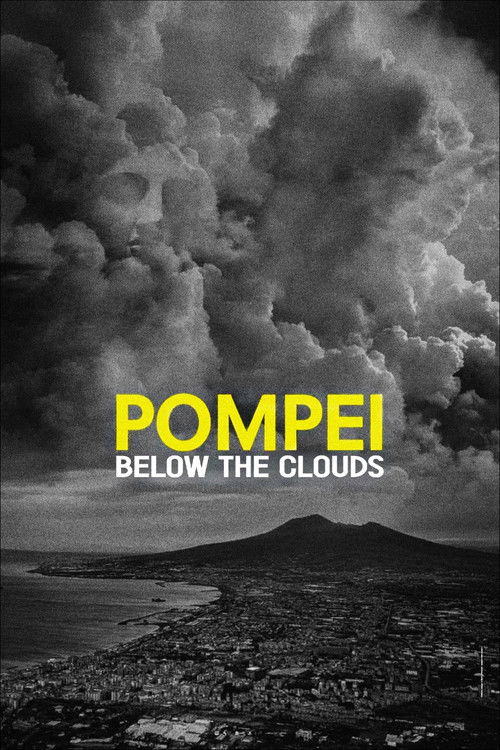
Pompei: Below the Clouds
2025 · Gianfranco Rosi
When you want a contemplative documentary to think alongside, not a disaster thriller — a film for a patient, curious mood that stays with you for days.
What it's about
Naples lives between two volcanoes: Vesuvius to the east and the restless Campi Flegrei caldera to the west. As tremors intensify, Gianfranco Rosi watches the people who live under the threat — archaeologists working the ruins of Pompeii, residents going about their days, emergency services straining to prepare — with the ancient buried city standing as a constant reminder of how this can end.
The experience
Meditative and quietly ominous — it observes rather than explains, letting dread and beauty sit side by side. You come out of it feeling the strange normalcy of living next to a catastrophe that hasn't happened yet.
The craft
Rosi works in his signature observational mode: patient, composed images, no lectures, meaning built by accumulation as ancient ruins and present-day anxiety rhyme with each other. The volcanic landscapes and excavated streets of Pompeii give it real visual weight on a big screen.
Why it matters
Another chapter from one of the most decorated documentarians alive — his previous work took top prizes at both Venice and Berlin — and a timely entry in cinema's reckoning with slow-motion disaster.
Snapshot
Pompei: Below the Clouds is a feature documentary by Gianfranco Rosi, the Italian non-fiction filmmaker whose work over the past fifteen years — Below Sea Level (2008), El Sicario, Room 164 (2010), the Golden Lion–winning Sacro GRA (2013), the Golden Bear–winning Fire at Sea (2016), and Notturno (2020) — has made him one of the most decorated documentarians of his generation. The film turns to the Bay of Naples, where two volcanic systems, Vesuvius to the east and the restless caldera of the Campi Flegrei to the west, frame daily life under a permanent, deferred threat. Against the backdrop of intensifying seismic activity in the Phlegraean Fields and the excavated ruins of Pompeii — the ancient city that stands as both archaeological site and memento mori — Rosi observes residents, emergency responders, and the archaeologists who labor at the threshold between the buried past and an anxious present.
Because the film belongs to 2025 and the bibliographic and critical record around it is still forming, several production particulars below are necessarily provisional; where I cannot verify a claim against the established record, I say so rather than invent it. What can be stated with confidence is grounded in Rosi's consistent, well-documented authorial practice across two decades.
Industry & production
Rosi occupies a distinctive industrial position: an arthouse auteur of documentary who works slowly, often over years, embedding himself in a place before a frame is finalized. His films are typically modest in crew but lavish in time, financed through European public-broadcast and film-fund ecosystems and Italian production houses, frequently with the involvement of companies such as Stemal Entertainment and 21Uno Film, alongside Rai Cinema and pan-European partners; international sales on his recent titles have run through The Match Factory. I would caution that the precise consortium of producers, broadcasters, and funds behind Pompei: Below the Clouds should be confirmed against the film's own credits, as I cannot verify the exact financing structure from the established record.
What is structurally characteristic — and almost certainly true here — is the economy of Rosi's model. He customarily shoots and records sound himself, which compresses the on-location footprint and allows the extended, patient residency that his method requires. This is less a low-budget constraint than an aesthetic precondition: the long gestation is the point. The Naples region also carries obvious production logic for an Italian filmmaker working on national volcanic memory, with the Pompeii archaeological park and the Campi Flegrei communities of the Pozzuoli area as natural anchors. Distribution would be expected to follow Rosi's established festival-first pathway — premiere on the major-festival circuit, then theatrical arthouse release and public-broadcast windows — though the specific premiere venue and release calendar for this title should be checked rather than assumed.
Technology
Rosi has worked, across his recent features, in lightweight digital capture that permits solo operation in difficult environments — the open sea of Fire at Sea, the borderlands of Notturno, the ring road of Sacro GRA. The technological signature is not spectacle hardware but mobility and patience: compact cameras, long lenses for compressed observational distance, and self-operated location sound. For a subject defined by subterranean instability, one anticipates a reliance on the seismic and monitoring apparatus of the region — the instruments of the Osservatorio Vesuviano and civil-protection systems — as both narrative content and a kind of found technological imagery, the screens and sensors through which a modern city listens to the ground beneath it. The specific cameras, formats, and post-production pipeline used on Pompei: Below the Clouds are not something I can confirm, and I flag that the record here is thin; the safe claim is methodological continuity with his recent digital, single-operator practice rather than any particular technical specification.
Technique
Cinematography
Rosi's camera is the most identifiable element of his authorship, and it is reasonable to read this film through that grammar. His images favor the held, composed observational shot over reactive handheld coverage: figures framed within doorways, ruins, vehicles, and apertures; foreground silhouettes against deep, luminous backgrounds; a patient willingness to let an action complete within the frame rather than cutting to find it. The Bay of Naples offers him a landscape already charged with the pictorial — Vesuvius as a permanent compositional horizon, the Phlegraean fumaroles, the stratified surfaces of excavation. One expects the dialectic that runs through all his work: the monumental landscape held in tension with the intimate human gesture, the geological timescale set against a single anxious face. Because he typically operates the camera himself, the point of view is authorial and embodied rather than delegated, and the duration of shots tends to register a watching consciousness.
Editing
The decisive shaping of a Rosi film happens in the edit, where years of accumulated observation are distilled into a mosaic. His structural method is associative and rhythmic rather than narratively driven: he assembles parallel lives and recurring motifs into a braided whole, withholding commentary, captions, and explanatory voice. Sacro GRA and Fire at Sea both proceed by interleaving discrete human strands until thematic rhyme, not plot, binds them. One anticipates the same architecture here — archaeologists, residents, and responders cut in counterpoint, the ancient catastrophe of Pompeii rhyming silently against present-day tremor. Rosi has worked in the editing room with editors including Jacopo Quadri and Fabrizio Federico across his recent features; the specific editor of record on this film should be confirmed from the credits, as I cannot verify that collaborator from the established record.
Mise-en-scène / staging
"Staging" in Rosi is a delicate term, because his is an observational cinema that nonetheless composes with great deliberation. He does not direct his subjects to perform, but he selects, frames, and waits — a controlled patience that yields scenes of startling pictorial order from unstaged life. The mise-en-scène here is the region itself: the layered theater of excavation, the domestic interiors of communities living atop a caldera, the institutional spaces of monitoring and emergency response. Pompeii furnishes a ready-made set of almost unbearable resonance — plaster casts of the dead, frozen mid-gesture — and one expects Rosi to treat such material with restraint rather than morbid emphasis, integrating it into the everyday rather than isolating it as spectacle.
Sound
Sound is central to Rosi's authorship and, as with the image, typically his own work on location. His soundscapes are dense, specific, and largely diegetic, eschewing wall-to-wall scoring in favor of environmental texture — wind, machinery, voices, the acoustic signature of a place. For a film about a city listening to the ground, sound becomes thematically loaded: the subterranean rumble, the instruments that translate tremor into signal, the human chatter that continues above. Whether Pompei: Below the Clouds employs an original score is not something I can confirm; Rosi's recent practice has leaned toward sparing musical intervention, and any specific composer credit should be verified rather than assumed.
Performance
Rosi's films have no actors in the conventional sense; their "performances" are the self-presentations of real people who have allowed the camera a sustained intimacy. The achievement is one of trust and selection — the filmmaker's capacity to be present long enough that subjects cease to perform for the lens, and his eye for the figure whose ordinary presence carries the film's larger meaning. The young Samuele of Fire at Sea is the model: a non-professional whose unselfconscious being becomes the film's emotional center. One anticipates analogous figures here — an archaeologist, a resident, a responder — whose lived presence anchors the abstraction of geological risk in a human face. Specific subjects cannot be named from the established record at this stage.
Narrative & dramatic mode
The film operates in Rosi's signature mode: observational, non-expository, structured by juxtaposition rather than argument. There is characteristically no narrating voice, no on-screen text marshaling facts, no interview apparatus directing the viewer's conclusions. Drama arises from situation and accumulation — the slow build of dread inherent to living under a volcano, the irony of a present-day city haunted by the fossilized end of an ancient one. The mode is essayistic in effect but imagistic in means: meaning is constructed by the cut and the composition, leaving interpretive work to the spectator. This withholding is precisely what has drawn both admiration and critique across Rosi's career, and it defines the dramatic contract here.
Genre & cycle
Generically the film is creative-observational documentary, the tradition of patient long-form non-fiction that descends from direct cinema but is inflected by a strong authorial-poetic sensibility. Within Rosi's own filmography it extends a clear cycle: the place-portrait that uses a bounded geography — a ring road, an island, a borderland — as a lens onto larger conditions of contemporary life and death. It also enters the broader cycle of cinema about volcanic and ecological precarity and, more specifically, the long cultural fascination with Pompeii as figure for catastrophe and memory, a lineage stretching from Rossellini's Journey to Italy (1954) to countless documentary and fiction treatments. Rosi's contribution to that lineage is to refuse the disaster-spectacle register in favor of the quotidian and the ambient.
Authorship & method
Rosi's method is the through-line of any account of his work, and it is the surest ground on which to read this film. He immerses himself in a location for an extended period — often years — living within the community, building trust, and shooting and recording largely alone. He resists the conventional documentary toolkit: no voiceover, no talking-head interviews framed as testimony, no expository graphics. The film is found in the edit, where the accumulated material is composed into an associative structure. This is a cinema of presence and patience, ethically committed to observation over assertion, and aesthetically committed to the composed frame.
On collaborators, the most reliable statement is that Rosi himself functions as director, cinematographer, and frequently sound recordist — an unusually consolidated authorship for feature documentary. His editing collaborations and any writing credit (his films are typically "written" in the structural sense during editing rather than scripted in advance) for Pompei: Below the Clouds should be drawn from the film's credits; I cannot verify the specific editor, composer, or producing collaborators on this title from the established record, and I decline to invent them.
Movement / national cinema
The film sits within contemporary Italian cinema and, more broadly, within a European auteur-documentary tradition that treats non-fiction as a vehicle for serious formal and ethical ambition. Rosi is one of the central Italian figures in that tradition, and his turn to Naples, Vesuvius, and Pompeii places the film squarely within an Italian cultural reckoning with its own volcanic geography and antiquity — a national-cinema engagement with landscape and memory that runs deep, from neorealism's attention to place through to the present. The subject matter is emphatically Italian, but Rosi's address is international, consistent with his standing as a festival-circuit auteur whose work circulates well beyond domestic borders.
Era / period
Made and set in the mid-2020s, the film registers a specifically contemporary anxiety: the documented intensification of seismic activity ("bradyseism") in the Campi Flegrei in recent years, which has brought renewed scientific and civil-protection attention to a densely populated zone. The film thus belongs to a moment of heightened ecological and geological consciousness, in which long-dormant or slow-moving threats press newly on public life. It also reflects the current maturity of creative-documentary practice, in which a filmmaker of Rosi's stature can mount a patient, large-canvas observational work and expect it to reach a global arthouse audience.
Themes
The film's themes are legible from its premise and Rosi's preoccupations. Foremost is the coexistence of ordinary life with catastrophic risk — the human capacity to inhabit a threatened place, to continue domestic and working routines beneath an indifferent geology. Closely related is memory and the layering of time: Pompeii literalizes the buried past, and the excavation that uncovers ancient death proceeds alongside a present community that may face its own. There is the theme of listening and prophecy — a city interpreting tremors and instruments, haunted by a precedent it cannot un-know. And there is Rosi's enduring concern with the marginal, the patient, the unspectacular human presence within vast impersonal forces, here the forces of the earth itself rather than the sea or the border. Across all of these runs a meditation on mortality framed not as event but as condition.
Reception, canon & influence
Rosi enters this film as one of the most honored documentarians alive — the only filmmaker to have won both the Golden Lion (Sacro GRA) and the Golden Bear (Fire at Sea), the latter an Academy Award nominee for Best Documentary Feature. That standing all but guarantees serious critical attention and a major-festival platform for Pompei: Below the Clouds; the specific premiere, awards, and critical verdict, however, belong to the still-forming 2025–2026 record, and I will not characterize a reception I cannot yet verify. What can be anticipated is the familiar critical fault line his work provokes: admiration for the beauty, patience, and ethical restraint of his observation, set against a recurring skepticism about aestheticization and about the political legibility of a method that withholds explanation.
On influences on the film (the backward lines): Rosi's practice descends from direct and observational cinema and from the European poetic-documentary tradition, and his Pompeii subject inherits a long cultural lineage of the city as emblem of catastrophe and memory, with Rossellini's Journey to Italy a notable Italian antecedent for the modern encounter with those ruins. His own prior place-portraits — Sacro GRA, Fire at Sea, Notturno — are the most direct precedents, this film reading as a continuation of that method applied to a new bounded geography. On influence forward (the legacy): it is too early to assess what this specific film will shape, but Rosi's broader body of work has already been formative for a generation of observational documentarians and has helped legitimize creative non-fiction at the highest tier of the festival canon. Its forward legacy should be revisited as the critical record matures; to claim more now would be to invent it.
A Deleuzian reading
Start with the plaster cast.
The full Deleuzian reading of Pompei: Below the Clouds →
Reception
How Pompei: Below the Clouds was received, from release to now →
How to watch Pompei: Below the Clouds: what to notice on a first viewing
- Watch Rosi hold a shot until the action completes on its own. Rosi favors composed, patient long takes over reactive coverage, letting a figure move through a doorway or a ruin without cutting away to find the next beat. The stillness of the camera is what lets ordinary routine read as something worth watching closely.
- Notice Vesuvius sitting in the background of almost every shot. Rosi frames figures within doorways and ruins against deep, luminous backgrounds, keeping the volcano as a constant compositional horizon behind ordinary daily activity. The mountain never leaves the frame, which is the film's whole argument without a single word of narration.
- Listen for wind, machinery, and voices instead of a musical score. Rosi builds his soundscape from dense, specific environmental noise, wind, tools, chatter, rather than wall-to-wall music, so the ground itself sounds like it is speaking. You end up listening the way the residents do, for information rather than emotional cues.
- Watch for the one ordinary face the film keeps returning to. Rosi builds his films around real people who stop performing for the lens after enough time together, so a resident's unguarded presence carries meaning no actor could supply. The trust between filmmaker and subject is what lets an ordinary face carry the weight of the whole film.
The whole guide to watching Pompei: Below the Clouds, with the keys for a rewatch →
Influences: the films it descends from and the films it influenced
- Journey to Italy (1954) — Its Pompeii excavation sequence — the plaster-cast bodies surfacing before living onlookers — established the Italian template Rosi inherits: the ruin filmed as a collapse of geologic and human time, mortality made physically present rather than narrated.
- Nanook of the North (1922) — Founded the long-immersion place-portrait method Rosi consolidates — the lone filmmaker living inside a bounded community for an extended period and shooting its daily survival, with non-professional subjects performing their own lives to camera.
- Banditi a Orgosolo / Lu tempu di li pisci (1961) — De Seta's Sardinian ethnographic shorts pioneered the director-recorded diegetic soundscape — wind, sea, labor captured on location with no commentary — the exact sound-as-environment practice Rosi records single-handedly.
- Titicut Follies (1967) — Codified the non-expository observational grammar Rosi uses — no voiceover, no talking-head testimony, no graphics — with the film's meaning assembled associatively in the edit rather than asserted on screen.
- Primary (1960) — The originating direct-cinema work whose synchronous-sound, fly-on-the-wall observation without narration is the movement Rosi descends from and refines into a composed-frame variant.
- Nostalgia for the Light (2010) — Models the landscape-against-intimate counterpoint Rosi favors — vast geologic/cosmic deep-time set beside grieving individuals — using monitoring/scientific imagery (telescopes there, seismographs here) as the device linking catastrophe to memory.
- Homo Sapiens (2016) — Its static, deep-focus, commentary-free compositions of abandoned ruins establish the unstaged-composed frame holding decayed architecture as layered time — the painterly observational stillness Rosi shares.
- Honeyland (2019) — Carries forward the festival-legitimized observational mode Rosi helped canonize — years of immersion, no voiceover, non-professional subject, ecological precarity composed as patient image — meaning emerging from the cut alone.
- Fire at Sea (2016) — Rosi's own immediate precedent: the parallel-counterpoint structure cutting between ordinary daily life and proximate mortal risk (migrant crossings), built entirely in the edit from solo-shot observation, here transposed to seismic danger.
- Sacro GRA (2013) — The bounded-geography place-portrait method — mapping a single circumscribed terrain through accumulated unstaged encounters with non-professional inhabitants — that Pompeii directly extends to a new perimeter.
- Notturno (2020) — Continues Rosi's deep-composition, low-light observation of communities living amid latent catastrophe, with narrative withheld and threat kept off-frame as ambient condition rather than event.
- Leviathan (2012) — Pushes the same director-recorded, diegetic-environmental immersion to a sensory extreme — the world delivered through embodied sound and texture with zero exposition — extending Rosi's sound-as-meaning practice.
- 'Til Madness Do Us Part (2013) — Extends the observational long-take and patient durational immersion in a single bounded institution, trust built over extended residence, the camera composing rather than chasing — Rosi's temperament at greater length.
- Aquarela (2018) — A non-expository, sound-driven portrait of life amid catastrophic natural force (water/ice), withholding commentary so that environmental power and human fragility are felt as composed image and recorded sound — Rosi's risk-as-condition theme.
- Stop the Pounding Heart (2013) — Shares the contemporary Italian observational practice of embedding within a rural community and shaping non-professional subjects into unstaged-composed scenes that hover between document and quiet fiction.
- Behemoth (2015) — Builds the landscape-against-intimate frame around industrial catastrophe and ruin, using associative montage and layered-time imagery to render environmental devastation and mortality without explanatory narration.
Similar films
- Journey to Italy (1954) — influence & lineage
- Honeyland (2019) — influence & lineage
- La Terra Trema (1949) — shared sensibility
- Paisan (1946) — shared sensibility
- Baraka (1992) — shared sensibility
- Salvatore Giuliano (1962) — shared sensibility
- Stromboli (1950) — shared sensibility
- Lessons of Darkness (1992) — shared sensibility