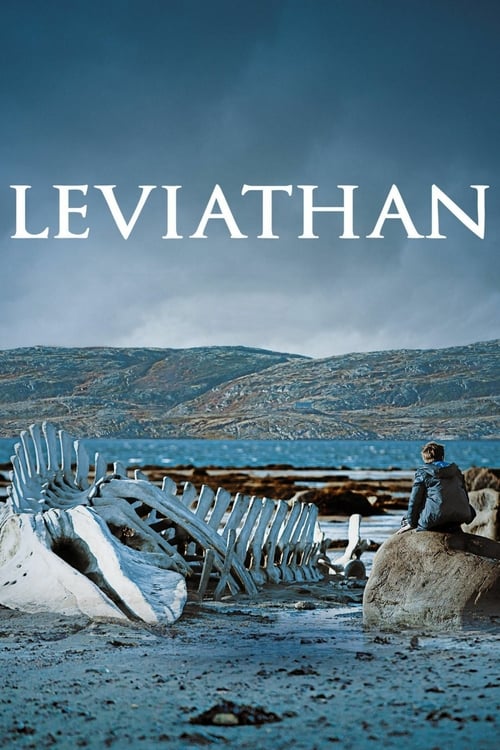
Leviathan
2014 · Andrey Zvyagintsev
For when you want a serious, chewy film that confronts something real — injustice, faith, the smallness of one man against the system. This is challenge viewing, best when you're ready to sit with anger.
What it's about
On a windswept stretch of Russia's northern coast, a hot-tempered mechanic named Kolya learns the town's corrupt mayor intends to seize his home — the house his family has always lived in, on land the mayor wants. Kolya calls in an old army friend, now a slick Moscow lawyer, to fight the expropriation, and the battle draws his wife, his teenage son, and everyone around him into the machinery of a state that always wins.
The experience
Heavy, magnificent, and quietly furious — it unfolds with the patience of a tragedy you can see coming and can't stop. There's vodka-soaked black comedy in the margins, but the overall effect is awe shading into despair; it leaves you hollowed out and thinking about power for days.
The craft
The cinematography is staggering: granite coastline, beached whale bones, and gray Barents Sea light composed like biblical landscape painting. Zvyagintsev frames a very specific Russian corruption story against the Book of Job, and the film holds both registers — courtroom procedural and metaphysical tragedy — without strain. See it on the biggest screen you can.
Why it matters
It won Best Screenplay at Cannes and the Golden Globe for foreign-language film, drew official displeasure at home for its portrait of Putin-era power, and stands as one of the defining Russian films of its decade.
Snapshot
Leviathan is Andrey Zvyagintsev's fourth feature, a monumental tragedy of the individual crushed by the machinery of state, church, and law in contemporary Russia. Set in a windswept town on the Barents Sea, it follows Kolya, a hot-tempered mechanic whose seaside house and garage are targeted for seizure by a corrupt provincial mayor under the pretext of eminent domain. Kolya summons an old army friend, now a Moscow lawyer, to fight the expropriation; the lawyer's intervention, and an affair he begins with Kolya's wife, precipitates a cascade of ruin. The film weds the granite naturalism of the Russian provinces to a deliberately mythic frame — the Book of Job, Hobbes's Leviathan, the beached whale skeleton on the shore — producing a work that is at once a specific indictment of Putin-era power and a metaphysical meditation on suffering without redress. It won Best Screenplay at Cannes and the Golden Globe for Best Foreign Language Film, and became, for a moment, the most internationally visible Russian film of its decade, while igniting a domestic controversy over its state funding and its bleak portrait of the nation.
Industry & production
Leviathan was produced by Alexander Rodnyansky and Sergey Melkumov through their company Non-Stop Production, Zvyagintsev's regular producing partners. It was made with financial support from the Russian Ministry of Culture — a fact that became central to the film's afterlife, since the completed picture was widely read as an excoriation of the Russian state that had helped pay for it. Culture Minister Vladimir Medinsky publicly criticized the film, objecting to its portrait of Russia and its unrelenting bleakness, and the episode fed into a broader tightening of cultural policy. Russia's law banning profanity (mat) in films, theater, and media took effect in 2014; Leviathan, saturated with obscenity as a register of ordinary speech, was caught in the crosswind, and the domestic release reportedly required alteration or bleeping of its language. The precise mechanics of that censoring are best stated cautiously: what is certain is that the film's language and its funding source together made it a flashpoint in a national argument about what Russian cinema was permitted to depict.
The shoot took place in the far north, principally around Teriberka on the Kola Peninsula in the Murmansk region, with the fictional town rendered on the Barents coast. The landscape — gray water, low sky, the rusting hulks of boats and the great arched bones of a whale — is not backdrop but argument, and the logistics of filming in that remote, weather-hostile terrain shaped the production's scale and rhythm. Internationally the film traveled the full festival-and-awards circuit: a Cannes competition premiere, the Golden Globe win, and a nomination for the Academy Award for Best Foreign Language Film (it lost to Paweł Pawlikowski's Ida). That trajectory confirmed Zvyagintsev's standing as the leading Russian auteur on the world stage, a position first established with his debut.
Technology
Leviathan was shot in anamorphic widescreen at a 2.35:1 aspect ratio, the CinemaScope frame giving the northern horizon its full lateral sweep and dwarfing human figures against sea and sky. Zvyagintsev and his cinematographer Mikhail Krichman work in the register of contemporary digital capture with meticulous color management, and the film's palette — desaturated blues, slate grays, the wet sheen of stone and water — is a controlled technical achievement as much as an aesthetic one. I won't specify a camera or lens package I can't verify; what is evident on screen is a preference for long focal patience, deep tonal restraint, and the kind of resolution that renders texture (peeling paint, wet rock, weathered skin) with documentary precision while holding an unmistakably composed, painterly image. The film's technological signature is thus one of restraint: nothing calls attention to the apparatus, which is precisely how the apparatus serves the film's sense of an implacable, indifferent world.
Technique
Cinematography
Krichman, Zvyagintsev's cinematographer since The Return, is the film's essential co-author of tone. His camera favours stillness and duration — locked or slowly gliding frames that let an action complete itself in real time. Landscapes are shot as tableaux, with the whale skeleton, the derelict church, and the beached boats functioning as fixed monuments the drama passes beneath. The light is northern and cold, overcast rather than golden, and Krichman resists any beautifying warmth that might soften the material. Interiors are cramped and dim against the vast exteriors, so that the film continually stages the smallness of the private household within an overwhelming natural and political immensity. The recurring image of the enormous whale bones on the shore — a literal leviathan — is the visual thesis: the human remains among ruins of something far larger and older than itself.
Editing
Cut by Anna Mass, the film moves at a deliberate, gathering pace that gives each scene room to breathe and each catastrophe time to land. The editing logic is one of accumulation rather than acceleration: extended dialogue scenes, drinking scenes, and bureaucratic encounters are held long enough to become oppressive, and the film trusts ellipsis at its cruellest turns, withholding certain events and letting their consequences arrive obliquely. This patience is structural — the tragedy works because the film refuses the relief of pace, mirroring the grinding, unhurried inevitability of the institutions that destroy Kolya.
Mise-en-scène / staging
Zvyagintsev stages power and powerlessness spatially. Officials sit behind desks beneath portraits and icons; the mayor operates from paneled rooms and receives counsel from an Orthodox bishop; verdicts are read aloud in a rapid, dehumanizing bureaucratic monotone. Against this, Kolya's world is the kitchen table, the garage, the shoreline — domestic and elemental. Vodka is a constant prop and a structuring ritual, lubricating friendship, grief, and violence alike. The half-ruined church where derelicts gather, and the intact church where the powerful worship, are staged as deliberate rhymes, drawing the line between institutional religion and abandoned faith.
Sound
The soundscape is dominated by the natural world — wind, surf, the mechanical noises of the garage and the town. Crucially, Leviathan has no original score. Zvyagintsev bookends the film with music by Philip Glass, drawn from the composer's opera Akhnaten, its surging, liturgical minimalism lending the coastal landscapes an oceanic, mythic gravity at the opening and close while the body of the film proceeds largely without scoring. The choice is pointed: the pre-existing Glass music imports a sense of ancient, impersonal grandeur, framing the intimate Russian tragedy as one instance of a much older pattern of power and suffering.
Performance
The ensemble plays in a naturalistic register calibrated to the film's realism. Aleksey Serebryakov gives Kolya a coiled, self-destructive volatility — a decent man whose only weapons against a rigged system are rage and drink. Elena Lyadova, as his wife Lilya, works largely through interiority and silence, carrying the film's most inward suffering. Vladimir Vdovichenkov plays Dmitri, the Moscow lawyer, with a cool metropolitan confidence that curdles into complicity, and Roman Madyanov's mayor, Vadim, is a grotesque of provincial corruption — bloated, drunk, alternately menacing and craven, a small tyrant who is nonetheless the local face of an entire order. The performances avoid melodrama; the horror is delivered through ordinariness.
Narrative & dramatic mode
The film's dramatic mode is tragedy in a near-classical sense, transposed to a realist, contemporary key. Its explicit template is the Book of Job: a righteous-enough man stripped of house, family, and standing by forces he cannot comprehend or contest, whose demand for justice is met not with an answer but with the crushing assertion of a power beyond appeal — the priest in the film paraphrases God's speech to Job from the whirlwind, invoking the leviathan itself. Zvyagintsev also drew on the modern American case of Marvin Heemeyer, the Colorado man who in 2004 armored a bulldozer and demolished town buildings after a zoning dispute, then killed himself — an incident of one individual's futile war against municipal power that the director transplanted to Russian soil. The narrative withholds catharsis by design: there is no redemptive turn, no punishment of the wicked, no consolation. The dramatic engine is not suspense but inexorability — the sense that the outcome is fixed from the first frame and the film merely reveals how it will be reached.
Genre & cycle
Nominally a drama and crime film — its engine is a property expropriation, an abuse of prosecutorial and police power, a killing, and a cover-up — Leviathan belongs more precisely to the tradition of the art-cinema social tragedy and the "state-of-the-nation" film. It sits within a lineage of European auteur cinema that uses a single family's destruction to diagnose a whole society, and within a specifically Russian cycle of post-Soviet reckoning with corruption, cynicism, and the fusion of church and state. It is a crime film in which the criminals are the institutions.
Authorship & method
Leviathan is a fully authored work, and its coherence rests on a stable creative nucleus. Zvyagintsev co-wrote the screenplay with Oleg Negin, his regular writing partner, and the two won Best Screenplay at Cannes for it. The director's method is one of rigorous control and slow construction — precise storyboarding, long takes, an insistence on landscape and symbol as load-bearing narrative elements. His enduring collaboration with cinematographer Mikhail Krichman is central: the two have built a shared visual language across The Return, The Banishment, Elena, and Leviathan, defined by stillness, cool light, and composed widescreen space. Editor Anna Mass shapes the film's gathering duration. The "score," as noted, is not composed but curated — Zvyagintsev's selection of Philip Glass's Akhnaten as the film's sonic frame is itself an authorial gesture, aligning the picture with the impersonal and the eternal. The result is a film in which every department serves a single, unwavering vision.
Movement / national cinema
Zvyagintsev is routinely, and rightly, placed in the great line of Russian and Soviet art cinema descending from Andrei Tarkovsky — a heritage of long takes, spiritual seriousness, landscape as metaphysics, and the moral weight of the image. Leviathan also draws on the European modernist tradition (the existential austerity of Bergman, the alienated compositions of Antonioni) that Tarkovsky himself belonged to. Within contemporary Russian cinema, the film stands as the most prominent example of a dissident-realist strain willing to depict the state's corruption directly, and its funding controversy made it a test case for how much critical latitude that national cinema would be granted. Zvyagintsev's international reputation — established when his debut The Return won the Golden Lion at Venice in 2003 — meant that Leviathan was received abroad as the Russian film of its moment, even as it was contested at home.
Era / period
The film is precisely of its time: the Russia of the early-to-mid 2010s, a period of consolidating state power, visible collusion between the political apparatus and a resurgent Orthodox Church, and a deepening official intolerance of dissent — the same years that produced the anti-profanity law that ensnared the film. Leviathan reads that era from the periphery, in a decaying coastal town far from Moscow, arguing that the true texture of the system is best seen in the provinces where it operates without cameras or restraint. Its portrait of vodka-soaked fatalism, petty tyranny, and institutional impunity is a deliberate period document of Putin-era Russia as Zvyagintsev saw it.
Themes
The film's governing theme is the individual's helplessness before Leviathan — the Hobbesian state as an all-devouring monster, fused here with the biblical sea-beast of God's answer to Job. Corruption is depicted not as an aberration but as the operating system: the mayor, the courts, the police, and the church are shown as a single interlocking mechanism of self-protection. The critique of the Orthodox Church is especially pointed — religion appears as an instrument of power, blessing the strong while offering the weak only the church-ruin where the dispossessed gather. Faith, justice, and law are all revealed as hollow or captured. Around these run the private tragedies: a marriage failing under economic and emotional pressure, a father losing his son's respect, friendship betrayed, and the persistent Russian motif of drink as both solace and self-destruction. The whale — bones on the shore, a living leviathan glimpsed at sea — binds these registers, holding the political and the metaphysical in one image.
Reception, canon & influence
Critically, Leviathan was received internationally as a major achievement — praised for its formal command, its performances, and the audacity of its indictment — and it accumulated the field's principal honors: the Cannes screenplay prize, the Golden Globe, and an Oscar nomination. In Russia the reception split sharply along political lines, with official displeasure and nationalist objection set against the recognition of critics and filmgoers who saw it as a truthful mirror. That very controversy became part of the film's cultural meaning, a real-world enactment of the tension between the individual artist and state power that the film dramatizes.
Looking backward, the film's influences are legible and often acknowledged: the Book of Job as narrative and thematic armature; Hobbes's Leviathan as its titular and conceptual frame; the Marvin Heemeyer bulldozer case as its contemporary spark; and, aesthetically, the Tarkovskian tradition of Russian spiritual realism together with the European modernism of Bergman and Antonioni. The use of Philip Glass connects it to a minimalist musical lineage that gives the ancient story its oceanic scale.
Looking forward, Leviathan consolidated Zvyagintsev's position as the pre-eminent Russian auteur of his generation and set the template for his subsequent Loveless (2017), which extended the same method — cool widescreen realism, social diagnosis through a disintegrating family — to renewed acclaim. More broadly, the film became a reference point for the international art-cinema conversation about corruption, church-state fusion, and the possibilities and perils of politically critical filmmaking under authoritarian conditions; it is frequently invoked in discussions of dissident cinema and of how a state-funded film can turn its critical gaze on the state itself. Its specific downstream influence on other filmmakers is harder to document with precision and is best left as an open question, but its stature within the canon of twenty-first-century world cinema — and as the defining Russian film of its decade — is not in doubt.
A Deleuzian reading
The verdict is read aloud in court at speed, in a flat administrative gabble, the way you'd read out a list of part numbers.
The full Deleuzian reading of Leviathan →
Reception
Abroad it was an instant triumph — Best Screenplay at Cannes 2014, a Golden Globe, an Oscar nomination — while at home it ignited a firestorm, denounced by Russian officials and church figures as anti-Russian even though the state had partly funded it. A decade on it's settled in as *the* modern Russian art film, its reputation only sharpened by events since.
How Leviathan was received, from release to now →
How to watch Leviathan: what to notice on a first viewing
- Watch how long the camera holds on the whale bones. Krichman shoots the whale skeleton, the derelict church, and beached boats as fixed monuments the drama passes beneath, in wide anamorphic frames that dwarf people against sea and sky. The vast frame keeps signaling how much power and consequence stays outside it, never shown.
- Notice where officials sit versus where Kolya sits. Officials sit behind desks under portraits and icons; Kolya's world is the kitchen table, the garage, the shoreline. The film keeps returning to this contrast. Power never has to argue when the room itself is built to make it obvious.
- Listen for music only at the very start and end. Philip Glass's Akhnaten frames the film at open and close; the middle runs on wind, surf, and garage noise with no score at all. The bare middle stays raw while Glass lends the coast an ancient, impersonal grandeur.
- Watch Lilya's face when others argue around her. Lyadova plays her almost entirely through silence and stillness, rarely speaking even as the men decide her house and her marriage. When action stops working, watching becomes the only thing left to do.
The whole guide to watching Leviathan, with the keys for a rewatch →
Influences: the films it descends from and the films it influenced
- Andrei Rublev (1966) — The load-bearing use of landscape and weathered architecture as spiritual tableau, filmed in extended takes where duration itself becomes the moral weather — the core of the Tarkovskian grammar Zvyagintsev and Krichman inherit.
- Stalker (1979) — Desaturated, near-monochrome palette and glacial camera movement that treat a degraded terrain as a metaphysical zone, the exact tonal register Krichman cools further for the Barents coast.
- Winter Light (1963) — The austere chamber framing of a faith emptied out into institutional ritual — the priest as functionary of a hollow church — supplying the model for Leviathan's collusion of clergy and power.
- L'Avventura (1960) — Compositions that dwarf figures against rock, sea and dead architecture, plus the refusal to resolve the plot's central loss — the ellipsis-and-withheld-catharsis structure Zvyagintsev adopts wholesale.
- Ordet (1955) — Slow, planimetric long-take staging that dramatizes true faith against a bureaucratized church, establishing the spatial-power theology Leviathan restages in Putin-era vestments.
- Mishima: A Life in Four Chapters (1985) — The use of Philip Glass's cyclic minimalism not as underscore but as an impersonal, oceanic frame that lends a single mortal a mythic scale — the curatorial move Zvyagintsev repeats with Akhnaten.
- Hukkle (2002) — Drives the embedded, non-human macro POV and sound-design-as-narrative to an extreme, treating the camera as one creature among many in the manner Hukkle first sketched.
- A Short Film About Killing (1988) — Renders institutional decay and the crushing of the individual by the state as austere moral tragedy, the muted palette and withheld interiority descending from Kieślowski's ethical frame.
- Baraka (1992) — Inherits Baraka's no-dialogue, no-voiceover immersion but radicalizes it, replacing serene composition with sensory-ethnographic camera placement while keeping sound structural, not illustrative.
- Titicut Follies (1967) — Sensory Ethnography Lab's extension of the same premises — no narration, no interviews, no score, and a wall of raw ambience carrying the whole soundtrack — with the camera pressed into industrial process the way Marshall's was pressed into the ward.
- Belfast, Maine (1999) — Radicalizes Belfast's fishing sequences — the same refusal of commentary, context or captions over commercial labor — by mounting the camera inside the gear and letting overwhelming ambient sound do the work exposition would otherwise do.
- The Act of Seeing with One's Own Eyes (1972) — Carries forward the camera-as-body-in-a-space premise — no narration, no orienting wide shot, lens repeatedly fouled and submerged among fish viscera — with GoPros doing what the wound Bolex did: producing disorientation as the honest record of a body working.
- Loveless (2017) — The direct extension of the method: Krichman's cold widescreen realism and gathering duration applied to a disintegrating family whose collapse indicts the surrounding state.
- Honeyland (2019) — The Sensory Ethnography Lab's use of multiple small cameras mounted on bodies and rigging to capture extreme close-ups and wide seascape within the same observational register models the macro-to-landscape range Daut and Ljuma achieve in Honeyland, where the frame moves between bee cells and mountain panoramas without changing mode.
- Thirteen Lives (2022) — Sensory ethnographic immersion in aquatic physical labor through body-mounted and underwater cameras, developing the grammar of moving-through-water-as-dramaturgy and the sustained attention to the body's encounter with liquid environment that informs Thirteen Lives's go-through-the-passage cinematographic logic.
- Minotaur (2026) — Leviathan refined the mapping of a scriptural frame (Job) onto a story of state power and adultery, which Minotaur repeats with the Cretan labyrinth myth.
- The Return (2003) — The founding Krichman collaboration: storyboarded stillness, cool northern light on water and island, and symbol-as-narrative — the visual language Leviathan scales up to national allegory.
- The Banishment (2007) — A biblical armature (here Annunciation, there Job) carried by composed anamorphic space and glacial pacing, proving out the method of hanging Scripture on realist widescreen.
- Elena (2011) — Diagnosis of a whole social order through one predatory household, scored by a Philip Glass string movement — the immediate template of curated-Glass-plus-class-tragedy that Leviathan enlarges.
- The White Ribbon (2009) — Rigorously composed, desaturated tableaux that convert a community's cruelty into a national moral indictment through withheld explanation — the state-of-the-nation tragedy built from formal austerity.
- Once Upon a Time in Anatolia (2011) — Anamorphic landscape-as-tableau and procedural long takes in which bureaucrats and their vehicles crawl across an indifferent terrain, staging institutional power as spatial hierarchy.
- Winter Sleep (2014) — A landlord's Anatolian domain filmed as chamber tragedy of power and self-justification, marrying naturalistic ensemble performance to a socially diagnostic scope in the same year as Leviathan.
- The Turin Horse (2011) — Book-of-Job endurance rendered as pure long-take duration against a punishing bleak landscape, the maximal form of using screen time to enact suffering without redemptive payoff.
- A Separation (2011) — Naturalistic ensemble caught in the grinding gears of legal and clerical machinery, so that an ordinary family's ruin becomes a portrait of the state — moral inquiry without authorial verdict.
- Beyond the Hills (2012) — Romanian New Wave long takes observing the Orthodox church as institutional power crushing an individual, with catharsis pointedly withheld — a near-contemporary of Leviathan's church-as-power theme.
- Ida (2013) — Severe, static compositions that frame religious institutions against a nation's buried guilt, using stillness and empty space as the vehicle of a historical-political reckoning.
- EO (2022) — Sensory-ethnographic, more-than-human camera placement that abstracts imagery into disorienting color and texture — the formal vanguard of the eco-cinema EO draws on.
- Afternoons of Solitude (2025) — Immersive direct-sound sensory documentary of bodily labor with no score, building meaning from distilled fragments of overwhelming captured material.
Similar films
- Loveless (2017) — influence & lineage
- Andrei Rublev (1966) — influence & lineage
- A Separation (2011) — influence & lineage
- Minotaur (2026) — shared sensibility
- Beanpole (2019) — shared sensibility
- Two Prosecutors (2025) — shared sensibility
- Hard to Be a God (2014) — shared sensibility
- Petrov's Flu (2021) — shared sensibility