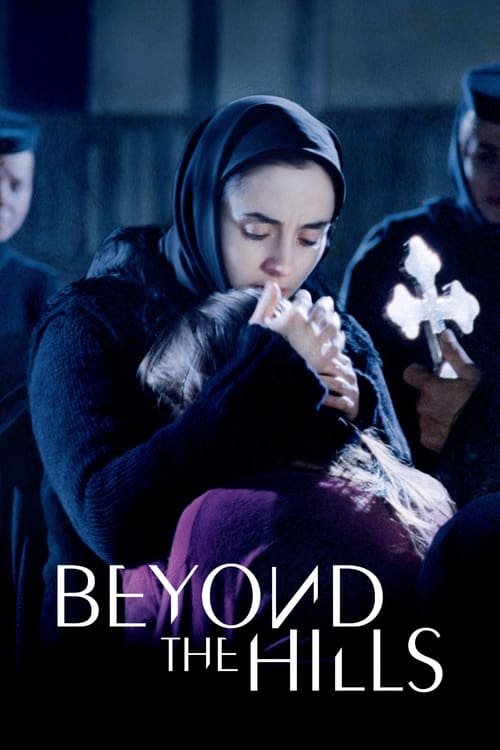
Beyond the Hills
2012 · Cristian Mungiu
For when you want a serious film to chew on for days and can handle real bleakness — this is challenge viewing, closer to a moral inquest than a drama, and it earns every difficult minute. Not one for a light evening.
What it's about
Alina returns to Romania from Germany to retrieve Voichița, the woman she grew up with in an orphanage and the only person she has ever loved. But Voichița now lives as a novice in an isolated Orthodox monastery, devoted to a priest the community calls Papa, and she won't leave. Alina stays, her desperation mounts, and the monastery, the hospital, and the state each pass her back and forth, none of them equipped to help.
The experience
Slow-burning, austere, and increasingly harrowing — it holds its long scenes without music or relief, so the dread builds from ordinary conversations and small institutional failures. It leaves you shaken and arguing with yourself about who, if anyone, is to blame.
Performances
Cosmina Stratan and Cristina Flutur, both newcomers, are devastating as Voichița and Alina — one all quiet, conflicted stillness, the other raw exposed nerve — and the film rests entirely on the push and pull between them.
The craft
Cristian Mungiu shoots in long, unbroken takes with a patient, watchful camera and no score, letting winter light and ambient sound do the work. The realism is so complete that the monastery feels documented rather than staged, which makes the story's escalation all the more frightening.
Why it matters
Drawn from a real 2005 case that scandalized Romania, it confirmed Mungiu as a leading figure of the Romanian New Wave and won major prizes at Cannes for its screenplay and its two lead actresses.
Snapshot
Beyond the Hills (După dealuri) is Cristian Mungiu's third solo feature and his first after the Palme d'Or for 4 Months, 3 Weeks and 2 Days (2007). Running roughly two and a half hours, it follows Alina, who returns from work in Germany to reclaim Voichița, the woman she loves and with whom she grew up in a state orphanage, from an isolated Orthodox monastery in eastern Romania. Voichița has taken up the life of a novice under a priest and a mother superior addressed as "Papa" and "Mama." Alina will not leave; her distress escalates; the monastery, the hospital, the foster family, and the police each handle her and hand her back; and the community's attempt to cast out what it takes to be a demon ends in her death.
The film is drawn from the 2005 Tanacu case, in which a young woman, Irina Cornici, died after being restrained during an exorcism at a monastery in Vaslui County — a case that produced criminal convictions for the priest and several nuns and became a national scandal. Mungiu adapted it by way of Tatiana Niculescu Bran's non-fiction novels about the affair. At Cannes in 2012 the film won Best Screenplay and a shared Best Actress prize for its two leads, Cosmina Stratan and Cristina Flutur, and it went forward as Romania's official Academy Award submission without securing a nomination. It is the Romanian New Wave's most sustained treatment of faith, and its most complete indictment of a society in which no single institution is villainous and all of them, together, are lethal.
Industry & production
The production was assembled the way most ambitious Romanian art films of the period were: a small domestic company anchoring a Franco-Belgian co-production. Mungiu produced through Mobra Films, his own outfit, with Why Not Productions in France and Les Films du Fleuve — the Dardenne brothers' company — in Belgium. That last partner matters beyond financing: it aligns the film institutionally with the Belgian tradition of moral realism that its own method resembles. Wild Bunch handled international sales; Sundance Selects/IFC released it in the United States in 2013.
The economics are worth stating plainly. Romanian cinema after 2000 was rebuilt on modest state support through the National Film Centre plus European co-production and Eurimages-style funds, and its directors became, of necessity, their own producers. Mungiu had already gone further than most: after 4 Months, he mounted a traveling caravan that screened Romanian films in towns without cinemas, a direct response to the collapse of the country's exhibition infrastructure. Beyond the Hills was made inside that logic — few locations, a compressed shooting economy, no stars, and a production design that could be built cheaply and convincingly because the world it depicts is itself poor.
Casting was the largest gamble. Stratan and Flutur came from Romanian theater and were essentially unknown in features; Valeriu Andriuță, who plays the priest, had appeared in Mungiu's Occident and in the Tales from the Golden Age project. Placing an unknown pair at the center of a 150-minute film composed largely of long takes is a producer's decision as much as a director's, and Cannes ratified it.
Technology
There is a temptation to over-specify here, and the published technical record on this production is thinner than the critical record; where sources are inconsistent I would rather flag the gap than fill it. What can be said with confidence concerns the conditions the technology had to serve. Beyond the Hills is set in a monastery without electricity or running water — candles, oil lamps, a wood stove, a generator whose sound is itself dramatic. Oleg Mutu's photography works from those sources, which means very low ambient levels held at a naturalistic exposure rather than lifted into legibility. Whatever the capture format, the film is one of the last of its kind to be conceived in a photochemical sensibility while arriving into a distribution world that had just gone digital: 2012 is the year the DCP became the default, and a film like this one — dependent on shadow detail, on grays and browns and the black of habits against snow — benefited from the projection consistency that transition brought even as it lost the grain structure that had characterized the wave's earlier work.
The other relevant technology is institutional rather than optical. The film's drama runs on the failures of unglamorous systems: an ambulance service, an overcrowded psychiatric ward, a pharmacy, a police station's paperwork, a mobile phone that does or does not get signal beyond the hills. Mungiu treats these as the real infrastructure of modern life, and the monastery's deliberate refusal of them as a choice with consequences.
Technique
Cinematography
Mutu — the cinematographer of The Death of Mr. Lăzărescu and 4 Months, 3 Weeks and 2 Days, and thus of the New Wave's founding images — builds the film out of long takes in which the camera reframes rather than cuts. Movement is motivated and unhurried: a pan to follow a body across a courtyard, a slow lateral drift that lets a second figure enter behind the first, a hold on a doorway after the characters have gone through it. Close-ups are rationed almost to absence. The default is a medium-long two-shot that keeps Alina and Voichița inside the same frame, so that every negotiation between them is also a negotiation about physical space — who steps toward whom, who turns away, who is left standing in the door.
The palette is winter: whitewash, unpainted wood, black cloth, mud, snow going gray. Interiors are lit to the level of the candle that is actually burning; faces fall into shadow and stay there. Exteriors are flat and overcast. The effect is not "beautiful austerity" so much as a refusal to editorialise through light — nothing is made holy by a shaft of sun, nothing is made sinister by a shadow the scene didn't already have.
Editing
Mircea Olteanu, who cut 4 Months, edits by scene rather than within it. The film's rhythm is architectural: each episode is allowed to run to its natural exhaustion, and the cut between episodes is hard, unsoftened, often skipping forward across ellipses that the viewer must reconstruct. Because so much is contained in single takes, the editorial intelligence shows up as a matter of where a scene begins and ends — typically late in and early out of the emotional event, so that we arrive after an argument has started and leave before anyone has drawn a conclusion. The accumulation is what produces the film's dread: no montage of escalation, just one procedure after another, each reasonable in isolation.
Mise-en-scène / staging
The monastery is a total institution built out of thresholds — gates, doorways, curtains, the unconsecrated church, the cell where Alina is confined. Mungiu stages almost everything in depth, using these apertures to separate the two women even when they share a frame: one inside the room, one in the corridor; one at the altar, one at the back. The community is blocked as a body. When the nuns act, they act collectively, converging and dispersing, so that responsibility is diffused into choreography — which is precisely the film's argument about how such a death happens.
The film's most notorious staging decision is its handling of the restraint itself. The board, the chains, the towel — the apparatus is assembled on screen in plain, practical shots, the way one would film people building a shed. There is no ritual grandeur, no low angle, no theatrical horror. What we watch is work, undertaken by people who believe they are helping.
Sound
There is no score. Mungiu has consistently refused non-diegetic music, and its absence here is structural rather than stylistic: nothing in the soundtrack tells us how to feel about what the community is doing. The film is instead dense with real acoustics — wind across open ground, dogs, the wooden knock and bell that call the nuns to prayer, chanting in a cold room, the generator, the hospital's institutional clatter, traffic when the characters descend into town. The contrast between the monastery's near-silence and the noise of the world below is the film's most reliable spatial cue. Off-screen sound does heavy narrative work: much of Alina's suffering is heard through walls and doors rather than shown.
Performance
Stratan and Flutur divide the film's moral labor. Flutur's Alina is all exteriority — demand, grip, refusal, a physical insistence that reads as illness to everyone around her and as love to her. Stratan's Voichița is the harder and finer performance: a face trained to composure, registering conflict in micro-adjustments, always half-turned toward the authority in the room. The jury's decision to split Best Actress between them is critically apt, because the film is a two-hander in which neither part functions alone. Andriuță's priest is played without a trace of hypocrisy or relish — a man of limited education and complete conviction, which is far more frightening than a fraud would be. Dana Tapalagă's Mother Superior supplies the institution's practical, managerial calm.
Narrative & dramatic mode
The mode is procedural realism applied to a metaphysical subject. Mungiu withholds interiority: no flashbacks to the orphanage, no confessional speeches, no explanation of what Alina suffers from. Diagnosis is left to characters who are unqualified to make one — a priest with a printed inventory of hundreds of sins, a doctor with no beds. The screenplay's Cannes prize recognizes an unusual achievement: a script whose structure is a sequence of institutional encounters, each with its own bureaucratic logic, cumulatively forming a tragedy with no tragic decision in it.
Crucially, the film declines the supernatural without debunking it. We are never shown a demon; we are also never given a clinical name that would let us file the case away. The refusal is symmetrical, and it forces the viewer into the position the characters occupy — acting on insufficient knowledge. The closing image, a windscreen fouled by passing traffic, is the film's thesis compressed: the view is obscured, and life continues to drive through it.
Genre & cycle
Nominally drama and, in its premise, a love story; in practice an anti-exorcism film. Everything the possession genre supplies — the child's transformation, the rite as spectacle, the priest as combatant, the score as instruction — is systematically removed. What remains is the sociology the genre normally displaces: an unheated room, untrained caregivers, a hospital that cannot admit her, and a group whose faith supplies both motive and alibi. It belongs beside the small cycle of European films that treat religious enclosure as a social institution rather than a spiritual condition, and beside the "institutional itinerary" film — a protagonist passed from office to office — that the Romanian New Wave essentially invented in its contemporary form.
Authorship & method
Mungiu came to film after studying English literature and working in journalism and teaching, and the reportorial habit persists: research first, ambiguity preserved, no character granted a summarizing speech. He writes his own scripts, produces his own films, and works with a small, stable crew — Mutu on camera, Olteanu on the cut — which is why his films share a grammar rather than a look. His stated method involves long rehearsal, scenes constructed to be playable in one, and a refusal to shoot coverage that would allow a more manipulative assembly later. The absence of a composer is not an oversight but a policy.
His filmography traces a consistent line: Occident (2002), the emigration comedy; 4 Months, 3 Weeks and 2 Days (2007), the Ceaușescu-era abortion film; Tales from the Golden Age (2009), the collective anthology of communist-era jokes he wrote and produced; Beyond the Hills; Graduation (2016), which took a Cannes directing prize; and R.M.N. (2022). Across them the subject is the same — how ordinary people arrange their complicity — with the setting migrating from the dictatorship to the present.
Movement / national cinema
Beyond the Hills is a mature work of the Romanian New Wave, the loose cohort that emerged after 2001 around Cristi Puiu, Corneliu Porumboiu, Radu Muntean, Cătălin Mitulescu and Mungiu, with Lucian Pintilie's Reconstruction (1968) as its acknowledged ancestor. The wave's signature — long takes, natural light, no score, deadpan attention to bureaucratic procedure, moral judgment withheld — is fully operative here. What distinguishes this film within the movement is its target. Where The Death of Mr. Lăzărescu anatomised the medical system and 4 Months the police state of memory, Beyond the Hills turns to the Orthodox Church, the one institution to emerge from 1989 with its authority enhanced, and to the orphanage system that produced both its protagonists — arguably the most damaging inheritance of the Ceaușescu era. The film thereby marks the wave's decisive pivot from the communist past to the post-communist present.
Era / period
The action is contemporary to its making: a Romania inside the European Union, its young people working abroad in Germany, its rural east materially unchanged. That gap — the ferry job in Germany, the monastery without electricity, both in 2012 — is the film's historical content. The Tanacu case had already been litigated in Romanian public opinion, and the film reopened the argument, forcing a debate about the Church's role, the state's abandonment of psychiatric care, and the fate of orphanage-raised adults. Mungiu declines to convert that debate into a message; the film's period accuracy lies in showing a country in which several centuries are simultaneously in force.
Themes
Love against renunciation, first: Alina asks for the one thing Voichița's vocation cannot permit, and the film treats the choice as genuinely tragic rather than as a case of repression to be exposed. Faith as institution: the priest's authority is uncredentialed, the church unconsecrated, the hierarchy above him uninterested — belief here is a local government. Complicity: no one intends to kill, everyone contributes, and the film's precision about the division of labor is its moral instrument. The orphanage as origin: both women's capacity for attachment and for obedience is traceable to an institution the film never shows. And knowledge itself — who is permitted to name what is wrong with a person, and what happens when no one qualified is available.
Reception, canon & influence
Critical reception was strong and serious, with the Cannes screenplay and acting prizes anchoring it; the most common reservation concerned length and severity, and some viewers found the withholding of psychological explanation a cost rather than a discipline. It became Romania's Academy Award submission and was honored at home, though it did not repeat the singular commercial-festival breakthrough of 4 Months.
Backward, its influences are legible and largely acknowledged by critics: Bresson, for the ascetic frame, the refusal of performance as display, and grace kept off-screen; Dreyer, for the confrontation between faith and a woman's body, though Mungiu withholds the miracle Dreyer grants; Italian neorealism by way of the Romanian wave's own founding texts; the Dardennes, whose company co-produced and whose method of moral suspense built from physical procedure is closely related; and Pintilie, the domestic precursor of the wave's institutional irony.
Forward, the film's influence runs in two channels. Within Romania it helped legitimize the contemporary-institution subject that shaped the country's subsequent output, including Bogdan George Apetri's Miracle (2021), which returns to a monastery, a novice, and a police procedure with an explicitly post-Mungiu grammar. Internationally it belongs to the run of European films that reclaimed religious life for art cinema — Pawlikowski's Ida (2014), Komasa's Corpus Christi (2019) — and it stands as the standard reference for treating exorcism as a social fact rather than a horror premise. Its most durable legacy may be formal: it demonstrated that a film could sustain two and a half hours of near-scoreless long-take realism on a subject as inflammatory as demonic possession without once telling the audience what to think, and that the result would be more disturbing, not less.
A Deleuzian reading
People carry in a board.
The full Deleuzian reading of Beyond the Hills →
Reception
Landed at Cannes 2012 to strong but slightly cooler notices than 4 Months, 3 Weeks and 2 Days — admired, yet tagged as austere and long. It's since settled in as one of the Romanian New Wave's essential films, usually named alongside 4 Months as Mungiu's peak.
How Beyond the Hills was received, from release to now →
How to watch Beyond the Hills: what to notice on a first viewing
- Watch the camera reframe instead of cutting within scenes. Oleg Mutu pans to follow a body across a courtyard, drifts sideways to let a second figure enter, and holds on a doorway after everyone has left it. The camera moves only when someone gives it a reason to, so every reframe feels earned rather than added.
- Notice how often both women share the same frame. The default shot is a medium-long two-shot holding Alina and Voichita together, close-ups rationed almost to nothing, so distance between them is measured in space, not in cuts. Every conversation becomes an argument about who steps closer and who turns away.
- Notice that interiors are lit only by visible candles. Faces fall into shadow and stay there because Mungiu lights each room to the level of the candle actually burning in it, never lifting exposure for legibility. Nothing here is made holy by a beam of light or sinister by an added shadow.
- Listen for the total absence of music. There is no score anywhere in the film; instead you hear wind, dogs, a wooden knock calling nuns to prayer, a generator, and later a hospital's institutional clatter. Nothing on the soundtrack is telling you how to feel about what you are watching.
- Watch scenes run well past their obvious dramatic point. Mircea Olteanu lets each episode play to its natural exhaustion, chore time and routine included, before a hard cut carries you into the next one. Time here is not measuring how close anyone is to a goal. It is just what is happening.
The whole guide to watching Beyond the Hills, with the keys for a rewatch →
Influences: the films it descends from and the films it influenced
- Mouchette (1967) — Supplies the model-not-actor protocol Mungiu applies to Cristina Flutur and Cosmina Stratan — faces held at neutral, gesture reported rather than expressed, so the girl's suffering is inferred from what the body does under handling and never from a performed inner state.
- Ordet (1955) — Establishes the long lateral take in which a whole household argues theology around a woman's prostrate body; Mungiu keeps the staging and the duration but cuts away before the miracle Dreyer grants, converting the resurrection beat into an ambulance ride.
- Umberto D. (1952) — The neorealist principle of letting an unremarkable procedure run to full length — a bed made, a meal prepared — is the source of the monastery's chore-time scenes, where labor is filmed at real duration rather than compressed into montage.
- The Son (2002) — Builds moral suspense purely from physical task and withheld motive — the shoulder-borne camera follows a working body and refuses the reverse shot that would explain it; Mungiu's producer relationship with Les Films du Fleuve makes the debt literal, and the tying-down sequence is its direct application.
- Reconstruction (1968) — The domestic founding text for institutional irony: authority stages a procedure 'for the record' and the procedure itself kills, which is exactly the grammar of the priest's ritual and the hospital's paperwork ending.
- The Death of Mr. Lazarescu (2005) — Invents the wave's institutional itinerary — a body passed hand to hand between indifferent institutions, shot handheld with reframing pans instead of cuts, on available light — and Oleg Mutu's camera work here is the same instrument Mungiu deploys in the monastery corridors.
- 4 Months, 3 Weeks and 2 Days (2007) — Fixes the house style Beyond the Hills extends: Mutu's static or slowly reframing long take, the scene as the unit of cutting, no score at all, and the fixed-frame table scene where the crisis happens off-screen while the camera stays on a face that cannot leave.
- Ida (2014) — Casts a wholly non-professional lead as a novice and builds the film on withheld interiority inside convent enclosure; it belongs to the post-Mungiu run that reclaimed religious life as art-cinema material by filming the rule, the timetable and the threshold rather than the belief.
- Son of Saul (2015) — Direct collaborator transmission — Oleg Mutu shooting long takes locked to one body with the decisive event pushed into offscreen space and rendered by sound alone, which is Beyond the Hills' offscreen technique pressed to its extreme.
- Graduation (2016) — Carries the two-shot blocking and scene-length take into contemporary bureaucracy, with conversations staged in depth through doorways and car windshields so that complicity is registered as a spatial arrangement between two people rather than stated in dialogue.
- Corpus Christi (2019) — Films priesthood as impersonation-by-procedure — the rites are learned as physical routines and the camera stays at working distance during them — extending the treatment of ritual as labor performed by fallible institutional staff.
- Never Rarely Always Sometimes Always (2020) — Adopts the institutional itinerary wholesale — two young women moved through clinics, intake forms and waiting rooms with no score, the crisis registered in a single unbroken take on a face during a questionnaire.
- Miracle (2021) — Explicitly post-Mungiu: a novice leaves a monastery, a police procedure follows, and the film is built in long traveling takes that stay with the vehicle and the interrogation while refusing to adjudicate the miraculous.
- Saint Omer (2022) — Places the accused woman inside a fixed institutional frame — frontal courtroom long takes, real testimony rhythms, no score — and withholds her interiority so that the institution's account and her silence sit unreconciled, the same refusal to explain the woman at the center.
- Fjord (2026) — Mungiu's earlier collision of a religious community's internal law with police and hospital procedure, closing on a paperwork interrogation that refuses to assign guilt, supplies Fjord's competing-sovereignties staging and its withheld verdict.
- Police, Adjective (2009) — Runs the same experiment in procedural duration — surveillance and dictionary-reading held past the point of narrative usefulness — so that the institution's language, not the plot, becomes the antagonist; Mungiu's police interview and death report are the religious variant.
- Lourdes (2009) — Treats miracle as an administrative process — intake, schedules, chaperones, committee verification — filmed in unscored static compositions, the identical decision to make the supernatural a social fact handled by staff rather than a horror event.
- Sieranevada (2016) — Extends depth-and-threshold staging to its limit: a camera parked in a hallway pans between doorframes of a crowded apartment, letting bodies block and unblock the view, the same use of architecture as an editing device Mungiu employs in the monastery.
- Two Prosecutors (2025) — Mutu again photographing an institution (a convent) grinding down an individual through procedure, sharing the duration-as-tragedy approach and muted palette.
- Leviathan (2014) — Romanian New Wave long takes observing the Orthodox church as institutional power crushing an individual, with catharsis pointedly withheld — a near-contemporary of Leviathan's church-as-power theme.
Similar films
- 4 Months, 3 Weeks and 2 Days (2007) — influence & lineage
- Graduation (2016) — influence & lineage
- Breaking the Waves (1996) — same viewing thread
- Fjord (2026) — shared sensibility
- Mother Joan of the Angels (1961) — shared sensibility
- Possession (1981) — shared sensibility
- The Wailing (2016) — shared sensibility
- Nostalgia (1983) — shared sensibility
All the films related to Beyond the Hills →
Watch it with: curated runs of related films
- The World Against Her — A run of women worn down or driven to extremity by a merciless community, marriage, or economy — watch them near each other and the sacrifice, the drift, and the violence start to rhyme.