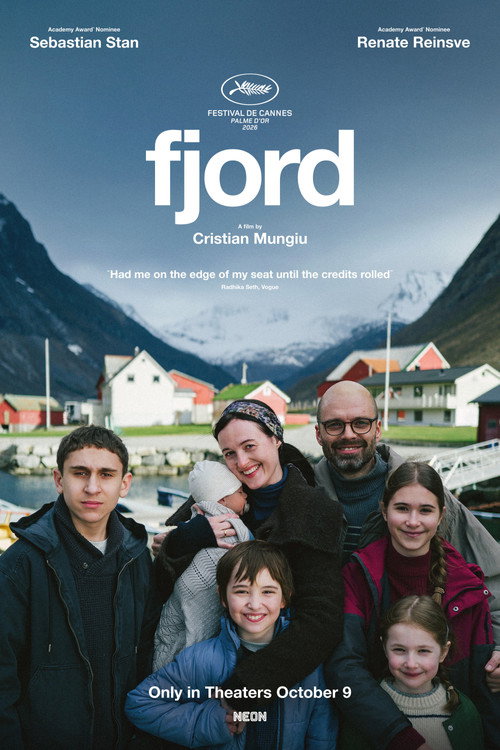
Fjord
2026 · Cristian Mungiu
For a night when you want a serious, grown-up film to wrestle with — one that leaves you debating it for days. This is challenge, not comfort: bring your full attention and someone to argue with afterward.
What it's about
A devout Romanian-Norwegian couple — he Romanian, she from the remote west-coast village they've moved to — are trying to rebuild their family after a tragedy. Then a teacher notices bruises on their young daughter, and Norway's child welfare service steps in, removing the children while it investigates. What follows is a slow-burning procedural about a family under suspicion, and about what a society is entitled to do with a family it doesn't understand — faith against secularism, immigrant against institution, parents against the state.
The experience
Patient, rigorous, and quietly devastating — the tension builds through meetings, interviews, and silences rather than confrontations, and it keeps shifting your sympathies until you're not sure who you'd side with. It's nearly two and a half hours and earns every minute, leaving you unsettled and arguing with yourself on the way out.
Performances
Sebastian Stan and Renate Reinsve, as the parents, do career-defining work — two people whose love and faith are being tested by an institution neither can read, played with almost documentary restraint.
The craft
Cristian Mungiu is a master of the long, unblinking scene, and here he applies that patience to a new country, a new language, and — for the first time in his career — a composed score. The Norwegian fjord landscape gives the film a cold, monumental beauty that presses in on the family drama. It rewards a big screen and total quiet.
Why it matters
The film that made Mungiu a two-time Palme d'Or winner, twenty years after his first — and his boldest departure: his first film shot outside Romania, largely in English, with international stars.
Snapshot
Fjord is Cristian Mungiu's sixth solo feature and the film that made him a two-time Palme d'Or winner, twenty years after 4 Months, 3 Weeks and 2 Days (2007). It is also the most deliberate rupture in his career: his first film shot outside Romania, his first largely in English, his first with international stars, and his first with a composed musical score. Sebastian Stan and Renate Reinsve play Mihai and Lisbet Gheorghiu, a devout couple — he Romanian, she Norwegian — who move with their children to her remote home village on the west coast of Norway. When a teacher notices bruises on their daughter Elia's neck, Norway's child welfare service removes the children pending investigation, and the film becomes a 146-minute procedural on what a society is entitled to do about a family it does not understand.
The film is openly inspired by the 2015 Bodnariu case, in which the five children of Marius and Ruth Bodnariu were taken into state care in Naustdal, provoking street protests in Romania and a durable international controversy over Barnevernet. Mungiu has been explicit that Fjord is not a reenactment — he has said it "has rather followed the elements which are typical" — and equally explicit that he is "not defending any of the parties involved in the story." That refusal is the film's design principle and the source of the argument that has followed it since Cannes.
Industry & production
Fjord is a six-country European co-production (Romania, France, Norway, Sweden, Denmark, Finland) budgeted at roughly €4.7 million — modest by any international standard, and characteristic of how Mungiu has always worked. Mungiu and Tudor Reu produced through Mobra Films, the Bucharest company Mungiu co-founded in 2003 and through which he has made every feature since 4 Months. Why Not Productions, his French partner since Graduation (2016), returned; the Nordic side was assembled from Eye Eye Pictures (Norway), Snowglobe Film (Denmark), Aamu Film Company (Finland) and Filmgate Films (Sweden), with producers Andrea Berentsen Ottmar and Dyveke Bjørkly Graver.
The shoot ran 36 days from March through May 2025 in Stenes, near Øye in the Hjørundfjorden area of Møre og Romsdal, staged deliberately across the seasonal turn so the landscape changes under the story. Roughly forty Romanian crew travelled north, both because Mungiu works with a settled team and because Romanian rates undercut Nordic ones — Graver has noted publicly that a euro-denominated budget goes further in Norway than its reputation suggests. Eye Eye had shot Halfdan Ullmann Tøndel's Armand nearby in Ålesund, and that local knowledge shaped the logistics: ferries for the minibuses and equipment trucks, private boats when roads closed, snow and landslides as working conditions. Cast and lead crew were housed in private homes and at the Hotel Union Øye, opened early in the season for the production.
Distribution reflects an ambition Mungiu's earlier films did not have. Neon holds English-language territories, extending a run in which the company has released the Palme d'Or winner in the United States for seven consecutive festivals; Le Pacte took France, Forum Film Romania the home market. Romania opened the film on 13 June 2026 across 96 theatres in 53 cities after preview screenings reported at some 43,000 admissions — an extraordinary figure for a domestic art film, and a reminder that in Romania this is not primarily an art-house event but a national argument. Comprehensive box-office reporting was not yet consolidated at the time of writing.
Technology
Digital capture in anamorphic-scale widescreen, consistent with Mungiu's practice since Graduation; the precise camera and lens package has not been published in the accessible trade record, and it would be an invention to specify one. What the technology visibly serves is duration. Mungiu's long-take method depends on a body that can run without reload anxiety through a nine- or eleven-minute scene, and on sensors that hold the low, blue, laterally raking light of a fjord in March — a latitude problem as much as an exposure one, with the sun never climbing far and the mountain walls eating half the day.
Working across four languages (English, Romanian, Norwegian, Swedish) with English as the on-set lingua franca is itself a production technology: it changes rehearsal, it changes how a director reads a take he cannot fully hear, and it puts translation inside the drama rather than only around it. The remote location imposed the rest — generator power, marine transport, weather holds — and pushed the schedule to a length most European art films can no longer afford.
Technique
Cinematography
Tudor Vladimir Panduru shoots his third Mungiu feature after Graduation and R.M.N.; he is also the cinematographer of Cristi Puiu's Malmkrog (2020), which is to say a specialist in sustaining a frame past the point of comfort. Critics have converged on a structural reading of the camera here: the film opens wide, treating the fjord as a tableau of serenity, and tightens as the community's regard hardens. Writing for the East European Film Bulletin, Anastasia Eleftheriou describes exactly this drift — "as time passes, the lenses tighten." Sophie Monks Kaufman, in Sight and Sound, notes Panduru's deliberate distance from the characters, situating them inside landscape rather than isolating them from it, and finds in the composed institutional interiors an echo of Roy Andersson's frontal tableaux. The two accounts describe the same instrument from opposite ends: a camera that offers the audience a position of judgement, then slowly withdraws the room needed to hold it.
Editing
Mircea Olteanu, Mungiu's editor since Beyond the Hills (2012), continues the house grammar: few cuts, and each one a structural event rather than a rhythmic one. In a Mungiu film the shot is the unit of argument, so the cut functions as a change of jurisdiction — from home to school, from kitchen to hearing room. At 146 minutes the film is among his longest, and several critics located its problem precisely at the level of construction rather than of shot-making. Lee Marshall in Screen judged that Mungiu "gets lost in screenplay rabbit holes," singling out a strand following Elia's friendship with the neighbouring Noora as a digression from the moral investigation.
Mise-en-scène / staging
The film's spatial argument is a set of thresholds: the school gym where the bruises are seen, the family home with its scripture study and merit charts, the welfare office, the courtroom. Mungiu stages these as competing sovereignties, each with its own furniture of legitimacy. Eleftheriou notes one telling move — a scene that appears to be mocking evangelical kitsch widens to catch the people doing the mocking, redistributing the embarrassment. That reflexive widening is the film's characteristic gesture, and the closest thing it has to an authorial voice.
Sound
The most significant break with Mungiu's method. From 4 Months through R.M.N. he worked without non-diegetic score, building instead from dense location sound and offscreen event — the celebrated principle that the decisive action often happens outside the frame and reaches us only as noise. Fjord is scored by the Danish composer Kaspar Kaae, whose credits include Hans Petter Moland's In Order of Disappearance and Out Stealing Horses. Whether Kaae's music functions as conventional underscore or as sparse punctuation is not something the published reviews settle, and the film's detailed sound department credits are not in the readily accessible record; the fact of the credit alone, however, marks a real departure and belongs in any account of Mungiu's evolution.
Performance
Mungiu has historically cast Romanian theatre actors and non-professionals in near-documentary registers. Here he cast two international leads, and the register survived the change: Marshall calls both performances "intriguingly understated," while Kaufman finds Reinsve "impassive" and Stan "unrecognizable" — the same restraint read as achievement or as flatness depending on the critic. Reinsve, Best Actress at Cannes for The Worst Person in the World (2021), was cast on the strength of her work for Joachim Trier; Mungiu credits her with "great intuition, empathy and insight." Stan, Romanian-born, plays a Romanian engineer negotiating a second language and a second country, which makes the linguistic strain of the part continuous with the character's. The child performances — Vanessa Ceban as Elia, Jonathan Ciprian Breazu as Emmanuel, Henrikke Lund-Olsen as Noora — carry the deadpan, affect-drained delivery Kaufman identifies as a deliberate stylistic choice.
Narrative & dramatic mode
Fjord is a moral procedural in the line of Graduation and R.M.N.: a single ambiguous event, then the slow institutional machinery that converts ambiguity into consequence. Crucially, the film declines the two obvious resolutions. It does not expose the parents as abusers, and it does not exonerate the state's suspicion as mere prejudice. Marshall's formulation is that the film "works, when it works, by presenting two sides and forcing the audience to take a stand." The trial that occupies the later movement is less a mechanism for producing truth than a display case for the assumptions of everyone in the room — Marshall Shaffer's Slant review makes the same point, that the proceeding matters more for what it reveals than for how it resolves.
The structure splits the couple's responses along a fault line that is itself the film's thesis: Mihai turns outward, mobilising sympathetic Christian demonstrators, some of them far-right; Lisbet turns to legal process. One route politicises the family, the other submits it to the system that took the children. Neither is endorsed.
Genre & cycle
Formally this is a child-protection drama, a genre with a strong European lineage: Ken Loach's Cathy Come Home (1966) and Ladybird Ladybird (1994) established the template of the state removing children from parents it has decided against, and the Dardenne brothers' films — The Son, The Kid with a Bike — mapped the moral weather around institutional care. Fjord joins the Nordic accusation cycle more directly still: Thomas Vinterberg's The Hunt (2012), in which a Danish community convicts a man on a child's ambiguous word, and Halfdan Ullmann Tøndel's Armand (2024), a Caméra d'Or winner starring Reinsve as a mother summoned to a school over an allegation about her son — a film made in the same region by the same Norwegian producer. Lars von Trier's Dogville (2003) is the other obvious relative, though Eleftheriou draws the distinction sharply: von Trier attributes cruelty to group psychology, where Mungiu locates it in bureaucracy that believes itself neutral. Kaufman reaches instead for Arthur Miller, calling the film "an inverted production of The Crucible."
It also belongs to a newer cycle: the 2020s European culture-war film, in which the antagonist is not the state as repressor but the state as therapeutic authority, and the drama turns on whose values count as neutral.
Authorship & method
Mungiu writes alone and researches like a reporter. For Fjord he says he "talked to everybody that agreed to talk to me: parents and relatives involved in such cases, lawyers, judges, representatives of the Child Welfare Services," and attended Norwegian court hearings — the same method that produced R.M.N. out of the 2020 Ditrău dispute over Sri Lankan bakery workers, and Graduation out of the ordinary machinery of Romanian favour-trading. The rule is consistent: a documented public conflict, fictionalised past the point of docudrama, then staged so no character carries the author's verdict.
The collaborators are the constant. Panduru on camera, Olteanu cutting, Mobra producing, Why Not co-financing. Production design credits are reported inconsistently across sources — the Norwegian designer Marius Winje Brustad and Mungiu's Romanian collaborator Simona Pădurețu are both named in different accounts, which most likely reflects a genuinely split department across the two countries rather than an error, though the division of labour is not documented. The variables are Kaae's score and the international cast; both loosen the ascetic contract Mungiu has kept since 2007, and both are legitimately contested as gains or losses.
His stated politics for the film are anti-certainty rather than anti-progressive. "I fear such people who are certain that they are right about things," he has said, applying it in both directions.
Movement / national cinema
Mungiu is a founding figure of the Romanian New Wave, the cluster that emerged with Cristi Puiu's Stuff and Dough (2001) and The Death of Mr. Lăzărescu (2005), Corneliu Porumboiu's 12:08 East of Bucharest (2006) and Mungiu's own Palme in 2007 — a cinema of long takes, natural light, no score, bureaucratic time and moral irresolution, made under chronic underfunding from the CNC. Fjord is what that movement looks like at maturity: the same grammar, exported, and turned on Western Europe rather than on the Romanian past.
That reversal is the movement-historical point. Eastern European art cinema has largely been read in the West as an accounting of communism's damage, with liberal democracy as the implicit horizon of repair. Fjord uses New Wave method to examine the horizon itself, from outside. It does so, notably, inside the Nordic co-production system — Snowglobe, Aamu, Film i Väst, Eye Eye — which makes the film an artefact of the very European integration it dramatises.
Era / period
The film arrives into a Europe where free movement of labour has produced large settled Eastern European populations in the north, and where the politics of that settlement have hardened. Romania's own recent history is present in the reception if not the frame: the annulled 2024 presidential election and the 2025 re-run made questions of religious conservatism, diaspora sentiment and anti-Western grievance immediate rather than abstract. Mungiu is working, deliberately, on the most flammable available material at the most flammable available moment.
Industrially it is a 2026 film in every respect: six flags on the financing, four languages on the soundtrack, a European auteur casting a Marvel-recognisable lead to reach a market that no longer reliably turns out for subtitled drama, and an American distributor whose business model is built on converting Cannes prizes into awards campaigns.
Reception, canon & influence
Fjord premiered in competition at Cannes on 18 May 2026 to a reported twelve-minute ovation and took an unusual sweep from Park Chan-wook's jury and the parallel juries: the Palme d'Or, plus the FIPRESCI Prize, the Prize of the Ecumenical Jury, the François Chalais Prize and the Prix de la Citoyenneté. The Ecumenical award to a film about an evangelical family under state suspicion is itself part of the reception story, as is the presence on the jury of Paul Laverty, Ken Loach's screenwriter on the British films this one most resembles, and of Laura Wandel, whose own work turns on children and institutional duty of care.
Aggregate reception was strong — roughly 92% positive on Rotten Tomatoes across 60 critics, 82 on Metacritic — but the distribution matters more than the average. Robbie Collin gave it five stars in the Telegraph, calling it "a slow-burn provocation that knows exactly which buttons it is pressing"; Pete Hammond in Deadline found it "fiercely intelligent and gripping"; Guy Lodge in Variety praised its attunement to "the world's ever-expanding possibilities for movement, misunderstanding and conflict." Against that, Peter Bradshaw in the Guardian gave two stars and called the film "anticlimactic, underpowered," disputing the Palme; Marshall's Screen review agreed on the underpowering; Kaufman's Sight and Sound piece charged it with cartooning its welfare workers into something like a child-catcher. A strand of French criticism read the film as reactionary — "anti-woke agitation" — a charge Eleftheriou inverts in the East European Film Bulletin, arguing the discomfort is evidence the film found its target. Romania submitted it for the Academy Award for Best International Feature, Mungiu's third such selection.
Backward, the influences are legible and mostly avowed by lineage rather than by quotation: Loach and the Dardennes for the institutional-realist frame, Vinterberg for the accusation plot, von Trier for the village as moral laboratory, the Romanian New Wave for the method, and Miller's The Crucible as the structural ghost several critics independently reached for.
Forward, it is simply too early. The film has been in release for three months at the time of writing, its American opening is 9 October 2026, and its awards season has not run. What can be said is that it has already done one thing that will outlast the argument about its quality: it demonstrated that the Romanian New Wave's formal apparatus travels, and that it can be aimed at the societies that first canonised it. Whether that produces a cycle of Eastern European films examining Western institutions from inside, or remains a single much-argued instance, is not yet knowable.
Sources: Wikipedia — Fjord) · Wikipedia — 2026 Cannes Film Festival · Screen Daily — review · Screen Daily — Romanian and Norwegian crew feature · Sight and Sound — review · East European Film Bulletin · Nordisk Film & TV Fond — Mungiu interview · IONCINEMA · Variety — review · Cineuropa
A Deleuzian reading
A teacher in a school gym notices marks on a girl's neck.
The full Deleuzian reading of Fjord →
Reception
Crowned with the Palme d'Or at Cannes 2026 — Mungiu's second, nineteen years after 4 Months, 3 Weeks and 2 Days — and contested almost immediately: critics split on its culture-war politics even as the awards piled up. Too new for a reappraisal arc; the first appraisal is still being fought over.
How Fjord was received, from release to now →
Influences: the films it descends from and the films it influenced
- 4 Months, 3 Weeks and 2 Days (2007) — The fixed frontal long take of the birthday dinner — Otilia pinned mid-frame while the decisive act plays out offscreen in another room — is the exact rig Fjord reuses for its hearing scenes: one lens, no cuts, the catastrophe audible rather than shown.
- Beyond the Hills (2012) — Mungiu's earlier collision of a religious community's internal law with police and hospital procedure, closing on a paperwork interrogation that refuses to assign guilt, supplies Fjord's competing-sovereignties staging and its withheld verdict.
- Graduation (2016) — First Mungiu–Tudor Panduru collaboration: the telephoto tether that trails a parent through institutional corridors at a fixed distance, compressing each negotiation into a shallow plane, is the lens grammar Fjord tightens further.
- R.M.N. (2022) — The seventeen-minute static wide of the Ditrău village-hall meeting — three languages overlapping in one unbroken frontal tableau, the camera never cutting to take a side — is the direct prototype for Fjord's courtroom-as-display-case and its multilingual sound.
- The Death of Mr. Lăzărescu (2005) — Puiu's founding Romanian New Wave method — a citizen handed from one institution to the next in near-real time, each handover played out in a single handheld take with no score — is the procedural chassis Fjord exports to a Norwegian welfare system.
- Police, Adjective (2009) — Porumboiu ends on a dictionary read aloud in a static office two-shot: the case decided by the definition of a word rather than by evidence, the same moral-procedural move Fjord makes when its case turns on how a phrase is translated.
- The Hunt (2012) — The template for the accusation engine: a child's half-sentence elicited by a well-meaning carer in a leading interview, after which the institution's protocol manufactures the certainty it claims to be testing.
- Dogville (2003) — The village as declared moral laboratory — a small community handed an outsider and observed under controlled, chaptered conditions — is the experimental frame Fjord adopts without the chalk lines.
- Ordet (1955) — Dreyer's slow lateral takes through a Jutland farmhouse split between two free-church factions establish the unhurried frontal tableau in which Scandinavian religious dissent is staged as a matter of rooms, doorways and waiting rather than of speeches.
- Ladybird Ladybird (1994) — The ur-text of the child-protection drama: social workers arriving with a legal order and a clipboard, shot in the same flat observational register as the family, so removal reads as procedure rather than villainy — precisely the balance Fjord's detractors accuse it of tipping.
- The Kid with a Bike (2011) — The Dardennes' first use of non-diegetic music — four brief Beethoven stabs over a boy in state care, in a filmography that had refused score outright — is the precedent for Fjord's first composed score and its rationing.
- The White Ribbon (2009) — Frontally composed, static village scenes in which every act of violence occurs offscreen and the inquiry closes without naming a culprit: the withheld verdict raised to a formal principle rather than a plot twist.
- Saint Omer (2022) — Diop holds the accused in long static frontal wides at the courtroom bar and lets testimony run nearly uncut, turning the court into a display case for a migrant mother's speech — the same device Fjord aims at its evangelical parents.
- Anatomy of a Fall (2023) — The trial as a machine for exhibiting a marriage rather than settling a death, with code-switching between languages admitted as evidence of character and a child's testimony as the hinge, closing on a verdict whose truth is deliberately withheld.
- Playground (2021) — Wandel locks the camera to a child's eyeline so adult institutional process enters only as offscreen voices at the frame's edge — the same restriction Fjord imposes when a welfare interview is heard but never shown.
- The Teachers' Lounge (2023) — A boxed-in ratio and lenses that tighten as the institution's protocol closes around one accused person, a pulsing score standing in for any exculpatory cut — the contemporary sibling to Fjord's tightening-lens scheme.
Similar films
- Anatomy of a Fall (2023) — influence & lineage · same viewing thread · often watched together
- Ordet (1955) — influence & lineage · same viewing thread
- 4 Months, 3 Weeks and 2 Days (2007) — influence & lineage · often watched together
- The Hunt (2012) — influence & lineage · often watched together
- Graduation (2016) — influence & lineage
- Beyond the Hills (2012) — influence & lineage
- The White Ribbon (2009) — influence & lineage
- Sentimental Value (2025) — same viewing thread · often watched together
All the films related to Fjord →
Watch it with: curated runs of related films
- When the Family Comes Undone — Watch these when you want intimate, one-household dramas where love and grief are the same thing — a parent fading, a marriage on trial, a child at the center of the wreckage.