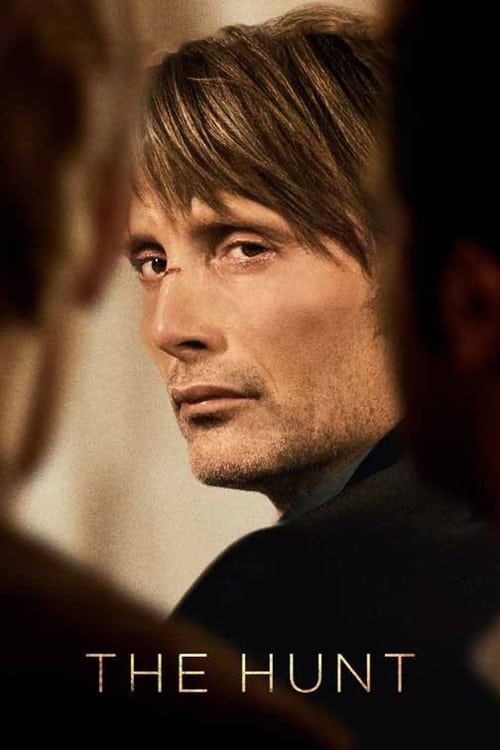
The Hunt
2012 · Thomas Vinterberg
For when you want a film that makes you furious in the best way — a serious, gripping drama for a night you're ready to be put through it. Absolutely not a comfort watch; absolutely worth it.
What it's about
Lucas is a gentle, recently divorced kindergarten worker in a small Danish town where everyone knows everyone — he hunts with his oldest friends, he's rebuilding a bond with his teenage son, and life is finally looking up. Then a small child tells an innocent, half-understood lie about him, and the town's protective instinct curdles into suspicion. The film watches, step by step, how an accusation nobody can prove and nobody dares doubt dismantles a man's life.
The experience
Quietly agonizing — a slow tightening you feel in your chest, because you know the truth and can only watch the town convince itself otherwise. It's controlled and unshowy, which somehow makes it more upsetting, and certain scenes will have you holding your breath.
Performances
Mads Mikkelsen, who won Best Actor at Cannes for this, plays Lucas with almost unbearable restraint — a decent man who keeps expecting decency back, and whose stillness makes every small humiliation land like a blow.
The craft
Vinterberg directs with cold clarity: warm, wintry-lit domestic scenes shot plainly, so the horror comes entirely from faces and silences rather than style. The screenplay's precision is the star — it shows exactly how each reasonable-seeming step in a moral panic locks the next one into place.
Why it matters
It relaunched Vinterberg internationally and confirmed Mikkelsen as one of Europe's great screen actors, and it remains the reference point people reach for in conversations about mob judgment and reputations destroyed ahead of the facts.
Snapshot
The Hunt (Danish: Jagten) is Thomas Vinterberg's lacerating chamber tragedy about Lucas, a gentle, recently divorced nursery-school worker in a tight-knit Danish provincial town whose life unravels when a small child's offhand, half-understood lie hardens into an accusation of sexual abuse. The film follows the mechanics of a moral panic in close, unbearable detail: how suspicion, once spoken, becomes self-confirming; how a community converts care for its children into collective cruelty; and how innocence, even when eventually acknowledged, can never quite be restored. Anchored by Mads Mikkelsen's interior, almost monastically restrained lead performance — which won him the Best Actor prize at the 2012 Cannes Film Festival — the film is at once a courtroom drama with no courtroom, a study of male friendship and its betrayal, and a parable about the irreversibility of a stain. For Vinterberg it marked a creative return to form and to his defining subject, child abuse and the family, here approached from the photographic negative of his 1998 breakthrough Festen: where that film exposed a real abuser, The Hunt tracks the destruction of an innocent man.
Industry & production
The Hunt was produced within the established Danish art-cinema ecosystem that had carried Vinterberg's generation since the late 1990s, principally through Zentropa — the production house co-founded by Lars von Trier and Peter Aalbæk Jensen — in collaboration with Nimbus Film, the company behind Festen. This places the film squarely in the orbit of the institutions that produced Dogme 95 and the subsequent wave of internationally circulated Danish features, supported by the Danish Film Institute and the public-service broadcaster financing typical of Scandinavian production. The casting of Mads Mikkelsen, by 2012 a genuine international star through both Danish work and Hollywood roles (the Bond villain Le Chiffre in Casino Royale), gave the project commercial reach well beyond the domestic market, and the film's Cannes competition slot confirmed its standing as a prestige export. The screenplay was co-written by Vinterberg with Tobias Lindholm, then emerging as one of Denmark's most incisive screenwriters and directors (R, A Hijacking, and later the Borgen television series and the Vinterberg-directed Another Round); their partnership is central to the film's tonal control. Precise budget and box-office figures are not something I can responsibly quote here, but the film was, by the standards of subtitled European drama, a strong critical and arthouse performer internationally, culminating in an Academy Award nomination.
Technology
The Hunt is a product of the early-2010s transition to digital cinema capture, and its look belongs to the era of large-sensor digital cameras that allowed naturalistic, available-light shooting with shallow depth of field and clean low-light performance — a toolkit that had matured considerably since the consumer-DV improvisations of the Dogme period. I won't assert a specific camera model without certainty, but the image is unmistakably digital-naturalist rather than celluloid-pictorial. What matters technologically is the contrast with Vinterberg's own past: Festen was shot on a small consumer camcorder under the Dogme "Vow of Chastity," embracing degraded, jittery, low-resolution video as an ethical-aesthetic stance. The Hunt, by contrast, uses the controlled, high-resolution digital tools of mainstream art cinema to achieve a surface of composed realism — handheld and intimate, but stable, legible, and richly graded. The technology here is invisible by design, deployed to keep the viewer inside the emotional pressure of faces and rooms rather than to foreground any formal apparatus.
Technique
Cinematography
The film's images were created by Charlotte Bruus Christensen, for whom The Hunt was a major early calling card before her international career (later Far from the Madding Crowd, The Girl on the Train, Fences, A Quiet Place). Her work here is built on autumnal Scandinavian light — burnished golds, foggy grays, the bare-branch palette of a northern fall sliding toward winter — that lends the small-town setting a deceptive warmth before it curdles. The camera is largely handheld but disciplined, favoring tight, shallow-focus close-ups that isolate Lucas within hostile spaces and study the micro-expressions of children and accusers alike. Crucially, the cinematography refuses melodramatic underlining: the horror is staged in ordinary, well-lit domestic and communal interiors — kitchens, the nursery, the supermarket, the church — so that the violence of social exclusion erupts out of the everyday. The recurring hunting landscapes, by contrast, open the frame into cold, mist-laden forest, where the film's title metaphor is made literal and where its devastating final image is set.
Editing
The film was cut by Janus Billeskov Jansen and Anne Østerud, with Billeskov Jansen a veteran of Danish cinema and a long-standing Vinterberg and Bille August collaborator. The editing strategy is patient and accumulative rather than propulsive: the first act takes its time establishing Lucas's gentleness, his bond with his best friend Theo, and his easy rapport with the children, so that the subsequent collapse lands as a betrayal of a fully felt world. As suspicion spreads, the cutting tightens around reaction shots and overheard conversations, building dread through what characters register on their faces rather than through event. The film withholds the comforting rhythms of vindication — even moments of apparent exoneration are cut short — and reserves its most controlled editorial gesture for the ellipsis into the final epilogue, a leap forward in time that delivers the story's bleakest insight in a single unresolved beat.
Mise-en-scène / staging
Vinterberg stages The Hunt around rituals of belonging and their inversion. The community is defined by shared institutions — the hunting club, the church service, the children's nursery, the friendships forged over drink — and the drama proceeds by systematically barring Lucas from each. Staging repeatedly places him at the threshold or the periphery: refused service in the local supermarket, made to stand apart, physically attacked. The single most discussed set-piece is the Christmas Eve church service, where Lucas, no longer able to bear his ostracism, confronts Theo across the pews in a scene of almost unbearable communal tension — a sequence that recalls the dinner-table confrontations of Festen while reversing their moral charge. Throughout, the staging keeps children present and ordinary, never demonizing them; Klara, the girl whose half-formed lie ignites the catastrophe, is shown as a confused child, not a villain, which is precisely what makes the adults' rush to certainty so damning.
Sound
The score, credited to Nikolaj Egelund, is used sparingly, avoiding the lush emotional cueing that the material might have invited; the film trusts silence, ambient room tone, and the textures of the natural world — wind, water, the report of a hunting rifle — to carry tension. Sound design is integral to the hunting motif: the gunshots that bracket the film connect the ritual killing of deer to the social "hunting" of Lucas, and the climactic final sound is among the most quietly terrifying in recent European cinema precisely because of what it leaves unresolved. Diegetic communal sound — children's chatter, hymn-singing, party noise — is repeatedly weaponized, the warmth of the group turned into an instrument of exclusion.
Performance
The Hunt is, above all, an actor's film, and Mikkelsen's central performance is a study in restraint under pressure. Where a lesser conception might have made Lucas hysterical or saintly, Mikkelsen plays a fundamentally decent, somewhat reserved man whose dignity becomes both his shield and, in the eyes of the mob, evidence of guilt — his refusal to grovel reads to the town as arrogance. The performance is built on containment, with the strain surfacing in small physical details and culminating in the church confrontation's rare release. It was rewarded with the Best Actor prize at Cannes. The supporting ensemble is essential: Thomas Bo Larsen as Theo, the friend torn between loyalty and parental terror; Annika Wedderkopp as the child Klara, in a remarkably unaffected performance; and the surrounding adults who collectively embody how reasonable people become a mob. Vinterberg, like many directors of the Danish realist school, draws naturalistic, lived-in work from children and non-stars alike.
Narrative & dramatic mode
The film operates as a tragedy of irreversibility. Its dramatic engine is dramatic irony of the cruelest kind: the audience knows from the outset that Lucas is innocent and that Klara's accusation springs from a child's muddled feelings and a fragment of overheard adult sexuality, so we watch the community's logic unfold with full knowledge of its falsity. This withholds the mystery-plot pleasures of "did he or didn't he" and substitutes a more harrowing question — whether truth can survive once a community has decided what it needs to believe. The structure is classically escalating, moving from idyll to accusation to ostracism to violence, but it pointedly denies catharsis: even the narrative's apparent resolution is undercut by an epilogue that reframes everything, suggesting that exoneration is social fiction and that the suspicion, having entered the bloodstream of the community, can never be fully purged.
Genre & cycle
The Hunt sits at the intersection of the social-realist drama and the "wrongful accusation" tradition, but it deliberately strips out the genre's usual machinery — there is little of the procedural, the courtroom, or the investigative thriller. It belongs more truly to a cycle of European moral-panic and persecution narratives, with clear thematic kinship to Arthur Miller's The Crucible and to the long literary-cinematic lineage of the scapegoat. Within Danish cinema specifically it forms a diptych with Festen as twin anatomies of child abuse and community denial. It also participates in the broader 2000s–2010s art-cinema preoccupation with masculinity in crisis and with the fragility of the individual against the collective, and it anticipates, ahead of its moment, the cultural reckonings around believing accusers and the costs of false accusation — a tension that has only made the film more contested over time.
Authorship & method
Thomas Vinterberg is inseparable from Dogme 95, the radical 1995 manifesto he co-authored with Lars von Trier, and from Festen (1998), the movement's first and most acclaimed film. The Hunt represents both a continuity and a maturation of that authorship: it retains the Dogme commitment to performance, emotional rawness, and the family-and-community as crucible, but abandons the movement's ascetic technical rules for a more classical, controlled craft. The decisive collaboration is with co-writer Tobias Lindholm, whose precise, unsentimental dramaturgy is evident throughout and whose partnership with Vinterberg would continue (notably on Another Round, 2020). The other defining collaborators are cinematographer Charlotte Bruus Christensen, whose autumnal naturalism gives the film its look; editors Janus Billeskov Jansen and Anne Østerud, whose patient construction governs its dread; and composer Nikolaj Egelund, whose restraint keeps the film from tipping into melodrama. Vinterberg's method here is one of sustained tonal discipline — building an entire world of warmth specifically so that he can document its withdrawal.
Movement / national cinema
The film is a flagship of post-Dogme Danish cinema, the national wave that made Denmark, relative to its size, one of the most influential film cultures of the late twentieth and early twenty-first centuries. Produced through Zentropa and Nimbus, it draws on the infrastructure, talent pool, and aesthetic instincts forged by Dogme 95 and the von Trier–Vinterberg generation, while exemplifying that movement's evolution into a confident, internationally legible art cinema. Its concerns — collective hypocrisy, the dark underside of the cohesive welfare-state community, the family as a site of buried violence — are recurrent in modern Scandinavian drama across film and the era's celebrated Nordic television.
Era / period
The Hunt is a film of the early 2010s, made in and about the present, and its anxieties are distinctly of that moment: heightened, sometimes panicked institutional vigilance around child protection; the speed with which accusation travels through a small, networked community; and a growing cultural unease about the collision between protecting the vulnerable and presuming innocence. Released in 2012 and reaching its widest international audience and its Oscar nomination over 2013–2014, it arrived just before the social-media-accelerated reckonings of the later 2010s, which it now reads as having presciently dramatized — a fact that has kept it perennially relevant and frequently invoked in debates it could not have fully anticipated.
Themes
The film's governing theme is the irreversibility of suspicion — the idea, voiced within the story, that nothing said can be unsaid, and that doubt, once introduced, contaminates permanently. Around this cluster several others: the tyranny of the collective over the individual, and how communal love for children mutates into communal cruelty; the fragility of male friendship and trust, embodied in Lucas and Theo; the limits of innocence as a defense in a world governed by belief rather than evidence; and the question of how children's testimony is shaped, misread, and weaponized by adults. The hunting motif binds these together: the film opens and closes on the rituals of the hunt, equates the pursuit of the deer with the pursuit of the man, and uses the initiation of Lucas's son Marcus into the hunting club to ask whether the boy will inherit the community's capacity for violence. The final, unresolved gunshot crystallizes the thesis that some marks are permanent.
Reception, canon & influence
Critically, The Hunt was widely praised, and it became one of the most internationally honored Danish films of its decade. Its centerpiece recognition was Mikkelsen's Best Actor award at the 2012 Cannes Film Festival, where the film also received warm critical notices; it went on to a nomination for the Academy Award for Best Foreign Language Film at the 86th ceremony (2014) as Denmark's submission, losing to Italy's The Great Beauty, and to a BAFTA nomination for Best Film Not in the English Language, among numerous other festival and critics' honors. (Where specific additional prize attributions are uncertain, I have left them unstated rather than risk error.) Reviewers consistently singled out the film's restraint, Mikkelsen's performance, and the discomfort of its dramatic irony, though some critics have argued the film stacks the deck by making Lucas so unambiguously innocent, thereby simplifying the genuine difficulty of adjudicating abuse claims — a debate that remains part of its reception.
Looking backward, the film's clearest influence is Vinterberg's own Festen, which it inverts, and behind that the persecution-and-scapegoat tradition exemplified by The Crucible; its realist method descends from Dogme 95 and the broader Scandinavian social-realist lineage. Looking forward, The Hunt consolidated Mads Mikkelsen's standing as one of Europe's preeminent actors and reaffirmed Vinterberg as a major filmmaker after an uneven stretch, helping set up the later international success of The Hunt's creative team, including the Lindholm-scripted Another Round. More diffusely, the film has become a touchstone reference in cultural conversations about false accusation, moral panic, and the ethics of belief — frequently cited, and sometimes contested, as those debates intensified in the years after its release. Its lasting achievement is the rare one of a film whose questions have grown sharper, not duller, with time.
A Deleuzian reading
Klara is a small girl with a crush and a head full of something she half-glimpsed on her brother's iPad.
The full Deleuzian reading of The Hunt →
Reception
A Cannes sensation in 2012 — Mads Mikkelsen took Best Actor — and it never really needed a reappraisal: streaming and Letterboxd just kept elevating it, from arthouse hit to one of the most beloved films of the 2010s.
How The Hunt was received, from release to now →
Influences: the films it descends from and the films it influenced
- The Celebration (Festen) (1998) — Vinterberg's own Dogme 95 template that The Hunt inverts — the family-gathering-as-tribunal where a buried child-abuse truth detonates at a ceremonial dinner, here flipped so the accusation is false.
- The Idiots (1998) — Co-founder of the Dogme 95 manifesto Vinterberg co-authored; supplies the handheld, available-light, performance-first ethos and the group-vs-individual provocation The Hunt classicizes.
- The Crucible (1996) — The persecution-and-scapegoat template — a community's collective hysteria over child testimony destroying an innocent man — that supplies The Hunt's moral-panic architecture and dramatic irony.
- The Passion of Joan of Arc (1928) — The Danish lineage of inquisitorial close-up and spiritual endurance, the wrongful-trial face held under accusation that Mikkelsen's restraint-under-pressure performance descends from.
- Ordet (1955) — Dreyer's staging of community, faith and ritual gathering as the arena of moral test — the church-and-congregation confrontation The Hunt routes through its Christmas service climax.
- Scenes from a Marriage (1973) — Scandinavian chamber-realism of bourgeois life eroding under close observation, the patient accumulative pressure on faces in domestic interiors that Bruus Christensen's shallow-focus naturalism inherits.
- The Hunt's forebear — Au Hasard Balthazar (1966) — Bressonian model of an innocent ground down by a community's cruelty through elliptical, undemonstrative editing and refusal of melodramatic underscoring.
- Submarino (2010) — Vinterberg's immediate prior return to stripped-down social realism and bleak Danish naturalism that re-tuned his method ahead of The Hunt's autumnal restraint.
- The Celebration (1998) — Vinterberg and Anthony Dod Mantle apply the identical ensemble-accusation structure in which community collective denial overwhelms individual truth — the accusation that resurfaces through social ritual, the dinner table as tribunal, Dod Mantle's handheld grammar now on digital rather than Mini-DV — a direct formal continuation of The Celebration's thematic and technical project.
- The Lives of Others (2006) — Vinterberg deploys a Danish village community as a collective surveillance apparatus whose bureaucratic credulity mirrors the Stasi's — institutional trust in an accusation functioning like a mandatory Stasi report — and structures the editing to sustain the same dramatic irony as The Lives of Others: the audience's knowledge of the protagonist's innocence is withheld from the institutional observers, generating tension from the gap between what is known and what the official record shows.
- The Children's Hour (1961) — Structures its narrative on a child's false accusation and the community insinuation that destroys a reputation — the exact rumor-and-libel mechanism drawn from Hellman's source case.
- Another Round (Druk) (2020) — The continued Vinterberg–Lindholm–Mikkelsen collaboration extending the same community-ritual-as-crucible structure and restraint-under-pressure performance built around Mikkelsen.
- The Hunt's descendant — Jagten-style The Guilty (Den skyldige) (2018) — Lindholm-school Danish minimalism extending the procedure-of-judgment thriller, where a single accusation and the audience's misplaced certainty drive the dramatic irony.
- Hannibal (NBC) (2013) — Consolidated Mikkelsen's restraint-under-pressure screen persona internationally, extending the controlled, interior performance style The Hunt crystallized.
- After the Hunt (2025) — Defines the modern allegation drama of a community turning on the accused before any verification, suspending the viewer in presumption — a debt the very title gestures toward.
- Far from the Madding Crowd (2015) — Charlotte Bruus Christensen's first full collaboration with Vinterberg developed the technique of sustained close framing on faces to externalize guilt, desire, and the way male possession corrodes community witness — a method transferred intact to FFTMC's staging and performance approach.
- The Guilty (2018) — Gives Möller his Danish moral template — a protagonist whose guilt or innocence cannot be adjudicated from outside, where a community constructs catastrophically wrong reality from partial, acoustically and socially mediated information — wrapped in post-Dogme formal restraint.
- Fences (2016) — Charlotte Bruus Christensen's method here — holding one man's face in shallow focus while the community's judgment accumulates at the unfocused edges of a wide frame — is the outsider's eye she brings to Troy's yard, and the reason the images stay unreverent toward Wilson.
- Fjord (2026) — The template for the accusation engine: a child's half-sentence elicited by a well-meaning carer in a leading interview, after which the institution's protocol manufactures the certainty it claims to be testing.
- A Hijacking (Kapringen) (2012) — Directed by The Hunt's co-writer in the same year, sharing Lindholm's procedural, unsentimental dramaturgy of ordinary people ground down by an institutional process beyond their control.
- The Celebration's heir — In a Better World (Hævnen) (2010) — Post-Dogme Danish social realism using handheld intimacy and child-centered moral crisis within a small community, sharing the national school of escalating ethical dread.
- The White Ribbon (2009) — Rural community implicating itself through accusation and punishment of children, built on austere staging and withheld score — the same dramatic-irony machine of suspicion-as-contagion.
- Doubt (2008) — A clergy abuse accusation adjudicated entirely through belief rather than proof, sharing The Hunt's interrogation of conviction without evidence and the irreversibility of suspicion.
- Hunger (2008) — Shares cinematographer-driven restraint and patient, accumulative duration building bodily dread without score — the European art-cinema discipline The Hunt's editing exemplifies.
- Festen's sibling — The Celebration successor Mifune (1999) — Dogme 95 (Dogme #3) entry sharing the movement's handheld naturalism and the secret-shaming-a-family structure from the same Danish cohort Vinterberg helped launch.
- The Vanishing (1988) — Vinterberg constructs dread from the same asymmetric dramatic irony as Sluizer: the audience holds knowledge the community acts against, and the gap between what we know and what is done in ignorance of it is where the horror lives — procedural and social rather than spectacular, accruing in mundane community space.
- Force Majeure (2014) — Nordic social autopsy using behavioral performance and observational camera to examine how a community's social performance and instinctive reactions diverge under accusatory pressure — the male protagonist's crisis of social belonging and the gap between his self-image and others' perception mirrors Force Majeure's thematic core exactly.
- Anatomy of a Fall (2023) — The structural maintenance of epistemological suspense across a community legal process; the film's refusal to confirm the protagonist's innocence to the viewer while the institution generates its own certainty — staging the gap between legal verdict and the truth the film withholds.
- A Separation (2011) — Builds a community-wide moral thriller from an unverifiable accusation, distributing culpability across an ensemble and keeping the audience uncertain of the literal truth — the same ethics-of-knowledge suspense.
- About Elly (2009) — A misreading hardens into a false accusation that a community rushes to punish, dramatizing interpretation-as-violence and social shaming exactly as Farhadi does.
- Silenced (2011) — Interrogates a child-abuse allegation and communal complicity through cool observational framing and a cold, desaturated palette, sharing Silenced's anatomy of collective silence.
Similar films
- The White Ribbon (2009) — influence & lineage
- Ordet (1955) — influence & lineage
- Another Round (2020) — often watched together
- Close (2022) — often watched together
- The House That Jack Built (2018) — often watched together
- Antichrist (2009) — often watched together
- Fjord (2026) — often watched together
- The Master (2012) — often watched together
All the films related to The Hunt →