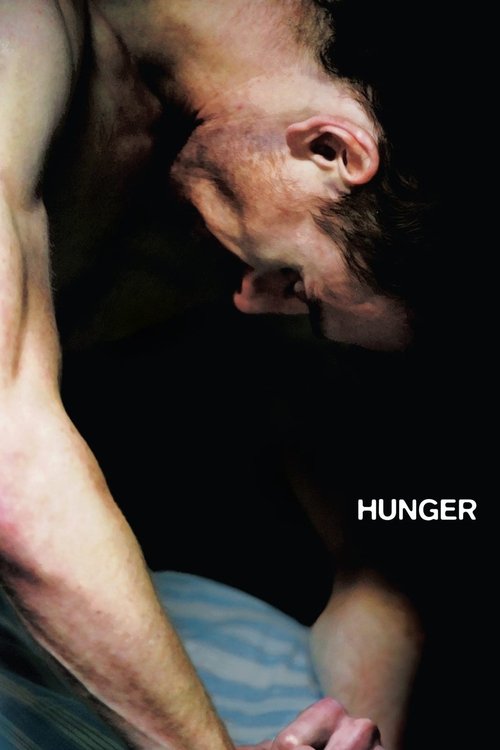
Hunger
2008 · Steve McQueen
For a night when you want to be confronted, not comforted — a film you sit with in silence afterward. Not a casual watch; come to it when you have the attention to give.
What it's about
Belfast, 1981. Inside the Maze prison, IRA inmates are deep into the blanket and no-wash protests, refusing uniforms and smearing their cells in a fight to be recognized as political prisoners rather than criminals. The film moves between guards and prisoners before narrowing to Bobby Sands, the man who escalates the standoff into a hunger strike he intends to lead from the front. It is history told almost entirely through bodies — beaten, washed, force-marched, and finally wasting away.
The experience
Long, near-silent stretches of pure observation broken by sudden bursts of violence, and one riveting extended conversation at the film's center. It's punishing but never gratuitous, and it leaves you drained, quiet, and thinking about conviction — what it costs and what it's for.
Performances
Michael Fassbender's physical transformation as Sands is staggering, and his long verbal duel with Liam Cunningham's priest — argued in a single unbroken shot — is one of the great two-person scenes in modern film.
The craft
Steve McQueen came from gallery art, and it shows: patient static compositions, an obsession with texture and light, and the nerve to hold a shot for many minutes, including a legendary seventeen-minute unbroken take. Dialogue is scarce, so sound — corridors, rain, breathing — does enormous work. Reward it with a quiet room and full attention.
Why it matters
One of the most acclaimed directorial debuts of its era, it launched McQueen's film career and began his defining partnership with Fassbender, and it reset expectations for how political history could be put on screen.
Snapshot
Hunger is the debut feature of the British artist Steve McQueen, a dramatization of the final weeks of Bobby Sands, the Provisional IRA volunteer who in 1981 led a hunger strike inside the H-Blocks of HM Prison Maze (Long Kesh) in pursuit of political-prisoner status. The film reconstructs the conditions that produced the strike — the "blanket" protest and the "no-wash" or "dirty" protest that preceded it — and then narrows to Sands himself as he starves to death. It is a film organized around the body: bodies beaten, washed, force-marched, smeared with excrement, and finally wasting away. McQueen, who came to cinema from gallery installation and the Turner Prize (which he won in 1999), brought a visual artist's patience to the material, building the film out of long, often near-silent observational passages punctuated by sudden violence and, at its center, a single sustained conversation that has become one of the most discussed scenes of twenty-first-century cinema. Hunger premiered at the 2008 Cannes Film Festival, where it won the Caméra d'Or for best first feature, and it launched both McQueen's directing career and the international standing of its lead, Michael Fassbender.
Industry & production
Hunger was a British production financed principally through Film4 (Channel 4's film arm) in partnership with the UK Film Council, Northern Ireland Screen, and Ireland's Bord Scannán na hÉireann/Irish Film Board, with Blast! Films producing. It was a modestly budgeted feature by industry standards, made within the ecosystem of British public-service film financing that has long backed first-time and auteur-driven directors. The decision to entrust a feature about one of the most politically charged episodes of the Northern Irish Troubles to a director with no narrative-feature experience reflects both the confidence of Film4's commissioning culture in the period and McQueen's existing reputation as a serious artist.
Production was shot in Northern Ireland, with the H-Block interiors recreated as sets that allowed McQueen and his crew the control required for the film's exacting compositions and for the physically punishing protest sequences. The film is co-written by McQueen and the Irish playwright Enda Walsh, a collaboration that proved decisive for the picture's most ambitious passage (see Technique). Casting Fassbender — then a relatively little-known actor — as Sands was a significant gamble, given the extreme physical transformation the role demanded. The shoot accommodated that transformation by structuring the schedule so that the dramatic weight loss could be staged safely, with the central dialogue scene reportedly filmed before the most severe emaciation. As with much of the production's finer detail, the published record on day-to-day logistics is comparatively thin, and claims beyond the broadly documented financing, location, and casting should be treated cautiously.
Technology
Hunger was shot photochemically on 35mm film, a choice consistent with the period's prestige-arthouse practice and with McQueen and cinematographer Sean Bobbitt's commitment to a rich, tactile image. The film's technological interest lies less in novel equipment than in the disciplined deployment of conventional tools: long lenses and locked-off framings, naturalistic available-light-style schemes built in a controlled set environment, and — most famously — a single extended take that required a camera setup capable of running uninterrupted for many minutes while two actors performed a continuous scene. That long take, executed on film rather than digitally, is a feat of pre-planning and stamina as much as of equipment, since film magazines impose their own constraints on take length. The production's restraint with technology is itself an aesthetic statement: nothing in the image announces its own apparatus.
Technique
Cinematography
Sean Bobbitt's photography is the spine of the film and the beginning of one of the most important director–cinematographer partnerships in recent British cinema. Bobbitt favors static, carefully weighted compositions and a palette dominated by institutional grays, sickly greens, the brown of smeared faeces on cell walls, and the pale flesh of the prisoners. The camera observes rather than dramatizes: it holds on a prison officer washing blood from his knuckles, on maggots, on a river of urine being squeegeed down a corridor, allowing duration to do the work that conventional coverage would hand to editing. When the camera does move, it tends to be deliberate and motivated. The film's visual rigor — its refusal of reaction-shot grammar and its willingness to let an image sit until it becomes almost unbearable — derives directly from McQueen's gallery practice, but Bobbitt translates that sensibility into a feature-length photographic logic that never feels merely arty.
Editing
Edited by Joe Walker — like Bobbitt, a collaborator who would remain central to McQueen's work — the film's cutting is defined by withholding. Walker and McQueen build sequences from long held shots, so that the rhythm of the film is slow, accretive, and bodily rather than propulsive. The structure is tripartite and elliptical: the film moves from the perspective of a prison officer, Raymond Lohan, into the world of the protesting prisoners, and only then to Sands, refusing a single continuous protagonist for much of its length. The editing's boldest gesture is its restraint at the center — the long conversation is essentially uncut — which throws the surrounding montage of bodies and violence into sharper relief.
Mise-en-scène / staging
McQueen stages the H-Blocks as a closed, ritualized world. The blanket protest (prisoners refusing uniforms, wrapped only in blankets) and the dirty protest (refusing to wash and smearing cell walls with excrement) are rendered with an almost liturgical attention to repeated gesture: the daily routines of degradation and resistance. Production design emphasizes confinement, hard surfaces, and the contrast between the bureaucratic order of the prison apparatus and the abjection it produces. McQueen's tableaux — most strikingly the swirling patterns the prisoners smear on their cell walls, composed like abstract paintings — fuse the political and the aesthetic without aestheticizing away the horror.
Sound
Sound is among the film's most expressive elements, and McQueen uses it in lieu of a conventional score for long stretches. The film opens with the archival voice of Margaret Thatcher articulating the British government's refusal to grant political status, a documentary anchor against which the fiction unfolds. Elsewhere the soundtrack is built from the textures of the institution — footsteps, batons, the scrape of the squeegee, the hush of cells — so that silence and ambient noise carry enormous dramatic weight. The film does not rely on an emphatic orchestral score to cue feeling; the published record does not foreground a dedicated composer in the way it does Bobbitt and Walker, and the picture's power is largely a function of sound design and the eloquence of near-silence rather than of musical underscoring.
Performance
Michael Fassbender's Bobby Sands is a performance of two registers. In the central dialogue he is voluble, quick, theologically and politically combative; in the film's final movement he is almost wordless, his presence reduced to the fact of his deteriorating body. Fassbender underwent a severe, medically supervised weight loss to embody the late stages of starvation, and the film's last act depends on the unflinching display of that physical reality. Stuart Graham as the prison officer Raymond Lohan and Liam Cunningham as Father Dominic Moran (Sands's interlocutor in the long scene) provide the film's other anchors; the ensemble of protesting prisoners performs largely through the body — endurance, abjection, and stillness — rather than through dialogue.
Narrative & dramatic mode
Hunger is structured in three movements and resists the biographical conventions its subject might invite. It does not narrate Sands's life, explain the Troubles, or build toward a conventional climax; instead it presents a descent through escalating states of bodily extremity. The first movement follows Lohan, humanizing the apparatus of the prison before the film shifts allegiance. The second immerses the viewer in the collective protest. The third isolates Sands and his dying. Hinging these is the celebrated central scene — a long, largely single-take conversation between Sands and Father Moran in which the priest tries to dissuade him and Sands articulates his resolve. This scene is the film's argumentative core, the one sustained passage of language in a film otherwise built from images and bodies, and it deliberately stages the strike as a reasoned, contested choice rather than a martyr's inevitability. The dramatic mode throughout is observational and durational, closer to durational gallery work and to a certain lineage of austere European art cinema than to the conventions of the historical biopic.
Genre & cycle
Nominally a historical drama, Hunger sits within the long tradition of Troubles cinema — films reckoning with the Northern Irish conflict — while standing apart from it stylistically. Where many Troubles films adopt the thriller or social-realist register, McQueen's is an art film, prizing duration, abstraction, and the body over plot. It also belongs to a broader cycle of "process" prison films concerned with confinement and the politics of the carceral body. Within McQueen's own emerging body of work it inaugurates a recurring preoccupation — the suffering, resisting, or commodified human body under systems of power — that would continue through Shame and 12 Years a Slave.
Authorship & method
Hunger is the foundational statement of an authorship that crosses the gallery and the cinema. McQueen directed and co-wrote the film, importing from his fine-art practice a commitment to duration, to the single fixed image held past comfort, and to the body as primary subject. His method is to let the camera observe rather than explain, trusting the viewer to assemble meaning from accreted detail.
The film also establishes a core creative team. Sean Bobbitt (cinematography) and Joe Walker (editing) would become long-term McQueen collaborators, their work here defining the director's photographic and rhythmic signatures. The screenwriter Enda Walsh brought a playwright's command of sustained dialogue to the central conversation, the one passage where language, not image, carries the film — a clear division of labor in which Walsh's theatrical voice complements McQueen's visual instincts. On the question of a dedicated composer, the public record is comparatively thin, consistent with a film that largely forgoes conventional underscoring in favor of archival sound and ambient design.
Movement / national cinema
The film belongs to British cinema and specifically to the Film4-backed strand of director-led, internationally ambitious filmmaking that has produced much of the country's most distinctive recent work. Thematically it is also Irish and Northern Irish cinema, engaging one of the defining traumas of modern Irish history. Stylistically, however, McQueen aligns less with British social realism than with a transnational art-cinema sensibility — the durational, rigorously composed, body-centered mode associated with contemporary European auteur and gallery-adjacent filmmaking. Hunger thus sits at a crossing point: a British-Irish co-financed historical subject rendered in the idiom of international art cinema.
Era / period
Hunger dramatizes events of 1981 — the second wave of hunger strikes at the Maze, in which Sands and nine other republican prisoners died — set against the early Thatcher government's hardline refusal to concede political status. The opening use of Thatcher's recorded voice fixes the film historically and ideologically. Made in 2008, more than a decade after the 1998 Good Friday Agreement, the film arrives in a period able to revisit the Troubles with some critical distance, and it participates in a broader post-conflict cultural reckoning with that history — though McQueen pointedly declines to editorialize, presenting the strike as event and ordeal rather than delivering a verdict.
Themes
The film's central theme is the body as the last instrument of political agency: when every other avenue is closed, the prisoners turn their own bodies — unwashed, naked, ultimately starved — into weapons and arguments. Closely bound to this is the theme of dehumanization and its resistances, staged in the cycles of the dirty protest and the prison's violent responses. The long central scene foregrounds the ethics of self-sacrifice and the line between conviction and self-destruction, refusing to settle whether Sands is martyr, fanatic, or both. Endurance, abjection, faith, and the mechanics of power over the incarcerated body run throughout. Crucially, the film withholds easy moral framing; it implicates the state apparatus (through Lohan, himself shown as damaged) without sentimentalizing the prisoners, leaving the political meaning of the strike contested.
Reception, canon & influence
Hunger was widely acclaimed on release. Its premiere at Cannes in 2008 won the Caméra d'Or for best first feature, and the film accumulated significant honors thereafter, including recognition at the British Independent Film Awards and from BAFTA, with Fassbender's performance singled out as a breakthrough. Critics consistently praised the film's formal audacity, the long Sands–Moran conversation, and Fassbender's physical commitment, while some debate attended its aestheticization of suffering and its refusal of conventional political exposition.
The influences on the film run backward to McQueen's own gallery and video-art practice and to a lineage of austere, durational art cinema concerned with the body and confinement; the use of archival audio and an observational, near-documentary attention to institutional process also reflect a documentary sensibility brought to bear on dramatized history. Its place within Troubles cinema is as a deliberate departure from that tradition's thriller and realist conventions.
The film's forward influence has been substantial. It launched Steve McQueen as one of the major filmmakers of his generation: he reunited with Fassbender for Shame (2011) and directed 12 Years a Slave (2013), which won the Academy Award for Best Picture — making Hunger the origin point of an authorship that would reach the center of world cinema. It established Michael Fassbender as a leading international actor, and it consolidated the McQueen–Bobbitt–Walker creative partnership that shaped his subsequent features. More broadly, Hunger's central long take became a touchstone in discussions of the dialogue scene and of duration in contemporary cinema, and the film stands as an influential model for art-cinema treatments of political history — proof that a gallery artist's sensibility could be brought to bear on narrative feature filmmaking without dilution. It is now widely regarded as one of the significant debut features of the 2000s and a defining work of recent British art cinema.
A Deleuzian reading
A man in a uniform pushes a squeegee down a long corridor, and a river of urine moves ahead of the rubber blade.
The full Deleuzian reading of Hunger →
Reception
Acclaimed from day one — it won the Caméra d'Or at Cannes 2008 — and its stature has only grown since, now routinely ranked among the great directorial debuts of the 21st century and the origin point of the McQueen–Fassbender partnership.
How Hunger was received, from release to now →
Influences: the films it descends from and the films it influenced
- A Man Escaped (1956) — Prison-process film built from patient, near-wordless observation of hands performing physical tasks, the body's labor carrying narrative where dialogue normally would — the model for Hunger's accreted cell rituals.
- Jeanne Dielman, 23 quai du Commerce, 1080 Bruxelles (1975) — Durational real-time observation of repeated institutional labor in fixed, static frames, meaning accruing through repetition rather than incident — directly transposed in Hunger's orderly mopping urine from the corridor and the methodical cell-cleaning.
- The Passion of Joan of Arc (1928) — Martyrdom rendered as a bodily passion through austere, decontextualized framing of suffering flesh and face, refusing surrounding political exposition — the formal template for treating Sands's starvation as ascetic passion play.
- Salò, or the 120 Days of Sodom (1975) — Composes bodily degradation and excrement into deliberate, aestheticized tableaux held as formal images — the precedent for Hunger's abstract excrement-smeared wall murals shot as composition rather than shock.
- Elephant (1989) — Strips Troubles violence of psychology and motive into affectless, repeated observational tracking shots of process — the explicit Clarke debt behind McQueen's refusal of the sectarian thriller mode for durational, procedural depiction.
- Beau Travail (1999) — Renders ritualized male institutional confinement as choreographed bodily drill, the body serving as the film's primary instrument and elliptical gesture carrying the story over exposition — the body-as-instrument and ritualized-confinement craft Hunger inherits.
- Sátántangó (1994) — Makes the extreme long take held past comfort the organizing structural principle, the camera contemplating bodies in degraded institutional space — the duration-over-coverage logic Hunger adopts.
- Stalker (1979) — Sustains held shots on texture and material decay — dripping water, damp surfaces — so duration becomes contemplative rather than narrative, a sensibility echoed in Hunger's lingering on the wet cell floor and falling snow.
- My Dinner with Andre (1981) — Builds a feature around a single sustained two-person conversation captured in static setups, treating talk itself as cinematic event — the precedent for Hunger's roughly seventeen-minute fixed-camera Sands–Moran exchange.
- Children of Men (2006) — McQueen deploys extended single takes as ethical duration — including a 17-minute static two-shot dialogue with no coverage — and strips the soundtrack to near-silence and diegetic sound throughout, extending Children of Men's conviction that unbroken temporal duration is itself a political and moral stance in depicting state violence.
- This Is England (2007) — McQueen uses Super-16mm grain to texturize political radicalization — the Maze Prison's material conditions rendered through patient, observational photography — and holds on performance in extended takes (the Fassbender-Cunningham scene) that treat the performer's unedited duration as an ethical act, extending Meadows' patience-with-performance principle into explicit political-body argument.
- Carandiru (2003) — McQueen's bodily, real-location depiction of state violence enacted on incarcerated men, where the indictment is built through physical accumulation and texture rather than speech, as in Carandiru's location naturalism.
- Shame (2011) — Reunites the Bobbitt–Walker team to extend the same fixed-frame durational observation of a compulsive body, including bravura unbroken takes (Brandon's nighttime run) — a direct continuation of Hunger's photographic and rhythmic signature.
- 12 Years a Slave (2013) — Scales up Hunger's body-in-suffering technique with Bobbitt's unbroken held shot of Northup hanging on his toes, using duration as moral endurance the viewer is forced to share.
- Lovers Rock (2020) — Carries the durational-immersion method into pleasure, holding on the extended a cappella 'Silly Games' so real-time duration becomes the experience itself rather than a means to plot.
- Kill the Messenger (2014) — Where cinematographer Sean Bobbitt forged the bodily, close, handheld realism — keeping the camera on physical and human consequence — that he carries directly into this film's texture.
- Judas and the Black Messiah (2021) — Sean Bobbitt's unbroken single-take oratory (the seventeen-minute priest dialogue) and available-light naturalism is the exact uncut-speech method he reuses for Hampton.
- A Twelve-Year Night (2018) — Sets the contemporary benchmark for prison endurance rendered through the visibly transformed, wasting body and extended-duration austerity, the physical-transformation and formal-rigor lineage the performances here descend from.
- Sing Sing (2024) — Builds an elliptical, largely wordless prison film around one sustained, near-static two-hander that becomes the structural axis of the whole — the same load-bearing use of the long take that Sing Sing gives its parole hearings against otherwise heavily elliptical cutting.
- The Tribe (2014) — Tells a story of institutional confinement in a deaf boarding school through unbroken durational long takes with no score and no subtitles, forcing meaning to be assembled observationally from behavior — Hunger's duration-and-withholding craft pushed further.
- Son of Saul (2015) — Deploys the body as the film's instrument inside a death-institution, locking to physical proximity while withholding context and refusing exposition — a sibling in body-as-instrument and durational-observational withholding.
- Starred Up (2013) — A British prison-process film foregrounding raw physicality and institutional ritual through procedural observation rather than backstory — extends Hunger's prison-process-film and body-as-instrument facets.
- A Prophet (2009) — Constructs the prison as a system learned through accreted procedural detail and bodily apprenticeship observed step by step — sharing Hunger's prison-process attention to institutional mechanics over melodrama.
- Two Prosecutors (2025) — Builds drama from static, frontally-blocked long takes — most famously a single fixed two-hander — the duration-as-tension and theatrical staging Two Prosecutors adopts for its interrogation scenes.
- Sexy Beast (2001) — McQueen's 22-minute unbroken conversation between Bobby Sands and a priest is the most rigorous deployment of theatrical confrontation as extended-take set piece in British cinema after the Logan sequences; both films treat duration itself — the refusal to cut — as formal pressure that forces the audience to inhabit rather than observe the performance.
- Mesrine: Killer Instinct (2008) — McQueen and Richet share a commitment to the political criminal's body as primary formal argument: durational close-ups of corporeal endurance and Cassel's physical transformation both make the actor's physique the vehicle for political-historical meaning rather than dialogue or narration.
- The Hunt (2012) — Shares cinematographer-driven restraint and patient, accumulative duration building bodily dread without score — the European art-cinema discipline The Hunt's editing exemplifies.
- Bloody Sunday (2002) — Shares the diegetic-naturalist sound design, withheld score and uninflected observational restraint applied to Troubles-era state violence, reaching for the same factual responsibility by opposite (composed, durational) formal means.
- The Wind That Shakes the Barley (2006) — Reframes Irish republican struggle anti-mythically through bodily realism, and centers a single unbroken dialectical two-hander (the priest conversation) that functions exactly like Wind's argument set-pieces.
- Papillon (1973) — Radicalizes silence-as-torture and the deteriorating body-in-the-cell as political statement, taking Papillon's enclosure motif and bodily-suffering-as-defiance to a formally austere extreme.
- Le Trou (1960) — McQueen's prison film built from long takes, bodily process and a near-total absence of score, letting physical reality and duration generate meaning, is a modern heir to Becker's patient, music-averse method.
Similar films
- Shame (2011) — influence & lineage
- 12 Years a Slave (2013) — influence & lineage
- Bloody Sunday (2002) — shared sensibility
- The Hill (1965) — shared sensibility
- The Wind That Shakes the Barley (2006) — shared sensibility
- Le Trou (1960) — shared sensibility
- Burning (2018) — shared sensibility
- 4 Months, 3 Weeks and 2 Days (2007) — shared sensibility
All the films related to Hunger →