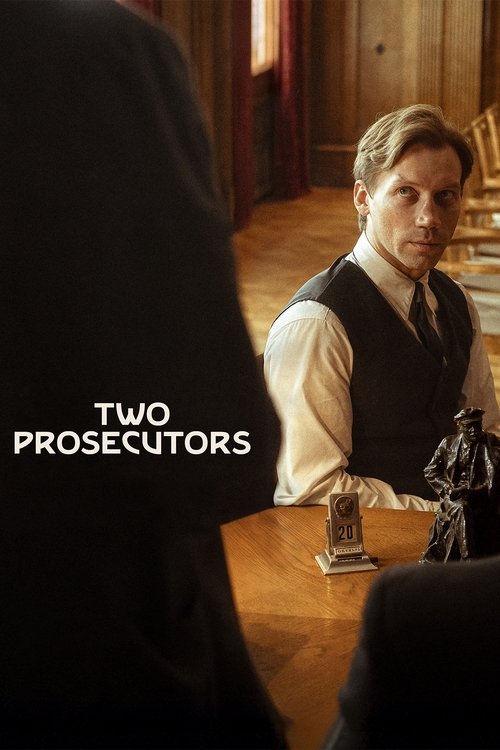
Two Prosecutors
2025 · Sergei Loznitsa
When you want something grave and gripping that trusts your patience — a film to sit with in silence and chew on for days. Firmly on the challenge end: rigorous, chilling, and worth it.
What it's about
Soviet Union, 1937, the height of Stalin's Great Terror. A young, freshly appointed regional prosecutor — a true believer in the law he serves — receives a letter smuggled out of prison alleging that the secret police are fabricating cases and torturing detainees. Taking the accusation at face value, he interviews the prisoner and carries the case up the chain, all the way to Moscow, convinced the system will correct itself.
The experience
Slow, austere, and quietly terrifying — a procession of waiting rooms, corridors, and interviews where dread accumulates like weather. It plays almost like a horror film built entirely out of bureaucracy, and the stillness is the point: you feel the machine closing around one decent man.
Performances
Aleksandr Kuznetsov gives the young prosecutor an unnerving purity — earnest to the point of doom — while veteran Aleksandr Filippenko is devastating in his scenes as the imprisoned Old Bolshevik whose letter sets everything in motion.
The craft
Sergei Loznitsa, returning to fiction after years of monumental archival documentaries, adapts a novella by Gulag survivor Georgy Demidov with fanatical control: long takes, exact framing, rooms that feel like traps. The muted palette and near-total absence of score make every closing door land like a verdict — see it somewhere you won't be interrupted.
Why it matters
Premiering to major festival acclaim, it was received as one of Loznitsa's finest fiction films and a pointed historical mirror — a study of how legality dies under terror, made by a filmmaker whose work keeps speaking to the present.
Snapshot
Two Prosecutors is Sergei Loznitsa's return to narrative fiction after a run of major archival documentaries, and his most concentrated chamber work to date. Adapted by the director himself from a novella by the Soviet physicist and Gulag survivor Georgy Demidov, the film unfolds in 1937, at the height of Stalin's Great Terror. A young, freshly appointed regional prosecutor named Kornyev (Aleksandr Kuznetsov) receives a letter — written, in the story's terrible image, in the prisoner's own blood — from an imprisoned Old Bolshevik, Stepniak (the veteran Aleksandr Filippenko). The letter alleges that the NKVD is fabricating cases and torturing detainees. Kornyev, a true believer in Soviet legality, takes the accusation at face value, interviews the prisoner, and carries the case all the way to Moscow and the office of Procurator General Andrey Vyshinsky — the real-life prosecutor of the show trials. He is granted an audience, seemingly vindicated, and then quietly destroyed by the machine he trusted. The film premiered in Competition at the 78th Cannes Film Festival on 14 May 2025, where it won the François Chalais Prize and competed for the Palme d'Or, and was widely received as one of the festival's most disciplined and chilling entries. It runs 117 minutes, in Russian and Ukrainian.
Industry & production
The film is a pan-European co-production assembled across France, Germany, Romania, Latvia, the Netherlands, and Lithuania — a financing map that reflects both the realities of art-cinema funding and Loznitsa's particular post-2022 position as a director who can no longer draw on Russian state money and does not work within Ukraine's wartime industry either. The lead producer is Kevin Chneiweiss, and the companies involved include Loznitsa's own Atoms & Void alongside SBS Productions, LOOKSfilm, White Picture, Avanpost Media, and Studio Uljana Kim. This consortium of small auteur-oriented outfits is characteristic of how Loznitsa has financed work for over a decade: modest budgets, multiple national soft-money sources, and a tight creative core that travels with him between projects.
Two facts of context matter here. First, the production is the work of a director operating in a kind of internal exile. Loznitsa, born in present-day Belarus and raised in Kyiv, has lived and worked outside the former Soviet space for years, and since 2022 has occupied a contested public position — opposing the Russian invasion of Ukraine while also resisting blanket boycotts of Russian culture, a stance that led to his expulsion from the Ukrainian Film Academy. Two Prosecutors, made in the Russian language about Soviet state crime, sits squarely inside that controversy. Second, the choice of source material is itself a production statement: Demidov's prose, suppressed for decades, only reached print after the Soviet collapse, so adapting it is an act of cultural recovery as much as filmmaking.
Technology
The most consequential technical decision is the framing: the film is composed in a near-square Academy-adjacent ratio of roughly 1.33:1, a boxed format that walls the protagonist inside cells, corridors, anterooms, and train compartments. Loznitsa and cinematographer Oleg Mutu shot in color, but the palette is so desaturated — wintry grays, institutional greens, the dun of overcoats and distempered walls — that critics repeatedly noted the film could almost pass for monochrome. The technological grammar is deliberately anti-spectacular: long static takes, available-feeling interior light, no digital flourish. The public record does not specify the exact capture format or camera system, and I won't guess at it; what is clear and verifiable is that the technology is bent entirely toward austerity and confinement rather than toward any showcase of resolution or movement. The score, by Christiaan Verbeek, is used sparingly, so the film's "sound technology" is in practice the engineered quiet of rooms, footsteps, and bureaucratic procedure.
Technique
Cinematography
Oleg Mutu — the Romanian cinematographer who shot Cristian Mungiu's Palme d'Or winner 4 Months, 3 Weeks and 2 Days and has lensed Loznitsa's My Joy and In the Fog — is the film's decisive collaborator. His camera is patient and frontal. Scenes are frequently held in single, near-immobile setups that let an interrogation, a wait, or a journey play in real time. The square frame is the organizing idea: it crops the world to the width of a doorway and forces Kornyev into the dead center of compositions that feel less like portraits than like specimens pinned to a board. Reviewers singled out Mutu's lensing of "deception and entrapment for maximum claustrophobia," and the visual logic is consistent — the deeper Kornyev penetrates the apparatus, the more the architecture closes around him.
Editing
Cut by Danielius Kokanauskis, Loznitsa's regular Lithuanian editor, the film is built from long durations and hard, unhurried transitions. The editing withholds the conventional rhythms of a thriller; tension is generated by duration — by making the viewer sit inside a bureaucratic delay until the delay itself becomes menacing. There is little cross-cutting and almost no montage acceleration. The structural arc is a steady, almost geometric tightening: the relative openness of the early scenes gives way to a final movement whose outcome the audience grasps before Kornyev does, so that the cut points land like the closing of doors.
Mise-en-scène / staging
Production design by Jurij Grigorovič and Aldis Meinerts reconstructs 1937 as a world of peeling paint, overheated offices, prison stone, and the heavy wood and frosted glass of state corridors. Staging is theatrical in the best sense — blocking is precise and frontal, characters arranged within the frame to dramatize hierarchy and supplication. The film is essentially a series of two-handers and antechamber scenes; much of its drama is the choreography of waiting, of being seen and not seen by power. The visual recurrence of thresholds, queues, and seated functionaries turns the set itself into the antagonist.
Sound
Sound design favors a dry, close, naturalistic register: the scrape of chairs, the rustle of paper, the clack of a train, the muffled acoustics of a cell. Verbeek's music enters rarely and to pointed effect, leaving the bureaucratic soundscape — silences, ticking procedure, the murmur of officials — to do the unsettling work. The restraint is itself a technique, refusing to cue emotion and thereby intensifying it.
Performance
Aleksandr Kuznetsov plays Kornyev with an upright, almost boyish conviction that is the film's tragic engine: his sincerity is precisely what dooms him. Aleksandr Filippenko, a great Soviet-trained character actor, gives the imprisoned Stepniak a wasted, lucid gravity in the film's central encounter. The supporting ranks — including Anatoli Beliy, Andris Keišs, and Vytautas Kaniušonis — embody the bland, unreadable officialdom through which Kornyev moves; their performances are studies in opacity, the affectlessness of men who already know how the story ends.
Narrative & dramatic mode
The film operates as a tragedy in the form of a procedural. Its dramatic mode is one of dramatic irony: the audience, schooled by history, understands the nature of 1937 long before the protagonist does, so every step of Kornyev's diligent investigation reads simultaneously as progress and as self-entrapment. Structurally it is close to a Kafkaesque parable — a lone rational man petitioning an unfathomable authority — but Loznitsa grounds it in concrete institutional procedure rather than dream logic. The narrative is linear, spare, and unrelievedly tightening; there are no subplots and almost no relief. The "two prosecutors" of the title — Kornyev the idealist and Vyshinsky the executioner of the law — frame the film's argument that within a totalitarian state the same office can house both conscience and its annihilation.
Genre & cycle
Generically the film braids drama, mystery, thriller, and historical reconstruction, but it subverts each: the "mystery" has no exonerating solution, the "thriller" denies catharsis, and the period frame is purged of pageantry. It belongs to a recognizable cycle of rigorous Eastern European cinema about state terror and bureaucratic violence — the lineage of the Romanian New Wave's procedural realism (to which Mutu is central) and of Soviet-history reckonings on film. Within Loznitsa's own filmography it forms a clear pairing with In the Fog (2012), his earlier literary adaptation about moral entrapment under totalitarian conditions, and extends the institutional critique of his documentaries into fiction.
Authorship & method
Loznitsa is the film's author in the fullest sense: director and sole credited screenwriter, adapting Demidov himself. His method here fuses the two halves of his career. From his documentary practice — The Event, State Funeral, Austerlitz, The Trial — he brings an anthropologist's patience with duration, ritual, and the texture of institutions; from his fiction (My Joy, In the Fog, A Gentle Creature, Donbass) he brings a bleak moral allegory of the individual ground down by collective power. Trained originally as a mathematician and scientist before studying at the VGIK film school in Moscow, he composes with an almost systemic rigor.
The authorship is collaborative in its consistency of personnel. Mutu's camera and Kokanauskis's cutting are recurring instruments of Loznitsa's style; here they are joined by Verbeek's restrained score and the Grigorovič–Meinerts production design. The director has spoken of setting himself strict "visual rules" for the film — the square frame, the static camera, the refusal of conventional coverage — and that self-imposed discipline is the clearest signature of method: a formal asceticism that mirrors the moral airlessness of the world depicted.
Movement / national cinema
The film resists a tidy national label, which is itself significant. It is a Russian-language film made by a Ukrainian director in European exile, financed by six countries, and shaped technically by a Romanian cinematographer and a Lithuanian editor. It can be read as belonging to a transnational "festival auteur" cinema, but its deepest affiliations are to the post-Soviet reckoning film and to the formal realism of contemporary Eastern European art cinema. Loznitsa's career has always sat athwart national categories — born in Belarus, raised in Ukraine, schooled in Moscow, based in Western Europe — and Two Prosecutors turns that rootlessness into a vantage: the film judges a Soviet crime from a position belonging to no single successor state.
Era / period
The film is set with documentary specificity in 1937, the worst year of the Great Terror, when Vyshinsky's procuracy lent a juridical veneer to mass arrest and execution. That period setting is inseparable from the film's contemporary charge. Several critics read it as "eerily attuned" to a present-day politics of fabricated cases, captured institutions, and the erosion of truth — and Loznitsa, making the film amid the war in Ukraine and his own disputes over Russian culture, plainly intends the 1937 frame to resonate forward. The era is rendered without nostalgia or production-design tourism; it is a moral climate as much as a historical date.
Themes
The governing theme is the fatal incompatibility of individual conscience with a totalitarian legal order. Kornyev's tragedy is that he believes in the law as a real instrument of justice, and that belief is exactly the lever by which the system disposes of him. Subsidiary themes braid through this: the corruption of language and procedure, where the forms of justice survive while their substance is inverted; the loneliness of the witness; the indifference of bureaucracy as a more efficient terror than overt brutality; and the question — pressing for both Demidov and Loznitsa — of how, and whether, such crimes can be told at all. The blood-written letter that sets the plot moving is the film's emblem: testimony that costs the body to produce and that the state can simply absorb.
Reception, canon & influence
Critical reception was strongly positive. The film holds an aggregate score near 97% positive on Rotten Tomatoes (across roughly 78 reviews) and in the mid-80s on Metacritic; Peter Bradshaw of The Guardian awarded five stars and called it "starkly austere and gripping," while other critics praised Mutu's cinematography, Verbeek's score, and the production design, and noted the film's resonance with a "post-truth" present. Its François Chalais Prize at Cannes — an award honoring films attuned to journalistic and humanist values — and its Palme d'Or nomination cemented its festival standing, and U.S. distribution via the Criterion Channel signals an early canonical positioning within serious art cinema.
The influences on the film run backward to Georgy Demidov's suppressed Gulag prose — the testimony of a physicist who himself entered the camps in 1937 and whose manuscripts were preserved and published only after the Soviet era — and to the broader literature of Soviet terror in the tradition of Shalamov and Solzhenitsyn, refracted through a Kafkaesque parable of bureaucracy. Cinematically it draws on the procedural realism of the Romanian New Wave (via Mutu) and on Loznitsa's own documentary studies of state ritual. As for what it may shape going forward, the record is necessarily thin for a 2025 release; its likeliest legacy is as a key late-career fiction work by Loznitsa and as a touchstone for politically engaged period cinema about state terror — but any claim to lasting influence remains, honestly, premature to assert.
Sources: Wikipedia · Cannes · Hollywood Reporter · The Film Stage · Sight and Sound (BFI)
A Deleuzian reading
A prisoner writes a letter in his own blood, and a young prosecutor decides to believe it.
The full Deleuzian reading of Two Prosecutors →
Reception
Premiered in Cannes competition in May 2025 to near-unanimous acclaim — a 97% Rotten Tomatoes score, a five-star Guardian rave from Peter Bradshaw, and the François Chalais Prize — and was quickly hailed as a return to peak form for Loznitsa's fiction filmmaking.
How Two Prosecutors was received, from release to now →
How to watch Two Prosecutors: what to notice on a first viewing
- Notice the frame is nearly square, not widescreen. Oleg Mutu's camera holds a cropped, almost 1.33:1 frame that fits the width of a doorway, and it keeps the prosecutor Kornyev pinned dead center of nearly every shot. The narrow box makes every room feel like a container closing around him, before anything actually happens to him.
- Notice how long the film holds on waiting rooms and queues. Editor Danielius Kokanauskis lets scenes of bureaucratic delay run in real time rather than cutting through them, so the wait itself becomes part of what you're watching. The delay isn't dead air before the real scene; here the delay is the scene.
- Listen for how sparingly the music enters. Sound design favors the dry scrape of chairs and rustle of paper over score, leaving silence and bureaucratic murmur to do the unsettling work instead of a cue. The quiet refuses to tell you how to feel, which makes the dread entirely your own.
- Watch the officials' faces give nothing back to Kornyev. The supporting officials play bland, affectless opacity, men who reveal nothing of what they know while Kornyev's own sincerity remains completely legible on his face. The mismatch between his open face and their blankness tells you who actually understands the situation.
The whole guide to watching Two Prosecutors, with the keys for a rewatch →
Influences: the films it descends from and the films it influenced
- In the Fog (2012) — The earlier Loznitsa–Mutu fiction collaboration that established the hushed, slow-burning long-take grammar in which an innocent man's doom accrues through duration rather than plot mechanics.
- My Joy (2010) — Loznitsa's fiction debut, also photographed by Oleg Mutu, originating the roving long-take method and the vision of an individual swallowed whole by an indifferent Russian institutional void.
- The Death of Mr. Lazarescu (2005) — Oleg Mutu's documentary-realist handheld camera and real-time procedural of bureaucratic indifference is the Romanian New Wave template Mutu later refines for Loznitsa.
- 4 Months, 3 Weeks and 2 Days (2007) — Mutu's desaturated palette and static, unbroken long takes generating dread under a totalitarian state — the precise cinematographic method reused in the seed.
- The Trial (1962) — The defining cinematic template for the bureaucratic-nightmare parable — an accused man processed by an unknowable legal apparatus whose logic is never disclosed to him.
- The Confession (1970) — Dramatizes the Stalinist purge machinery from inside — interrogation, the manufactured confession, the loyal Party man devoured — the historical engine Two Prosecutors anatomizes.
- Repentance (1987) — The foundational Soviet indictment of the Great Terror, rendering denunciation and disappearance through a surreal parable of conscience versus the state.
- 12 Angry Men (1957) — The single-room justice procedural built on frontal theatrical blocking and the lone moral holdout against institutional consensus — the chamber-drama staging the seed echoes.
- A Gentle Creature (2017) — Loznitsa's most explicitly Kafkaesque film, structuring its drama as a citizen battering against an opaque prison bureaucracy — the same labyrinth-of-institutions architecture Two Prosecutors inherits.
- Beyond the Hills (2012) — Mutu again photographing an institution (a convent) grinding down an individual through procedure, sharing the duration-as-tragedy approach and muted palette.
- Ida (2013) — Shares the boxed Academy ratio, desaturated austerity, and static frontal compositions deployed to render Eastern-bloc moral airlessness as a formal condition.
- Son of Saul (2015) — Uses the constricting Academy frame as a moral instrument, locking the viewer inside the procedural machinery of a death-dealing institution.
- Cold War (2018) — Academy-ratio, high-contrast formal asceticism narrating private lives crushed in the gears of the Soviet state apparatus — the same disciplined visual rule-set.
- The Trial (2018) — Loznitsa's documentary montage of a 1930 Soviet show trial — the nonfiction study of staged state ritual whose archival texture underwrites the fiction's courtroom-bureaucratic verisimilitude.
- State Funeral (2019) — Loznitsa's archival anatomy of Stalinist spectacle, exhibiting the anthropological patience with state ritual and frontal procession he transposes into staged fiction.
- Hunger (2008) — Builds drama from static, frontally-blocked long takes — most famously a single fixed two-hander — the duration-as-tension and theatrical staging Two Prosecutors adopts for its interrogation scenes.
Similar films
- Repentance (1987) — influence & lineage
- The Trial (1962) — influence & lineage
- Son of Saul (2015) — influence & lineage
- 4 Months, 3 Weeks and 2 Days (2007) — influence & lineage
- The Order (2024) — same viewing thread
- Case 137 (2025) — shared sensibility
- Dear Comrades! (2020) — shared sensibility
- It Was Just an Accident (2025) — shared sensibility
All the films related to Two Prosecutors →
Watch it with: curated runs of related films
- One Man Against the Machine — A run of thrillers about a single conscience squaring off against entrenched, corrupt or outright murderous power — watch these when you want the slow-burn tension of someone who won't back down.