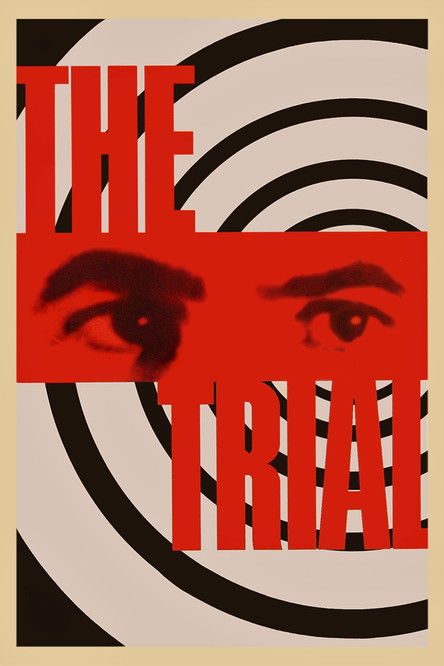
The Trial
1962 · Orson Welles
For when you want a film to chew on for days — something strange, cerebral, and visually overwhelming rather than comforting. Ideal for a solo night when you're in the mood to be unsettled by ideas as much as images.
What it's about
Josef K., a mid-level office functionary, wakes one morning to find policemen in his room informing him he is under arrest — for what, they won't say. Still free to go to work, he is pulled ever deeper into a labyrinth of courtrooms in tenement attics, advocates who hold court from their sickbeds, and endless corridors of files and clerks, protesting his innocence to a system that assumes guilt and explains nothing. Orson Welles adapts Kafka's novel into a modern nightmare of paranoia and faceless authority.
The experience
Disorienting by design — spaces don't connect the way they should, crowds stare, doors open into the wrong rooms — with a streak of jet-black comedy running through the dread. It's an anxiety dream you watch with your eyes wide, and it makes you think hard about every queue, form, and 'that's just policy' you've ever endured.
Performances
Anthony Perkins is perfectly cast as Josef K. — nervy, twitchy, guilty-seeming even in innocence — and Welles himself looms enormously as the Advocate, all bulk and purring menace.
The craft
Shot largely inside a derelict Paris railway station, the film conjures vast, oppressive spaces — thousand-desk offices, corridors of hanging files — in stark, deep-shadowed black and white with lenses that warp every room into a trap. On a big screen the sheer scale of the images is staggering.
Why it matters
Welles repeatedly called it the best film he ever made, and it stands as both the definitive screen rendering of Kafka's nightmare and a model of what Welles could conjure independently, on scavenged locations and thin budgets.
Snapshot
The Trial (Le Procès) is Orson Welles's adaptation of Franz Kafka's posthumously published novel, and it is the film Welles himself most often named as his finest — "the best film I ever made," he insisted, "say what you like." A French–Italian–West German co-production shot largely in a derelict Paris railway station, it transposes Kafka's parable of a man arrested for an unnamed crime into a cavernous, oppressive modern world of files, corridors, and faceless authority. Anthony Perkins plays Josef K., a mid-level functionary woken one morning by policemen who inform him he is under arrest without ever naming the charge; over the film's course K. is drawn through interrogation chambers, law offices, an advocate's sickroom, and a painter's garret, protesting his innocence to a system whose logic he cannot grasp and whose verdict is foregone. Welles surrounds Perkins with an international cast — Jeanne Moreau, Romy Schneider, Elsa Martinelli, Akim Tamiroff — and casts himself as the bloated, manipulative Advocate. Framed by an animated telling of Kafka's parable "Before the Law" and closing on an image of nuclear annihilation that is wholly Welles's invention, the film is at once one of the most faithful and one of the most personal of literary adaptations: a Kafka filtered through Welles's own lifelong preoccupations with guilt, power, paranoia, and the labyrinth. Coolly received by many critics on release and long underrated within Welles's canon, it has since been recognized as a major late work and one of the most fully achieved film treatments of Kafka ever made.
Industry & production
The Trial belongs to the wandering, financially improvised European phase of Welles's career, the long exile after Touch of Evil (1958) in which he assembled films from whatever resources and territories would have him. The production was mounted by the producers Alexander and Michael Salkind, a peripatetic father-and-son team (the Salkinds would later finance the Superman films) whose financing was notoriously precarious. Welles was offered a choice of public-domain or affordably optioned literary properties and selected Kafka's Der Process, writing the screenplay himself.
The production's defining crisis became its defining virtue. Welles had intended to build sets, but the money for them never materialized; stranded in Paris and facing a shoot he could not properly mount, he discovered the abandoned Gare d'Orsay — the disused Beaux-Arts railway terminus on the Left Bank, decades before its conversion into the Musée d'Orsay — and recognized in its vast, dust-filled halls, iron vaults, and endless administrative offices the perfect architecture for Kafka's bureaucratic nightmare. By his own account the entire conception of the film's look crystallized in that building in a single night. The Gare d'Orsay supplied the bulk of the interiors; additional photography took place in Zagreb in Yugoslavia (whose modernist apartment blocks and industrial spaces furnished the film's cold contemporary exteriors), in Rome, and at Paris studios.
The cast was international and assembled in the European art-cinema manner of the period. Anthony Perkins, only two years past Psycho, brought a persona of nervous, ambiguous guilt that Welles exploited deliberately. Jeanne Moreau, then at the height of her New Wave celebrity, plays the neighbor Marika Bürstner; Romy Schneider plays Leni, the advocate's seductive nurse; Elsa Martinelli plays Hilda; and Welles's long-time collaborator Akim Tamiroff plays the broken client Bloch. Welles himself took the role of the Advocate Hastler. As was his habit on under-resourced productions, Welles dubbed numerous supporting voices himself in post-production, a practice that contributes to the film's uncanny, ventriloquized texture. The shoot was completed quickly and cheaply, and the film was released in 1962.
Technology
The Trial is a black-and-white film photographed on 35mm, and its technological interest lies less in equipment than in two distinctive choices. The first is its exploitation of a found location at architectural scale: rather than constructing controlled sets, Welles and his cinematographer worked within the genuine, enormous volumes of the Gare d'Orsay, which required wide-angle optics and deep-focus staging to register the crushing disproportion between the human figure and the spaces that contain it. The second is the film's prologue, the parable "Before the Law," which Welles rendered not in live action but through the pinscreen (écran d'épingles) technique of the animators Alexandre Alexeieff and Claire Parker — a screen pierced by thousands of movable pins whose shadows, lit obliquely, produce grainy, engraving-like images of extraordinary tonal subtlety. The pinscreen's velvety, dreamlike stills give the opening fable a quality distinct from the rest of the film, marking it as myth before the narrative descends into K.'s waking world. Beyond these, the film makes no claim to technical novelty; its power is a matter of optics, architecture, and montage rather than apparatus, and it would misrepresent the record to suggest otherwise.
Technique
Cinematography
The cinematography is by Edmond Richard, who would go on to shoot Luis Buñuel's late French films, and his work on The Trial is among the most striking black-and-white photography of the early 1960s. Richard and Welles deploy extreme wide-angle lenses and deep focus to distort and aggrandize space, so that ceilings loom, corridors stretch toward vanishing points, and Josef K. is dwarfed by the rooms he moves through. Low angles monumentalize authority; high angles diminish K. into a speck within a grid. The lighting is high-contrast and expressionist — hard shafts cutting through gloom, figures swallowed by shadow, vast surfaces of darkness pierced by isolated light sources. Several of the film's most famous images depend on real scale rather than effects: the immense office where rows of clerks toil at identical desks, the warehouse-like rooms of files, the throng of waiting defendants. The camera is restless and mobile, tracking with K. through doorways and down passages in long, disorienting movements that refuse the viewer a stable sense of geography. The cumulative effect is a world that is simultaneously concrete and impossible — recognizably modern in its materials yet spatially nightmarish, a built environment that behaves like a dream.
Editing
The editing — credited to a team including Yvonne Martin, with Frederick Muller and Denise Baby — organizes the film as an accelerating spiral rather than a clean linear progression. Kafka's novel is famously episodic and unfinished, its chapters of uncertain order; Welles's film embraces that dislocation, cutting between spaces in ways that defy continuity and that make K.'s journey feel like a single unbroken descent through contiguous chambers of the same monstrous institution. Doors open onto rooms that cannot be where they should be; the law court adjoins a tenement, the advocate's chamber connects to a painter's studio, and the editing deliberately blurs the seams so that the entire world seems to be one continuous, inescapable interior. The rhythm tightens as the film proceeds, the cutting growing more agitated and fragmented toward the climax. This montage-driven construction is characteristic of Welles, who always thought of editing as the decisive creative act, and here it serves to dissolve rational space into the logic of anxiety.
Mise-en-scène / staging
The staging is the film's supreme achievement, and it is inseparable from the Gare d'Orsay. Welles uses the station's genuine immensity to dramatize the central Kafkaesque relation: the individual rendered insignificant before an apparatus without visible limit. The recurring composition sets a small, hurrying human figure against an overwhelming field — a sea of desks, a wall of doors, a colonnade receding into dark. Crowds are marshaled into geometric masses: the rows of identical clerks, the herd of accused men standing in numbered humiliation. Props accumulate the bureaucratic uncanny — towering stacks of paper, ledgers, the detritus of an administration that produces nothing but its own perpetuation. Welles also stages intimate scenes with a claustrophobic density, packing rooms with bodies and clutter so that even private encounters feel surveilled and airless. The contrast between the inhuman vastness of the institutional spaces and the suffocating crowdedness of the personal ones is itself a thematic statement: in this world there is no scale at which a person can simply breathe. The modernist Zagreb exteriors extend the conception outward, locating the nightmare not in a Gothic past but in the cold concrete present.
Sound
The soundtrack is restless and layered. The score draws on the Adagio in G minor attributed to Tomaso Albinoni (in fact composed by the musicologist Remo Giazotto), whose mournful, processional strings lend the film an elegiac gravity, supplemented by original music credited to Jean Ledrut. Welles's sound design is dense with overlapping voices, echoing footsteps, the clatter of typewriters and machinery, and the murmur of crowds — an aural correlative to the bureaucratic din. Because Welles post-synchronized much of the dialogue and dubbed many parts himself, the voices carry a slightly detached, disembodied quality that heightens the dreamlike alienation. The narration of the opening parable, spoken by Welles in his unmistakable resonant bass, frames the entire film as a story being told, an authority speaking over images, which is itself thematically apt for a fable about the Law as something handed down and never explained.
Performance
Anthony Perkins anchors the film as Josef K., and his casting is a deliberate use of his post-Psycho persona: the slim, jittery, defensive young man whose protestations of innocence carry an undertone of guilt he cannot account for. Perkins plays K. as increasingly frantic, indignant, and exhausted, a man arguing his case ever more loudly to a world that will not state the charge — and Welles draws on the actor's ambiguous, anxious quality to suggest that K.'s guilt, if it exists, is existential rather than legal. Welles himself, as the Advocate Hastler, is a monumental, bedridden, theatrical presence, all velvet menace and self-regard, embodying the corrupt intimacy of the legal apparatus. Around them the European cast supplies a gallery of seductive and grotesque figures: Jeanne Moreau's worldly Marika, Romy Schneider's web-fingered Leni, Elsa Martinelli's Hilda, and Akim Tamiroff's abjectly servile Bloch, whose total degradation before the Advocate is among the film's most disturbing scenes. The performances are pitched in a heightened, slightly unreal register consistent with the film's dream logic.
Narrative & dramatic mode
The film's dramatic mode is the nightmare-parable: a structure that obeys the associative, escalating logic of a bad dream rather than the cause-and-effect of conventional drama. The premise — a man arrested for a crime never named, presumed guilty by a court whose workings are unknowable — generates not a mystery to be solved but a condition to be endured. K. seeks explanation, redress, escape; each avenue (the court, the advocate, the painter Titorelli) only enmeshes him further. The film is bracketed by Kafka's parable "Before the Law," in which a man waits his whole life at a door meant only for him and is admitted only to learn, dying, that it is now to be closed — a story Welles places at the opening as overture and returns to at the close as commentary, making the whole film an expansion of its terrible logic. The mode is allegorical and absurdist, refusing realism while insisting on the emotional reality of dread. Crucially, Welles alters Kafka's ending: where the novel has K. stabbed "like a dog" by two executioners, Welles's K. is left in a quarry as his killers, rather than knife him, hurl dynamite — and the film ends on a billowing explosion that unmistakably evokes a nuclear mushroom cloud. Welles stated plainly that after the Holocaust he could not let K. submit and die passively; his K. laughs at his executioners and is destroyed by a force that consumes the world, transposing Kafka's personal doom into the collective catastrophe of the atomic age.
Genre & cycle
The Trial sits at the intersection of several traditions without belonging wholly to any. It is an art-cinema literary adaptation of the kind that flourished in early-1960s European production, when ambitious directors mined modernist literature for material; it is a work of cinematic Expressionism, drawing on the distorted spaces, hard chiaroscuro, and psychological menace of the German silent tradition that had always informed Welles's style; and it is, in its imagery of paranoia, surveillance, and persecution by an inscrutable authority, a key entry in the modern cinema of bureaucratic dread. Its closest kin are other films that render institutional nightmare through expressionist design, and it anticipates a later cycle of dystopian and Kafkaesque cinema concerned with the individual crushed by faceless systems. Within Welles's own body of work it joins his recurring "trials" and inquisitions — the courtrooms, hearings, and interrogations that run from Citizen Kane through Touch of Evil — and his lifelong fascination with the abuse of power and the labyrinthine machinery that conceals it.
Authorship & method
The Trial is a thoroughly Wellesian film despite its fidelity to Kafka, because Welles found in the novel an objective correlative for obsessions he had pursued since Citizen Kane: the individual versus the overpowering institution, guilt and its uncertain grounds, the corruption that hides behind authority, and the maze as the fundamental shape of modern experience. As writer, director, and co-star, Welles controlled the adaptation completely, compressing and reordering Kafka's chapters, inventing transitions, and — most consequentially — rewriting the ending to speak to the nuclear present. His method here is the method of his exile years: improvisation forced by penury turned into aesthetic discovery, as with the seizing of the Gare d'Orsay, and the assembly of a film from international talent, found locations, and extensive post-synchronized sound, with Welles himself dubbing voices and narrating.
Among the key collaborators, cinematographer Edmond Richard was indispensable, translating Welles's deep-focus, wide-angle conception into the film's monumental black-and-white images. The animators Alexandre Alexeieff and Claire Parker contributed the pinscreen prologue that sets the film's mythic frame. The editing team gave the film its dislocating, dream-continuous montage, the cutting that Welles always regarded as the heart of direction. And the score's use of the Albinoni-attributed Adagio supplied a tone of mourning that runs beneath the absurdity. But the authorship is unmistakably singular: Welles spoke of the film as a personal statement, and his readiness to claim it as his best work — a striking judgment from the maker of Kane — signals how completely he regarded it as his own rather than Kafka's.
Movement / national cinema
The film is a product of the pan-European art-cinema economy of the early 1960s, a French–Italian–West German co-production assembled across Paris, Rome, and Zagreb in the manner that allowed stateless, big-budget-impossible projects to be financed through pooled national subsidies and territories. It is not a national cinema in any settled sense: Welles was an American working in permanent European exile, drawing on French and Italian stars, a Yugoslav location, and German co-financing. Stylistically it descends from German Expressionism and the broader European modernist tradition rather than from any single contemporary movement, though it shares the period's appetite — visible across the French New Wave, the Italian art film, and the modernist literary adaptation — for formal experiment and for confronting alienation and the failures of postwar civilization. As a Welles film it belongs to the remarkable late European chapter of his career, the run of independently financed, technically resourceful, critically embattled works he made far from Hollywood.
Era / period
The Trial is a film of the early 1960s Cold War, and although Kafka wrote his novel in the 1910s, Welles's adaptation is saturated with mid-twentieth-century anxieties. The modernist concrete settings, the rows of computer-like office machines, and the imagery of mass administration locate the nightmare in the bureaucratic present rather than in any Habsburg past. Above all, the invented ending — the dynamite blast rising as a mushroom cloud — anchors the film firmly in the atomic age, making explicit a fear of total annihilation that Kafka could not have intended. Welles repeatedly connected his changes to the experience of the Second World War and the Holocaust, arguing that a passive, doglike death for K. was no longer morally tenable after the industrialized murders of the century. The film thus reads its Kafka through the lens of totalitarianism, genocide, and nuclear terror, transforming a prewar parable of individual guilt into a postwar meditation on collective catastrophe and the systems that engineer it.
Themes
The film's master theme is the individual's helplessness before an unknowable and unaccountable authority — the Law as a vast machine that assumes guilt, withholds explanation, and admits no appeal. From this flow its principal concerns. There is guilt itself, rendered metaphysical rather than legal: K. is guilty of nothing nameable yet behaves, and is treated, as though guilt were the default condition of being. There is the theme of bureaucracy as a labyrinth, the endless corridors and files standing for a modern order in which power has no locatable center and no face to confront. There is complicity and corruption — the advocate, the painter, the court officials all reveal a system that thrives on the abjection of those it processes, exemplified by Bloch's total self-abasement. There is sexuality as another snare, the women who offer K. help or solace while drawing him deeper into the apparatus. And, in Welles's hands, there is the overarching theme of the modern catastrophe: the film's nuclear conclusion universalizes K.'s fate into the threatened destruction of everyone, suggesting that the bureaucratic machinery of guilt and the technological machinery of annihilation are expressions of the same dehumanizing modernity. Beneath all runs the parable of the door "before the Law": the terrible idea that the way to meaning stands open and meant for us, yet is one we are never permitted to enter.
Reception, canon & influence
The Trial divided critics on release and for some time afterward. Many reviewers found it cold, overwrought, or excessively literary, and it was frequently treated as a lesser, willfully difficult entry in a career already shadowed by the legend of decline. Yet from the first the film also had passionate defenders who recognized the audacity of its design and the power of its imagery, and Welles's own unwavering insistence that it was his best work forced a continuing reassessment. Over subsequent decades critical opinion has shifted decisively in its favor, and it is now widely regarded as one of the major achievements of Welles's European period and among the most successful of all attempts to bring Kafka to the screen — a judgment grounded less in fidelity to the letter of the novel than in the film's capture of its spirit of dread.
Influences on the film run backward to Kafka's novel itself, the indispensable source; to the German Expressionist cinema whose distorted architecture and chiaroscuro shaped Welles's visual imagination from the start; and to Welles's own prior films, whose courtrooms, inquisitions, and studies of power The Trial extends. The pinscreen art of Alexeieff and Parker brought a distinct graphic tradition into the work. Influence forward is felt across the later cinema of bureaucratic and dystopian nightmare: the film stands as a foundational screen rendering of "the Kafkaesque," and its imagery of an individual lost in monumental, dehumanizing institutional space prefigures a long line of later films concerned with surveillance, paranoia, and the crushing of the self by faceless systems. For students of Welles it has become a key text in the rehabilitation of his post-Hollywood career, evidence that the constraints of his exile produced not failure but some of his most personal and formally daring work. Secure now in the canon both of Welles's filmography and of literary adaptation, The Trial endures as the rare case of a great director adapting a great writer and producing something that belongs unmistakably to them both.
A Deleuzian reading
The image that stays is small.
The full Deleuzian reading of The Trial →
Reception
Critics in 1962 largely called it cold, cluttered, a betrayal of Kafka — and Welles stunned them by calling it the best film he'd ever made. Decades of restorations later, cinephiles have largely come around to his side, and it now sits comfortably in the top tier of his filmography.
How The Trial was received, from release to now →
Influences: the films it descends from and the films it influenced
- The Cabinet of Dr. Caligari (1920) — Establishes the Expressionist grammar Welles inherits — architecture deformed into psychic projection, where painted/raked sets externalize a persecuted man's dread rather than depict real space.
- Metropolis (1927) — Pioneers the low-angle monumentalizing of institutional architecture that swallows the human figure, the compositional logic Welles uses to dwarf Josef K. inside cavernous offices and corridors.
- M (1931) — Models the lone individual ground between two faceless institutional machineries (law and underworld), the 'human figure vs. institution' staging that structures K.'s pursuit.
- Citizen Kane (1941) — Welles's own template — Toland's deep-focus, wide-angle compositions with ceilinged low angles, here re-deployed by Edmond Richard to make bureaucratic space oppressive and total.
- The Lady from Shanghai (1947) — Its hall-of-mirrors climax prototypes the discontinuous, geographically impossible space that K. traverses, where one door opens implausibly onto another world.
- Othello (1951) — Welles applies Othello's architecture-as-psychology method to Kafka by shooting in an actual abandoned Zagreb courthouse and the derelict Paris Gare d'Orsay, so that spatial disorientation becomes the film's subject, extending the same percussive fragmented editing into pure labyrinthine form.
- The Crowd (1928) — The immense hall of hundreds of identical clerk desks stretching into darkness restates The Crowd's image of bureaucratic anonymity as pure spatial oppression.
- Mr. Arkadin (1955) — Carries forward the labyrinthine expressionist architecture and low-angle distortion in service of an individual crushed by an unknowable power.
- Alphaville (1965) — Extends Welles's seizure of found modern locations (Paris shot as a dehumanized institutional future) to render bureaucratic dystopia with no built sets, only the alienating real city.
- Repulsion (1965) — Inherits the wide-angle interior that elastically warps around a paranoid protagonist, the apartment itself becoming an accusing, distorting antagonist.
- Playtime (1967) — Pushes the 'human figure vs. institution' staging to its limit — the individual reduced to a speck inside glass-and-steel monumental modernism, lost in a labyrinth of partitions and desks.
- The Conformist (1970) — Storaro's low-angle monumentalizing of fascist architecture, the figure crushed beneath vast institutional geometry, directly continues Welles's compositional politics of scale.
- THX 1138 (1971) — Translates the bureaucratic-dread parable into a surveillance state, the self dissolved in faceless systems — a sci-fi mutation of K.'s prosecution by an authority that is never seen whole.
- The Conversation (1974) — Carries forward the nightmare of the individual atomized by an unseen institutional apparatus, paranoia rendered architecturally as the man shrinking inside his own emptied space.
- The Tenant (1976) — A direct Kafkaesque persecution parable — petty institutional/communal authority closing on a guiltless man until identity collapses, the 'bureaucratic dread' genre Welles foundationally screened.
- Eraserhead (1977) — Builds the nightmare-parable on post-synchronized industrial sound and dream-continuous editing, the dislocating montage-plus-soundscape method Welles assembled from dubbing and found noise.
- Brazil (1985) — The most direct heir to 'the Kafkaesque' on screen — paperwork as labyrinth, monumental ducted architecture dwarfing the clerk, and Welles's nuclear-anxious altered ending recast as retrofuturist absurdism.
- Kafka (1991) — An explicit homage that revives the Expressionist black-and-white bureaucratic labyrinth and chiaroscuro, consciously adapting the Welles-Kafka mode of dread over literal fidelity.
- Barton Fink (1991) — Converts the institutional maze into a psychic one — the decaying hotel as a bureaucracy of guilt and unseen authority, sustaining the same dread-parable logic over plot mechanics.
- Two Prosecutors (2025) — The defining cinematic template for the bureaucratic-nightmare parable — an accused man processed by an unknowable legal apparatus whose logic is never disclosed to him.
- Touch of Evil (1958) — Welles's contemporaneous extreme wide-angle distortion and dense chiaroscuro — the lens warping faces and rooms into menace — is the immediate stylistic sibling of The Trial's visual attack.
- 1984 (1956) — Welles extends the same craft of the interrogation drama set inside cavernous totalitarian architecture, using monochrome scale and labyrinthine bureaucracy to crush the individual accused.
Similar films
- Brazil (1985) — influence & lineage · often watched together
- Touch of Evil (1958) — influence & lineage
- Two Prosecutors (2025) — influence & lineage
- Citizen Kane (1941) — influence & lineage
- The Cabinet of Dr. Caligari (1920) — influence & lineage
- The Lady from Shanghai (1947) — influence & lineage
- The Conversation (1974) — influence & lineage
- Lolita (1962) — often watched together
All the films related to The Trial →
Watch it with: curated runs of related films
- Discipline and Defiance — A run of men pitted against total institutions — prisons, wards, camps, the state — where the only freedom left is refusing to break.