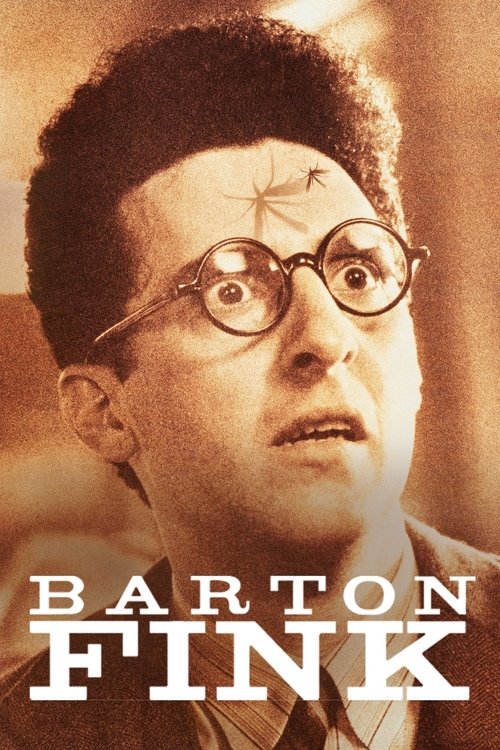
Barton Fink
1991 · Joel Coen
For when you want something strange to chew on for days — a film that rewards attention and arguments afterward. Challenge over comfort, though the laughs come steadily.
What it's about
In 1941, a celebrated New York playwright who champions "the common man" is lured to Hollywood to write for the studios — and assigned a wrestling picture he has no idea how to start. Installed in a peeling, sweltering residential hotel with only a genial insurance-salesman neighbor for company, he stares at the blank page while the building itself seems to close in around him.
The experience
It starts as a wickedly funny showbiz satire and slides, almost without your noticing, into genuine dread — the humidity practically comes off the screen. Unnerving, absurd, and blackly hilarious in the same breath, it leaves you happily puzzling over what you just saw.
Performances
John Turturro makes preening self-regard weirdly sympathetic, and John Goodman, as the friendly neighbor, gives one of the great supporting performances — warmth with something unreadable moving underneath.
The craft
The Coens turn a single hotel into a character: peeling wallpaper, groaning pipes, a mosquito's whine on the soundtrack, every detail tuned to low-grade menace. Roger Deakins shoots the corridors like a slow-motion nightmare, and the writing lands studio-mogul bluster and creeping horror in the same scene without dropping either.
Why it matters
It swept the top prizes at Cannes in 1991 — including the Palme d'Or — and cemented the Coen brothers as major American filmmakers with a voice nobody else could imitate.
Snapshot
Barton Fink is the fourth feature written by Joel and Ethan Coen, a chamber piece of psychological horror disguised as a Hollywood satire, set in 1941 Los Angeles. John Turturro plays a high-minded Broadway playwright lured west by a studio, installed in a decaying residential hotel, and asked to produce a wrestling picture he cannot write. What begins as a comedy of artistic vanity curdles into a fever dream of paralysis, complicity, and violence. The film occupies a singular place in the Coens' filmography and in the broader cinema of the period: it is at once their most claustrophobically interior work and their most explicit meditation on what they elsewhere only imply — the writer's terror of the blank page, and the moral abdication that can hide behind the phrase "the life of the mind." Its formal control, its refusal of explanation, and its now-legendary sweep at Cannes make it a pivotal text in early-1990s American independent cinema.
Industry & production
The film's origin is one of the better-documented episodes in the Coens' career, because they have repeatedly recounted it: while writing Miller's Crossing (1990), they hit a wall, set that script aside, and wrote Barton Fink in a short, concentrated burst before returning to finish the earlier film. The new screenplay was, in part, a transmutation of their own writer's block into subject matter — a writer about a writer who cannot write. They wrote the role of Barton specifically for Turturro and the role of Charlie for John Goodman, both of whom had appeared in Miller's Crossing.
Barton Fink was produced through Circle Films, the Coens' backers of the period, and released in the United States by 20th Century Fox. It was a modestly budgeted production by studio standards and a modest commercial performer; precise figures vary across sources, so it is most honest to say the film was never conceived as, nor became, a wide popular success — its cultural weight derives from critical and festival prestige rather than box office. Ethan Coen took the producer credit and Joel the director credit, per their longstanding division of billing, though by every account the brothers directed jointly. The production's most consequential creative decision may have been the commissioning of a single, dominating set — the Hotel Earle — built by production designer Dennis Gassner as an environment that could decay, sweat, and close in around its occupant.
Technology
Barton Fink is a film of conventional 35mm photochemical production, and its innovations are aesthetic rather than technological. There is no marquee visual-effects achievement here in the way the period's blockbusters were defining one. What distinguishes it technically is the disciplined use of practical, in-camera and on-set craft to achieve an atmosphere of physical wrongness: wallpaper engineered to peel and ooze a glue-like substance on cue, lighting rigged to render an ordinary hotel room as something between a sweatbox and a tomb, and a climactic hotel-fire sequence executed practically. The film's "effects" are almost entirely environmental and acoustic — the achievement is one of controlled, tactile decay rather than optical trickery.
Technique
Cinematography
Barton Fink marks the first collaboration between the Coens and cinematographer Roger Deakins, the beginning of one of the most celebrated director–DP partnerships in modern American film. Deakins's work here is a study in oppressive interiority. The Hotel Earle is rendered in a palette of sickly greens, jaundiced yellows, and humid browns, the light seeming to thicken the air. He favors wide-angle lenses that subtly distort the cramped room and lend Barton's isolation a faintly nightmarish curvature. Among the film's signature images are its slow, deliberate tracking movements — most famously a track that pushes in toward the drain of a bathroom sink, an unmistakable nod to Hitchcock and a way of announcing that the camera will follow meaning into places narrative refuses to go. A recurring photograph of a woman seated on a beach, pinned above Barton's desk, becomes a visual leitmotif Deakins lights as a window onto an unreachable elsewhere; the film's final image rhymes with it directly. The compositions are frequently symmetrical and frontal, framing Barton as a small figure pinned within an indifferent architecture.
Editing
The film is credited to "Roderick Jaynes," the pseudonym under which the Coens edit their own work — a fact now widely known and openly acknowledged by the brothers. The cutting is patient and tightly controlled, holding on discomfort, letting scenes of conversation extend until they become unbearable. The editing logic mirrors Barton's mental state: lucid and even staid in the satirical Hollywood scenes, increasingly elliptical and dislocated as the hotel's reality dissolves. The transitions between Barton's interior collapse and the external plot are managed so that the viewer is never quite given a stable border between the literal and the hallucinated.
Mise-en-scène / staging
Gassner's Hotel Earle is the film's central performance of design. Its empty corridors lined with shoes left out for shining, its silent lobby presided over by a bellhop who rises from a trapdoor in the floor, its single oppressive room with the bed, the desk, and the beach photograph — all constitute a built metaphor for the writer's skull and, by the film's logic, for hell itself. The peeling wallpaper functions as both literal decay and externalized anxiety, and the room's temperature is made visible through sweat, sagging paper, and the slow ruin of surfaces. Against this, the studio world is staged as gleaming, expansive, and absurd: Jack Lipnick's vast office, the deco interiors, the bright unreality of California. The contrast between the two staging registers — swollen interior dread versus brittle exterior comedy — is the film's structural spine.
Sound
Sound design, much of it associated with the Coens' longtime collaborator Skip Lievsay, is among the film's most powerful instruments. The Earle hums. A persistent mosquito whine torments Barton even as studio men insist there are no mosquitoes in Los Angeles, making the insect both a literal irritant and an auditory hallucination. The peeling of wallpaper, the buzz of a doused light, the muffled sounds of weeping or coupling through the walls — all build an acoustic environment of leakage and intrusion. Carter Burwell's score, in his ongoing partnership with the Coens, is restrained and melancholic rather than propulsive, ceding much of the soundscape to ambient dread. The interplay of near-silence and sudden intrusive noise is essential to the film's horror register.
Performance
Turturro's Barton is a performance of clenched, nasal earnestness — a man so convinced of his own moral seriousness that he cannot hear anyone else, his idealism curdling visibly into self-regard. John Goodman's Charlie Meadows is the film's great achievement in performed warmth concealing dread: genial, voluble, and finally terrifying, the insurance salesman who is Barton's neighbor and, the film suggests, something far worse. Judy Davis brings brittle weariness to Audrey, the writer's mistress-secretary. Michael Lerner's studio chief Jack Lipnick — a composite of Hollywood moguls — is a tour de force of bullying ingratiation that earned the film's Academy Award nomination for Best Supporting Actor. John Mahoney plays the dissolute Southern novelist W. P. Mayhew, and Tony Shalhoub and Steve Buscemi contribute sharp character work as a harried producer and the hotel's bellhop. The ensemble is calibrated so that every figure outside Barton's head seems faintly grotesque, an effect of his perception as much as their nature.
Narrative & dramatic mode
The film's dramatic mode is its most studied feature: it begins as recognizable social satire and slides, without a clear seam, into surreal psychological horror. For its first half it follows the legible logic of a fish-out-of-water Hollywood story; in its second half causality loosens, a corpse and a mysterious box appear, the hotel may be burning literally or figuratively, and the narrative withholds any reliable account of what is "real." The Coens deliberately refuse to resolve the ambiguity — the box's contents, the meaning of the final beach image, the precise ontology of Charlie. This is a narrative built to be interpreted rather than solved, and it rewards allegorical reading (about fascism, the Holocaust, artistic complicity, damnation) without ever confirming a single key.
Genre & cycle
Barton Fink belongs to the durable tradition of Hollywood-on-Hollywood films — the studio system anatomizing itself — alongside works that treat the dream factory as a site of corruption and delusion. But it splices that tradition with the apartment- and hotel-bound psychological-horror cycle, and with film noir's moral entrapment. It is also a "writer's film," part of a small genre about creative paralysis. Its refusal to sit comfortably in any one cycle — comedy, noir, horror, allegory — is itself characteristic of the Coens, who throughout their career have used genre as raw material to be hybridized and estranged.
Authorship & method
The film is a definitive statement of Coen authorship: co-written by the brothers, jointly directed under Joel's solo credit, edited by them under the Jaynes pseudonym, and built from their recurring preoccupations — language as both weapon and trap, ordinary American men who turn out to harbor catastrophe, the comedy that shades into dread. The key collaborators here are foundational to the rest of the Coens' work: Roger Deakins (cinematographer, here at the start of a partnership that would run across decades), Carter Burwell (composer, already their established musical voice), Dennis Gassner (production designer, whose Hotel Earle is arguably the film's true protagonist), costume designer Richard Hornung, and sound designer Skip Lievsay. The Coens' method — writing roles for specific actors, controlling the edit themselves, and designing the film around a single dominating environment — is fully visible.
Movement / national cinema
The film is a product of the American independent-minded cinema that flourished within and alongside the studio system in the late 1980s and early 1990s — filmmakers operating with studio distribution but pursuing idiosyncratic, authored visions. It is unmistakably American in subject (the studio system, the immigrant moguls, the New York intellectual versus the Hollywood machine), yet its sensibility draws heavily on European art-cinema models of ambiguity and dread, which is partly why it found such a receptive audience at Cannes. It sits at the confluence of American genre traditions and a continental willingness to leave meaning unresolved.
Era / period
Barton Fink is doubly periodized. As an artifact, it belongs to the early-1990s moment when the Coens, Jim Jarmusch, and their contemporaries were redefining what an American auteur film could look like. As a setting, it is fixed precisely in 1941 — the eve of America's entry into the Second World War — and that date is not incidental. The looming war, the figure of the "common man" Charlie who turns out to embody mass violence, and the Faulkner-like novelist's decay all locate the film at a hinge of American innocence and complicity. The period setting allows the Coens to stage the studio system at its zenith while seeding it with intimations of the catastrophe gathering in Europe.
Themes
The film's governing theme is the writer's relationship to "the life of the mind" — a phrase Barton invokes as a credo and Charlie hurls back as an accusation. Barton professes to write for and about the common man while being unable to listen to the actual common man living next door; his idealism is a form of narcissism, and his paralysis a moral as much as a creative failure. Around this sits a constellation of concerns: artistic prostitution and the studio's devouring of talent (literalized in Mayhew's ruin); the relationship between the intellectual and fascism, with Charlie's transformation into the murderer "Karl Mundt" read by many critics as an allegory of the artist's blindness to encroaching barbarism, freighted with Holocaust imagery; and damnation, with the Hotel Earle functioning as a purgatorial or infernal space from which there is no clear exit. The film is also, simply, about heat, decay, and the body's intrusion upon the mind that would deny it.
Reception, canon & influence
Barton Fink premiered to extraordinary acclaim at the 1991 Cannes Film Festival, where the jury — presided over by Roman Polanski, a filmmaker whose own apartment-horror films are among the work's evident antecedents — awarded it the Palme d'Or, Best Director, and Best Actor for Turturro. This unprecedented sweep of the festival's top honors by a single film is widely credited with prompting Cannes to subsequently limit the number of awards any one film could receive. The film went on to receive three Academy Award nominations — Michael Lerner for Best Supporting Actor, and nominations in Art Direction and Costume Design — though it won none.
Looking backward, the influences ON the film are legible and have been much discussed: Polanski's The Tenant and Repulsion for its paranoid interior horror; Kubrick's The Shining for the haunted-hotel architecture and the writer undone by his lodgings; the Hollywood satires and the tradition of Nathanael West's The Day of the Locust in its apocalyptic vision of the dream factory; Clifford Odets as a model for the committed-leftist Broadway playwright Barton resembles; and William Faulkner's troubled Hollywood sojourn behind the figure of W. P. Mayhew. The studio mogul Lipnick is a composite drawn from the larger-than-life heads of the classical studios.
Looking forward, the film's legacy is substantial if diffuse. It cemented the Coens' international critical standing and launched the Deakins partnership that would shape the look of American prestige cinema for a generation. It became a touchstone for films about creative paralysis and for the "ambiguous interior horror" mode, and a perennial subject of academic interpretation precisely because it refuses to resolve. Its imagery — the peeling wallpaper, the bathing beauty on the beach, "I'll show you the life of the mind" — has entered the common vocabulary of cinephilia. Where the historical record is genuinely thin is on the film's direct, traceable influence on specific later filmmakers, which tends to be asserted in general terms rather than documented; what is beyond dispute is its enduring status as a canonical American film of the 1990s and one of the Coens' most analyzed works.
A Deleuzian reading
The wallpaper sweats.
The full Deleuzian reading of Barton Fink →
Reception
It swept Cannes in 1991 — Palme d'Or, Best Director, and Best Actor for John Turturro, a haul so lopsided the festival changed its rules to stop it happening again — then promptly flopped at the US box office. Now it's a consensus Coen brothers high point, the deep cut people cite to prove they know the filmography.
How Barton Fink was received, from release to now →
Influences: the films it descends from and the films it influenced
- Repulsion (1965) — Establishes the apartment as an externalized psyche — walls that crack, breathe, and decay tactilely — the precise device behind the Hotel Earle's sweating, peeling wallpaper tracking Barton's unraveling.
- The Tenant (1976) — Models the persecutory bond between a lodger and his room, where neighbors and architecture conspire against a paranoid mind — the interior-horror grammar the Coens transplant into the Earle.
- The Shining (1980) — Supplies the blocked writer destroyed by an immense, near-empty hotel whose corridors and architecture function as the true antagonist, with creative paralysis as the engine of dread.
- Psycho (1960) — The cited Hitchcock debt: the tracking shot plunging into the sink drain directly quotes the shower-scene drain dissolve, alongside the motif of a genial, soft-spoken man harboring catastrophe.
- Sunset Boulevard (1950) — Originates the Hollywood-on-Hollywood mode told from the trapped, exploited screenwriter's vantage — the dream factory rendered as a gilded prison for the writer.
- Sullivan's Travels (1941) — Shares the 1941 milieu and the central comedy of a committed artist agonizing over making meaningful work 'for the common man' against the studio's demand for product (here, wrestling pictures).
- The Day of the Locust (1975) — Provides the Nathanael West apocalyptic vision of Hollywood as combustible illusion, its climactic conflagration prefiguring the Earle's final descent into flame.
- Eraserhead (1977) — Pioneers the continuous ambient/industrial sound-bed of dread and the sickly, decaying interior world that Skip Lievsay's mosquito-whine design and the Earle's atmosphere extend.
- The Trial (1962) — Converts the institutional maze into a psychic one — the decaying hotel as a bureaucracy of guilt and unseen authority, sustaining the same dread-parable logic over plot mechanics.
- Sid and Nancy (1986) — Deakins extends the Chelsea Hotel scheme — a peeling-wallpaper interior lit almost wholly by practical lamps and keyed to one sickly color so the location itself reads as the character's condition.
- Mulholland Drive (2001) — Extends the ambiguous-Hollywood interior-horror mode, deploying dream logic and unresolved spatial dread to indict the dream factory exactly as Barton Fink does.
- Synecdoche, New York (2008) — Dramatizes creative paralysis as an artist literally consumed by the work and the structure he inhabits — the 'life of the mind' turned into an inescapable architecture.
- The Lighthouse (2019) — Seals two men (one a hearty, dread-concealing Goodman analog) inside a claustrophobic decaying structure descending into madness, with foregrounded foghorn/insect sound-design as psychological pressure.
- Black Swan (2010) — Carries the artist's-apartment psychological horror forward, rendering creative pressure as decaying-interior and body horror in the Polanski-via-Barton-Fink tradition.
- The Big Lebowski (1998) — The first Roger Deakins/Coen collaboration established the visual language Lebowski extends — wide-angle distorting interiors, oppressive institutional spaces contrasted with cramped personal ones — and John Goodman's Charlie Meadows is the direct rehearsal for Walter Sobchak: the operatically erupting man who shares a room with a passive, bewildered protagonist.
- Being John Malkovich (1999) — Carter Burwell scored both films; the minimal plaintive string writing he developed with the Coens to mark creative entrapment and psychological constriction is the direct precursor to the music-box sparse-string palette he brought to BJM's Lester Corp. sequences, making Barton Fink an early proof-of-concept for Burwell's idiom of intellectual despair.
- Inside Llewyn Davis (2013) — The Coens' first sustained portrait of an artist trapped in creative paralysis uses spatial confinement — a single decaying hotel floor — to externalize irresolution; Llewyn Davis inherits this spatial-marginalization strategy, substituting the city's winter geography for the hotel.
- Jarhead (2005) — Early Deakins showcase of oppressive, drained, near-monochrome interiors and oppressive negative space — the desaturated emptiness he scales up to Jarhead's desert.
- Fargo (1996) — The first Coen–Roger Deakins collaboration, where the cinematographer's control of static, precisely framed wide shots and oppressive emptiness is forged before Fargo perfects it.
- Adaptation. (2002) — The agonized screenwriter paralyzed before the blank page in a hostile Hollywood, scored by Carter Burwell — writer's-block rendered as dread.
- A Poet (2025) — Models the puncturing of the artist's vanity and self-mythology—the futility and pretension of the creative vocation played as absurdist tragicomedy.
- American Fiction (2023) — The writer's-block film staged as fixed proscenium two-shots in which executives instruct the author on the authenticity they want ('that Barton Fink feeling'); Monk's publisher and producer meetings reproduce the flat frontal framing and the comedy of a writer being told what his own material means.
- Blood Simple (1984) — The Coens' first realization of their signature genre-slippage and Carter Burwell-scored slow-building dread, the method matured in Barton Fink's satire-to-horror turn.
- Miller's Crossing (1990) — Written immediately before — the Coens' own block on it inspired Barton's — and sharing the Dennis Gassner/Burwell team and the same obsessive control of a period world.
- The Hudsucker Proxy (1994) — Extends the period studio-system satire built around a single dominating Gassner-designed environment as the film's true protagonist, the architecture-as-character method carried forward.
- No Country for Old Men (2007) — Matures the Deakins/Lievsay partnership begun on Barton Fink — wide-angle compositions, dialogue-stripped silence, and Bardem reprising Goodman's warmth-concealing-dread split.
- A Serious Man (2009) — Reprises the ordinary man besieged by escalating metaphysical menace and the deliberate refusal to resolve — the same calibrated ambiguity that makes Barton Fink unparaphrasable.
- The Player (1992) — A near-contemporary reflexive Hollywood nightmare of a writer's creative-moral compromise, sharing the world-of-surfaces decor and dread beneath studio gloss.
- Naked Lunch (1991) — Same-year vision of writing as horror staged in a hermetic, decaying interior where the creative act manifests physical menace, sharing the writing-as-metabolized-trauma conceit.
Similar films
- No Country for Old Men (2007) — influence & lineage
- Miller's Crossing (1990) — influence & lineage
- Synecdoche, New York (2008) — influence & lineage
- The Hudsucker Proxy (1994) — influence & lineage
- The Big Lebowski (1998) — shared sensibility
- The Man Who Wasn't There (2001) — shared sensibility
- Pulp Fiction (1994) — shared sensibility
- Joker (2019) — shared sensibility
All the films related to Barton Fink →