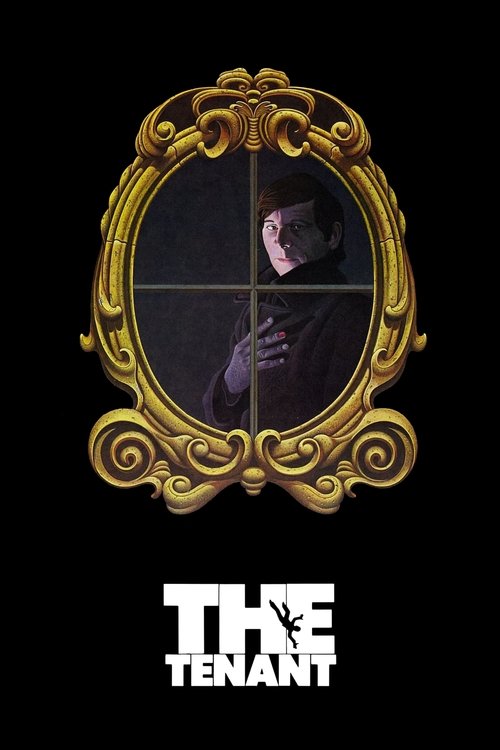
The Tenant
1976 · Roman Polanski
For when you're craving unease over jump scares — psychological horror that gets under your skin and stays there. Definitely a challenge pick; watch it when you want to feel genuinely unsettled.
What it's about
A timid clerk of Polish origin rents a cramped Paris apartment whose previous tenant, a young woman, threw herself from its window and lies dying in hospital. As he settles in, the landlord and neighbors press him with complaints, rules, and strange courtesies that all seem to nudge him toward becoming her — and he begins to lose his grip on where their pressure ends and his own mind begins.
The experience
A slow tightening of the screws: clammy, paranoid, and shot through with grotesque deadpan humor that makes the dread stranger rather than lighter. By the end you feel the walls of that apartment yourself.
Performances
Polanski directs himself in the lead and is disturbingly convincing as a man apologizing his way into oblivion — his meekness becomes the film's engine. Isabelle Adjani brings a jolt of warmth and strangeness as the dead woman's friend.
The craft
Polanski makes an ordinary apartment building into a machine of surveillance — courtyards, windows, and shared toilets framed so that watching and being watched become the same thing. Sven Nykvist's murky, sickly cinematography and a needling score keep the everyday just slightly wrong, and the sound of neighbors through walls does half the work of the horror.
Why it matters
The closing panel of Polanski's loose apartment-horror trilogy, dismissed by many on release and since reclaimed as a cult cornerstone of urban paranoia cinema, echoing through decades of identity-slippage horror.
Snapshot
The Tenant (Le Locataire) is the closing panel of what critics have retroactively called Roman Polanski's "Apartment Trilogy," following Repulsion (1965) and Rosemary's Baby (1968). Adapted from Roland Topor's 1964 novel Le Locataire chimérique, it follows Trelkovsky — a meek, naturalized French citizen of Polish origin, played by Polanski himself — who rents a cramped Parisian flat whose previous occupant, a young woman named Simone Choule, has thrown herself from its window and lies dying in hospital. As Trelkovsky settles in, the building's landlord and neighbors seem to press him, by increments of petty surveillance and complaint, into assuming the dead woman's identity. The film is at once a paranoid thriller, a study of alienation and the immigrant's precarious belonging, and a grotesque comedy of social conformity curdling into persecution. It is the most explicitly autobiographical-feeling of the trilogy — Polanski casting himself as the victim — and the most divisive, dismissed by many at its 1976 Cannes premiere and steadily reclaimed since as a key work of 1970s art-horror.
Industry & production
The Tenant was a French production with American studio backing, shot largely in and around Paris and at the Studios de Saint-Maurice / Épinay facilities, with interiors and the central courtyard apartment building reconstructed on stages. It was produced by Andrew Braunsberg, Polanski's longtime associate, through Marianne Productions, and distributed by Paramount Pictures, which gave the film international reach. The project arrived at a particular moment in Polanski's career: he had made Chinatown (1974) in Hollywood to enormous acclaim, and The Tenant represented a deliberate return to Europe, to a smaller and stranger register, and to the French-language milieu of his early collaborations.
That return was also entangled with Polanski's biography as a perpetual émigré — Polish-born, a survivor of the Kraków ghetto, working across France, Britain, and the United States — and the film's preoccupation with foreignness, papers, and provisional citizenship reads as continuous with his own displacement. The casting of Polanski in the lead was both an economy and a statement of authorship. Around him the production assembled a strikingly international, prestige-heavy supporting cast: the young Isabelle Adjani (fresh from Truffaut's The Story of Adèle H.) as Stella; American veterans Shelley Winters as the concierge, Jo Van Fleet as the imperious Madame Dioz, and the Oscar-winning Melvyn Douglas as the landlord Monsieur Zy; plus Bernard Fresson and Lila Kedrova. The polyglot cast was dubbed/performed in English for the principal release version, a common arrangement for European co-productions of the period aimed at the Anglophone market. The film screened in competition at the 1976 Cannes Film Festival.
Technology
Technologically, The Tenant is a conventional mid-1970s 35mm color production, and its innovations are aesthetic rather than instrumental. It was shot on 35mm in color (the prevailing Eastmancolor-derived stocks of the era) and framed for widescreen presentation. The decisive technical choices lie in optics and camera movement rather than in any novel apparatus: the film makes pointed use of wide-angle lenses to distort the cramped interiors, and of slow, prowling camera mobility — including crane and elevated positions to survey the central courtyard — to convert architecture into an instrument of menace. The communal bathroom visible across the courtyard, and the way figures appear motionless within it, depends on careful set construction and sightline planning rather than any optical trickery. Where the film does reach for effects — Trelkovsky's hallucinations, the vertiginous fall, the uncanny apparitions in the courtyard window — they are achieved through staging, in-camera framing, makeup, and editing rather than through the optical-printing spectacle then emerging elsewhere in 1970s cinema. The record on specific lab or effects vendors is thin, and I will not invent it.
Technique
Cinematography
The film's cinematographer was Sven Nykvist, Ingmar Bergman's principal collaborator and one of the supreme image-makers of the period. His presence is significant: Nykvist's gift for modulated, naturalistic light — interiors that feel lived-in and underlit, faces emerging from gloom — grounds the film's escalating unreality in a tactile, almost documentary surface, so that the slide into hallucination is all the more destabilizing. Nykvist and Polanski exploit the wide-angle lens to bow the geometry of small rooms, making ceilings loom and corridors yawn, and they organize the apartment building around the obsessive motif of the window and the courtyard it overlooks. Recurrent compositions trap Trelkovsky within frames-within-frames — doorways, windows, the dark rectangle of the communal toilet opposite — so that the architecture itself seems to watch and to enclose him. The camera's movement is patient and insinuating, often drifting toward or circling the protagonist, aligning the spectator with his thickening paranoia.
Editing
Editing was by Françoise Bonnot, an Academy Award winner (for Costa-Gavras's Z) and a major figure in French editing. The cutting strategy is keyed to subjective dread: the film proceeds for long stretches with a slow, accumulating rhythm — the patient registration of small humiliations and ambiguous glances — before contracting into sharper, more fragmented passages as Trelkovsky's grip loosens. Bonnot's work manages the film's most delicate problem, the calibrated ambiguity between external persecution and internal delusion, holding shots long enough to let menace fester while withholding the cut that would resolve whether what we see is real. The doubled climactic fall, repeated and theatricalized, is an editorial set-piece that turns suicide into a recursive performance.
Mise-en-scène / staging
Mise-en-scène is the film's deepest achievement. The apartment building is a total environment — a closed social world of staircases, thin walls, shared toilet, and a central courtyard that functions as a panopticon. Polanski stages the neighbors as a chorus of surveillance and complaint, their faces appearing at windows, their footsteps and knocks penetrating the walls. Props carry obsessive weight: Simone's leftover possessions, the rolled cigarettes and particular brand of chocolate she favored, the tooth Trelkovsky discovers in a hole in the wall, the Egyptian hieroglyphs he hallucinates in the toilet. Costume and makeup track his dissolution as he is drawn into the dead woman's wardrobe and finally her wig, lipstick, and dress — the staging of gender transformation as both the engine of horror and a grim social metaphor. The geography is deliberately destabilized so that the building feels simultaneously claustrophobic and infinite.
Sound
The sound design builds menace from domestic banality — knocks, muffled voices through walls, footsteps on stairs, the noises a neighbor uses to police another's existence. The musical score is by Philippe Sarde, a leading French composer of the era, whose music threads unease through the film without tipping prematurely into the overtly horrific. The interplay of diegetic apartment-house noise and Sarde's scoring sustains the ambiguity between an ordinary, petty social reality and a supernatural or psychotic one.
Performance
Polanski's own performance as Trelkovsky is central and risky: a study in ingratiating timidity, apologetic smiles, and a desperate wish not to give offense, which curdles into terror and finally a kind of resigned hysteria. It is a performance built on self-effacement, and the director-as-victim casting lends it an autobiographical charge. Around him, the supporting players pitch their roles toward the grotesque without quite breaking into caricature — Melvyn Douglas's fastidious landlord, Shelley Winters's sour concierge, Jo Van Fleet's monstrous neighbor — while Isabelle Adjani's Stella offers the one note of warmth, itself eventually contaminated by Trelkovsky's suspicion.
Narrative & dramatic mode
The film operates in the mode of subjective psychological horror, narrated almost entirely from within Trelkovsky's perception so that the spectator cannot finally distinguish conspiracy from delusion. Its dramatic engine is the slow tightening of a social vise: a sequence of escalating, individually trivial pressures — complaints about noise, a petition against a neighbor, insinuations about the apartment's history — that cumulatively coerce the protagonist toward a predetermined fate. This is the Kafkaesque structure of guilt without crime, of a bureaucratic and communal apparatus that seems to have decided one's identity in advance. The narrative folds back on itself with a circular, fated design: Trelkovsky is pressed to become Simone Choule and ultimately to reenact her suicide, and the film's recursive ending — his return to a hospital bed to find himself, bandaged, screaming at his own visitor — closes the loop into a nightmare with no exit.
Genre & cycle
The Tenant belongs to several overlapping cycles. Most obviously it completes Polanski's Apartment Trilogy, sharing with Repulsion and Rosemary's Baby the conceit of the domestic interior as the site of psychic disintegration and external menace: Repulsion's solitary madness, Rosemary's Baby's conspiratorial neighbors, and The Tenant's fusion of both. It sits within the broader 1970s vein of paranoid cinema, and within a European tradition of art-horror that prizes ambiguity over spectacle. Generically it is a hybrid — thriller, psychological horror, black comedy, and social satire — and part of its initial reception trouble was precisely that it refused to settle into one. Its lineage runs back to Gothic doubling and the literature of the persecuted self, and its grotesque comedy of conformity links it to a Central European absurdist tradition that Topor's source novel exemplifies.
Authorship & method
The film is unmistakably Polanski's, and it crystallizes his signature concerns: the apartment as trap, the unreliable subjective camera, the persecution of the outsider, the thin membrane between social cruelty and supernatural conspiracy. He co-wrote the screenplay with Gérard Brach, his closest writing collaborator across decades (Repulsion, Cul-de-sac, and others), adapting Roland Topor's novel Le Locataire chimérique. The authorial method here is collaborative in the strongest sense, drawing on a cohort of major artists working at the top of their craft: cinematographer Sven Nykvist importing the textural realism of Bergman's cinema; editor Françoise Bonnot supplying the rhythmic control that sustains ambiguity; composer Philippe Sarde providing an unsettled musical undertone. Polanski's decision to play Trelkovsky himself binds the film's authorship to its subject — the director literally inhabiting the role of the dispossessed foreigner — and gives the project the quality of a personal confession encrypted in genre.
Movement / national cinema
The Tenant is best understood as a transnational European art film with American studio distribution rather than the product of any single national movement. Polanski belongs to the postwar Polish film culture (a graduate of the Łódź film school whose Knife in the Water announced him internationally), but by 1976 he was a fully cosmopolitan filmmaker working in French and English. The film's French setting, French co-writer and composer, Swedish cinematographer, and Anglo-American cast embody a particular mode of 1970s European co-production that pooled prestige talent across borders. Its sensibility — absurdist, paranoid, attentive to the indignities of foreignness and paperwork — draws on a Central and Eastern European tradition (Kafka, the émigré's-eye view) transplanted into a meticulously observed Parisian apartment world.
Era / period
The film is a product of the mid-1970s, the height of the international art-cinema's engagement with paranoia, surveillance, and the unstable self — a period whose Anglo-American wing produced conspiracy thrillers and whose European wing pursued more interior, ambiguous forms of dread. For Polanski personally it followed the triumph of Chinatown and preceded the legal catastrophe of 1977 that would force his flight from the United States, lending the film, in retrospect, the aspect of a last European work before exile. Its themes of provisional belonging, identity under coercion, and the hostility of a closed community resonate with the decade's broader anxieties even as the film keeps its scale deliberately domestic and small.
Themes
The film's governing themes are identity and its erosion — the terror that the self is not securely one's own but can be overwritten by the expectations and pressures of others. Closely bound to this is the condition of the outsider: Trelkovsky's foreignness, his anxiety about papers and citizenship, his eagerness to be inoffensive, dramatize the immigrant's precarious provisionality and the violence latent in a community's demand for conformity. Surveillance and social coercion form a second cluster: the building is a machine for watching and judging, and persecution operates through the most ordinary instruments of neighborly complaint. A third strand is the instability of perception and the collapse of the boundary between the real and the delusional, sustained by the film's refusal to verify what Trelkovsky sees. The motif of becoming the dead woman introduces themes of gender, doubling, and the uncanny — the self as something that can be displaced into another body. Beneath all of these runs a current of fatalism: the sense of a destiny already written, a suicide one is compelled to repeat.
Reception, canon & influence
The Tenant premiered in competition at the 1976 Cannes Film Festival, and its initial reception was famously mixed to hostile; a substantial body of contemporary criticism found it overwrought, tonally unstable, or self-indulgent in Polanski's casting of himself, and it did not enjoy the immediate acclaim of Rosemary's Baby or Chinatown. Precise box-office figures are not something I will assert here, but the film was widely regarded at the time as a commercial and critical disappointment relative to Polanski's standing.
Its reputation has risen steadily in the decades since. Reassessment has tended to read the film's tonal instability as deliberate and productive — a calculated oscillation between horror and absurd comedy — and to recognize it as the keystone of the Apartment Trilogy and one of the purest cinematic expressions of Kafkaesque persecution. It has accumulated a strong cult following and is now routinely cited among the major art-horror films of the 1970s.
Looking backward, the film's influences are clear: Roland Topor's source novel supplies its plot and its absurdist-grotesque sensibility; the Kafka tradition of guilt-without-crime and bureaucratic dread informs its structure; Gothic literature's motif of the double underlies the identity transfer; and Polanski's own earlier apartment films establish its formal vocabulary. Nykvist's involvement imports the textural realism of Bergman's cinema into the genre frame.
Looking forward, The Tenant has exerted a diffuse but real influence on subsequent psychological and apartment-set horror — films built on an unreliable protagonist trapped in a hostile domestic space, on the ambiguity between conspiracy and madness, and on the slow-burn aesthetic of dread accreting from banality. Its DNA is legible in later works that locate horror in the surveillance and coercion of a building's community and in the dissolution of a single besieged self. Within Polanski's own filmography it stands as the culminating statement of his great theme of the persecuted outsider, and its standing as a misunderstood masterwork-in-waiting has become, over time, a critical commonplace.
A Deleuzian reading
Across the courtyard there is a window, and in the window a figure stands without moving.
The full Deleuzian reading of The Tenant →
Reception
Booed at Cannes in 1976 and widely trashed as self-indulgent, it flopped hard — but decades of reappraisal have turned it into the beloved capstone of Polanski's 'Apartment Trilogy' alongside Repulsion and Rosemary's Baby.
How The Tenant was received, from release to now →
Influences: the films it descends from and the films it influenced
- Repulsion (1965) — First panel of the Apartment Trilogy; it invents the subjective-camera grammar of a mind dissolving inside a flat — wide-angle distortion, walls that crack and clutch, predatory domestic space — that The Tenant reprises with a male protagonist.
- Rosemary's Baby (1968) — Middle panel of the trilogy; supplies the template of the apartment building's neighbors as a smiling coordinated conspiracy and the sustained ambiguity between paranoid delusion and an actual plot against the tenant.
- Cul-de-sac (1966) — Earlier Polanski/Gérard Brach screenplay whose absurdist tonal instability — dread sliding into grotesque comedy — is the exact co-writing method The Tenant inherits.
- Persona (1966) — The film of two identities merging into one, shot by Sven Nykvist; Polanski hires Nykvist specifically to import that textural realism and the visual logic of one self overwriting another.
- The Trial (1962) — The defining cinematic Kafka adaptation, codifying guilt-without-crime and labyrinthine bureaucratic persecution as a visual structure — the fated machinery that grinds Trelkovsky exactly as it does Josef K.
- Rear Window (1954) — Codifies the apartment courtyard as a panopticon in which the protagonist is at once watcher and watched across a ring of windows — the staging The Tenant weaponizes with the communal toilet visible across the court.
- Vertigo (1958) — The obsessive remaking of one person into another — dress, hair, gesture, identity — prefigures Trelkovsky's coerced transformation into the dead Simone Choule.
- The Cabinet of Dr. Caligari (1920) — Polanski revisits Caligari's frame-narrative unreliability: a protagonist's dissolving identity is rendered through mise-en-scène — silent neighbors as coordinated, enclosing watchers — that externalizes paranoid subjective experience as Expressionist spatial menace rather than as explicable social fact.
- Él (1953) — Mounts first-person persecutory paranoia through domestic architecture and staircases, treating the delusion from wholly inside the sufferer as Él does with Francisco.
- The Shining (1980) — Extends the besieged-self-in-a-hostile-building into a hotel-as-panopticon, dread accreting from banal routine, with an unreliable protagonist whose madness may be the structure's own design.
- Possession (1981) — Berlin-apartment art-horror of identity and marital disintegration, pushing The Tenant's erosion of a single self into hysterical performance and literal bodily doubling.
- Perfect Blue (1997) — Animates the unreliable-subjective, identity-erosion structure directly — a protagonist losing the boundary between herself and an imposed double, edited for the same hallucinatory ambiguity between persecution and madness.
- Mulholland Drive (2001) — Circular-fated, subjectively unreliable narrative in which one self is overwritten by another, extending the Gothic double and the dream-logic dissolution of identity that closes The Tenant.
- Bug (2006) — Folie-à-deux paranoia sealed inside one room, dread building from banality into the irresolvable conspiracy-or-delusion ambiguity that is The Tenant's central engine.
- Black Swan (2010) — Gender/body transformation and subjective dread sourced from mirrors and domestic space; the persecuted self splits and physically transforms exactly as Trelkovsky's does.
- Enemy (2013) — A Doppelgänger thriller of a man confronting his exact duplicate amid oppressive apartment interiors, carrying forward the identity-erosion-through-the-double motif.
- The Double (2013) — Explicitly Kafkaesque/Dostoevskian horror-comedy of a meek clerk erased by his confident double in a bureaucratic dreamscape — the guilt-without-crime persecution lineage made literal.
- mother! (2017) — The dwelling-as-panopticon besieged by an escalating, coercive community, shot in claustrophobic subjective proximity to one victimized protagonist — The Tenant's apartment-trap scaled to an entire house.
- Mad Detective (2007) — Polanski stages paranoid self-multiplication — the protagonist seeing himself occupy another body across a courtyard — without expressionist distortion, treating the vision as spatially plausible; this commitment to spatial plausibility over visual signposting is the precise method Mad Detective inherits.
- Forgotten (2017) — Cinematizes paranoid domestic fiction through enclosed framing — doorways, corridor bottlenecks, and window sightlines used as threshold geometry that makes the residential interior itself feel like a trap closing.
- Barton Fink (1991) — Models the persecutory bond between a lodger and his room, where neighbors and architecture conspire against a paranoid mind — the interior-horror grammar the Coens transplant into the Earle.
- Images (1972) — Contemporary study of a woman's subjective breakdown where hallucination and reality are cut together without markers, the same editing strategy for sustaining an unreliable interior that Françoise Bonnot builds in The Tenant.
- Eraserhead (1977) — Locates horror in domestic banality and oppressive sound design within a single squalid dwelling, the slow-burn dread-from-the-mundane aesthetic developing in parallel to Polanski's.
- Mr. Klein (1976) — Same-year Paris identity dissolution: a man persecuted into becoming someone else through Kafkaesque apartment-block paranoia and bureaucratic menace.
- The Father (2020) — Single-flat paranoia in which neighbors and architecture are quietly recast and reconfigured while the occupant's sense of identity dissolves — the chamber-thriller template of an unreliable domestic narrator.
Similar films
- Repulsion (1965) — influence & lineage · same viewing thread · often watched together
- Rosemary's Baby (1968) — influence & lineage · same viewing thread
- The Shining (1980) — influence & lineage · same viewing thread
- Possession (1981) — influence & lineage
- Cul-de-sac (1966) — influence & lineage
- Rear Window (1954) — influence & lineage
- Persona (1966) — influence & lineage
- The Trial (1962) — influence & lineage
All the films related to The Tenant →
Watch it with: curated runs of related films
- The Walls Are Closing In — Watch these when you want horror that comes from inside the house — a mind or a family cracking apart in rooms that slowly turn hostile.