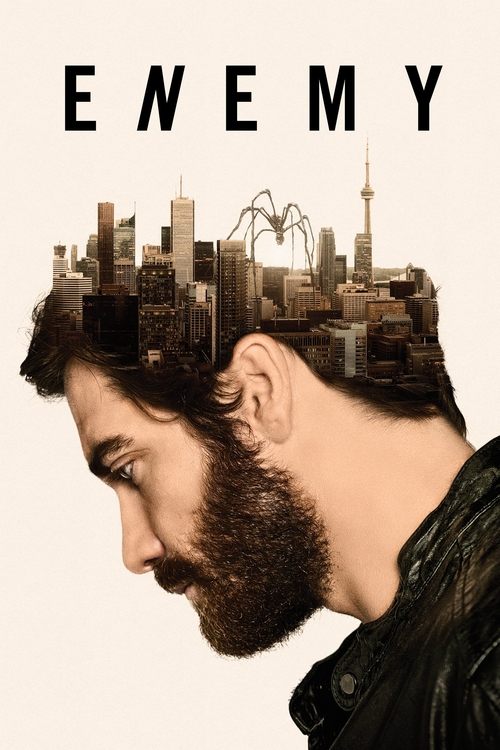
Enemy
2014 · Denis Villeneuve
The "serious sci-fi" standard-bearer whose Dune films made slow, austere blockbusters a mainstream event, and whose hiring to direct James Bond set off a fresh round of "can an auteur save a franchise" debate. Perpetually invoked in arguments about whether spectacle can still be art.
When you want a puzzle to chew on for days — the kind of film you finish and immediately look up theories about. Choose it for unease, not answers; it's short, but it lingers way out of proportion to its runtime.
What it's about
A rumpled Toronto history professor, sleepwalking through lectures and a distant relationship, spots his exact double in a rented movie — a bit-part actor with his face, his voice, his scar. He tracks the man down, and the two lives begin to contaminate each other, pulling in both men's partners and something much stranger underneath.
The experience
Suffocating and dreamlike — ninety minutes of low hum and mounting wrongness, shot in a sickly amber haze, with an ending that will make you gasp and then immediately want to start the film over. It explains almost nothing, and that's the design.
Performances
Jake Gyllenhaal plays both men and makes them unmistakably different people with identical faces — posture, tempo, appetite — a genuine double performance rather than a gimmick.
The craft
Villeneuve drains Toronto into a jaundiced, fogged-over dream city and lets recurring imagery — webs, tangles, one unforgettable spider — do the talking the script refuses to. The droning score keeps your nerves at a constant low boil; watch it in the dark with good sound and no distractions.
Why it matters
Initially a small, strange sibling to Villeneuve's bigger thrillers, it grew into a cult object with one of the most dissected final shots in modern movies, and it remains the darkest key to his whole filmography.
Snapshot
A Toronto history professor discovers his exact physical double — a minor film actor — and begins a disintegrating investigation into the man's private life. Adapted from José Saramago's 2002 novel The Double (O Homem Duplicado), Enemy is Denis Villeneuve's most uncompromisingly interior work: a 90-minute psychic wound dressed as a mystery thriller, bathed in a jaundiced amber grade, and closed by one of contemporary cinema's most discussed final images. Where Villeneuve's concurrent Prisoners (shot around the same period) works its dread through procedural accumulation, Enemy works through subtraction — withholding causality, erasing psychological seams, letting the viewer free-fall. The film functions simultaneously as paranoid thriller, Kafkaesque allegory, and anxiety dream about masculine selfhood, and it has steadily grown into a cult object since its limited theatrical release, discussed more often in academic and cinephile forums than in mainstream critical discourse.
Industry & production
Enemy was produced under relatively modest circumstances by Rhombus Media, the Toronto-based production company with a long history of literary adaptations and art-cinema productions (the company had previously backed Atom Egoyan's early work). Entertainment One handled distribution. The film was shot in Toronto in 2012, prior to Prisoners, but held back for wider release until 2014 — a sequencing that initially confused some observers who assumed it was a follow-up to the more commercially successful Prisoners rather than its sibling.
The source is Saramago's The Double, a novel that had circulated through development circles for some years before screenwriter Javier Gullón, a Spanish writer then relatively early in his career, delivered the adaptation. Villeneuve has spoken about his long attachment to the Saramago novel and his desire to translate its metaphysical vertigo into purely cinematic terms rather than literalizing the book's philosophical digressions. The production budget was modest by the standards of a Jake Gyllenhaal vehicle; box-office figures were negligible in theatrical release, but the film's afterlife on home video and streaming has been substantial. Gyllenhaal was a creative partner in the project rather than simply a hired lead — his involvement reflected a period in which he was actively seeking films that could reframe his screen persona after a run of more conventional genre work.
Technology
The film was shot on digital rather than film stock — a choice that contributes to its particular visual texture, one of hyper-sharpness nested inside an aggressively applied post-production color grade. Cinematographer Nicolas Bolduc and Villeneuve worked to strip the image of warmth by pushing the finished frame into a sickly yellow-amber register that reads alternately as institutional fluorescence, nicotine stain, old newspaper, or something organically diseased. The grade is totalizing: no sequence escapes it, no outdoor scene recovers into naturalistic blue sky. This represents a deliberate rejection of digital's tendency toward crisp, neutral reproduction in favor of something that feels chemically altered.
Toronto's architecture — particularly its proliferating glass-and-steel residential towers — was shot to exploit the reflective, depersonalizing qualities of those facades. Buildings double and mirror each other in background frames. The CGI spider shots, including a brief apparition of an enormous arachnid limb extending over the city skyline, were integrated at relatively low cost but with considerable compositional care; their uncanny effectiveness depends less on photorealism than on contextual placement within an image world already made strange.
Technique
Cinematography
Bolduc's framing is persistently uncomfortable. The camera favors medium close-ups that give characters insufficient breathing room within the frame — faces pressed toward edges, ceilings too low, corridors too narrow. Wide shots of Toronto's glass towers are used not as establishing relief but as vertiginous intrusions: the city itself becomes part of the uncanny system. Depth of field is frequently collapsed, so background figures dissolve into abstract color fields, reinforcing the film's logic of selective perception. Natural light sources are treated with suspicion; interiors feel as though the light comes from nowhere identifiable, sourceless and even.
Editing
Matthew Hannam's editing is calibrated for maximal narrative disorientation within a deceptively clean formal structure. Cuts between Adam and Anthony's storylines refuse orienting cues — no conventional match-cutting, no auditory bridges that would establish causal connection. Instead, transitions feel arbitrary at first encounter, only resolving into logic retroactively, if at all. Sequences in the surrealist register — the prologue in an underground sex club, the closing bedroom revelation — are cut with the elliptical rhythm of dream recall: impressionistic, decisive, refusing explanation.
Mise-en-scène / staging
Villeneuve stages the doppelgänger encounters with extreme choreographic precision. The first physical meeting between Adam and Anthony unfolds in a hotel room in which Gyllenhaal plays off himself through a combination of split-screen, body doubles, and careful eyeline management — an exercise that demands both technical planning and performance precision. The staging insists on the identical nature of the two men while subtly amplifying bodily unease: postures and vocal registers are close but not quite synchronized. Domestic spaces — apartments, offices, corridors — are stripped of particularizing detail, rendered as generic enough to belong to either man, reinforcing the possibility that Adam and Anthony occupy not just the same body but the same continuous life.
Sound
The sound design operates as a continuous low-grade threat. Danny Bensi and Saunder Jurriaans's score deploys dissonant strings and a pervasive low-frequency hum that functions less as musical cue than as environmental pressure — the sonic equivalent of the color grade. Diegetic sound is frequently treated: footsteps on institutional linoleum, the mechanical sounds of elevators and surveillance doors, the particular acoustics of Brutalist academic architecture. The film's most extreme sonic gesture is the pre-climax crash sequence, in which a sudden cut from dialogue to impact sound is designed to induce physical shock — a direct intrusion of the repressed into the narrative's controlled surface.
Performance
Gyllenhaal's dual performance is the film's central technical and interpretive achievement. The two men — Adam, a withdrawn, vaguely depressed academic; Anthony, more volatile and conventionally masculine — are differentiated through posture, vocal placement, and micro-gestural choices rather than through obvious physical transformation or wig-and-makeup conventionalism. Adam carries his weight forward slightly, collapsing inward; Anthony is expansive, occupying more spatial volume. The performance registers the psychic logic of the film: these are not two men who happen to look alike but projections of a divided interiority. Mélanie Laurent (Adam's girlfriend) and Sarah Gadon (Anthony's pregnant wife) are deployed with classical efficiency — both women are more archetype than character, which is consistent with the film's design but worth naming as a formal choice rather than simply an oversight. Isabella Rossellini, in a brief appearance as Adam's mother, lends the film a specific film-historical weight.
Narrative & dramatic mode
Enemy withholds resolution as a structural principle. The film presents itself as a mystery — who is Anthony? How do the two men exist? — but quietly forecloses the possibility of a satisfactory answer. Villeneuve has indicated in interviews that the film should be understood as taking place inside a single psyche: Adam and Anthony are aspects of the same man, the doubling a projection of repressed desire, male anxiety about commitment and autonomy, and a relationship to female authority figured by the recurring spider imagery. This reading is strongly supported by the film's structure but never confirmed by its surface narrative — the ambiguity is constitutive rather than decorative.
The film's dramatic mode is closer to Surrealist cinema's dream-logic than to the procedural thriller it superficially resembles. It opens with a non-narrative prologue (the underground club, the spider) that operates as a symbolic register the main action gradually decodes, and it closes with an image that enforces symbolic return over narrative resolution. The middle sections build mystery through the accumulation of unanswered questions rather than through revelation, and the viewer's position is repeatedly destabilized rather than clarified.
Genre & cycle
Enemy occupies a generic territory shared by the doppelgänger thriller, the paranoid art film, and the psychosexual mystery. It belongs to a loose cycle of prestige psychodrama that found notable expression in the early 2010s, including films like Black Swan (Aronofsky, 2010) and Under the Skin (Glazer, 2014), which use genre mechanics as a vehicle for sustained psychological inquiry rather than as ends in themselves. The doppelgänger narrative has a long literary and cinematic pedigree — Poe, Dostoevsky, and Hoffman in fiction; Hitchcock in cinema — and Enemy positions itself explicitly within that tradition while filtering it through contemporary art cinema's appetite for ambiguity.
The film is also legible as a contribution to what might be called the Toronto school of unease: a set of Canadian productions, associated particularly with Cronenberg and his inheritors, that use the city's glass-and-concrete anonymity as expressionist landscape for bodily and psychological anxiety. Villeneuve is Quebecois by origin and sensibility, but Enemy engages this English-Canadian tradition directly.
Authorship & method
Villeneuve's authorship in Enemy is most visible in his treatment of dread as architectural — the film's sense of threat derives not from shock events but from the deliberate construction of a world in which something is perpetually, structurally wrong. This was an established tendency in his Quebecois work (Maelström, 2000; Polytechnique, 2009; Incendies, 2010) and would persist through his Hollywood period (Arrival, 2016; Blade Runner 2049, 2017). His collaborations tend toward long-term partnerships: he has worked repeatedly with composers and cinematographers across multiple films, suggesting a production culture organized around aesthetic trust rather than project-by-project assembly.
Javier Gullón's screenplay compresses and metabolizes the Saramago novel's philosophical scaffolding, retaining its doubling logic while stripping away the more discursive, essayistic elements that prose fiction can sustain but cinema typically cannot. The spider motifs — some present in Saramago, some introduced or amplified for the film — are Gullón's most consequential interventions. Nicolas Bolduc's contribution to the film's color and framing philosophy cannot be overstated; much of what makes Enemy visually distinctive is the result of his collaboration with Villeneuve on a consistent image-world rather than Villeneuve's unilateral direction. Matthew Hannam's editing reflects a similarly collaborative intelligence, finding the rhythm that keeps the film disorienting without becoming incoherent.
Movement / national cinema
Enemy is a Canadian production shot in Toronto, and it engages Canadian cinema at the level of both industrial structure and cultural imagination. The Toronto cityscape — generic enough to read as almost any large North American metropolis, yet specific enough in its glass-tower residential architecture to be recognizable — functions here as it does in a strand of Canadian art cinema: as a landscape of dislocation, anonymity, and failed interiority. Cronenberg's influence on this mode is significant, and Enemy reads in dialogue with films like Videodrome (1983) and Dead Ringers (1988), which use Toronto's particular blandness as a container for extreme psychological content.
Villeneuve's Quebecois sensibility — formed in the tradition of Québec cinema's intense attention to identity, language, and psychological fracture — is legible even in an Anglophone Toronto production. His background in Incendies and earlier Québec work infuses the film's treatment of repressed family violence and masculine anxiety with a cultural specificity that extends beyond the Saramago source material.
Era / period
Enemy was made and released during a period of unusual ambition in mainstream-adjacent prestige cinema, roughly 2010–2016, in which mid-budget films with art cinema ambitions received studio-adjacent distribution and marquee casts. The same pressures that would eventually close off this space — the consolidation of studio spending around franchise IP, the retreat of mid-budget drama from theatrical markets — were already visible at the time of Enemy's release, and the film's marginal theatrical performance reflected the difficulty of selling genuinely difficult work without a genre promise to fulfill.
The period also saw a resurgence of interest in psychoanalytic and Jungian readings of film within cinephile culture — a critical context that made Enemy's symbolic architecture more legible to its early audience than it might have been in an earlier era.
Themes
The film's most persistently investigated theme is the divided male self: the tension between the man who has settled (Adam, the professor, the relationship with Laurent's character) and the man who transgresses (Anthony, the actor, the pregnant wife, the sex club). Villeneuve and Gullón frame this not as a moral contest between good and evil versions of a self but as a structural impossibility — the simultaneous existence of commitment and its refusal, responsibility and its evasion. The pregnancy functions as the pressure point around which the division becomes unsustainable.
Spiders — specifically the enormous, threatening, feminine spider — carry the film's most concentrated symbolic charge. They appear in the prologue, briefly in an exterior shot, and definitively in the film's closing image. The spider in this reading represents the feminine as perceived through the anxious male gaze: enveloping, uncontrollable, infinitely extensible. This is not the film's endorsement of such a view but its diagnosis — the spider is what Adam's psyche projects onto the women in his life, and the final image, in which the woman becomes the spider in a moment of revelation, reads as the return of a repression that has organized the entire film.
Control, surveillance, and anonymity form a secondary thematic register. Toronto's glass towers reflect and multiply without revealing interiority. The film's architecture enforces visibility without transparency — we see everything and understand nothing.
Reception, canon & influence
Critical reception at the time of theatrical release was respectful but divided. Reviewers praised Gyllenhaal's performance and the film's visual distinction while acknowledging that its refusal of conventional resolution would limit its audience. It did not penetrate major awards circuits in the way Prisoners did in the same period, reflecting the difficulty of campaigning an elliptical art film alongside a more legible genre entry from the same director. Over time, critical opinion has consolidated significantly in the film's favor, and it now occupies a strong position in retrospective assessments of Villeneuve's work, often cited as his most formally pure achievement.
Backward influences: The doppelgänger tradition in literature and film is the primary genealogy — Dostoevsky's The Double, Poe's William Wilson, Hoffmann's uncanny figures form the deep literary substrate. In cinema, Hitchcock's Vertigo (1958) is the inescapable precedent: the obsession with an identical woman, the male desire to colonize and replace, the vertigo of identity. Buñuel's That Obscure Object of Desire (1977) and his broader Surrealist inheritance — particularly the intrusion of irrational imagery into bourgeois realist scenarios — are directly operative. Cronenberg's Toronto psychodramas, especially Dead Ringers with its identical twin surgeons, provide an immediately adjacent model. Lynch's dream-logic filmmaking (Lost Highway, Mulholland Drive) shapes the film's structural ambiguity and its confidence in the unresolved symbol. The Kafka of The Trial and The Metamorphosis — bureaucratic dread, inexplicable guilt, identity under dissolution — is a pervasive if non-cinematic presence.
Forward legacy: Enemy has functioned primarily as a cult reference point rather than as an explicitly acknowledged influence on subsequent work. It has been extensively analyzed in academic film studies, particularly in the context of psychoanalytic film theory and in Canadian cinema studies. Its color-grading strategy — the totalizing desaturation toward a monochromatic affective register — has been observed in subsequent prestige horror and thriller production, though direct causal lines are difficult to establish. More significantly, the film helped consolidate Gyllenhaal's reputation as a serious artistic risk-taker, establishing the creative credibility that enabled Nightcrawler (Gilroy, 2014) and subsequent departures from conventional star behavior. Within Villeneuve's own career, Enemy represents the far pole of interiority against which his subsequent, more externally expansive work (Arrival, Dune) can be measured — evidence that the same sensibility capable of science-fiction epic can also produce something this sealed and strange.
A Deleuzian reading
Adam Bell rents a movie because a colleague recommended it, watches it alone in a sourceless amber gloom, and stops on a bellhop in the background of one shot.
The full Deleuzian reading of Enemy →
Reception
Slipped out quietly in 2014 to baffled, divided reactions — but as Villeneuve rocketed to A-list status with Arrival and Dune, cinephiles circled back and crowned it his strangest, most rewatchable puzzle box.
How Enemy was received, from release to now →
Influences: the films it descends from and the films it influenced
- Vertigo (1958) — The dolly-zoom that materializes Scottie's identity-vertigo as a physical sensation in the frame is the cinematographic precedent for Enemy's collapsed depth-of-field: both use lens optics to externalize a male protagonist's inability to disentangle desire from the projected double, treating the distorted image as the psychological truth.
- Persona (1966) — Bergman and Sven Nykvist's superimposition of two faces into a composite close-up — the specific formal device of making one face from two through optical printing — is the staging precedent Enemy's dual-Gyllenhaal confrontations inherit, achieving the same identity-merger through elliptical cutting and eyeline matching rather than optical trick.
- Seconds (1966) — James Wong Howe's extreme wide-angle close-ups distort the protagonist's face in the frame, making identity itself appear plastic and surgically renegotiable; Enemy's use of compressed telephoto framing to flatten and defamiliarize Gyllenhaal's features in dual-role scenes applies the same strategy of using lens choice to render the face as an unreliable surface.
- The Tenant (1976) — Polanski's claustrophobic framing of Parisian apartment spaces — low ceilings pressing into the frame, windows that frame surveillance rather than light — establishes the spatial grammar Enemy uses to make domestic interiors feel like psychological enclosures; both films use the apartment corridor as the primary arena for identity erosion.
- That Obscure Object of Desire (1977) — Buñuel's deployment of two different actresses in a single role without narrative acknowledgment treats the instability of the desired object as a formal fact rather than a puzzle to solve; Enemy's doppelganger staging inherits this specific Surrealist technique of presenting the impossible as self-evident realism, forcing the audience to absorb contradiction rather than resolve it.
- Dead Ringers (1988) — Cronenberg's system of synchronized costuming, blocking, and micro-gesture for Jeremy Irons's dual performance — the twins differentiated by behavioral register rather than appearance — is the direct performance methodology Enemy's dual-Gyllenhaal scenes apply; Toronto locations provide the same cold clinical spatial context, making this as much a production-culture inheritance as a formal one.
- Lost Highway (1997) — Lynch and Angelo Badalamenti's use of sustained sub-bass frequencies as the primary structural carrier of dread — pitched below audibility into physical sensation — is the precise audio architecture Enemy's low-frequency sound design inherits; the film's mid-film identity substitution, in which one protagonist simply becomes another without explanation, also models Enemy's single-psyche-two-bodies structure.
- Mulholland Drive (2001) — Lynch's formal confidence in deploying unexplained surrealist imagery — the blue box, the dumpster figure — as psychic truth rather than genre mystery establishes the license Enemy's spider sequences require: both films treat the uninterpreted symbol as structurally complete, refusing the explanatory apparatus that would reduce it to allegory.
- Spider (2002) — Cronenberg's Toronto-set unreliable-narrator film uses elliptical editing to render memory as structurally suspect — the same event returns in different configurations — developing within the Cronenberg/Toronto production context the editing approach Enemy directly extends; Ralph Fiennes's performance of dissociation through withholding rather than display anticipates Gyllenhaal's dual-register restraint.
- Perfect Blue (1998) — A man confronting an identical double as a manifestation of a fracturing self, staged with the same dread-laden ambiguity about which figure is 'real' that Kon built around the second Mima.
- Incendies (2010) — Pushes Incendies' formalism into doppelganger dread — oppressive slow zooms, a sickly monochrome palette, and identity collapse as a puzzle the viewer must reassemble.
- Mr. Klein (1976) — Doppelgänger identity dissolution steeped in a jaundiced, oppressive monochrome palette — the wintry-green-gray strategy pushed toward sickly yellow to signal a self coming apart.
- Nightcrawler (2014) — Enemy's establishment of Gyllenhaal as a credible vehicle for extreme artistic risk-taking — emaciated, affectless, performing psychological extremity without conventional star-protection — directly enables Nightcrawler's predatory characterization; Robert Elswit's amber-neon L.A. nightscape extends Enemy's aggressive digital grade into a different urban register while maintaining the same color-temperature logic.
- Arrival (2016) — Villeneuve exports Enemy's sealed single-psyche structure — one consciousness experiencing two temporal realities simultaneously — into a science-fiction frame, carrying the elliptical editing rhythm, the Jóhann Jóhannsson low-frequency dread score (replacing Brion's similarly pitched work), and the withheld-resolution narrative commitment wholesale from Enemy's interiority to a planetary scale.
- Possessor (2020) — Brandon Cronenberg works within the precise aesthetic zone Enemy occupied — identity invasion rendered through digital aggressive grading, practical body-horror effects inserted into otherwise photorealist cinematography, and Toronto production infrastructure — explicitly extending the Dead Ringers lineage through the Enemy-era development of the Toronto psychodrama tradition into a new generation.
- Black Swan (2010) — Both films organize psychosexual prestige horror around a protagonist's fragmentation into a shadow-double using subjective handheld camera and binaural sound design to collapse the boundary between performed and authentic self; Black Swan's use of hallucination as formal device rather than genre signpost — the scratched skin, the feathers — runs parallel to Enemy's surrealist integration of the spider as psychological fact.
- Under the Skin (2013) — Glazer and DP Daniel Landin push digital desaturation into a monochromatic affective register where color functions as psychological temperature rather than representational information — the same totalizing-grade strategy Enemy applies with its amber monoculture — and both films use this chromatic reduction to render the human body as alien terrain within an otherwise recognizable urban landscape.
- The Double (2013) — Adapting the Dostoevsky doppelganger tradition simultaneously with Enemy, Ayoade and DP Erik Wilson use a desaturated tungsten-heavy palette and compressed telephoto framing to create Kafkaesque spatial alienation that directly parallels Enemy's amber-grade claustrophobia, both films working within the same literary genealogy and arriving at overlapping cinematographic solutions.
- Twinless (2025) — Jake Gyllenhaal's composited doppelgänger pairing, set against a deliberately muted palette, turns dual-role compositing into a study of identity anxiety the way Twinless does.
- Inland Empire (2006) — Builds dread from a doubled protagonist split into two lives, rendered in a degraded jaundiced image keyed to the uncanniness of the divided self.
- The Autopsy of Jane Doe (2016) — Scored by Danny Bensi and Saunder Jurriaans in the same texture-forward, string-scraping idiom of sustained low dread they bring to Jane Doe — a shared composer method.
- White Noise (2022) — Matthew Hannam's editorial signature — holding shots past the point of comfort so that dread accumulates in duration rather than in cuts, and letting tonal registers switch without a transitional beat — is the mechanism by which White Noise's three movements are joined.
Similar films
- Nightcrawler (2014) — influence & lineage
- Dead Ringers (1988) — influence & lineage
- Arrival (2016) — influence & lineage
- Twinless (2025) — influence & lineage
- Enemy (2013) — shared sensibility
- Sicario (2015) — shared sensibility
- Incendies (2010) — shared sensibility
- Prisoners (2013) — shared sensibility
All the films related to Enemy →