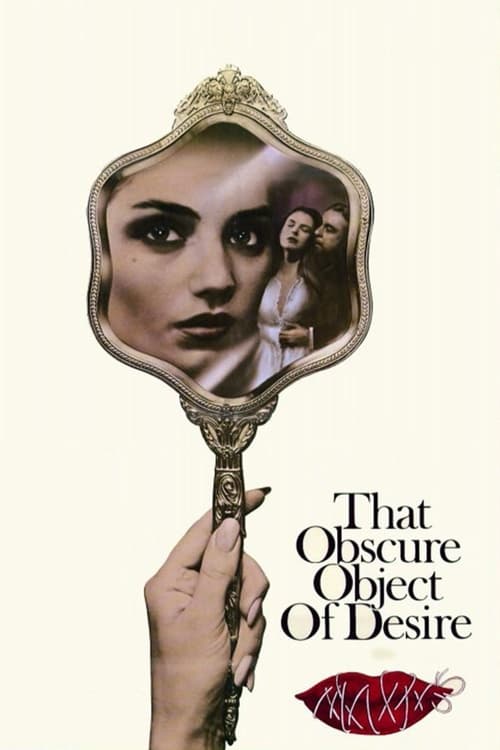
That Obscure Object of Desire
1977 · Luis Buñuel
For when you want something clever and strange — a film to laugh at, puzzle over, and argue about afterward. Best with a glass of wine and a taste for mischief.
What it's about
On a train out of Seville, a wealthy, aging Frenchman dumps a bucket of water on a young woman's head — then calmly explains himself to his fellow passengers by telling the whole story. It's the tale of his years-long obsession with Conchita, a beautiful flamenco dancer who draws him close and pushes him away in an endless dance of promise and refusal. The famous twist of the production: Conchita is played by two different actresses, swapped without explanation, sometimes mid-scene — while bombs go off in the background of a world politely falling apart.
The experience
Wicked, elegant, and slyly funny — a comedy of humiliation told with a straight face, where the absurdity creeps up on you. It's playful on the surface and corrosive underneath, and the two-actress trick keeps you delightfully off balance.
Performances
Fernando Rey is perfect as the self-deluding gentleman, dignity intact even at his most ridiculous, while Carole Bouquet and Ángela Molina split one woman between them — one icy, one earthy — and somehow make her more real, not less.
The craft
Luis Buñuel's dual-casting of the female lead is one of cinema's great formal gambles, turning a story of obsession into a demonstration of how desire invents its own object. The framing device of the train-car confession gives the film the rhythm of a told story — urbane, unhurried, booby-trapped.
Why it matters
Buñuel's final film, it capped a fifty-year career as cinema's great surrealist provocateur and remains the reference point for any movie that casts multiple actors in a single role.
Snapshot
Luis Buñuel's final film is one of cinema's most formally audacious farewells: a bitter comedy of erotic obsession in which the same woman is played, without comment or explanation, by two different actresses. Based on Pierre Louÿs's 1898 novel La Femme et le pantin, the film follows Mathieu, a wealthy, aging Frenchman who recounts, to strangers on a train, his years of humiliation and thwarted desire at the hands of Conchita, a young Andalusian dancer who torments him with near-seductions she perpetually withholds. The dual-actress conceit — Carole Bouquet and Ángela Molina alternating the role, sometimes within a single narrative beat — transforms a tale of obsessive love into a formal argument: desire, Buñuel insists, is always a projection onto a screen, and the woman behind the projection is irreducibly, unknowably other. Set against a backdrop of terrorist bombings that no character treats as alarming, the film fuses the erotic with the political and the absurd in a manner that is characteristically Buñuelian: mocking, elegant, and completely sure of itself.
Industry & production
The film was produced by Serge Silberman through his company Greenwich Film Production, with co-production from the French–Spanish axis that had sustained Buñuel's late career. Silberman had produced Buñuel's three preceding features — The Discreet Charm of the Bourgeoisie (1972), The Phantom of Liberty (1974), and now this — and the partnership gave Buñuel a degree of creative latitude unusual even by his standards. The production was comfortable rather than lavish; Buñuel had long since abandoned the appetite for spectacle that occasionally marked his Mexican studio years.
The film's most consequential production event was the abrupt departure of its original lead actress, María Schneider, shortly after shooting began. The specific reasons for her exit are somewhat obscured in the record, though incompatibility with the production has been cited in various accounts. It was Buñuel's collaborator Jean-Claude Carrière who reportedly suggested the solution that became the film's central formal innovation: cast two actresses in the role simultaneously and offer no explanation whatsoever. Buñuel, who turned eighty-one during production, embraced the idea immediately. Carole Bouquet, a French actress then largely unknown, and Ángela Molina, a Spanish actress with an already-established career in her home country, were cast together. The logistics of the alternation were handled with a combination of scripted design and in-the-moment decision-making on set; Buñuel occasionally chose which actress would appear in a given day's work almost arbitrarily, a surrealist method entirely in keeping with his practice.
The film was shot primarily in France (Paris, Seville's stand-ins, and the Midi) and in Spain, lending the locations an authentic split identity that mirrors the national ambiguity of Conchita herself, who is described as Andalusian but operates within a distinctly French bourgeois social frame.
Technology
The film was shot on 35mm using conventional professional equipment of the period. There is nothing technically innovative about the film's material production; Buñuel had long distrusted innovation for its own sake and preferred to work with established, transparent tools. His increasing deafness — a condition he had struggled with for decades and documented frankly in his memoirs — meant that he relied heavily on the precision of pre-production planning and on trusted collaborators to manage on-set sound monitoring. The film's audio design, including its striking use of flamenco music, was shaped in post-production with particular care.
Technique
Cinematography
Edmond Richard, who had shot The Phantom of Liberty and The Discreet Charm of the Bourgeoisie for Buñuel, served as director of photography. Richard's approach to these late Buñuel films is governed by a deliberate, almost hostile refusal of visual flourish. The lighting is even, often flat, mimicking the quality of affluent domestic life rather than cinema's standard idealization of it. Close-ups are used sparingly and without sentimentality: Bouquet and Molina are photographed as objects of obsession, but the camera does not collude in Mathieu's adoration — it observes with the cool irony of a witness, not the heat of a participant. The film's train-carriage framing device establishes a confessional, enclosed visual register that the flashbacks then expand without ever quite escaping: even the Spanish landscapes feel somehow interior.
Editing
The editing — Buñuel worked with Hélène Plemiannikov, who had also edited The Phantom of Liberty — handles the actress alternation with studied nonchalance. Cuts between Bouquet and Molina occur at conventional edit points, and the film provides no visual or sonic cue that anything unusual is happening. This refusal to mark the switch is itself the formal argument: the editing apparatus that would ordinarily stabilize character identity is deployed to dissolve it. Within scenes, the cutting is classical and unhurried, befitting a story told in elegant retrospective narration.
Mise-en-scène / staging
The staging throughout is in the mode Buñuel had perfected in his French period: realist in surface, surrealist in logic. The film's most discussed prop — a large, lumpy sack that Mathieu is seen carrying in several scenes, its contents never identified and never questioned — is a perfect encapsulation of Buñuel's method: insert the inexplicable into the quotidian and film the quotidian's failure to react. The terrorist bombings that punctuate the narrative are staged similarly: characters step over rubble and past cordons with the mild inconvenience of commuters encountering roadworks. The gap between event and response generates the film's dark, dry comedy.
Conchita's dance sequences — when they appear — are staged with a documentary attention to flamenco's actual technique, giving the sequences an erotic power that is earned rather than manufactured. The staging of Mathieu's repeated sexual humiliations, by contrast, has a farcical precision: the locked doors, the sudden arrivals of relatives, the interrupted moments accumulate with the rhythm of a cruel joke.
Sound
Buñuel declined to commission an original score in the conventional sense, preferring to draw on pre-existing music. Flamenco pieces are used throughout, diegetically and non-diegetically, grounding Conchita's world in a cultural soundscape that Mathieu, as a Northern European bourgeois, cannot fully enter. The music functions as a persistent reminder of cultural and erotic difference: Conchita is, among other things, a site of exoticism that Mathieu desires without understanding. The film's final image — the two characters watching a woman's embroidery through a shop window, followed by an explosion that ends the film — plays against a fragment of Wagner's Ring cycle, a characteristically Buñuelian joke about bourgeois cultural aspiration detonating in real time.
Performance
Fernando Rey gives what many consider his finest performance in the Buñuel collaboration. His Mathieu is not a villain but something more uncomfortable: a decent, cultured, wholly self-deceived man who describes his own degradation with the composure of a man recounting someone else's folly. Rey's physical elegance — his voice, his bearing, the precise calibration of his outrage — allows Buñuel to make Mathieu both ridiculous and genuinely pitiable.
The two Conchitas present a more complex case. Bouquet's Conchita is colder, more aristocratic in affect, her refusals carrying a hauteur that reads as withholding power; Molina's is warmer, more sensual, her cruelties mixed with visible appetite. The interplay between the two creates a Conchita who is, as a character, more complete than either actress alone could have made her — precisely because the composite exposes the extent to which Mathieu is responding to a fiction. Neither actress, importantly, was permitted to see what the other was doing; their portrayals were developed independently, which accounts for the genuine difference in register.
Narrative & dramatic mode
The film adapts the embedded-narrative structure of Louÿs's novel: Mathieu addresses a captive audience of strangers on the train from Madrid, and the film cuts between that confessional frame and the events he recounts. This device allows Buñuel to hold Mathieu at an ironic distance even while granting him the floor: the audience on the train (a banker, a psychologist, a widow, a dwarf) occasionally interjects, their reactions emphasizing the absurdity of Mathieu's self-serving account. The film is a comedy of the unreliable narrator a decade before that category had been fully theorized in film studies.
The narrative's dramatic logic is closer to the compulsive than the progressive: the Mathieu–Conchita cycle spirals rather than advances, each repetition of pursuit-and-denial adding incremental humiliation rather than new information. This is structurally deliberate. The film refuses the teleology of the conventional love story — no final consummation, no clear rejection — because its argument is that desire is constitutively unsatisfied. Its final image, the explosion, is less a resolution than a punctuation mark on an absurd infinity.
Genre & cycle
The film sits at the intersection of the European art-film comedy of manners, the erotic drama, and the Buñuelian genre that has no proper name beyond his own: the systematic dismantling of bourgeois sexuality and social ritual from within. It belongs to the cycle of Spanish-exile films Buñuel made in France in the 1970s alongside The Discreet Charm of the Bourgeoisie and The Phantom of Liberty, a loose trilogy of works that attack the comfort and complacency of the European upper-middle class with a serenity that is itself a form of contempt.
The film also participates, obliquely, in the political thriller cycle of the 1970s — the terrorism subplot gestures toward contemporaneous anxieties about Baader-Meinhof, ETA, and the Red Brigades — while systematically refusing the thriller's demand for meaningful cause-and-effect. The political violence is present but narratively weightless, which is the point.
Authorship & method
Buñuel's working method in his late French period was distinctive in its combination of rigorous pre-production and relaxed on-set improvisation. He co-wrote all his scripts from 1964 onward with Jean-Claude Carrière, a partnership that transformed both men. Carrière brought structural discipline and an ear for absurdist dialogue; Buñuel provided the images, the logic of the irrational, and a lifetime's accumulated contempt for the clergy and the bourgeoisie. Their collaboration on this film produced one of their most compressed and confident scripts: the dual-actress device, which seems like a formal stunt in description, is rendered in the screenplay as a seamless inevitability.
Buñuel had been adapting Louÿs's novel in his mind for decades; the material's combination of sexual obsession, Spanish setting, and class dynamics made it a natural target. He was well aware of Josef von Sternberg's 1935 adaptation The Devil Is a Woman, starring Marlene Dietrich — indeed, it is impossible to watch this film without registering that Buñuel is in implicit dialogue with Sternberg's hyper-aestheticized version of the same story. Where Sternberg turned the femme fatale into a goddess of surface, Buñuel insists on her irreducible ordinariness and multiplicity.
Edmond Richard, by this point a veteran of the Buñuel method, understood that his role was to illuminate the story without editorializing. Fernando Rey, who had appeared in six Buñuel films including Viridiana, Tristana, and The Discreet Charm of the Bourgeoisie, required almost no direction; the collaboration between actor and director had passed beyond the need for explicit communication.
Movement / national cinema
The film is formally a French production — spoken in French, set largely in France, produced by French money — yet it is profoundly marked by Buñuel's Spanish identity and his lifelong exile from it. The Andalusian setting of the flashbacks, the flamenco music, Molina's specifically Spanish physicality, and the Seville locations encode Spain as both an object of nostalgia and a site of the irrational. Buñuel's relationship to surrealism, the French movement in which he was formed, is equally present: the dual-actress device is a surrealist intervention in the realist narrative tradition, consistent with the practice of his earliest work while being also a late-career invention.
The film occupies a complicated position in French cinema history: it belongs to the Nouvelle Vague's European art-film inheritance without being of it, and it anticipates certain strategies (narrative unreliability, formal defamiliarization) that later French filmmakers would develop. Buñuel remained, throughout, an outsider in the French industry — an honored foreigner rather than an adopted son.
Era / period
The film arrives at the end of a decade of European political and social upheaval and was in production as the threat of domestic terrorism had become a normalized feature of European life. The 1970s also saw the consolidation of the European art film as an international market category, and the final Buñuel features were among the most commercially successful art films of the decade — a paradox Buñuel found mildly amusing and slightly irritating. The film's production in 1977 also coincides with the final years of the post-1968 cultural ferment in France and with the transition in Spain following Franco's death in 1975; Conchita's Andalusian origins carry a political charge, however discreetly handled, in this context.
Themes
Desire as an inherently self-defeating structure is the film's governing argument, and it is stated with unusual directness for Buñuel. The title — echoing Freudian and what later critics would situate within Lacanian frameworks of the objet petit a, the unattainable object that sustains desire precisely by remaining unattainable — announces the theme that every scene then illustrates. Mathieu does not want Conchita; he wants the wanting of Conchita. Her perpetual refusal is not an obstacle to his desire but its condition.
Class and gender power operate at every level of the narrative. Mathieu's wealth and social standing give him structural power over Conchita's family; Conchita's sexual availability, or rather its endless deferral, is the sole counter-leverage available to her. The film is unsparing about this: Mathieu's romantic self-presentation is punctured repeatedly by behavior — buying access to her apartment, installing himself as a patron — that names itself as what it is.
Religion and bourgeois hypocrisy, Buñuel's lifelong targets, surface in the figure of a quasi-religious group Conchita's mother invokes and in the moral scaffolding Mathieu erects around his obsession. The terrorism, finally, functions as an eschatological undertow: the bourgeois social order that produces a Mathieu is also one that will, sooner or later, be blown up.
Reception, canon & influence
Influences on the film (backward): The primary source is Louÿs's La Femme et le pantin, a novel in the tradition of the femme fatale and the male artist destroyed by erotic obsession — a lineage that runs from Prosper Mérimée's Carmen through Flaubert and into French naturalism. Von Sternberg's The Devil Is a Woman (1935), Julien Duvivier's adaptation with Brigitte Bardot (La femme et le pantin, 1959), and earlier silent adaptations are the film's cinematic precursors, all of which Buñuel consciously departed from by refusing to glamorize Conchita or to render the story as tragedy. Surrealism, Freud, and Buñuel's own earlier work — particularly the corrosive bourgeois studies of the 1960s and 1970s — are the formal and intellectual inheritance.
Critical reception: The film was received as a masterpiece upon release, and critical consensus has not significantly shifted since. It won the BAFTA Award for Best Film Not in English Language and received an Academy Award nomination for Best Foreign Language Film. Critics recognized immediately that the dual-actress device was not a stunt but a formal argument fully integrated into the film's meaning. Buñuel, who was characteristically equivocal about critical praise, noted that the device seemed to him, in retrospect, obvious — the most natural solution to the problem of representing an ungraspable object of desire.
Legacy (forward): The film's influence on formal experimentation in cinema has been diffuse but traceable. The use of multiple actors to play a single character — later employed by Alain Resnais in Providence (1977, the same year) and more notoriously in Todd Haynes's I'm Not There (2007), in which six actors play figures facets of Bob Dylan — owes something to Buñuel's example, even when the direct debt is unacknowledged. As a final film, it has become a reference point in discussions of late style: the combination of formal radicalism and tonal serenity that marks the great late-career works. Buñuel did not make another film after this; he died in Mexico City in 1983, having reportedly remarked that he was pleased to have ended with this one. The film's insistence on desire as constitutively unsatisfied, and on the beloved as a cinematic construction rather than a person, anticipates a decade of psychoanalytic film theory that would arrive fully developed in the 1980s. It remains among the most searching accounts of erotic obsession in the medium.
A Deleuzian reading
Mathieu carries a large burlap sack through several scenes of his own story, and not once does anyone ask what's inside it.
The full Deleuzian reading of That Obscure Object of Desire →
Reception
Hailed on release as a triumphant swan song for the 77-year-old Buñuel (it picked up two Oscar nominations), and its reputation has never really dipped — though the two-actresses device, sometimes shrugged off at the time as a stunt born of necessity, is now treated as the whole point of the movie.
How That Obscure Object of Desire was received, from release to now →
Influences: the films it descends from and the films it influenced
- Morocco (1930) — Buñuel explicitly enters dialogue with Sternberg's erotics of distance: the grammar of staging an enigmatic woman observed from reverential remove is adopted wholesale, then dismantled — replacing Dietrich's unified mystique with two irreconcilable actresses to prove the 'obscure object' was always a projection the male observer supplied.
- The Blue Angel (1930) — Fernando Rey's Mathieu descends directly from Emil Jannings's Professor Rath — both films stage the comic degradation of an educated bourgeois man before a cabaret-adjacent performer who refuses possession, with Buñuel inheriting the class-humiliation structure while replacing Sternberg's tragic register with dry irony.
- L'Age d'Or (1930) — Establishes the foundational surrealist grammar That Obscure Object inherits: bourgeois sexuality thwarted by social interruption, political violence staged as trivial inconvenience, and diegetic concert music deployed ironically against erotic frustration — the template for the film's Wagner closing and terrorism-as-background staging.
- Persona (1966) — Bergman's systematic dissolution of a single female character across two actresses (Ullmann and Andersson) is the most immediate formal precedent for the dual-actress device; Buñuel strips Bergman's metaphysical anguish from the conceit to redeploy it as a comedy of erotic projection.
- Belle de Jour (1967) — Direct formal predecessor of the Rey-Buñuel obsession structure: Rey plays the same character type — bourgeois male consumed by desire for an unavailable young woman — with the same flat, non-sentimental interior cinematography and the same refusal to psychologize the woman's interiority.
- Tristana (1970) — Establishes the Fernando Rey template — aging, Spanish, bourgeois, obsessive — and the Spanish setting as politically charged backdrop for erotic narrative; the staging of desire within post-Franco Spain directly anticipates That Obscure Object's use of terrorism as ambient background to bourgeois erotic obsession.
- The Discreet Charm of the Bourgeoisie (1972) — Immediate predecessor sharing the complete Buñuel-Carrière-Silberman-Richard-Plemiannikov creative team; originates the cyclical narrative structure where bourgeois comfort is perpetually deferred without resolution and political violence (assassination attempts) is staged as routine social inconvenience.
- The Phantom of Liberty (1974) — Same crew as Discreet Charm; fully develops the grammar of inexplicable behavior inserted into quotidian settings without character reaction — the formal workshop for That Obscure Object's unidentified sack prop and its terrorism-as-background staging.
- Diary of a Chambermaid (1964) — Carrière-scripted culmination of eros-and-death: the older man's thwarted, fetishistic desire set against a recurring undertow of political terror.
- The Criminal Life of Archibaldo de la Cruz (1955) — Builds its whole narrative on obsessive, endlessly thwarted desire for a woman, the mature form of Archibaldo's serially frustrated intent to possess/kill.
- Él (1953) — Extends Él's retrospective confessional structure — obsessive male desire narrated to bystanders — into Buñuel's final meditation on the paranoia of possessive love.
- Eyes Wide Shut (1999) — Inherits the cyclical non-teleological structure of bourgeois erotic obsession — the protagonist's picaresque through projected desire ends exactly where it began — and the comedy of the bourgeois male's systemic inability to possess the woman he desires, staged with a flat, undramatized visual register that refuses emotional resolution.
- Mulholland Drive (2001) — Lynch's most direct heir to the dual-actress device: Naomi Watts and Laura Elena Harring are cast as potentially the same character across the film's two halves with no marking of the identity shift, and Lynch, like Buñuel, uses the conceit to argue that the beloved is a projection of the desiring subject — the obscure object is always constructed, never found.
- Caché (2005) — Inherits Buñuel's flat, unscored observational cinematography that refuses to amplify bourgeois domestic life emotionally; the self-serving bourgeois male narrator systematically undermined by the camera's cool witness; and the staging of colonial political violence as an intrusion on Parisian comfort that provokes wholly inadequate bourgeois affect.
- Certified Copy (2010) — Deploys the Buñuelian device of performance-without-cue: midfilm, Binoche and Shimell begin performing husband and wife without any signal marking the transition, and the film refuses to adjudicate whether the new personas are 'real' — the formal argument of actress alternation applied to identity rather than casting.
- The Skin I Live In (2011) — As Buñuel's most direct Spanish heir, Almodóvar inherits the staging of horrifying situations within a meticulously domesticated visual register — the nonchalant framing of the inexplicable that Buñuel deployed for the sack prop — and the central figure of a woman whose body is the site of a possessive male fantasy construction she ultimately refuses.
- Enemy (2014) — Buñuel's deployment of two different actresses in a single role without narrative acknowledgment treats the instability of the desired object as a formal fact rather than a puzzle to solve; Enemy's doppelganger staging inherits this specific Surrealist technique of presenting the impossible as self-evident realism, forcing the audience to absorb contradiction rather than resolve it.
- Bad Education (2004) — Spanish surrealist precedent for splitting a single desired figure across performance and deceiving the obsessed man — the doubled/unstable object that Bernal's dual roles literalize.
- Jacquot (1991) — Precedent for splitting a single character across multiple performers, the device Varda extends by casting three boys as Jacquot at successive ages.
- Damage (1992) — The model of the erotic object rendered structurally unreadable — Buñuel's two-actress device, Malle's flat-affect Binoche — plus the retrospective narration to a captive listener that frames the whole obsession as already concluded.
- The Marquise of O (1976) — Rohmer's use of Nestor Almendros's flat, non-dramatizing lighting to film bourgeois interiors (a precise match for Edmond Richard's work for Buñuel) and his frame-narrative of an incomprehensible woman observed from a respectable male perspective place both films in the same formal register of cool observational irony toward female behavior.
- 3 Women (1977) — Released the same year, Altman independently deploys identity-transfer between two women as a formal argument that female character is projection rather than stable self; both films arrive simultaneously at desire-as-projection as their structuring thesis, deploying the device in opposite genre registers — dreamlike in Altman, comedic in Buñuel.
- The Father (2020) — The literal recast-role: one character played by two different actresses with no diegetic explanation, forcing the audience to hold an unstable identity — exactly Hopkins's daughter/wife slippage.
Similar films
- Belle de Jour (1967) — influence & lineage · same viewing thread
- The Discreet Charm of the Bourgeoisie (1972) — influence & lineage · same viewing thread
- The Phantom of Liberty (1974) — influence & lineage · same viewing thread
- Tristana (1970) — influence & lineage · same viewing thread
- Diary of a Chambermaid (1964) — same viewing thread
- L'Âge d'or (1930) — same viewing thread
- The Criminal Life of Archibaldo de la Cruz (1955) — same viewing thread
- Viridiana (1962) — same viewing thread
All the films related to That Obscure Object of Desire →
Watch it with: curated runs of related films
- Buñuel and the Bourgeoisie — A run of surrealist provocations where every dinner, prayer, and marriage bed hides an appetite polite society can't admit — watch them together for the way Buñuel (and Pasolini's Theorem) keep pulling the tablecloth out from under the well-heeled.