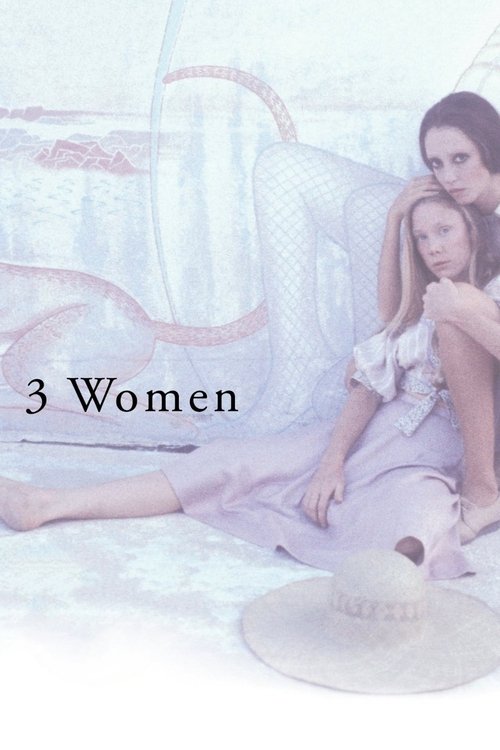
3 Women
1977 · Robert Altman
For when you want a film to chew on for days — a late-night, lights-off watch that trades answers for atmosphere. This is a challenge, not comfort food, and it's best when you're willing to let it stay strange.
What it's about
At a geriatric spa in the California desert, chatty Millie takes the new girl Pinky under her wing, and the two become roommates in a garish apartment complex where a silent third woman paints strange murals by the pool. What starts as an odd-couple friendship slides into something stranger, as the line between the two women's personalities begins to blur. It's a story about identity — who you copy, who you become — told with the logic of a dream.
The experience
Slow, sun-bleached, and quietly eerie, it works on you like heat haze: nothing jumps out, but the ground keeps shifting. You come out unsettled and a little hypnotized, not sure what you just saw but sure it meant something.
Performances
Shelley Duvall is extraordinary as Millie — a self-invented woman whose nonstop patter can't hide how invisible she is to everyone around her — and Sissy Spacek matches her with an unnerving blankness that keeps flickering into something else. The two performances seem to trade places before your eyes.
The craft
Altman shoots the desert and its aqua pools in washed-out pastels, letting water, mirrors, and those uncanny poolside murals carry the mood while the story drifts on dream logic rather than plot. The sound design and woodwind score keep everything slightly underwater. A film of images and textures that rewards patience and a good screen.
Why it matters
One of the boldest experiments of 1970s American filmmaking, it became a cult touchstone for dreamlike, psychologically porous cinema and stands as proof of how far a major studio-era director could push into the irrational.
Snapshot
Robert Altman's 3 Women is one of the most genuinely strange and irreducible films to emerge from 1970s American cinema: a psychological dreamwork set in the bleached-out heat of the California desert, in which three women gradually dissolve into one another's identities. Two co-workers at a geriatric rehabilitation spa — the vain, chatterbox Millie Lammoreaux (Shelley Duvall) and the blank, wide-eyed newcomer Pinky Rose (Sissy Spacek) — become roommates; after Pinky's near-drowning in a garish apartment-complex pool, identity begins to bleed and transfer in ways the film refuses to explain. The third woman, Willie Hart (Janice Rule), a mural-painting desert recluse, circles both of them wordlessly. The result is less a psychological thriller than a sustained waking-dream about the instability of the self — femininity as a performance with no original performer behind it. 3 Women stands today as one of the defining achievements of New Hollywood, an auteur film made on instinct and nerve that has grown steadily in critical stature since its release.
Industry & production
Altman arrived at 3 Women by an unusual route even by his own unpredictable standards: he has stated in multiple interviews that the film originated in a dream he had during a period in which his wife was seriously ill in hospital. In that dream he already saw the casting — Duvall and Spacek, both of whom he knew — and the desert setting. He developed the screenplay himself, working largely without a conventional narrative blueprint. The result is one of the rare cases in American commercial cinema where a director's account of a work's origin is borne out by the finished film: 3 Women has the associative logic, the narrative ellipsis, and the emotional certainty of remembered dreams rather than constructed plots.
The film was produced by Lion's Gate Films — the original, Altman-associated company, distinct from the later Canadian major — and distributed by 20th Century Fox. It was made on a relatively modest budget by the standards of mid-1970s studio production, which suited Altman's preference for working quickly, on location, with a close collaborator unit. Shooting took place primarily in the Coachella Valley and the Palm Springs area of California, where the arid landscape, low-slung apartment complexes, and retirement-community isolation provided the film's distinctly American weirdness: a nowhere of sun, concrete, and conspicuous leisure. The production used the Aztec Hotel pool and surrounding facilities as the primary location for the apartment complex that anchors the film's central section.
Technology
The film was shot in anamorphic Panavision, a format Altman had come to trust as a vehicle for compositions of unusual lateral complexity — the wide frame allowed him to layer figures and background detail in ways that compress or isolate characters within a single shot. The combination of desert glare and the high-saturation, slightly garish palette of the locations demanded careful control of exposure; cinematographer Chuck Rosher Jr. managed a difficult tonal range between blinding exteriors and the interior murk of the apartment. The processing and color timing reflect a characteristically 1970s American palette — warmer than European art cinema, more anxious than classical Hollywood — which sits perfectly with the film's emotional temperature.
Gerald Busby contributed the score, a piece of contemporary classical music characterized by sustained tones, dissonance, and gradual harmonic drift rather than conventional melodic themes. The score is integral to the film's texture: it functions less as emotional commentary than as environment, maintaining a low-grade unease that matches the desert itself. The sound design more broadly — ambient wind, the slap of pool water, the hollow echo of corridors — is handled with the same atmospheric seriousness. Altman was consistently one of the most sophisticated practitioners of multi-track sound in American cinema, and even in a relatively quiet film like 3 Women, the sonic architecture is carefully constructed.
Technique
Cinematography
Chuck Rosher Jr.'s work in 3 Women is among the most accomplished desert-location cinematography of the 1970s. He uses the Panavision frame to produce compositions that are frequently uncomfortable: figures placed at odd distances from one another, negative space that feels threatening rather than restful, the swimming pool lurking as a horizontal rupture in nearly every exterior shot. The camera often moves slowly, almost imperceptibly, creating an impression of surveillance that becomes overtly relevant once identity-transfer begins. In the film's key sequences — particularly Pinky's drowning and its aftermath — the cinematography tilts toward expressionism without abandoning its location realism: the camera floats, circles, holds in ways that feel simultaneously observational and hallucinatory.
Editing
The editing, by Dennis Hill, works against conventional narrative momentum. Scenes do not resolve so much as stop; transitions between sequences can feel unmotivated or abrupt in ways that initially register as ellipsis and eventually as something more epistemological — the gaps are where identity shifts, and the cutting refuses to dramatize them. The film's rhythm is slow but not stately: it has the quality of a dreamer who cannot quite catch up with what they are watching.
Mise-en-scène / staging
The film's central spatial element is the apartment complex's swimming pool, whose bottom is decorated with large primitive murals — painted specifically for the film — depicting archaic, vaguely threatening figures, male bodies looming over prone or crouching female forms. The murals appear in nearly every exterior sequence, visible through the water, shifting in color with the light. Their presence is never explained and never needs to be: they function as the film's unconscious made visible, the mythological substrate underlying the social performance happening above ground. Altman's staging consistently places characters in relation to this painted underworld — above it, falling into it, recovering from it — without ever making the symbolism schematic. The apartment complex itself, with its coded color scheme, its carefully maintained social rituals, and its total absence of privacy or interiority, is staged as a kind of society in miniature, all performed identity and no revealed self.
Sound
Busby's score and Altman's ambient sound design work in tandem throughout. The desert wind is almost constant, producing a background hiss that blurs the boundary between location sound and musical texture. Dialogue — and 3 Women is a film in which dialogue carries unusual social weight, since Millie talks compulsively and Pinky and Willie barely speak at all — is mixed at a naturalistic level, neither amplified for drama nor distanced for irony. The sonic transformation of Pinky's character after the drowning is subtle but consistent: where previously she whispered and trailed off, she begins to inhabit vocal space with new confidence, as if she has borrowed not only Millie's identity but Millie's relationship with the air.
Performance
Shelley Duvall's Millie is one of the great comic-pathetic performances of American cinema: a woman of relentless, aggressive cheerfulness whose social scripts are transparently hollow but whose need behind them is achingly real. Duvall's physicality — her angular frame, her rangy, slightly awkward movement, her voice — makes Millie instantly legible as someone performing femininity from a manual she only half-understands. Sissy Spacek's Pinky begins as something close to pure receptivity, a blank surface that records and replays stimuli without processing them, and then — after the drowning — becomes something harder to name: a new person constructed from borrowed material. The precision of Spacek's physical transformation across the film is remarkable, a performance built of small muscular adjustments rather than dramatic gestures. Janice Rule's Willie says almost nothing and is given almost nothing conventional to act; her presence operates as pure atmosphere, and Rule manages to make this theatrically compelling.
Narrative & dramatic mode
3 Women refuses the conventions of psychological thriller even as it exploits them. Altman establishes the preconditions for a conventional narrative — a suggestible, impressionable young woman attaches to a dominant older one; something violent disrupts the relationship; the aftermath is strange — and then systematically withholds the explanatory machinery that genre would provide. There is no revealed pathology, no backstory that accounts for the dissolution of identities, no return to a prior stable state. The film ends in a configuration that has no clear relationship to any character's original desires or trajectory. What Altman dramatizes is less a psychological event than an ontological one: the possibility that selfhood is contingent, assembled rather than given, and that under the right pressure it can simply transfer. The mode is closest to what would now be called literary surrealism — a realistic surface that opens onto an irrational depth — but Altman achieves this without any of the stylistic signals (distortion, unreliable narration, explicit fantasy sequences) that usually mark the genre. The dream happens in broad daylight, in real locations, between people who seem entirely ordinary.
Genre & cycle
3 Women belongs to a loose, international cycle of films concerned with the dissolution of female identity — a cycle that has Ingmar Bergman's Persona (1966) as its defining prior text and that extends through European art cinema into American independent and prestige production of the 1970s and beyond. Within American cinema, it sits alongside a group of films from the same period (roughly 1970–1980) that used the psychological study of women as a vehicle for formal experiment: Images (Altman, 1972), The Conversation (Coppola, 1974), various films by John Cassavetes. It is also, laterally, a film about the American Southwest as a zone of existential blankness — sharing that concern with Zabriskie Point (Antonioni, 1970) and anticipating a body of desert-set American strangeness that runs through the 1980s and 1990s.
Authorship & method
Altman's authorial method in 3 Women is more concentrated and less collaborative — in the structural sense — than his ensemble works. The screenplay is entirely his own, developed from the dream narrative, and the film does not rely on the overlapping improvisation, multi-track audio, and orchestrated chaos of Nashville (1975). What it shares with his larger body of work is his characteristic skepticism about performance, social role, and American self-construction; the willingness to let scenes end without resolution; and his deep comfort with ambiguity as a permanent condition rather than a problem to be solved. Chuck Rosher Jr. had worked with Altman previously and understood the director's preference for unobtrusive camera work that nonetheless maintains a consistent visual intelligence. Gerald Busby — a contemporary classical composer who had not previously scored a major film — was brought in specifically for the distinctiveness of his harmonic language, and his score sounds unlike anything else in Hollywood cinema of the period.
Movement / national cinema
3 Women is an American film, but its relationship to mainstream American cinema is adversarial. It belongs, temperamentally and formally, to the tradition of European art cinema as much as to Hollywood: its debt to Bergman and Antonioni is visible on the surface. Within American cinema, it represents the furthest edge of what New Hollywood was willing to finance and distribute — a major-studio-distributed film with no conventional narrative resolution, no sympathetic identification, and no generic comfort. It is also, underneath its European formal influences, a deeply American film in its subject matter: the California desert, the retirement-community landscape, the relentless pressure of social performance, the absence of any sustaining tradition. It could not have been set anywhere else.
Era / period
The film arrives at the peak of New Hollywood's ambition and, in retrospect, near the beginning of its end. Star Wars was released the same year, beginning the industrial shift away from director-driven, ambiguity-tolerant adult cinema toward high-concept franchise product. 3 Women thus sits at a hinge point: it is only possible because of the conditions that New Hollywood briefly created, and those conditions were already dissolving around it. The film's release in 1977 places it in a brief window when a major American distributor would stake money on a director's personal dream narrative with no conventional story.
Themes
Identity is the film's explicit and total subject: what it is, how it is constructed, whether it belongs to anyone. Altman stages the question through the specific lens of femininity, which he presents as a set of social performances with no authentic core — Millie's relentless cheerfulness, her carefully memorized recipes and décor preferences and social scripts, her total absorption in the project of being a certain kind of woman, all suggest that the self she presents is something she has assembled from available cultural materials, rather than expressed from within. When Pinky appropriates this assembled self, the horror is that it fits — not because Pinky is Millie, but because Millie was never more than an assembly in the first place. Willie's muteness and her underground paintings suggest a third possibility: a self that has retreated entirely from social performance into private mythology, at the cost of communication. The film also dwells on loneliness and the violence of American social isolation — the retirement community, the apartment complex, the desert town are all places where people perform sociability over a void of genuine connection.
Reception, canon & influence
3 Women received strong critical attention on its initial release. Shelley Duvall won the Best Actress prize at the Cannes Film Festival in 1977, one of the few major award recognitions a film of this strangeness has received at the commercial-festival level. American critics were divided, as they generally were with Altman's more experimental work: the film's admirers praised its courage and its evocative power; those less persuaded found its refusal of conventional narrative satisfaction frustrating. Pauline Kael, the period's most influential American critic, was an Altman advocate in general but her response to 3 Women specifically was more qualified.
Looking backward, the film's debts are primarily to Bergman's Persona — the dyadic relationship between a talkative and a silent woman, the dissolution of the boundary between them, the surrealist climax — and, more diffusely, to the atmospheric existentialism of Antonioni. There is also something of Carl Jung's concept of the anima and of archetypal femininity in the film's structure, though whether Altman had this consciously in mind or arrived at similar patterns through his dream origin is impossible to determine from the available record.
Forward, the film's influence is less traceable through direct acknowledgment than through structural resemblance. David Lynch's Mulholland Drive (2001) is the film most consistently discussed in relation to 3 Women: it shares the desert-California setting, the central female dyad, the identity transfer, the dreamlike narrative logic that refuses paraphrase. Darren Aronofsky's Black Swan (2010) belongs to the same loose family. 3 Women has also been a persistent reference point in feminist film theory, particularly in discussions of the performance of femininity and the question of whether women's identity can be represented in conventional narrative forms. The film was released by the Criterion Collection, which has materially contributed to its status as a canonical work of world cinema — one of the small number of American films from the period that genuinely belongs to the international art-cinema tradition rather than simply borrowing from it.
A Deleuzian reading
There is a swimming pool at the center of 3 Women, and someone has painted the bottom of it.
The full Deleuzian reading of 3 Women →
Reception
Baffled audiences and did little business in 1977 despite champions like Roger Ebert, then spent decades nearly impossible to see — the 2004 Criterion release turned it from rumor into a bona fide rediscovery, and it's now widely ranked among Altman's very best.
How 3 Women was received, from release to now →
Influences: the films it descends from and the films it influenced
- Persona (1966) — The formal template of a talkative woman and a mute woman whose psychic boundaries progressively dissolve — including the surrealist rupture where the film itself appears to break down — is the direct structural source for 3 Women's identity-exchange narrative and dream-climax; Altman explicitly acknowledged this debt and the dyad-merging architecture is reproduced at the level of scene construction, not just theme.
- L'Avventura (1960) — Antonioni's technique of ending scenes without conventional dramatic resolution and staging barren architectural and landscape space as an index of characters' interior psychic states — rather than as neutral backdrop — is absorbed into 3 Women's elliptical cutting and its treatment of the desert as a projection of the women's shared unconscious.
- Images (1972) — Altman's own earlier experiment with a female protagonist experiencing identity collapse — using Stomu Yamash'ta's percussive score and dreamlike narrative intrusions (a dead husband who may be hallucinated) to externalize psychic disintegration — is the direct workshop in which he developed the formal strategies he would concentrate and refine for 3 Women five years later.
- Belle de Jour (1967) — Buñuel's technique of inserting fantasy sequences into the waking narrative without optical or editorial demarcation — so the viewer cannot determine which register is 'real' — is the literary-surrealism model for 3 Women's dream-logic, which refuses to mark the boundary between Pinky's waking perception and the nocturnal pool visions.
- Daisies (1966) — Two young women who perform femininity as an exchangeable, destabilizing game — progressively collapsing the distinction between their identities through deliberate role-swapping and anarchic self-invention — establishes the formal treatment of femininity-as-mutable-performance that 3 Women deepens into sustained psychological uncanny.
- Repulsion (1965) — The systematic use of ambient sound design — dripping, scraping, indeterminate surface noise — as the primary register of a female character's psychic dissolution anticipates 3 Women's approach, where Gerald Busby's score and the ambient desert sound layer function together to make feminine interiority audible rather than legible.
- Mulholland Drive (2001) — Lynch adopts the desert-California setting, the female dyad of aspiring ingénue and established woman, and the dream-logic structure in which a second narrative retroactively reframes all prior action as fantasy projection — directly extending 3 Women's identity-dissolution architecture into Hollywood's mythologies of self-invention and erased origin.
- Possession (1981) — Żuławski extends 3 Women's use of extreme physical performance as the register for female identity disintegration: Adjani's bodywork in the subway tunnel sequence takes the physical-transformation/comic-pathetic mode of Duvall's Millie — humiliation made physical — to its maximum expressive intensity, where the body itself becomes the site of psychic replacement.
- Safe (1995) — Haynes uses the same surveillance-style cinematographic strategy — holding the female protagonist at medium-long distance within geometrically precise suburban California spaces, the camera observing without intimacy — to render female identity as simultaneously watched and opaque, extending 3 Women's visual grammar of feminine dissolution to the registers of environmental illness and self-erasure.
- The Piano Teacher (2001) — Haneke positions a contemporary classical composer's music — performed diegetically by the protagonist — as both the structuring frame and the psychological externalizer of a woman's repressed and fractured identity, directly paralleling Altman's use of Gerald Busby's contemporary classical score; the technique of treating new-music performance as a symptom of femininity-under-pressure is 3 Women's inheritance.
- Black Swan (2010) — Aronofsky adapts 3 Women's central technique of staging identity dissolution through physical transformation: Matthew Libatique's handheld surveillance camera tracks the body itself as the site where one woman's self is replaced by another's, and the doubling structure — repressed understudy absorbs and displaces the established star — is 3 Women's identity-transfer mechanism transposed into classical-ballet performance.
- Inland Empire (2006) — Lynch extends 3 Women's dream-logic narrative principle to its structural limit: identity is transferred between actress, role, and viewer without any stable referent remaining, using video-texture degradation in place of Altman's anamorphic widescreen but preserving the core technique of narrative as unreliable psychological projection with no authoritative waking layer to return to.
- The Virgin Suicides (1999) — Ed Lachman's anamorphic cinematography and Coppola's surveillance structure — adolescent boys observing the Lisbon sisters at a distance, femininity visible but fundamentally opaque — extends 3 Women's formal treatment of female identity as performance-for-an-observing-eye that cannot be decoded; Air's electronic score functions as a contemporary classical frame analogous to Busby's, rendering the women's interiority as sound rather than psychology.
- The Long Goodbye (1973) — Vilmos Zsigmond's continuously restless zoom lens and surveillance-style camera movement — the eye perpetually reframing without the characters' awareness, holding them at an ironic observational distance — is the cinematographic technique Chuck Rosher Jr. extends and applies to 3 Women's pool and desert spaces, producing the same sense of watched-but-unknowable femininity.
- Nashville (1975) — The multi-track overlapping sound-recording system Altman and sound designer Jim Webb developed for Nashville — simultaneously capturing ambient noise, overheard dialogue fragments, and score across eight channels — is the direct technical infrastructure inherited by 3 Women's layered ambient-sound-design, though applied here to a concentrated two-person register rather than an ensemble.
- Picnic at Hanging Rock (1975) — Russell Boyd's anamorphic widescreen uses shallow focus and slow drifting camera movement to render the Australian landscape as a dreamlike psychic force that literally absorbs and dissolves female characters — a parallel formal solution to Rosher's desert cinematography in 3 Women, where the Californian landscape functions as both setting and unconscious threat.
- That Obscure Object of Desire (1977) — Released the same year, Altman independently deploys identity-transfer between two women as a formal argument that female character is projection rather than stable self; both films arrive simultaneously at desire-as-projection as their structuring thesis, deploying the device in opposite genre registers — dreamlike in Altman, comedic in Buñuel.
- The Face of Another (1966) — Descendant of the identity-transfer chamber film: personalities bleeding and swapping between characters, carrying the Persona/Teshigahara inquiry into whether the self survives the loss of its face.
- Face to Face (1976) — A dream-sourced study of feminine identity dissolving, using surreal interior tableaux and close observation of the face to render psychic disintegration in the same year.
Similar films
- Persona (1966) — influence & lineage · same viewing thread
- Nashville (1975) — influence & lineage · often watched together
- The Long Goodbye (1973) — influence & lineage
- Mulholland Drive (2001) — influence & lineage
- Inland Empire (2006) — influence & lineage
- Interiors (1978) — same viewing thread
- Last Year at Marienbad (1961) — same viewing thread
- Face to Face (1976) — same viewing thread
All the films related to 3 Women →
Watch it with: curated runs of related films
- The Fractured Self — A run of art films where identity, memory, and sanity refuse to stay solid — watch them near each other and the faces, silences, and doublings start to rhyme.