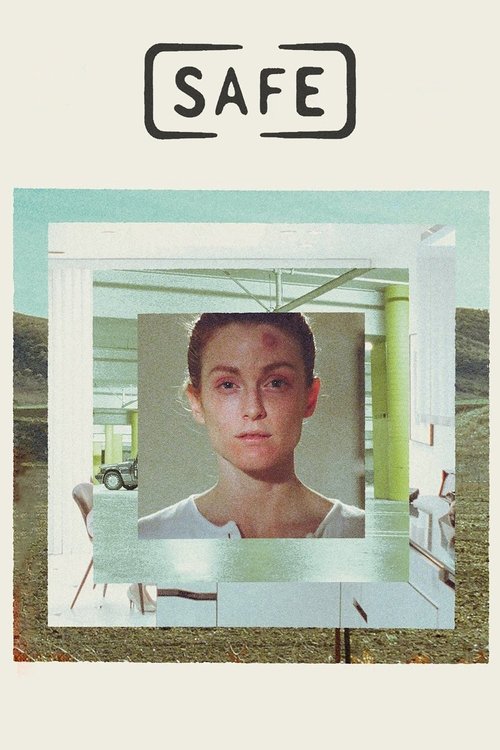
Safe
1995 · Todd Haynes
For when you want a slow-burn film to chew on — an unnerving puzzle about illness, wellness culture, and modern life that trusts you to sit with ambiguity. Definitely a challenge, best when you're in the mood to think.
What it's about
Carol White is an affluent San Fernando Valley homemaker in the late 1980s — new furniture, aerobics, a placid marriage — who starts getting sick, and no doctor can say why. She comes to believe she's allergic to the modern world itself: fumes, chemicals, the air of her own life. Her search for an answer leads her out of the suburbs and into a New Age desert retreat for the 'environmentally ill,' where the promised cure may be its own kind of trap.
The experience
Cool, eerie, and quietly suffocating — the camera keeps its distance, the pastel rooms hum with dread, and the film refuses to hand you an explanation. It's less scary than deeply unsettling, and it lingers for days.
Performances
Julianne Moore, in an early career-defining role, does something remarkable: she plays a woman with almost no interior vocabulary, disappearing physically and vocally as Carol fades — a performance built from smallness rather than fireworks.
The craft
Todd Haynes frames Carol in wide, immaculate compositions that make her own home feel like a showroom she's trapped in, while the sound design turns everyday hums and drones into low-grade menace. It's horror-movie grammar applied to suburban drama, and it's chilling without a single conventional scare.
Why it matters
Read on release as a parable of the AIDS crisis and a takedown of blame-the-patient wellness culture, it has only grown in stature — regularly ranked among the best American films of the 1990s, and the start of one of cinema's great actor-director partnerships.
Snapshot
Safe is Todd Haynes's second feature, a clinically composed drama about Carol White (Julianne Moore), an affluent San Fernando Valley homemaker who develops a debilitating, undiagnosable illness she comes to understand as an allergy to her environment — to fumes, chemicals, the modern material world itself. The film tracks her from a numbly comfortable suburban existence in 1987 through escalating physical crisis and into Wrenwood, a New Age desert retreat for the "environmentally ill" presided over by a self-help guru. Cool, withholding, and formally severe, Safe refuses the catharsis of either a medical explanation or a spiritual cure, leaving Carol — and the viewer — suspended in ambiguity. Widely read on release as an oblique parable of the AIDS crisis and a critique of the wellness industry's blame-the-patient logic, it has since become one of the most esteemed American films of the 1990s, anchored by Moore's breakthrough performance. In 1999 the Village Voice critics' poll named it the best film of the decade.
Industry & production
Safe was produced within the American independent ecosystem that defined the early-to-mid 1990s, a collaboration between Christine Vachon's company (the producing partnership that would soon crystallize as Killer Films) and James Schamus and Ted Hope's Good Machine, with backing that included British television money via Channel Four and the involvement of American Playhouse. This is the same low-budget, producorially scrappy world that incubated the New Queer Cinema; Vachon had already produced Haynes's debut Poison (1991) and would remain his closest production partner for decades. The budget was modest — reported figures place it around the low single-digit millions — and the film bears the marks of resourceful independent production: a small number of locations, a compact shoot, and a reliance on precise design rather than spectacle.
Safe premiered at the Sundance Film Festival in January 1995, where its austerity divided audiences accustomed to the more ingratiating indie fare of the era, and was acquired and released by Sony Pictures Classics later that year. Commercially it was a niche art-house title rather than a hit; its cultural weight accrued through criticism and reputation rather than box office, and I would caution against citing precise grosses, which are not reliably documented. The film's importance to the careers it touched — Haynes, Vachon, and especially Moore — far exceeded its theatrical footprint.
Technology
Safe was shot photochemically on 35mm, in keeping with mid-1990s independent practice, and its technological character lies less in any novel apparatus than in the disciplined conventionality of its tools turned to estranging ends. Haynes and his cinematographer use the standard kit of the period — dollies, long lenses, sodium and fluorescent practical light sources native to the Valley interiors — to manufacture a sense of antiseptic unease. The film's most pointed "technological" subjects are diegetic: the off-gassing consumer surfaces of late-1980s domestic life (perms, hairspray, dry cleaning, new couches, exhaust, pesticide), and later the medical and pseudo-medical instruments of diagnosis and treatment, from allergy testing to the oxygen tank and the hermetic porcelain "igloo" Carol retreats into at Wrenwood. The film treats the built environment itself as a hostile technology.
Technique
Cinematography
The cinematography, by Alex Nepomniaschy, is the film's signal achievement and the engine of its dread. The dominant strategy is distance and stillness: Carol is repeatedly framed in wide, static or near-static shots that swallow her in domestic and institutional space, a small figure marooned in the geometry of rooms, hallways, and parking structures. The camera frequently holds at a remove rather than cutting in for the reassurance of a close-up, denying the viewer easy identification and emphasizing Carol's smallness within systems larger than herself. Compositions exploit negative space and architectural symmetry; light is often flat and cool, the palette drained toward beige, teal, and sickly fluorescent green. Slow, deliberate camera moves — a creeping push-in, a quiet reframe — replace conventional coverage. The effect is closer to surveillance or to the formal horror of Kubrick than to the warm intimacy typical of the period's character drama, and it makes the ordinary suburban interior feel uncanny and faintly malignant.
Editing
The editing, by James Lyons — Haynes's frequent collaborator and a crucial creative voice across his early films — is patient and withholding. Scenes are allowed to run past the point of dramatic comfort; the long take is honored, and cuts tend to arrive a beat later than narrative convention would dictate, stranding the viewer in dead time. The rhythm is deliberately enervating in the first act, mirroring the anesthetized routine of Carol's life, before the illness introduces ruptures. Crucially, the cutting refuses to dramatize "turning points" with emphatic montage; even Carol's most alarming physical episodes are framed at a remove and not sensationalized through rapid editing, which preserves the film's clinical ambiguity.
Mise-en-scène / staging
Production design (David Bomba) and staging carry much of the film's meaning. Carol's home is a study in upscale Valley blandness — coordinated neutrals, plush furniture, a fortress of comfort that the film reframes as a sealed, airless trap. Objects acquire menace: the new black sofa that arrives "wrong," the milk, the fruit, the exhaust of freeway traffic. Costuming keeps Carol in soft, muted tones that camouflage her against her surroundings, visualizing her lack of selfhood. The second half relocates to Wrenwood, whose rustic, sun-bleached desert architecture and hand-lettered affirmations offer a different but equally controlling vocabulary of space. Haynes stages bodies within these environments to stress isolation — characters held apart within the frame, conversations played across distances — so that the décor itself seems to act upon Carol.
Sound
Sound is among the film's most underrated weapons. The mix foregrounds the low ambient hum of modern life — air conditioning, traffic, appliances, fluorescent buzz — turning the everyday soundscape into a source of subliminal threat. Ed Tomney's score is sparse, electronic, and ominous, closer to the drones and unease of horror than to the strings of melodrama; it surfaces at intervals to pull the floor out from under otherwise placid scenes. Dialogue is often flat, banal, and emotionally muffled, especially in the wellness-speak of Wrenwood, where therapeutic vocabulary curdles into menace. The interplay of oppressive ambient sound and chilly synth score is central to the film's atmosphere of contamination.
Performance
Julianne Moore's performance as Carol is a landmark of recessive acting. She builds the character out of vagueness — a thin, breathy voice, half-finished sentences, a faintly apologetic smile — so that Carol reads as a person without a stable interior, formed entirely by the expectations around her. As the illness takes hold, Moore renders deterioration through subtle physical means: pallor, breathlessness, a nosebleed, a seizure-like collapse, a body visibly shrinking inside its clothes. She withholds the usual signposts of "great acting," refusing big emotional release, which makes Carol both heartbreaking and unknowable. The supporting cast — Peter Friedman as the HIV-positive Wrenwood guru Peter Dunning, whose serene self-help rhetoric carries a coercive undertow, and Xander Berkeley as Carol's oblivious husband — work in a similarly muted register that keeps the film's irony intact.
Narrative & dramatic mode
Safe operates in a deliberately anti-melodramatic mode: it has the raw material of a disease-of-the-week weepie but systematically denies that genre's pleasures. There is no clarifying diagnosis, no medical vindication, no redemptive cure, and no reconciling embrace. The structure is roughly bipartite — the suburban descent into illness, then the Wrenwood "recovery" — but the second movement offers no relief, only a new ideology of self-blame dressed as empowerment. The film's controlling irony is that every framework offered to explain Carol's condition (medical, psychological, environmental, spiritual) is shown to be inadequate or self-serving, and Carol's apparent embrace of Wrenwood's doctrine in the devastating final scene — telling her own reflection "I love you" — registers as ambiguous to the point of horror rather than as triumph. The dramatic mode is one of sustained, unresolved suspension; the viewer is denied the interpretive safety the title ironically promises.
Genre & cycle
The film slips between genres by design. It is nominally a domestic drama, but its formal vocabulary — the dread, the malign environment, the body under invisible siege — borrows heavily from horror, and critics have aptly described it as a horror film in which the monster is modernity itself. It also functions as a subverted illness melodrama and as social satire, skewering both affluent Valley emptiness and the New Age wellness industry. Within Haynes's own development it belongs to his ongoing engagement with the conventions of melodrama (which he would address more directly in Far From Heaven), here approached through estrangement rather than pastiche. As a cycle marker, Safe sits within the early-1990s wave of formally ambitious American independent cinema and, more specifically, within the New Queer Cinema's expansion beyond explicitly gay subject matter into oblique allegory.
Authorship & method
Safe is a Todd Haynes film in the fullest authorial sense: he wrote the screenplay and directed, and the film extends the conceptual, theory-literate concerns of his banned-and-celebrated short Superstar: The Karen Carpenter Story (1987) and his debut Poison. Haynes's method is intellectual and structural — he begins from ideas about ideology, the body, and genre, then builds a rigorous formal system to embody them, refusing the humanist warmth that would resolve the film's questions. His key collaborators are essential to the result: editor James Lyons, a longtime partner whose patient cutting shapes the film's temporality; cinematographer Alex Nepomniaschy, who realized the distanced, architectural visual scheme; composer Ed Tomney, whose electronic score supplies the undertow of unease; and producer Christine Vachon, whose stewardship made the uncompromising film possible. Above all, the Haynes–Moore collaboration begins here and would continue across Far From Heaven (2002) and Wonderstruck (2017); their shared willingness to build a protagonist out of absence defines the film.
Movement / national cinema
Safe is an American independent film closely identified with the New Queer Cinema, the early-1990s movement (named by critic B. Ruby Rich) of formally adventurous, politically charged films by gay and lesbian filmmakers, of which Haynes — alongside the producing presence of Vachon — was a leading figure. Though Safe has no overtly gay characters, it is routinely read as a New Queer Cinema work because of its coded engagement with the AIDS epidemic and its critique of how illness gets moralized. Its art-cinema lineage is explicitly transnational, drawing on European modernism (see below), but its subject — the spiritual and physical sickness underlying American suburban prosperity — is pointedly national.
Era / period
The film is set in 1987, a date announced at the outset, and the period setting is doubly purposeful. It plants Carol's mysterious immune affliction squarely within the years of the AIDS crisis, inviting the allegorical reading without ever naming it, and it situates her amid the consumerist late-Reagan affluence whose surfaces the film treats as toxic. The production itself, in the mid-1990s, looks back on that recent moment with critical distance, and the wellness/self-help culture it satirizes at Wrenwood was a recognizable feature of the period's response to inexplicable illness — the rise of "environmental illness" and multiple chemical sensitivity as contested diagnoses, and the New Age tendency to locate the cause of disease in the patient's own psyche.
Themes
The film's central theme is the porousness and vulnerability of the body within a hostile modern environment — the dissolution of the boundary between self and world. Around this cluster several others: the ideology of self-blame, whereby Wrenwood's doctrine that "the only person who can make you sick is you" transforms compassion into a subtler cruelty; the emptiness of affluent suburban womanhood, with Carol as a self so thoroughly shaped by others that illness becomes her only authentic experience; and the inadequacy of all explanatory systems — medicine, psychology, spirituality — to account for suffering. AIDS hovers over the whole as an unspoken referent, less a one-to-one allegory than a structuring absence. The title's irony — the impossibility of safety, and the way the pursuit of it becomes its own form of sickness — governs every level of the film.
Reception, canon & influence
On release, Safe was a critics' film: divisive at Sundance and only modestly attended, but championed by influential reviewers who recognized its rigor and Moore's performance. Its canonization came swiftly and decisively when the Village Voice critics' poll voted it the best film of the 1990s in 1999, a verdict that has only hardened with time; it now appears regularly on lists of the greatest American films of its decade and received a Criterion release that confirmed its art-house standing.
Its influences run backward into European modernism and American genre. The static, durational portrait of a woman's domestic entrapment owes a clear debt to Chantal Akerman's Jeanne Dielman; the alienated framing and emotional flatness recall Michelangelo Antonioni's studies of modern anomie; the cold architectural dread and unsettling control evoke Kubrick; and the underlying engagement with the woman's melodrama looks to Douglas Sirk and Rainer Werner Fassbinder, filmmakers Haynes has long claimed. Forward, the film's legacy is substantial. It established Julianne Moore as a major dramatic actor and helped make possible her run of complex 1990s roles, including her work with Paul Thomas Anderson. It cemented the Haynes–Vachon partnership and the Killer Films model of director-driven independent production. More diffusely, Safe became a touchstone for a strain of patient, formally controlled American art cinema concerned with illness, alienation, and the suburban uncanny — a sensibility visible in the work of filmmakers drawn to slowness, ambiguity, and the refusal of catharsis. Its reputation as one of the defining American films of the 1990s rests on exactly the qualities that made it difficult on first contact: its coldness, its withholding, and its insistence that there is no safe place to stand.
A Deleuzian reading
The couch arrives wrong.
The full Deleuzian reading of Safe →
Reception
It divided critics and barely made a ripple at the box office in 1995, but by 1999 the Village Voice critics' poll had crowned it the best film of the decade — and its stock only climbed from there, with COVID-era viewers rediscovering it as eerily prophetic.
How Safe was received, from release to now →
Influences: the films it descends from and the films it influenced
- Jeanne Dielman, 23 quai du Commerce, 1080 Bruxelles (1975) — Real-time durational long takes that pin a woman inside fixed domestic frames and refuse dramatic emphasis — the static-wide, anti-melodrama grammar Safe inherits wholesale.
- Red Desert (1964) — A woman made literally ill by a toxic industrial environment, rendered through alienated framing and color-as-anomie — the template for environmental sickness staged as modernist landscape.
- The Shining (1980) — Symmetrical architectural compositions and slow steadicam push-ins that convert built domestic space itself into the source of dread, the formal device Safe borrows for its menacing interiors.
- All That Heaven Allows (1955) — The affluent-suburban women's melodrama whose excessive mise-en-scène indicts the home it depicts — the genre substrate Haynes coldly dismantles rather than fulfills.
- Ali: Fear Eats the Soul (1974) — Sirkian melodrama estranged through distanced doorway/window framings and recessive, flattened blocking — the Brechtian cooling of melodrama Haynes openly adopts.
- Repulsion (1965) — The apartment as expanding psychic prison built from menacing close-ups of domestic objects and a near-mute, recessive female lead charting bodily disintegration.
- Superstar: The Karen Carpenter Story (1987) — Haynes's own prior anatomy of a woman's body consuming itself under invisible social/ideological pressure — the same theory-driven 'protagonist built from absence' method.
- The Marriage of Maria Braun (1979) — Haynes adopts Fassbinder's compositional strategy of architectural entrapment—extreme wide shots in which the female protagonist is engulfed by domestic and institutional space, consistently framed at a distance that forestalls identification—along with a withheld-interiority performance mode for Julianne Moore modeled on Schygulla's method of suppressing emotional legibility in Maria Braun.
- The China Syndrome (1979) — Haynes deploys China Syndrome's institutional-palette grammar — clean fluorescent domestic and medical spaces that normalize environmental danger — and its suppression-register performance mode (Julianne Moore's Carol White as a figure whose body registers threat before her consciousness does), transposing nuclear anxiety into chemical-sensitivity contamination within spaces that look exactly as safe as a nuclear control room looks routine.
- Alphaville (1965) — Haynes adopts the clinical wide-angle cinematography of antiseptic domestic and institutional spaces as evidence of environmental totalitarianism, and Julianne Moore's near-absent affective register — a performance of progressive self-erasure — directly extends Alphaville's deadpan-opacity mode: the body as symptom of a system that has colonized interiority.
- 3 Women (1977) — Haynes uses the same surveillance-style cinematographic strategy — holding the female protagonist at medium-long distance within geometrically precise suburban California spaces, the camera observing without intimacy — to render female identity as simultaneously watched and opaque, extending 3 Women's visual grammar of feminine dissolution to the registers of environmental illness and self-erasure.
- Forever a Woman (1955) — A clinical, distanced study of a woman's failing body and the medical gaze upon it, inheriting Tanaka's unsentimental hospital observation.
- Far From Heaven (2002) — Direct continuation of the Haynes–Moore collaboration and full Sirk reconstruction, with Moore again constructing a protagonist out of withheld interiority and held framing.
- The Headless Woman (2008) — A bourgeois woman's dissociative drift after trauma assembled from off-center framing, dense ambient sound design, and a recessive performance that withholds all catharsis.
- Dogtooth (2009) — Architectural isolation and deadpan, recessive performance generating social satire through static-wide framing and negative space rather than overt commentary.
- Under the Skin (2013) — Body-environment porousness rendered via clinical distanced framing and an ambient electronic drone score that supplies unease as undertow, extending Safe's sound strategy.
- First Reformed (2017) — Ecological/environmental dread channeled through austere static framing, a slow push-in, and a programmatic refusal of release — the horror-of-modernity in withholding form.
- We Need to Talk About Kevin (2011) — The suburban uncanny built from menacing everyday objects, fractured ambient sound, and a mother's flattened, recessive affect in place of expository melodrama.
- Saint Maud (2019) — Body-horror of belief carried by a recessive lead, slow push-ins, and ambient drone, treating the porous, betraying body as Safe does its environmental illness.
- Carol (2015) — Establishes Haynes's interiorized soundscape and a performance style built on reduction and suppression, the affectless withholding Mara and Blanchett extend into held silences and indirection.
- Dark Waters (2019) — Haynes's own template of environmental illness invading the suburban home, here literalized from allegory into journalistic fact and shot by Lachman in the same clinical, static, desaturated mode.
- Kim Ji-young: Born 1982 (2019) — Supplies the clinical, distanced long-shot framing of a housewife whose body somatizes a diffuse social malaise, plus the against-type interiorized performance that withholds emotional legibility.
- Me and You and Everyone We Know (2005) — A woman held small inside wide, static, symmetrically composed frames of bleached San Fernando Valley domestic space, the camera's refusal to move toward her doing the work that close-ups would ordinarily do.
- White Noise (2022) — Renders environmental toxicity entirely through production design and framing — wide, held, unhelpfully distant compositions of consumer interiors that make the suburb itself the pathogen — the formal precedent for treating the supermarket and split-level home as the film's real subject.
- Cure (1997) — Contemporary horror-of-modernity constructed from negative space, low ambient drone, and architectural menace rather than shock — dread located in empty modern interiors.
- Happiness (1998) — Contemporary indie kin that renders suburban anomie through flat clinical lighting and static symmetrical compositions, refusing to editorialize over its heroine's hollowing-out.
- Sweetie (1989) — Uses clinical deep-focus framing to render suburbia as a sickening environment dwarfing a disintegrating woman, sharing Sweetie's strategy of letting composition diagnose repression.
- The Sweet Hereafter (1997) — Cinematography of withholding distance strands its protagonist in wide, depopulated frames and refuses the reassurance of psychological close-up.
- The Brood (1979) — Transposes the Somafree Institute into the Wrenwood retreat and holds it in long, static, symmetrically composed wides under flat fluorescent light, so the therapy-culture guru's explanation of the patient's symptoms becomes the horror — Cronenberg's clinical distance without prosthetics.
Similar films
- Far from Heaven (2002) — influence & lineage
- Carol (2015) — shared sensibility
- The Stepford Wives (1975) — shared sensibility
- The Ice Storm (1997) — shared sensibility
- Dark Waters (2019) — shared sensibility
- The Invisible Man (2020) — shared sensibility
- Interiors (1978) — shared sensibility
- Sorry, Baby (2025) — shared sensibility