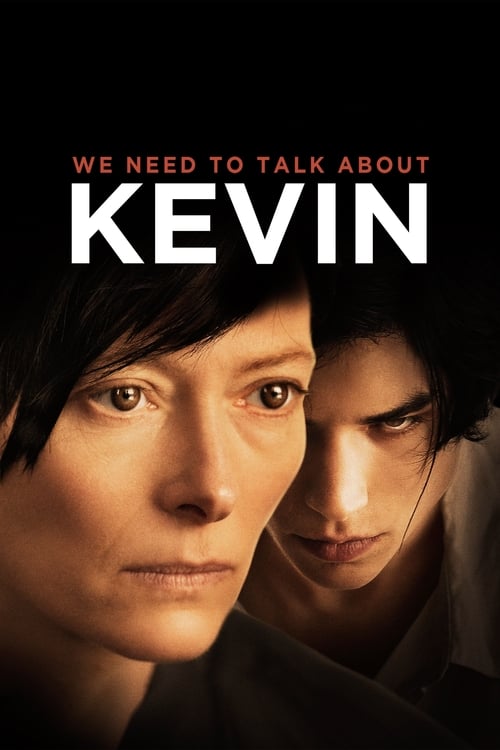
We Need to Talk About Kevin
2011 · Lynne Ramsay
For when you want a film to chew on for days and can handle real darkness — this is a challenge, not comfort viewing. Reach for it when you're ready to be haunted by a question with no answer.
What it's about
Eva was an adventurous, unwilling mother; her son Kevin was a difficult baby who grew into an unnervingly cold teenager — and then did something unforgivable. The film follows Eva in the aftermath, living as the town pariah while her memory sifts through fifteen years of their relationship, hunting for the moment it went wrong, or proof that it was wrong from the start. It's less a crime story than an autopsy of a bond between a mother and a child she could never quite love.
The experience
Suffocating and hypnotic — the dread builds through color, sound, and fragments of memory rather than plot, so you feel the catastrophe long before you understand it. It's quiet, slow, and genuinely hard to shake; expect to sit in silence when it ends.
Performances
Tilda Swinton is extraordinary as Eva — a whole performance built from guardedness and guilt, most of it happening behind her eyes. Ezra Miller makes teenage Kevin magnetic and chilling without ever tipping into cartoon villainy.
The craft
Lynne Ramsay tells the story almost musically: shattered chronology, saturated reds recurring like a bruise, and sound design that turns sprinklers and supermarket hum into menace. Very little is explained in dialogue — the film trusts images to carry the horror. Reward it with good speakers and your full attention.
Why it matters
It won the BAFTA for Outstanding British Film and confirmed Ramsay as one of the most distinctive filmmakers working — the rare film about school violence that critics still hold up as the way to approach the unapproachable.
Snapshot
We Need to Talk About Kevin is a British psychological drama adapted from Lionel Shriver's acclaimed 2003 epistolary novel of the same name. Starring Tilda Swinton as Eva Khatchadourian, the film reconstructs — in fractured, fragmented form — a mother's retrospective reckoning with her son Kevin, a child she could never fully love who grew into an adolescent capable of mass violence. Rather than dramatizing the act itself (a school crossbow attack), Ramsay centers the weight of the film on what surrounds it: the slow sensory accumulation of dread, the impossibility of explanation, the experience of surviving as the mother of a killer. The film premiered in competition at the 2011 Cannes Film Festival and won the BAFTA for Outstanding British Film, cementing Ramsay's reputation as one of the most singular — and uncompromising — voices in contemporary British cinema.
Industry & production
The project had a protracted gestation. Ramsay acquired the rights to Shriver's novel and spent years developing the script, a process that required significant structural translation: Shriver's novel is entirely epistolary, written as a series of letters from Eva to her absent husband Franklin, meaning the film had to reconstitute a first-person interior voice through purely cinematic means — image, sound, and fragmented time rather than literary confession. This formal challenge of converting an unreliable, letter-bound narrator into visual grammar became central to every aesthetic decision the film makes.
The production was a UK co-production backed by BBC Films and the UK Film Council among other financiers. The relatively modest budget was channeled into formal precision rather than scale. Tilda Swinton's attachment was essential to the film's viability: her particular quality of controlled interiority and corporeal strangeness made her the ideal vessel for Eva's traumatized consciousness, and her participation lent the project international prestige in the art house market.
Ezra Miller was cast as teenage Kevin, and his performance — coiled, eerily still, radiating predatory intelligence — announced a screen presence of unusual intensity. John C. Reilly plays Franklin, Kevin's father, whose cheerful, somewhat obtuse warmth is neither villainized nor entirely excused; his structural function is to make Eva's isolation more legible. The film does not adjudicate between Eva's perception and an objective truth: whether Kevin is genuinely sociopathic or whether Eva's ambivalent maternity has shaped and perhaps distorted her reading of him is left deliberately unresolved. Ramsay has spoken of the novel's central ambiguity as precisely what drew her to it.
Ramsay's career had been marked by a difficult decade before Kevin: she had been attached to adapt Alice Sebold's The Lovely Bones before that project passed to Peter Jackson, and various other developments stalled. Kevin marked a return after nearly a decade without a feature.
Technology
Cinematographer Seamus McGarvey shot the film on photochemical film stock, a choice consistent with Ramsay's preference for analog grain and the textural richness it affords. The stock contributed to the film's palette: a muted, desaturated world punctuated by insistent reds — tomato juice, Halloween paint, blood — which become the film's chromatic signature and thematic spine. Production design reinforced technological modesty: the film was shot largely on location and in practical spaces rather than built sets, grounding Eva's domestic and suburban environments in recognizable reality while allowing Ramsay's compositions and sound design to make that reality strange.
Technique
Cinematography
McGarvey's cinematography is organized around Eva's fractured interiority. Rather than a conventional observational mode, the camera frequently adopts tight, partial framings — a hand, a texture, a half-obscured face — that deny the viewer the orienting distance of a stable establishing shot. This compression of space mirrors the compression of Eva's psychology: the world as she experiences it is a series of sensory intrusions rather than coherent scenes.
The red motif is among the most discussed formal choices in the film's reception. La Tomatina footage that opens the film introduces red as carnivalesque and communal before the film slowly transforms it into something private and catastrophic. Tomatoes become paint; paint becomes blood. The progression is not announced but accumulated, so that by the time the film reaches its violence, the color has been so thoroughly saturated into the viewer's nervous system that it registers viscerally before it registers symbolically.
Long lenses compress the suburban spaces around Eva; wider lenses in domestic interiors create an oppressive flatness. Natural light dominates, and Ramsay and McGarvey resist artificial illumination that would impose emotional legibility onto scenes the film deliberately keeps ambiguous.
Editing
Joe Bini's editing is central to the film's achievement. The temporal structure is genuinely non-linear — not in the modish way that simply scrambles chronology for effect, but in a way that reproduces the associative logic of traumatic memory. Present-tense scenes (Eva's isolated, shamed existence in the aftermath of the attack) bleed into past-tense memories without conventional transitional devices. A color, a sound, a gesture splices two moments from very different points in time into something that feels continuous. The cuts are often disorienting rather than lyrical — designed to keep the viewer off-balance rather than meditative.
This editing owes a debt to Nicolas Roeg's fragmented montage, particularly Don't Look Now (1973), a film about grief and premonition that similarly refuses chronological comfort, and to the impressionistic editing practices of European art cinema more broadly. Bini, who worked with Werner Herzog on several projects, brought to Ramsay's material a structural adventurousness well matched to the narrative ambitions.
Mise-en-scène / staging
Ramsay's staging works consistently against the conventions of performance-centered drama, in which emotional scenes are mounted to maximize legibility and catharsis. Key moments are deflected, withheld, or placed in the periphery of the frame. The actual school attack is not shown directly; we learn of it obliquely, through sound and through its aftermath. This withholding is not coyness — it is a moral and aesthetic position. The film refuses to aestheticize the violence itself, placing the weight instead on what surrounds it: the making of a perpetrator, the survival of a mother.
The suburban American setting (though much of the film was shot in the United Kingdom and the United States) is rendered as a landscape of quiet menace — well-maintained exteriors concealing domestic failure. Ramsay is particularly attentive to the spatial politics of the family home, staging the cold war between Eva and Kevin in enclosed, claustrophobic interiors that amplify the sense of entrapment on both sides.
Sound
The sound design is among the film's most arresting achievements. Everyday sounds — the scrape of a fork, the slap of a wet cloth, a child's mechanical toy — are isolated, amplified, or distorted until they carry an almost physical discomfort. This follows a broader tradition of using domestic sound as psychological pressure (Chantal Akerman's Jeanne Dielman, 23 quai du Commerce, 1080 Bruxelles is a touchstone), but Ramsay pushes the register closer to horror.
The film deploys licensed music strategically and often ironically: Buddy Holly tracks are used with devastating effect, their bright, cheerful normalcy made uncanny against the film's imagery. Composed scoring is used sparingly and functions as texture rather than emotional direction, refusing to cue the viewer's responses through conventional melodic scaffolding. The film trusts the viewer to do the affective work without musical instruction.
Performance
Tilda Swinton's performance is the film's central axis and arguable the finest sustained achievement of her career. She plays Eva across several temporal registers — as a younger woman navigating a pregnancy she did not wholeheartedly want, as a mother caught in a cold war with her own child, and as a survivor processing catastrophe — and maintains consistent interiority across all of them without resort to conventional expressiveness. Much of what Eva feels is registered through minute muscular shifts, averted glances, the quality of stillness. Swinton's body becomes the film's primary instrument of meaning.
Ezra Miller as teenage Kevin performs a sociopathic composure that is deeply unsettling precisely because it is so controlled. He is never simply monstrous; there are moments of what might be need or pain beneath the surface, which is what keeps the character philosophically live and the film's central question genuinely open. The performers playing Kevin at younger ages sustain this essential ambiguity across the film's age-structure.
John C. Reilly provides necessary structural contrast: his cheerful paternal warmth is rendered neither as villainy nor as pure obliviousness, and his presence makes the abyss between what Eva perceives and what Franklin sees feel like a genuine epistemological problem rather than a simple dramatic irony.
Narrative & dramatic mode
The film operates in a mode of retrospective dread. Its primary temporal register is the aftermath — Eva's present-tense life of social ostracism, guilt, and damaged selfhood — into which memories surface involuntarily, following the logic of trauma rather than narrative convenience. This structure has precedent in literary modernism (Shriver's epistolary form draws on a long tradition of retrospective first-person confession) and in a film tradition running from Rashomon through Hiroshima mon amour to Don't Look Now.
Crucially, the film withholds resolution or catharsis. Eva is not redeemed; Kevin is not explained. The final exchange between mother and son — brief, spare, emotionally underdetermined — offers proximity without understanding. Ramsay refuses the consolations of psychological revelation: we do not learn why Kevin did what he did, and neither does Eva. The film's power derives precisely from this refusal.
Genre & cycle
We Need to Talk About Kevin participates in several overlapping generic cycles. It belongs to a small but significant group of films addressing school shootings and mass violence from non-perpetrator perspectives, of which Gus Van Sant's Elephant (2003) — itself a Palme d'Or winner — is the most prominent antecedent. Van Sant, influenced by Béla Tarr's long-take aesthetics, approached the subject through affectless procedural observation; Ramsay approaches it through traumatized maternal subjectivity. Together they define two very different formal responses to the same cultural wound.
More broadly, the film sits within the tradition of maternal melodrama — films that interrogate the social and psychological pressures on motherhood — but it systematically inverts the genre's consolations. Where the classical maternal melodrama (Stella Dallas, Mildred Pierce) offers sacrifice as a form of transcendence, Ramsay offers no such redemption. The film is also adjacent to the "bad seed" horror tradition, from Rosemary's Baby to The Omen, which uses the malevolent child as a vehicle for anxieties about heredity, fate, and maternal culpability. Kevin refuses to settle into horror's explanatory and cathartic mechanisms, remaining stubbornly within the register of the psychologically real.
Authorship & method
Lynne Ramsay trained at the National Film and Television School and whose career is characterized by long gaps between features and an uncompromising investment in sensory, non-narrative cinema. Her debut, Ratcatcher (1999), established her visual and thematic preoccupations: working-class environments rendered with lyrical precision, damaged children at the center, violence at the periphery rather than the foreground. Morvern Callar (2002) further developed her fragmented temporality and her interest in female interiority operating under social pressure.
Ramsay has spoken of her approach as essentially tactile — she is interested in what images feel like against the skin rather than what they communicate to the intellect. This produces a cinema that distrusts verbal and psychological explanation; her characters rarely articulate what is happening to them, because the films hold that experience exceeds articulation. Kevin is the fullest expression of that method.
Seamus McGarvey had established himself across a wide range of productions — from Joe Wright's Atonement (2007) to Stephen Daldry's The Hours (2002) — and brought a painterly sensibility that complemented Ramsay's fragmented approach. Joe Bini's structural adventurousness proved well matched to the project's ambitions. The screenplay, adapted from Shriver's novel by Ramsay, undertook the formidable task of converting an epistolary interior into visual grammar — replacing the novel's confessional letters with the film's associative image-stream.
Movement / national cinema
The film occupies an interesting position in British cinema: a UK production with a primarily American subject, directed by a Scottish filmmaker in the tradition of European art cinema, starring a British actress whose career bridges art house and mainstream international film. It sits within a period of relative formal ambition in British film — a generation of filmmakers willing to work at the intersection of literary adaptation and visual experiment — while its deepest aesthetic affiliations lie with continental European auteur cinema rather than any specifically British tradition.
Ramsay's work is best understood within a pan-European sensory cinema lineage — fragmented temporality, elliptical narrative, trust in image and sound over language — that owes as much to Bresson, Tarkovsky, and Akerman as to any British national cinema. Kevin is Scottish only in its director's sensibility; it is pan-European in its formal commitments and internationally distributed as art cinema.
Era / period
The film was made and released in the aftermath of more than a decade of cultural reckoning with school shootings in the United States — Columbine (1999) had defined a generation's sense of social rupture — and sits within a broader post-millennial turn toward what might be called the cinema of difficult endurance: films that refuse catharsis, complicate identification, and occupy morally unresolved positions. The early 2010s saw significant international art cinema (Amour, Caché, 4 Months 3 Weeks and 2 Days, A Separation) that demonstrated audiences and critics were prepared for feature-length moral discomfort. Kevin belongs to this moment.
Themes
The film's central preoccupation is maternal ambivalence — the experience of a woman who does not feel what she is supposed to feel for her child, and who can never resolve whether her failure of love produced the catastrophe or was merely its helpless witness. This theme was radical at the time of Shriver's novel and remains so: the film refuses to pathologize Eva's ambivalence or to deploy it as simple explanation, treating it instead as a human complexity that social convention suppresses and that catastrophe violently exposes.
Adjacent themes include: the gap between social performance and interior experience (Eva performs maternal love without fully possessing it); the nature/nurture problem as it pertains to violence (whether Kevin's capacity for destruction was innate or conditioned is never resolved); the asymmetry of knowledge within families (Franklin's blindness as structural rather than willful); and the experience of collective guilt by association, which Eva's post-attack existence dramatizes with particular precision. The film is also, quietly, about female psychology under social pressure. Eva is punished — by Kevin's knowing gaze, by Franklin's incomprehension, by her community's post-attack hostility — for failing to perform femininity correctly. Her ambivalence toward motherhood is the original transgression for which everything else reads as punishment, whether or not the punishment is proportionate to the sin.
Reception, canon & influence
The film received strong critical response at its Cannes premiere and was widely praised for Swinton's performance and Ramsay's formal control. It won the BAFTA for Outstanding British Film in 2012; Swinton received a BAFTA nomination and a Golden Globe nomination for her performance. The film was not a wide commercial release, playing primarily in art house contexts, and verifiable box-office figures for the international run are not widely cited in the scholarly record.
Influences on the film. The most direct antecedent is Shriver's novel, which Ramsay has cited as the source of the film's irreducible moral ambiguity — she was drawn specifically to its refusal to explain Kevin. Nicolas Roeg's Don't Look Now is legible in the temporal fragmentation and the treatment of grief as a state that dissolves chronology. Chantal Akerman's Jeanne Dielman provides a model for using domestic sound and domestic space as vectors of female psychological compression. Terrence Malick's impressionistic approach to memory — particularly in Badlands and Days of Heaven — informs the film's elliptical image-making. Gus Van Sant's Elephant establishes an aesthetic and ethical context for a film about a school shooting that refuses to narrativize or explain. Stanley Kubrick's The Shining contributes to the film's formal vocabulary of domestic dread and malevolent childhood, particularly in its use of enclosed spaces and the child who sees more than adults acknowledge.
Legacy and influence. We Need to Talk About Kevin has become a touchstone in discussions of maternal ambivalence in cinema and continues to circulate on syllabi in feminist film criticism and art cinema surveys. It contributed to a broadened conversation about what "difficult" subject matter could look like in British prestige cinema, and it established Ezra Miller as a screen presence of unusual intensity. Ramsay's subsequent feature, You Were Never Really Here (2017), consolidated her position as a major auteur and confirmed that the formal strategies of Kevin — fragmented temporality, sensory accumulation, the subjective experience of trauma bypassing conventional narrative — were not accidents of adaptation but the consistent method of a mature filmmaker. Kevin remains the film most widely cited when Ramsay's work is discussed, and Swinton's performance retains the status of a landmark in British screen acting of the period.
A Deleuzian reading
Start with the red.
The full Deleuzian reading of We Need to Talk About Kevin →
Reception
It premiered in competition at Cannes 2011 to strong reviews, with the conversation quickly becoming about Tilda Swinton's awards run — and her much-protested Oscar snub. Since then it's only grown, becoming the Ramsay film everyone has seen and a fixture of 'films that will ruin your week' lists.
How We Need to Talk About Kevin was received, from release to now →
Influences: the films it descends from and the films it influenced
- Persona (1966) — Establishes the extreme close-up of a woman's face held past comfort as a formal grammar for psychological dissolution — Ramsay inherits this language for Swinton's tight partial framings, where the face becomes a surface of unreadable interior collapse.
- A Clockwork Orange (1971) — The canonical cinematic model for deploying cheerful licensed popular music against images of violence to produce cognitive estrangement — Ramsay's use of Buddy Holly's 'Everyday' and similar tracks over scenes of domestic dread works directly in this tradition.
- Badlands (1973) — The retrospective female voiceover narrating male violence with affectless dissociation — Ramsay transposes this moral strategy into non-linear imagery, replacing Holly's flat narration with Eva's fragmented visual memory as the vehicle for withheld judgment.
- Don't Look Now (1973) — Intercutting between temporally displaced moments — past intimacy, present grief, future horror — to establish that traumatic loss disorders chronology rather than progressing through it, which Ramsay adopts wholesale as Kevin's structural spine.
- Jeanne Dielman, 23 Commerce Quay, 1080 Brussels (1975) — Amplifies domestic labor and household sounds — chopping, water running, footsteps — as precise indices of female psychological compression, making the home a site of mounting internal pressure legible only through its surfaces; Ramsay inherits both the amplified-sound strategy and the kitchen-as-trap.
- The Shining (1980) — Formalizes the domestic architecture as a hostile agent — corridors, rooms, and enclosed spaces that channel and amplify violence — combined with a malevolent child functioning as a vessel the adults around him cannot read, both of which Kevin reconstructs in a suburban register.
- The Bad Seed (1956) — The foundational genre text for the innately malevolent child within domestic melodrama, establishing the conventions — maternal denial, suburban surface, eventual revelation and punishment — that Ramsay systematically refuses, withholding both explanation and catharsis.
- Ratcatcher (1999) — Ramsay's debut establishes the visual grammar Kevin inherits: an isolated, damaged child at the center, violence held at the frame's periphery, and working-class domestic space rendered through tactile sensory accumulation rather than psychological exposition.
- Morvern Callar (2002) — Ramsay's second feature develops the specific formal template Kevin extends — a female protagonist processing extreme trauma through dissociation rendered in associative non-linear imagery and an almost purely sensory visual vocabulary that refuses psychological explanation.
- Elephant (2003) — The ethical refusal to provide psychological motivation for a school shooting — holding the camera at the position of pure witness without dramatic causality — which Ramsay internalizes by placing that same refusal of explanation inside a mother's fractured retrospective memory.
- Autumn Sonata (1978) — Ramsay reworks Autumn Sonata's structure of maternal guilt and suppressed self-examination by fragmenting it across non-linear chamber scenes — the mother's accumulated damage revealed in sustained close-up rather than confessed in speech, the domestic interior rendered as a space the body cannot escape.
- Safe (1995) — The suburban uncanny built from menacing everyday objects, fractured ambient sound, and a mother's flattened, recessive affect in place of expository melodrama.
- You Were Never Really Here (2017) — Directly extends Kevin's formal method — traumatic memory as fragmented sensory accumulation, violence withheld from the frame and registered only through its physical aftermath, and a protagonist's subjective experience of dread rendered through image-sound texture rather than narrative progression.
- The Babadook (2014) — Kent inherits the formal vocabulary of maternal ambivalence structured as domestic horror: amplified household sounds, a home that mirrors the mother's psychological state, and a threatening child whose monstrousness is inseparable from the mother's own grief and guilt — the ambivalence Kevin makes structurally irresolvable.
- Mommy (2014) — Dolan's choice of a 1:1 aspect ratio that constricts the frame around mother and son formally enacts Kevin's tight partial framings as ideology — the format itself produces claustrophobic mutual confinement, making the closed circuit of the mother-son relationship a spatial condition rather than a psychological metaphor.
- Hereditary (2018) — Adopts Kevin's structural architecture of a family trapped inside a domestic geometry that externalizes inherited violence and maternal guilt, using the home's physical layout and overhead framings to render the family as a closed system through which catastrophe has already been transmitted.
- Die My Love (2025) — Ramsay's own prior maternal-terror film with the same DP Seamus McGarvey: fractured non-linear montage, saturated color and tactile motifs (red, water, texture), and sound-led subjectivity, here approached from the same maternal-anguish vantage.
- System Crasher (2019) — Saturated red-drenched palette and expressionist, associative sound design externalize an adult's dread of an ungovernable child — a formal blueprint for color-and-sound as psychological state.
- Irréversible (2002) — The reverse-chronological structure that opens on the violent outcome and works backward creates foreknowledge that transforms every prior scene into retroactive dread — a spectatorial position Kevin constructs through fragmented rather than reversed time, producing the same suffocating retrospective logic.
- Caché (2005) — A bourgeois domestic interior becomes a site of paranoid guilt rendered through a withheld originating violence and a protagonist whose interiority is inaccessible — Haneke's contemporaneous formal strategy for making audience complicity and the withheld act the film's true subject.
- To Catch a Killer (2023) — Treats mass violence through interiorized aftermath and expressive sound/silence, prioritizing a single withholding consciousness over the spectacle of the act itself.
- If I Had Legs I'd Kick You (2025) — Maternal terror built from elision and subjective sound, withholding the crucial event so dread metastasizes in the mother's head rather than on screen.
- Stoker (2013) — Contemporaneous demonstration of the same non-chronological, motif-cued cutting Stoker adopts — associative matches on color and texture and a sound mix that reads as memory rather than continuity — applied to the same premise of a family raising a predator it declines to name.
- Polytechnique (2009) — A mosaic non-chronology organized by survivor guilt rather than event order, with the massacre withheld to the final minutes and delivered through aftermath, offscreen space and sound design in place of score.
Similar films
- Ratcatcher (1999) — influence & lineage
- You Were Never Really Here (2017) — influence & lineage
- Morvern Callar (2002) — influence & lineage
- Die My Love (2025) — influence & lineage
- The Shining (1980) — influence & lineage
- Hereditary (2018) — influence & lineage
- Confessions (2010) — shared sensibility
- Let the Right One In (2008) — shared sensibility
All the films related to We Need to Talk About Kevin →