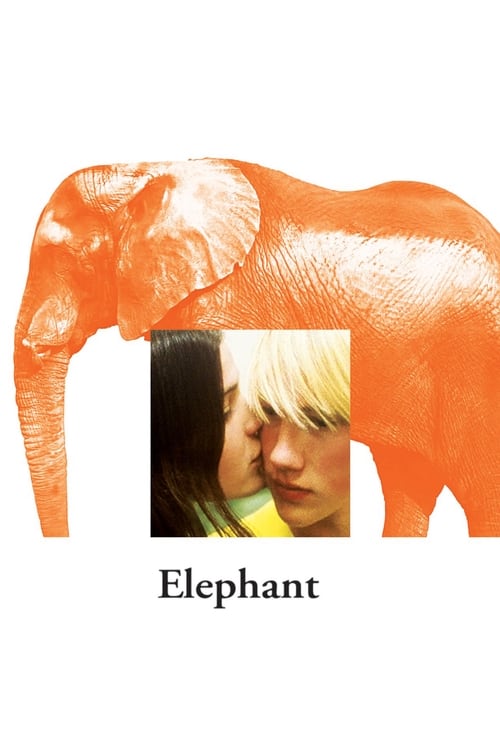
Elephant
2003 · Gus Van Sant
For when you want a film that treats you like an adult and refuses easy answers — a demanding, sobering watch, not a comfort watch. Reach for it when you're ready to sit with something and think about it for days.
What it's about
An ordinary day at a suburban Portland high school, told by drifting behind a handful of students — the photographer, the jock, the awkward girl, the gossips — as their paths cross and recross in the corridors. Two boys among them are preparing an act of violence, and the film lets you watch the day unfold knowing what it can't yet know about itself.
The experience
Quiet, hypnotic, and almost unbearably calm — long unbroken walks through hallways where nothing happens, which is exactly what makes your stomach tighten. It offers no explanation and no release, and the dread accumulates in the silence.
Performances
The cast of unknown, mostly non-professional teenagers is the point: nobody performs, they just exist, and that ordinariness is what makes the film so quietly devastating.
The craft
Built almost entirely from long, unhurried Steadicam takes that follow students through corridors in real time, sometimes replaying the same minutes from another person's path. The looping structure and ambient sound design turn a school day into something dreamlike and inescapable — it rewards patience and a quiet room more than a big screen.
Why it matters
Made in the shadow of Columbine, it won both the Palme d'Or and Best Director at Cannes in 2003, igniting debate over whether refusing to explain violence is honesty or evasion — a debate that still frames how films approach school shootings.
Snapshot
Elephant is Gus Van Sant's spare, hypnotic reconstruction of an ordinary American school day that ends in a massacre. Drifting through the corridors of a fictional suburban high school behind a series of unhurried Steadicam takes, the film follows a loose ensemble of teenagers — each chapter named for the student it trails — until two boys, Alex and Eric, arrive with duffel bags of weapons and begin to kill. Made in the long shadow of the 1999 Columbine shootings, it refuses the consolations of explanation, motive, or moral framing. Premiering at Cannes in 2003, it took the Palme d'Or and a Best Director prize for Van Sant — an unusual double award that crystallized both the film's prestige and the controversy around its studied refusal to interpret. It stands as the central panel of the director's so-called "Death Trilogy," and as one of the defining art films of the early-2000s American independent scene.
Industry & production
Elephant originated as a project for HBO Films rather than for theatrical release — a fact that helps explain both its modest scale and its formal freedom. Van Sant was coming off a period of mainstream studio work (Good Will Hunting, Finding Forrester, the much-derided Psycho remake) and had deliberately retreated toward a more austere, European-influenced mode of filmmaking with Gerry (2002). Elephant extended that retreat. Produced on a small budget with backing from HBO and with Diane Keaton's company (Blue Relief) and producers including Dany Wolf and Fernando Sulichin attached, the film was shot quickly in Portland, Oregon, in and around a decommissioned high school. The decision to cast nonprofessional local teenagers rather than known actors kept costs low and was integral to the aesthetic; the production functioned almost as a workshop, with the young cast contributing to dialogue and characterization. After its Cannes triumph, HBO Films and Fine Line handled distribution, and the film reached theaters on the strength of its festival laurels. Specific budget and box-office figures are not something I can state reliably here, and I won't invent them; what is clear is that Elephant was conceived and made outside the economics of conventional theatrical features, which is precisely what licensed its experimentation.
Technology
The film was shot on 35mm and framed in the boxy, near-square Academy ratio (approximately 1.37:1), a deliberately archaic choice that boxes the students into the frame and lends the corridors a vertical, claustrophobic emphasis unusual for a contemporary release. The dominant technological instrument is the Steadicam: long, gliding, uninterrupted takes that follow figures from behind through the school's hallways. This is a film built on the capacities of a stabilized camera rig to sustain mobile long takes without cutting, and the technique is inseparable from the film's meaning — the apparatus produces the sense of fate gliding alongside ordinary life. Sound was handled with comparable care, using layered, often subtly designed ambience (the swell of voices, footsteps, the hush of empty spaces) rather than a conventional underscore. The film predates the wholesale move to digital capture that would shortly transform low-budget filmmaking; its texture is recognizably photochemical, with naturalistic available-light-leaning cinematography that suits the documentary surface.
Technique
Cinematography
Harris Savides, Van Sant's frequent collaborator, shot Elephant, and his work is the film's signature. The visual strategy is built around extended Steadicam takes that trail students through corridors at walking pace, frequently from directly behind the head and shoulders, so that the world unfolds as a continuous, present-tense flow. Savides favored soft, naturalistic light and muted color, with the Academy frame cropping the image tightly around the body. The camera's neutrality is calculated: it neither editorializes nor flinches, holding ordinary actions — a walk to class, a conversation, a turn down a hallway — at the same unhurried register it will later apply to violence. Time-of-day skies and corridor light recur as connective tissue, and the film periodically pauses on near-abstract inserts (clouds in time-lapse) that puncture the documentary surface with something more contemplative. The result is one of the most influential cinematographic schemes of its decade, widely imitated in subsequent festival cinema.
Editing
Van Sant edited the film himself, and the cutting is where its apparent simplicity reveals real structural daring. Elephant is organized as a set of overlapping timelines: the same stretch of a single day is traversed repeatedly from different students' vantages, so that a figure glimpsed in the background of one long take becomes the protagonist of the next, and certain moments — two students crossing paths in a hallway — recur from new angles. The editing thus produces a temporal lattice rather than a linear chronology, withholding the comfort of cause-and-effect sequence. Within scenes, cuts are sparse; the long take is the basic unit, and the montage works between blocks rather than within them. This braided, recursive construction is fundamental to the film's refusal of explanation: by circling the day rather than driving through it, the editing denies the viewer the forward momentum that would imply a reason for what comes.
Mise-en-scène / staging
The staging privileges real architecture and unforced behavior. The high school — long corridors, a library, a cafeteria, locker-lined passages — functions as a near-labyrinthine space through which bodies move, and Van Sant exploits its geometry for both the wandering takes and the eventual hunt. Performances are pitched at the threshold of the everyday: students eat, gossip, take photographs, sit in class, with much dialogue improvised or lightly scripted around the cast's own speech. The two perpetrators are introduced amid banal domestic and consumer textures — weapons arriving by mail, video games, a shared shower — staged with the same flat naturalism as everything else, a refusal of villainizing emphasis that many found unsettling. The mise-en-scène's governing principle is equivalence: the ordinary and the catastrophic occupy the same visual key.
Sound
Sound design, credited to Leslie Shatz, is central to the film's atmosphere. Rather than a scored emotional track, Elephant relies on a dense, sculpted field of ambient sound — the murmur of crowds, the acoustics of empty corridors, footsteps and distant voices — that can swell to near-abstraction. Diegetic music carries enormous weight: Alex plays Beethoven (the "Moonlight" Sonata and "Für Elise") at a piano, threading high European art through the ordinary suburban day in a way that is both tender and disquieting. The near-absence of conventional underscore strips the violence of musical cueing; the soundtrack neither builds suspense nor signals catharsis, leaving the events to land without affective guidance.
Performance
The cast was composed largely of nonprofessional Portland-area teenagers, and the characters carry the actors' own first names (Alex, Eric, John, Elias, Michelle, Nathan, and others). Performances are deliberately undramatized, built from improvisation and the actors' own idiom, so that the ensemble reads as observed rather than acted. This casting method is integral to the film's ethics and aesthetics: it grounds the school in a recognizable social texture and makes the eventual violence feel like an eruption within an ordinary community rather than a genre event performed by professionals. The flatness is the point — affect is withheld, and the absence of conventional "acting" reinforces the documentary illusion.
Narrative & dramatic mode
Elephant operates in an anti-dramatic, observational mode that withholds the machinery of conventional storytelling. There is no protagonist in the ordinary sense, no arc of motivation, no scene of explanation. The film offers fragments that might be read as causes — bullying, violent media, the ease of acquiring guns, adolescent alienation — but it pointedly declines to assemble them into an argument, presenting them with the same neutrality as a piano lesson or a walk across a field. The recursive, multi-perspective structure substitutes a spatial-temporal architecture for plot: we come to know the day as a place rather than a sequence. This is dramaturgy as immersion and dread rather than as conflict and resolution, and its refusal of catharsis — the film ends without consolation or comprehension — is its most discussed and most divisive feature.
Genre & cycle
Nominally a crime drama, Elephant sits uneasily within genre. It belongs to a small cycle of films reckoning with the Columbine-era American school shooting, but it stands apart from the issue-movie and thriller conventions that typically structure such material; it neither builds suspense toward the violence in the manner of a thriller nor delivers the sociological thesis of a problem picture. More productively, it can be placed in a lineage of "slow cinema" and observational art film — long takes, ambient duration, refusal of psychology — and within Van Sant's own avant-garde turn. It is the middle film of his loosely grouped "Death Trilogy," flanked by Gerry (2002) and Last Days (2005), each of which approaches a death or deaths through extended duration and minimal explanation.
Authorship & method
Elephant is the work of a director consciously reorienting his practice. Van Sant directed, wrote (in the loose, improvisation-friendly sense the project demanded), and edited the film, and his authorial signature here is one of restraint and structural risk rather than the more conventional craftsmanship of his studio period. He has openly cited the influence of European and avant-garde filmmakers — the long-take durational cinema associated with Béla Tarr and Chantal Akerman is frequently invoked in discussions of this period of his work — and the trilogy represents his most sustained engagement with that tradition. The collaboration with cinematographer Harris Savides is decisive: the Steadicam grammar that defines the film is a shared achievement. Sound designer Leslie Shatz shaped the immersive aural field. The choice of nonprofessional actors and the integration of their own names and speech reflect a method that blurs documentary and fiction. There is no original score composer in the conventional sense; the film's music is the diegetic Beethoven played within the story. The title itself was borrowed, by Van Sant's account, from Alan Clarke's 1989 film; Van Sant has spoken of associating it with the parable of the blind men and the elephant — each touching only a part of the whole — though Clarke is generally understood to have meant the "elephant in the room," the unspoken thing everyone ignores. Both senses resonate with the film.
Movement / national cinema
The film belongs to American independent cinema, but its affinities are conspicuously transatlantic. It emerges from the early-2000s moment when several American auteurs absorbed the durational, contemplative strategies of contemporary European art cinema, and Van Sant became one of the most prominent conduits for that exchange. Its most direct ancestor is British: Alan Clarke's Elephant, a near-wordless 1989 television film for BBC Northern Ireland that depicts a series of sectarian killings in flat, repetitive long takes, from which Van Sant took both the title and the central formal device of the trailing Steadicam shot. Elephant thus sits at a crossing point between American subject matter and a European-derived, Clarke-inflected form.
Era / period
Elephant is profoundly a film of its moment — the post-Columbine, early-post-9/11 United States, when the school shooting had entered the national imagination as a recurring trauma and the surrounding discourse (about guns, media violence, bullying, and adolescent masculinity) was at high pitch. Released in 2003, it intervenes in that discourse precisely by refusing to participate in its explanatory rituals. Technologically and industrially it belongs to the last years of photochemical, festival-driven independent filmmaking before digital capture and streaming reshaped the field; institutionally, its HBO Films origin marks the period when premium cable was becoming a significant patron of auteur work. It is, in short, a turn-of-the-decade artifact in both its anxieties and its means.
Themes
The film's governing theme is the inscrutability of catastrophic violence — the impossibility, and perhaps the indecency, of explanation. By withholding motive it foregrounds the gap between the ordinary texture of teenage life and the enormity of what erupts within it. Adjacent concerns thread through: the architecture of the institutional school as a space of routine, surveillance, and drift; adolescence as a state of unformed, opaque interiority; the banality and accessibility of weapons; the saturation of contemporary life by violent imagery. The recurring time-lapse skies and the high-European piano music set a register of beauty and contemplation against the dread, refusing to let the violence be merely sensational. Underlying all of it is a meta-theme about looking itself — the parable of the elephant, the limits of any single vantage, the camera's complicity and helplessness as it follows bodies toward an end it cannot avert.
Reception, canon & influence
Elephant was both garlanded and contested. Its Cannes Palme d'Or, paired with the Best Director award, was widely reported as a surprise and was read by some critics as an overvaluation of formal austerity; the very qualities that admirers prized — its neutrality, its refusal to explain, its equanimity toward perpetrators and victims alike — struck detractors as evasive or even irresponsible in the face of real atrocity. That debate is itself part of the film's significance: it made the ethics of depicting mass violence a central critical question.
The influences on the film are unusually legible. Alan Clarke's 1989 Elephant supplied the title and the trailing-Steadicam form. The durational European art cinema associated with figures such as Béla Tarr and Chantal Akerman shaped its commitment to long takes and real time, and Van Sant has acknowledged this orientation in interviews around the trilogy. Within his own filmography, Gerry was the immediate experimental precedent.
Its legacy forward has been substantial. Elephant helped legitimize and popularize a "slow cinema" idiom within American and international art film, and its visual grammar — the patient Steadicam following figures from behind through institutional spaces — became one of the most imitated stylistic gestures of the 2000s, recognizable in subsequent festival cinema and, in diluted form, well beyond it. Van Sant completed the cycle with Last Days (2005), and Elephant remains the trilogy's most discussed and most widely taught entry. As a cultural document it continues to be cited in debates about how cinema should — or whether it can — represent the American school shooting, a subject that has only grown more freighted in the years since. Its reputation as a landmark of early-2000s independent filmmaking is secure.
A Deleuzian reading
Start with the back of a head.
The full Deleuzian reading of Elephant →
Reception
Booed and cheered at Cannes 2003, where its shock double win (Palme d'Or AND Best Director) split critics between 'masterpiece' and 'empty provocation' — two decades on it's settled comfortably into the arthouse canon as the centerpiece of Van Sant's death trilogy.
How Elephant was received, from release to now →
Influences: the films it descends from and the films it influenced
- Gerry (2002) — Immediate self-precedent: the first Van Sant–Savides collaboration to abandon plot for protracted Steadicam following of figures through landscape, establishing the durational method Elephant refines indoors.
- La Haine (1995) — Van Sant's single-day Aristotelian compression within a fatal institutional geography — overhead tracking shots positioning figures within architecture that determines their fate — extends La Haine's formal grammar of spatial entrapment, including the sudden eruption of withheld violence whose inevitability the structure has been building toward.
- Dog Day Afternoon (1975) — Van Sant adopts Dog Day Afternoon's democratic ensemble framing — no performance hierarchy, camera committed to each figure in turn through long tracking takes — and its ambient sound design without score, applying the grammar to a real-time institutional siege with the same refusal to impose dramatic shape from outside.
- Sonatine (1993) — Van Sant's elliptical withholding of cause-and-effect narrative connective tissue — scenes beginning without establishing context and terminating before consequences are shown, violence arriving without stylistic announcement or musical emphasis — is the most formally precise American application of the editorial strategy Kitano perfected in Sonatine, transposed to the high school massacre genre.
- The Enigma of Kaspar Hauser (1974) — Van Sant's sustained Steadicam shots following students from behind through institutional corridors — camera positioned as peripheral witness, never achieving frontal access to interiority — directly inherits Schmidt-Reitwein's peripheral-framing strategy for Kaspar's encounters with the institutions of bourgeois society.
- if.... (1968) — Van Sant's extended handheld tracking shots through school corridors combined with a deliberate refusal of psychological causation for the eruption of violence extends *if....*'s method of observational realism interrupted by unmediated political fantasy into an American school-shooting register.
- Code Unknown (2000) — Van Sant inherits Code Unknown's long-take tracking of peripheral figures through institutional architecture and its subtractive editing that withholds causal explanation, extending Haneke's argument that the camera's sustained duration is the only ethical alternative to conventional coverage of violence.
- Henry: Portrait of a Serial Killer (1986) — Uses observational long-take tableaux and aggressive refusal to explain mass violence, foregrounding banality in the lineage of Henry's ethnographic flat gaze.
- Damnation (1988) — Carries Tarr's long Steadicam following-shot behind characters through corridors into an American idiom, contemplative tempo masking an impending atrocity.
- Kids (1995) — Nonprofessional teens trailed through a high school in long observational takes toward an anti-cathartic, refusal-of-explanation climax — Kids' drift-then-detonate structure abstracted.
- My Own Private Idaho (1991) — Develops the time-looping elliptical structure, Steadicam available-light naturalism, time-lapse cloud interludes, and ceded authorship to non-professional actors first tested in Idaho.
- All About Lily Chou-Chou (2001) — Extends the drifting-Steadicam-through-school-corridors staging and non-linear, multi-POV chronology to detonate ordinary adolescence into sudden violence.
- Son of Saul (2015) — Inherits the trailing-Steadicam-behind-a-figure form and Academy ratio, locking the frame to one body moving through institutional horror while atrocity blurs at the edges — Elephant's grammar pushed to its claustrophobic extreme.
- We Need to Talk About Kevin (2011) — The ethical refusal to provide psychological motivation for a school shooting — holding the camera at the position of pure witness without dramatic causality — which Ramsay internalizes by placing that same refusal of explanation inside a mother's fractured retrospective memory.
- Monster (2023) — Van Sant's practice of trailing different students through the same school corridors on the same day, with temporal overlaps where characters pass each other unknowingly, anticipates Monster's re-entry into institutional space from successive perspective-angles using the same scene-repetition technique.
- To Catch a Killer (2023) — The formal precedent for the mass-shooting drama that withholds motive and explanation, observing the perpetrator and institutional spaces with deliberate, affectless patience rather than thriller mechanics.
- Confessions (2010) — Contemplative, formally detached treatment of a school killing, drifting POV among students in slow-motion long takes — a cold aesthetic distance toward youth violence.
- Fruitvale Station (2013) — The architecture of dread — trailing ordinary characters through banal, near-real-time hours toward a violent death the audience already knows is coming, charging every mundane beat.
- An Elephant Sitting Still (2018) — Harris Savides' steadicam trailing students from behind through corridors — back-of-head framing across a multi-strand single day converging toward violence — is the exact device (and title motif) Hu Bo rebuilds.
- mid90s (2018) — Model for the long observational take trailing teenagers through mundane space with non-professional performers and a deliberate refusal of moralizing dramatic emphasis.
- The Long Walk (2025) — Its Steadicam that trails walking subjects from behind for uninterrupted takes, foregrounding footfalls on the soundtrack, prefigures the Walk's tracking-with-subjects camera and footstep-and-gunfire sound design.
- Victoria (2015) — Long Steadicam takes trailing characters through corridors in flat available light, drifting between figures with no score — the withheld-music, follow-the-body handheld realism Victoria inherits.
- Polytechnique (2009) — Harris Savides' Steadicam trailing shots down school corridors combined with a looped structure that replays the same minutes along different characters' paths — the exact device Villeneuve converts into his nonlinear mosaic of Valérie, Jean-François and the killer crossing one another.
- Elephant (1989) — Donor of the title and the core form — a near-wordless procession of killings shot with a trailing Steadicam that follows perpetrators from behind through institutional corridors, refusing motive or context, which Van Sant transposes wholesale to the school.
- Jeanne Dielman, 23 Quai du Commerce (1975) — Model for real-time durational observation in which mundane action is filmed at its actual length, so that drama is withheld and the camera's patience itself becomes the meaning — the anti-dramatic temporal contract Elephant adopts.
- Sátántangó (1994) — Source of the extended-take walking grammar — minutes-long shots tracking figures across space in real time, an austerity Van Sant explicitly cited as license for Elephant's gliding corridor takes.
- The Shining (1980) — Origin of the Steadicam-through-architecture vocabulary — Garrett Brown's fluid low tracking of a figure down endless institutional hallways, the exact rig-and-space relationship Savides quotes in the school's corridors.
- Pickpocket (1959) — Ancestor of the flat, affectless performance method — non-actor 'models' delivering undramatized behavior, with emotional climax deliberately suppressed (the refusal of catharsis Elephant inherits).
- Rashomon (1950) — Template for recursive multi-perspective structure: a single event re-entered from different characters' vantage points, the overlapping-timeline device Elephant uses when it loops back to replay the same hallway moment through each student.
- Last Days (2005) — Completes the Death Trilogy with the same Savides Steadicam, real-time drift, and refusal to dramatize a death foretold — a direct continuation of Elephant's method applied to a Cobain-like figure.
- Paranoid Park (2007) — Extends Elephant's craft directly — Christopher Doyle's lingering takes, a non-professional skater cast speaking their own idiom, and a fractured recursive timeline that circles an act of violence rather than explaining it.
- Utøya: July 22 (2018) — Sibling response to the same subject — a single unbroken real-time take following a victim through a massacre, extending Elephant's durational, non-explanatory ethics of filming mass shooting.
- Entre les murs (The Class) (2008) — Shares the non-professional-cast method built from real students playing versions of themselves in an actual school, improvising their own speech in an observational, anti-dramatic register.
- Wendy and Lucy (2008) — American slow-cinema sibling — naturalistic light, minimal incident, and durational attention to a single drifting figure, refusing the dramatic payoffs Elephant also withholds.
- Fish Tank (2009) — Sibling in the Academy-ratio, follow-the-youth idiom — handheld camera trailing a non-professional adolescent through real housing-estate architecture with improvised, present-tense performance.
Similar films
- Gerry (2002) — influence & lineage · same viewing thread · often watched together
- Au Hasard Balthazar (1966) — often watched together
- Amour (2012) — often watched together
- Climax (2018) — often watched together
- An Elephant Sitting Still (2018) — shared sensibility
- Close (2022) — shared sensibility
- Nickel Boys (2024) — shared sensibility
- Boyhood (2014) — shared sensibility
All the films related to Elephant →
Watch it with: curated runs of related films
- Adrift and Coming Apart — A run of solitary souls drifting through motels, deserts, and empty apartments and quietly dissolving — they rhyme on stillness, loneliness, and dread.