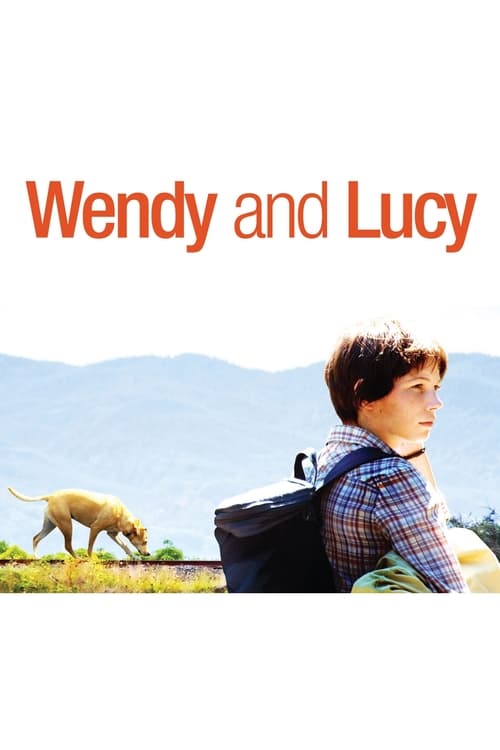
Wendy and Lucy
2008 · Kelly Reichardt
For when you want something small, true, and deeply felt — a film that breaks your heart with almost nothing. Fair warning if you love dogs: keep tissues close. It's a gentle watch in tone but a heavy one in feeling.
What it's about
Wendy is driving to Alaska with her dog Lucy and a carefully counted envelope of cash, hoping a cannery job will be a fresh start. In a small Oregon town her car breaks down, and after she's caught shoplifting dog food, Lucy goes missing. With almost no money and no one to call, Wendy spends the next days trying to find her dog while everything that keeps a life upright — car, cash, sleep, dignity — slips away a little at a time.
The experience
Quiet, patient, and slowly heartbreaking. Nothing is dramatized; the tension comes from watching small setbacks compound, and the restraint makes the emotional moments land twice as hard. At 80 minutes it never wastes a frame.
Performances
Michelle Williams carries nearly every frame with almost no dialogue to lean on — the performance is all held-back panic and practical calculation, and it's one of the best things she's ever done.
The craft
Kelly Reichardt strips the movie down to essentials: long takes, ambient sound instead of score, an eye for the exact texture of parking lots, drugstores, and train yards. The minimalism is the point — you feel every dollar Wendy counts. It doesn't need a big screen, but it rewards your full, undistracted attention.
Why it matters
A defining work of 2000s American independent film, it caught the mood of economic precarity right at the edge of the 2008 crash and cemented Reichardt as a major American director.
Snapshot
Wendy and Lucy is a 80-minute drama of attrition, observing a young woman stranded in a small Oregon town when her car breaks down and her dog goes missing on the way to a hoped-for cannery job in Alaska. Directed by Kelly Reichardt from a screenplay she co-wrote with Jonathan Raymond, adapted from Raymond's short story "Train Choir," it stars Michelle Williams as Wendy Carroll in a performance built almost entirely from restraint. The film is among the defining works of American minimalist realism in the 2000s — small in scale, rigorous in attention, and quietly political in its portrait of economic precarity at the threshold of the 2008 financial crisis. Premiering at the Cannes Film Festival's Un Certain Regard and screening at Toronto and the New York Film Festival, it was released by Oscilloscope Laboratories and confirmed Reichardt, after Old Joy (2006), as a singular voice in the American independent landscape. Its central fact is simple and devastating: a person with almost nothing can lose the one thing that matters, and the systems around her offer no remedy.
Industry & production
The film is a product of the micro-budget American independent sector at its most resourceful. It was made for a very small sum — widely reported as well under a million dollars, in the low six figures — and the production reflects that economy in its compact crew, short shooting schedule, and reliance on real locations in and around Portland, Oregon. Production companies included Field Guide Films, Glass Eye Pix (the shingle of director-actor Larry Fessenden, a recurring Reichardt collaborator and ally), and Washington Square Films, with Reichardt working alongside a tight circle of producers including Neil Kopp, Anish Savjani, and Fessenden.
Distribution came through Oscilloscope Laboratories, the independent outfit co-founded by the Beastie Boys' Adam Yauch, whose curatorial sensibility was well matched to a film of this kind. The picture's festival path — Cannes Un Certain Regard in 2008, then Toronto and New York — gave it the critical platform that micro-budget work depends on, since theatrical returns for films this austere are necessarily modest. The exact box-office record is thin and the film was never a commercial event; its industrial significance lies instead in demonstrating that a deeply serious, formally controlled feature could be assembled with minimal capital and still command international critical attention. It became, in effect, a template for a certain kind of American art film: regionally grounded, modestly financed, festival-launched, distributor-curated.
Technology
Wendy and Lucy was shot on 16mm film, a choice consonant with both budget and aesthetic. The 16mm format yields a grain structure and tonal softness that suit the film's overcast Pacific Northwest palette and its documentary lineage; the texture itself carries meaning, lending the images a worn, unglamorous materiality appropriate to the subject. The production made no use of elaborate technological apparatus — no significant visual effects, no large lighting packages, minimal camera movement hardware. This is filmmaking that treats technology subtractively, stripping away rather than adding, and the analog capture is integral to that stance rather than incidental. In an era when digital acquisition was rapidly becoming the independent default, the commitment to celluloid was both an economic negotiation and an authorial signature.
Technique
Cinematography
The cinematography is by Sam Levy, and it is exemplary of observational restraint. Levy and Reichardt favor a largely static or barely mobile camera, medium and long takes, and compositions that hold Wendy within frames that emphasize her smallness against parking lots, rail yards, roadsides, and the indifferent architecture of a service economy. Natural and available light dominate; the palette is muted, dominated by grays, greens, and the washed blues of Oregon overcast. The framing repeatedly isolates Wendy, placing her at the edges of spaces or behind glass and grating, so that the visual grammar enacts her marginality. There is little of the expressive camera flourish; the images instead accumulate attention, asking the viewer to watch closely and patiently, and the discipline of that looking is the film's primary visual achievement.
Editing
Reichardt edited the film herself, as is her practice, and the cutting is central to its meaning. The rhythm is slow and deliberate, holding shots past the point of conventional narrative efficiency so that duration becomes content — we feel the dead time of waiting, walking, and worrying alongside Wendy. The editing refuses the manipulative shorthand of crisis cinema; there are no montage compressions of suffering, no musical swells to cue feeling. Instead, the film lets scenes play to their quiet ends, and the result is an austerity that paradoxically intensifies emotion by withholding the usual mechanisms for producing it.
Mise-en-scène / staging
The staging is documentary-adjacent, built around real and lightly dressed locations — a Walgreens parking lot, a mechanic's garage, a recycling center, the woods at the edge of town, the rail line. Wendy's possessions are minimal and meaningful: the car that is her shelter, the ledger in which she tracks dwindling money, the dog's leash. Reichardt stages action with an emphasis on process and labor — the bureaucratic friction of a police booking, the transactional logic of the mechanic's estimate, the slow walk along tracks. The mise-en-scène insists on the texture of a working-class American landscape rarely granted such sustained, unsentimental attention.
Sound
The soundscape is naturalistic and largely diegetic — traffic, rail cars, dogs, the ambient drone of a town. Music is used with extreme economy. The film's recurring musical motif is a wordless, hummed tune that Wendy carries with her, and the spare musical contribution is credited to Will Oldham (the musician known as Bonnie "Prince" Billy, himself a Reichardt collaborator who had appeared in Old Joy). The near-absence of conventional scoring is itself a sound-design decision: silence and ambient noise are allowed to define the emotional register, and the rare appearance of the melody lands with disproportionate force precisely because the film is otherwise unscored.
Performance
Michelle Williams's performance is the film's anchor and one of the signal pieces of American screen acting of its decade. Williams plays Wendy with a stripped-down interiority — minimal dialogue, contained gesture, a watchfulness that registers exhaustion and dread without declaration. The performance trusts the close attention of the camera and refuses the actorly markers of distress; its most celebrated moment, a scene of Wendy weeping in confined circumstances, is powerful precisely because it breaks a sustained composure. Around her, the supporting cast works in a register of plain authenticity: Walter Dalton as the kindly older parking-lot security guard whose small generosities are among the film's few graces, Larry Fessenden as a frightening figure Wendy encounters at night, and a gallery of largely non-starry faces that reinforce the film's documentary grain. The dog Lucy was Reichardt's own dog, named Lucy, a biographical fact that deepens the film's tenderness toward the animal.
Narrative & dramatic mode
The dramatic mode is observational realism in a minor key. The plot is deliberately slight: a breakdown, a shoplifting arrest, a lost dog, a search. Reichardt builds drama not from incident but from the accumulating weight of small obstacles, each of which would be trivial for someone with resources and is catastrophic for someone without. The narrative operates on a logic of subtraction — Wendy loses her car, her money, her dog, her plan — and the film's tension derives from how little margin separates her from ruin. There is no villain and no melodramatic reversal; the antagonist is structural, the slow grind of a system in which a missing twenty dollars or a broken alternator can unmake a life. The ending is restrained and morally complex, a sacrifice presented without sentiment, and it leaves the viewer with an ache rather than a resolution.
Genre & cycle
Nominally a drama, Wendy and Lucy belongs more precisely to a cycle of American realist cinema that critics in the late 2000s began to identify as a distinct tendency — a return to neorealist principles applied to contemporary American economic life. It sits alongside Reichardt's own Old Joy and films by Ramin Bahrani (Man Push Cart, Chop Shop) and others as part of what the critic A. O. Scott influentially termed "neo-neorealism" in a 2009 New York Times Magazine essay that took Wendy and Lucy as a central example. It is also adjacent to, though distinct from, the contemporaneous "mumblecore" movement: it shares the low-budget, naturalistic, regional ethos but trades that movement's verbal, twenty-something self-absorption for a quieter, more politically charged study of poverty and the road.
Authorship & method
The film is the product of a sustained authorial partnership. Kelly Reichardt directs, co-writes, and edits, exercising the kind of control that defines her as one of American cinema's most uncompromising minimalists. Her method favors small crews, real locations, long patient takes, animals and landscapes as co-equal subjects, and narratives pared to essentials. The screenplay was co-written with the novelist Jonathan Raymond, adapting his short story "Train Choir"; the Reichardt–Raymond collaboration, which also produced Old Joy and would continue through Meek's Cutoff and Night Moves, is among the more fruitful writer-director partnerships in recent American film. Sam Levy's cinematography, Will Oldham's musical motif, and the producing and performing support of Larry Fessenden round out a tight repertory of collaborators. Reichardt's authorship is legible in every formal choice — the refusal of spectacle, the centrality of duration, the moral seriousness without moralizing — and Wendy and Lucy is one of its purest expressions.
Movement / national cinema
This is American independent cinema in its most regional and oppositional form — a deliberate counter-statement to the maximalism of mainstream Hollywood. Geographically it is rooted in the Pacific Northwest, a landscape Reichardt has returned to repeatedly, and it draws on a national tradition of road narratives even as it strips the road story of its romance of mobility and freedom. Its lineage runs through Italian neorealism (De Sica's Umberto D., with its companion dog, is an oft-cited antecedent) and the American social realism that periodically resurfaces in independent film. It is national cinema as critique: a portrait of the United States seen from its economic underside, attentive to the places and people that dominant cinema renders invisible.
Era / period
Released in 2008, the film is inseparable from its moment — the onset of the global financial crisis and the recessionary anxiety that defined the late Bush years. Without ever announcing a topical agenda, it registers the period's precariousness with uncanny timing: the thin margins, the vanishing jobs, the migration toward distant work, the way a single misfortune can become a free fall. It belongs to a brief window of American films that anticipated or paralleled the recession's human costs, and it has since been read as one of the most prescient cinematic documents of that downturn, its small story standing in for a much larger structural reckoning.
Themes
The film's governing themes are economic precarity and the fragility of life lived without a safety net. It is a study of poverty rendered concretely — in ledgers, estimates, and the price of dog food — rather than abstractly. Closely bound to this is the theme of the human–animal bond: Wendy's relationship with Lucy is the film's emotional center and its moral test, a love that becomes both her vulnerability and the measure of her decency. Further themes include mobility and its illusions (the American promise of escape via the road, here exposed as a trap), the kindness and cruelty of strangers (the security guard's small mercies against the indifference or menace of others), and the loneliness of the unhoused and unmoored. Underlying all of these is a quiet inquiry into what we owe one another in a society organized around transaction, and into the dignity of a person whom that society has rendered nearly nonexistent.
Reception, canon & influence
Critical reception was strongly positive, and the film became a critics' touchstone of its year, singled out especially for Williams's performance and for Reichardt's formal control. Its prominence in A. O. Scott's "neo-neorealism" argument helped frame a broader critical conversation about a resurgent American realism, and the film appeared on numerous year-end and decade-end lists, cementing its canonical standing among serious cinephiles even as it remained a niche commercial title.
Backward, the influences on the film are clear: Italian neorealism (the De Sica comparison is frequently and aptly made), the observational ethics of slow cinema, and the regional naturalism of Reichardt's own earlier work, alongside the literary source in Jonathan Raymond's fiction. Forward, its legacy is substantial relative to its scale. It consolidated Reichardt's reputation and enabled the major works that followed — Meek's Cutoff, Certain Women, First Cow — securing her place as a leading American auteur. It helped legitimize a model of micro-budget, regionally rooted, festival-launched filmmaking, and it confirmed Michelle Williams as an actor of the first rank in the independent sphere. More diffusely, it became a reference point for subsequent films about economic hardship and itinerant American life, its influence visible in the strain of patient, unsentimental realism that runs through later independent cinema about people living at the edge.
A Deleuzian reading
The image that stays is small.
The full Deleuzian reading of Wendy and Lucy →
Reception
Acclaimed from the start — it landed on many critics' 2008 top-ten lists — but its timing gave it a second life: opening right as the financial crisis hit, it came to be seen as the defining film of recession-era America, and its stature has only climbed as Reichardt's has.
How Wendy and Lucy was received, from release to now →
Influences: the films it descends from and the films it influenced
- Bicycle Thieves (1948) — Supplies the template Reichardt adapts wholesale: a plot reduced to a single precarious object (bike/car-and-dog), real streets shot without spectacle, and nonprofessional-style staging in which economic catastrophe is observed at ground level rather than dramatized.
- Umberto D. (1952) — The direct model for the human-animal bond as the film's emotional spine — a destitute protagonist whose dog becomes the last index of dignity — and for De Sica's refusal to score the loss, letting duration and the animal's presence carry feeling.
- Mouchette (1967) — Source of the affectless, undemonstrative performance register and the ethic of withholding close psychological access, so that a marginalized girl's hardship reads through behavior and framing rather than through emoting.
- Wanda (1970) — The foundational American precedent for the drifting, near-mute working-class woman shot on 16mm with available light and marginal framing, the protagonist often pushed to the edge of the composition amid indifferent commercial landscapes.
- Killer of Sheep (1978) — Models the regional-naturalist mode Reichardt extends: 16mm, real neighborhood locations, an episodic observational structure built from dead time and small economic transactions instead of plot mechanics.
- Vagabond (1985) — Pioneers the itinerant-woman portrait built from static, laterally observed encounters and a documentary attentiveness to a transient on society's margins, treating landscape and bystanders as co-equal to the protagonist.
- Old Joy (2006) — Reichardt's immediate prototype — the first Jonathan Raymond adaptation, with the same Pacific Northwest locations, long static takes, diegetic ambience, and a dog as a central non-speaking presence — that established the method Wendy and Lucy distills.
- Young Mothers (2025) — American minimalist realism of precarity that strips out non-diegetic music and comforting establishing shots, letting a single act of responsibility carry the whole moral weight.
- Stranger Than Paradise (1984) — Fixed static compositions observe a woman and her dog in the Pacific Northwest with near-wordless scenes and direct location sound; Reichardt's poverty cinema is StP's closest stylistic heir, extending its formal restraint and anti-narrative ellipsis to situations bereft even of the deadpan comedy Jarmusch retains.
- Paris, Texas (1984) — Available-light cinematography, Michelle Williams's performance mode of physical stillness carrying what language cannot articulate, withheld backstory, ambient sound design, and a displacement structure in which movement leads back to dispossession rather than destination.
- Down by Law (1986) — Reichardt's available Pacific Northwest light, minimal dialogue, and long observational takes of a woman drifting through an indifferent landscape directly inherit the Jarmusch negative-space method; the episodic structure and productive silence demonstrate that Down by Law's demonstration—that American independent film could be built from withholding rather than accumulation—had become a transmissible tradition.
- Stroszek (1977) — Michelle Williams suppresses trained technique to approach non-actor transparency in available-light 16mm-equivalent texture; American consumer society is witnessed from its underside (parking lots, chain stores), and the ending refuses both rescue and tragedy—the ethical and formal inheritance of Stroszek's American passage, applied to a woman rather than an immigrant man.
- Meek's Cutoff (2010) — Carries the Wendy and Lucy method into period filmmaking — the Raymond script, real-time walking duration, static framing, and refusal of resolution — proving the patient observational grammar scales beyond contemporary settings.
- Winter's Bone (2010) — Extends the patient, unsentimental regional realism around a young woman's economic desperation, using local non-actors and on-location Ozark naturalism in the lineage Wendy and Lucy helped legitimize.
- Certain Women (2016) — Refines the same toolkit — 16mm, Montana real locations, marginal framing, long quiet takes built around working women — reuniting Reichardt and Michelle Williams in the observational portraiture Wendy and Lucy crystallized.
- The Rider (2017) — Applies Reichardt-style observational realism to a non-professional cast playing versions of themselves, with available-light landscape framing and a wounded protagonist's economic precarity told through behavior and duration.
- The Florida Project (2017) — Inherits the ground-level study of American economic marginality — people living week-to-week at the edge of commerce — staged in real motel locations with naturalistic non-actors and an unsentimental refusal to editorialize.
- Leave No Trace (2018) — Continues the lineage of itinerant Pacific Northwest survival shot in real woodland locations with available light, restrained performances, and a narrative pared to subsistence logistics rather than melodrama.
- First Cow (2019) — The mature culmination of the Raymond collaboration and the human-animal motif — the cow as co-equal subject, boxy 16mm-derived framing, and an economy-of-survival plot — descending directly from Wendy and Lucy's concerns and craft.
- Nomadland (2020) — The most prominent heir to the recession-era itinerant-American portrait: a lone woman moving through real locations and non-professional communities, shot in available light with observational restraint, mainstreaming the mode Wendy and Lucy modeled.
- Emily the Criminal (2022) — Reichardt's micro-budget aesthetic — female protagonist in economic freefall, available light, score almost entirely suppressed, the environment as an indifferent economic system — established the austere formal mode within American independent cinema that Ford adapts for the Los Angeles social-realist context.
- Riceboy Sleeps (2023) — 16mm minimalist realism of economic precarity built on patient observational stillness and a pared-down, restrained central performance.
- Chop Shop (2007) — Co-anchor of A. O. Scott's 'neo-neorealism' cohort: contemporaneous American micro-budget realism using real working locations and a child laborer's daily economic survival shot observationally, the explicit critical pairing for Wendy and Lucy.
- Frozen River (2008) — Same-year companion in recession-era realism — a financially cornered woman, hand-held available-light shooting in cold marginal geographies, and narrative tension generated purely by lack of money rather than genre incident.
- Ballast (2008) — Parallel exercise in austere American realism: nonprofessional cast, static available-light compositions, near-silent emotional register, and a Mississippi-Delta regionalism that, like Reichardt, lets place and duration do the dramatic work.
- The Mastermind (2025) — Static-observational study of economic precarity, where Reichardt-as-editor sustains unhurried duration to make hardship legible — the social-observational engine repurposed here through heist.
- Elephant (2003) — American slow-cinema sibling — naturalistic light, minimal incident, and durational attention to a single drifting figure, refusing the dramatic payoffs Elephant also withholds.
- La Promesse (1996) — Strips score and plot to behavioral observation of a marginal figure in a single bind, sharing the Dardennes' restricted POV and refusal of consolatory resolution.
- The Child (2005) — American minimalist realism that strips melodrama to a single precarious figure and a morally charged object (a lost dog, a shoplifted item), observed without score in long patient takes.
- The Station Agent (2003) — A solitary figure in unglamorous American margins, shot in long-take available light with sparse-to-absent score, extends the same restraint-as-empathy aesthetic to economic isolation.
- Bleak Moments (1971) — Practices the same duration-over-plot minimalism with no nondiegetic score and a refusal of catharsis, observing an undramatized ordinary life in muted, patient framing.
- One Million Yen Girl (2008) — A parallel minimalist portrait of a solitary drifting woman in economic precarity, built on ellipsis, sparse dialogue and an open, non-cathartic ending — the same reticent-protagonist craft on another continent.
- Microhabitat (2018) — Pares an entire film down to one woman's arithmetic of survival at the economic edge, using restrained duration and withheld backstory to make a single act of loss carry the whole social critique — the same lean portrait method as Microhabitat.
- Hachi: A Dog's Tale (2009) — The same year's rigorous inverse — natural-light long takes, a dog defined by absence and a search, and a scoreless soundtrack of yard noise and trains, demonstrating the too-late pathos Hachi reaches with a cue and Reichardt reaches without one.
Similar films
- Certain Women (2016) — influence & lineage
- Wanda (1970) — influence & lineage
- Hachi: A Dog's Tale (2009) — same viewing thread
- First Cow (2020) — same viewing thread
- Meek's Cutoff (2011) — shared sensibility
- WALL·E (2008) — shared sensibility
- Isle of Dogs (2018) — shared sensibility
- Paris, Texas (1984) — shared sensibility
All the films related to Wendy and Lucy →
Watch it with: curated runs of related films
- Unlikely Companions, Gentle Roads — Watch these together for the way a mismatched pair — a yakuza and a lost boy, an old man on a lawnmower bound for his brother, a runaway kid and a grizzled uncle, two frontier drifters with a stolen cup of milk — becomes a whole small world; they rhyme on tenderness carried at walking pace.