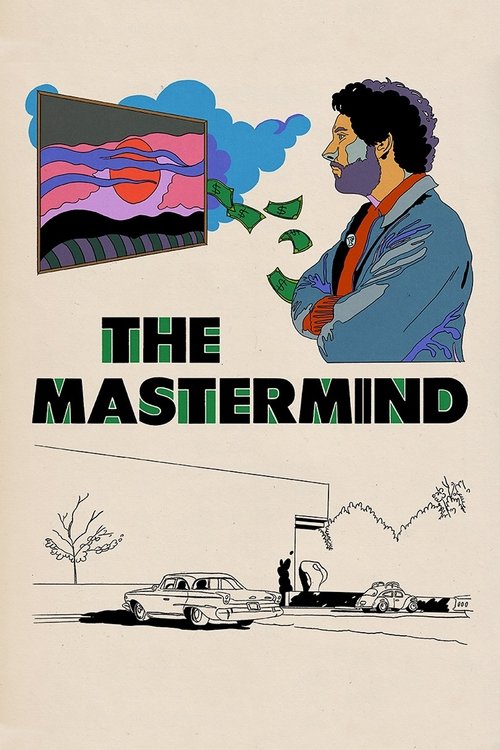
The Mastermind
2025 · Kelly Reichardt
For a patient, low-key evening when you want character over spectacle — a slow-burn crime story to settle into rather than a thrill ride. Perfect if you like your capers human-sized and a little sad.
What it's about
A sedate Massachusetts suburb, 1970, with the Vietnam War humming in the background. J.B. Mooney is an unemployed family man who has decided he's a gentleman art thief: he's cased the local museum, recruited accomplices, and convinced himself the plan is airtight. The film follows what a 'perfect' amateur heist actually looks like — and what it costs a man to keep believing in himself as it unravels.
The experience
Dry, wry, and quietly absorbing — a heist film with the air let out on purpose, where the suspense comes from watching vanity collide with reality. It's funny in a sidelong way and melancholy underneath, the tension of ordinary life closing in rather than alarms going off.
Performances
Josh O'Connor is quietly great as Mooney — all soft charm and misplaced confidence, playing a man whose self-image as a mastermind is the most fragile thing he's ever stolen.
The craft
Reichardt's precise, unhurried style turns the caper inside out: long takes, ordinary rooms, and a rich early-seventies texture from her longtime cinematographer Christopher Blauvelt. The period detail — station wagons, wallpaper, the war on the evening news — does as much storytelling as the dialogue.
Why it matters
A standout American entry in competition at Cannes 2025, it extended Reichardt's reputation as the great chronicler of small American lives and proved a genre premise could survive being played entirely at her volume.
Snapshot
The Mastermind is Kelly Reichardt's ninth feature, a wry, deliberately deflationary heist film set in a Massachusetts suburb in 1970. Josh O'Connor plays J.B. Mooney, an unemployed family man and self-styled gentleman art thief who convinces himself that a museum robbery is a clean path back to dignity and means. Reichardt, working in her characteristic register of minor keys and ordinary surfaces, takes the most genre-coded of premises — the meticulous caper — and drains it of bravado, observing instead how amateurism, vanity, and the friction of daily life corrode a "perfect plan." The film premiered in competition at the Cannes Film Festival in May 2025 and was positioned as one of the festival's notable American entries. It reunites Reichardt with cinematographer Christopher Blauvelt and continues her long practice of editing her own work; in casting O'Connor it pairs her unhurried, behaviorist method with one of the most watched young actors of the moment. Coming after the artist-world chamber comedy Showing Up (2022), it confirms Reichardt's late-career drift toward dry humor while keeping her abiding subject — people under economic and historical pressure, improvising their way through — fully intact.
Industry & production
The Mastermind sits squarely within the American independent ecosystem Reichardt has occupied for two decades: modest budgets, regional shooting, and producers who have followed her across films. Her recurring production base — the Portland-rooted filmscience team associated with Neil Kopp, Vincent Savino, and Anish Savjani, who shepherded Old Joy, Wendy and Lucy, Meek's Cutoff, Night Moves, Certain Women, First Cow, and Showing Up — represents the kind of stable, low-overhead infrastructure that lets Reichardt work on her own terms and her own scale. The film carries the imprint of that continuity even where the precise contractual details of this particular production are not exhaustively documented in the public record. Distribution in the United States falls to Mubi, the platform-and-distributor that has aggressively built a prestige theatrical-and-streaming slate around exactly this kind of auteur cinema; the company's involvement reflects the post-2020 reshuffling in which boutique streamers absorbed much of the specialty-distribution role once held by traditional art-house labels.
The casting marks a step up in marquee visibility without abandoning Reichardt's ensemble habits. O'Connor, fresh from broad recognition across television and a run of festival-circuit features, anchors the film, surrounded by performers drawn from the indie and character-actor worlds Reichardt favors. As with most of her productions, the budget is best understood as small by industry standards and large by the standards of her own early no-budget work (River of Grass, 1994); the economics are designed to protect creative control rather than to chase scale. Where specific figures — budget, financing structure, exact shooting schedule — are concerned, the reliable public record is thin, and they should not be stated with false precision.
Technology
Reichardt is, by conviction and by long collaboration with Blauvelt, a photochemical filmmaker, and The Mastermind belongs to that lineage of shooting on celluloid in an overwhelmingly digital industry. Her recent features have favored film stock for its grain, its color rendition, and the discipline its cost imposes on coverage, and the period setting of The Mastermind — 1970 — makes the texture of film an expressive as well as a nostalgic choice: the image is meant to feel of its era rather than merely depict it. The exact capture format and gauge of this particular film are not something I can state with certainty, and I will not invent a specification; what is well established is the director's general commitment to analog acquisition and to a controlled, restrained palette rather than to contemporary high-resolution gloss.
Beyond the camera, the relevant "technology" of a Reichardt film is largely a matter of restraint: practical period production design, available and motivated light, and an absence of the digital spectacle and aggressive post-production manipulation that define mainstream filmmaking. The heist genre normally leans on technological set-pieces — surveillance, gadgetry, slick montage of preparation; part of The Mastermind's comedy and pathos comes from its protagonist's reliance on decidedly low-tech, period-appropriate, and fallible means.
Technique
Cinematography
Christopher Blauvelt has been Reichardt's principal cinematographer since Meek's Cutoff (2010), and his work for her is defined by patient framing, naturalistic light, and a refusal of the restless camera. Expect from The Mastermind the qualities that have characterized their partnership: compositions that hold, that let action play out within the frame rather than chopping it into emphatic pieces, and a sensitivity to the textures of the ordinary American landscape — here the muted browns, greens, and grays of a New England autumn and the unremarkable interiors of suburban and institutional spaces. The period palette of 1970 lends itself to Blauvelt's instinct for desaturated, lived-in color. The camera in a Reichardt film tends to observe rather than pursue, and the suspense of a robbery staged in this idiom comes not from kinetic coverage but from duration and the viewer's awareness of everything that can go wrong in a fixed, unblinking shot.
Editing
Reichardt edits her own films, and the cut is one of the truest signatures of her authorship. Her style is elliptical but unhurried: she lets scenes breathe, trusts dead time and transitional moments, and withholds the propulsive rhythm that the heist genre conventionally demands. The dramatic irony of The Mastermind — a caper film cut against the genre's expectations — is realized largely in the editing room, where the absence of an adrenalized tempo becomes its own comment on the protagonist's delusion of competence. The structure favors consequence over thrill; the "plan" sequences and their unraveling are paced to expose rather than to excite.
Mise-en-scène / staging
Period reconstruction in Reichardt's work is never showy. The 1970 setting is built from the small, correct details of furnishing, dress, and domestic clutter, and staged so that the era reads as ambient fact rather than as a costume-drama display. Her blocking tends to keep characters at human scale within real-feeling spaces, and the suburban Massachusetts milieu — the family home, the museum, the unglamorous in-between places of a small-time crime — is rendered with the same attentive plainness she brought to the Oregon Trail in Meek's Cutoff or the frontier outpost of First Cow. The museum heist is the film's central staging problem, and Reichardt's interest is visibly less in the choreography of the theft than in the awkward human reality of it.
Sound
One of the most discussed departures in The Mastermind is its use of jazz. Reichardt's films have historically been spare in their soundtracks, leaning on ambient sound and using music sparingly; here the score is reported to be jazz-driven, a notable shift in register that gives the film a looser, more period-evocative, late-1960s/early-1970s American texture. The score is credited to the jazz musician and composer Rob Mazurek; readers should treat the finer points of the music's deployment as less than fully documented, but the embrace of jazz as a structuring presence is a genuine and frequently noted feature. Around the music, expect Reichardt's usual fidelity to environmental sound — rooms, weather, the unromantic acoustics of everyday life — which keeps even the scored passages tethered to the real.
Performance
Reichardt directs performance toward understatement and behavioral truth, discouraging the demonstrative and favoring the small gesture, the withheld reaction, the unspoken. O'Connor, an actor capable of both charm and a curdled inwardness, is well suited to a protagonist whose self-image as a "mastermind" is steadily contradicted by his conduct; the role asks him to play competence as a performance the character gives himself. The surrounding ensemble — drawn from the seasoned character actors and indie performers Reichardt habitually assembles — is calibrated to the same low-volume realism, so that the comedy emerges from recognizable human behavior rather than from caricature.
Narrative & dramatic mode
The film operates in an ironic, anti-heroic mode that systematically undercuts the genre it inhabits. Where the classical caper builds toward mastery and the elegant execution of a scheme, The Mastermind is a study in self-deception: its dramatic engine is the gap between J.B. Mooney's belief in his own "airtight plan" and the accumulating evidence of his ordinariness. Reichardt favors a process-oriented, observational narration — attention to preparation, to the texture of waiting and doing — over plot-driven suspense, and she lets consequence rather than cleverness govern the story's shape. The tone is dry comedy shading into something sadder: a portrait of male vanity and economic desperation rationalized as ambition. This is consistent with her long-standing interest in characters whose plans collide with material reality, from the drifting protagonists of Old Joy to the eco-saboteurs of Night Moves, where the act and its messy aftermath matter more than the genre payoff.
Genre & cycle
The Mastermind is a heist film made in deliberate dialogue with, and against, the heist tradition. It joins a lineage of American crime cinema that runs from the procedural cool of mid-century caper films through the disillusioned, anti-heroic crime pictures of the New Hollywood 1970s — and its period setting places it pointedly within that latter moment's sensibility. The film also extends Reichardt's own recurring engagement with crime and transgression: River of Grass riffed on the lovers-on-the-run film, and Night Moves dismantled the eco-thriller. As in those, the genre framework is a vehicle for character and milieu rather than an end in itself, and the "cycle" it most clearly belongs to is the contemporary art-house revisionist genre film, in which familiar templates are slowed, deglamorized, and turned toward social observation.
Authorship & method
Reichardt is one of the most consistent auteurs in American independent cinema, and The Mastermind bears her method throughout: regional, observational, economical, attuned to class and to the dignity and folly of ordinary people. A defining feature of this project appears to be that Reichardt worked without her longtime writing collaborator Jonathan Raymond, whose fiction and screenwriting underpinned Old Joy, Wendy and Lucy, Meek's Cutoff, Night Moves, Certain Women (adapted from Maile Meloy), and First Cow; The Mastermind is understood to be a Reichardt-authored screenplay, though the precise writing credits should be confirmed against the finished film's titles rather than assumed. Her key collaborators reflect deep continuity: Christopher Blauvelt behind the camera since 2010, and Reichardt herself as editor, the role through which she most directly imposes her rhythm. The significant variable is the music — the move into jazz, credited to Rob Mazurek, marks a conscious expansion of her sonic palette. Where individual craft attributions are not firmly established in the public record, they are best left flagged as such rather than stated with false confidence.
Movement / national cinema
The film belongs to American independent cinema and, more specifically, to the strain of slow, regionally grounded realism that critics have variously tied to a contemporary "American minimalism." Reichardt is frequently discussed alongside a loose cohort of US independents committed to small stories, non-urban or unglamorous settings, and a humane attention to economic precarity. Her work has also been read in relation to international slow cinema and to the observational traditions of European art film, but its idiom is distinctly American — its landscapes, its class textures, its vernacular. The Mastermind keeps that national specificity central, rooting itself in the particular social fabric of small-town New England.
Era / period
The 1970 setting is not incidental. Placing the story at the turn of the decade situates it amid the Vietnam War, anti-war ferment, and the disillusionment that suffused early-1970s American life, and it allows Reichardt to let the political atmosphere bleed into a private, domestic crime story without turning the film into an issue picture. The choice also aligns the film aesthetically with the New Hollywood era it depicts — a period whose crime films interrogated the American dream and the myth of the competent operator. The historical backdrop functions as pressure and irony: a man pursuing a self-aggrandizing private scheme against a national moment of upheaval, the public crisis throwing his small private one into relief.
Themes
The film's central themes are recognizably Reichardt's: economic precarity and the lengths to which it drives people; masculine self-image and the vanity of the "plan"; the gap between intention and competence; and the way large historical forces frame, and dwarf, individual ambition. The art heist becomes a metaphor for a certain American faith in the shortcut to status and self-worth — the conviction that one clever act can resolve structural problems. There is also a thread about art itself and its commodification, given the literal theft of paintings, and about family, responsibility, and the costs a man's fantasies impose on those around him. Running beneath it is Reichardt's persistent attention to labor and its absence: J.B. Mooney is, after all, an unemployed family man, and his turn to crime is legible as a distorted response to economic exclusion.
Reception, canon & influence
The Mastermind arrived with the considerable critical attention that now attends any Reichardt premiere, debuting in competition at Cannes in 2025 and entering the conversation as a significant entry in her body of work and in the year's American cinema. Reception consistent with her career trajectory has tended to praise her control, her humor, her humane intelligence, and the performances she draws out, while the persistent minority criticism of her cinema — that its slowness and refusal of conventional payoff can read as withholding — is the kind of response her films reliably provoke; specific review counts, awards outcomes, and box-office figures should not be asserted without verification, and where I cannot confirm them I am declining to invent them.
The influences on the film are clear enough to name responsibly: the New Hollywood crime cinema of the early 1970s and its anti-heroic, deglamorized sensibility; the broader heist tradition that Reichardt is revising; and her own prior crime-adjacent films, especially River of Grass and Night Moves. The jazz score gestures toward the period's American music and its use in the era's films. As for the film's forward influence — what it will shape — it is too early to assess with any authority. What can be said is that Reichardt's standing as a model for a patient, economically attentive, genre-skeptical American independent cinema is already well established, and The Mastermind extends and consolidates that influence rather than departing from it. Its most lasting contribution may be as further evidence that genre frameworks can be repurposed, at art-house scale, into instruments of social and characterological observation.
A Deleuzian reading
Watch the robbery.
The full Deleuzian reading of The Mastermind →
Reception
Premiered in competition at Cannes 2025 to a genuinely split room — walkouts-and-raves territory, with some critics calling it a triumph and others 'a story about nothing at all' — before settling into warm critical standing on its MUBI release that fall.
How The Mastermind was received, from release to now →
How to watch The Mastermind: what to notice on a first viewing
- Watch the heist unfold in one held, unblinking shot. Rather than a fast-cut montage, Reichardt and Blauvelt stage the robbery in a fixed, unblinking frame that holds long enough for you to notice everything that could still go wrong. Suspense here comes from duration, not rhythm; you watch the whole awkward thing happen in real time.
- Listen for jazz where Reichardt usually keeps things quiet. The score, composed by Rob Mazurek, is a notable departure into a jazz-driven, period-evocative register for a director whose films are usually spare and built from ambient, environmental sound. The music gives the film a cool, confident texture the story keeps quietly undermining.
- Watch small period details that never announce themselves. The 1970 setting is built from small, correct choices in furnishing, dress, and domestic clutter rather than displayed as costume-drama spectacle, so the era reads as ambient fact. You absorb the period the way you absorb a real room, without the film pointing at it.
- Watch O'Connor perform confidence rather than actually have it. O'Connor plays J.B. Mooney's self-image as a 'mastermind' as something the character narrates to himself, competence staged for his own benefit rather than demonstrated through his actual conduct. The role he thinks he's playing and the man the film shows you keep quietly disagreeing.
The whole guide to watching The Mastermind, with the keys for a rewatch →
Influences: the films it descends from and the films it influenced
- The Friends of Eddie Coyle (1973) — The template for deglamorized, procedurally observed New Hollywood crime: low-energy small-timers, ambient working-class location texture, and a flat anti-heroic register that refuses the score's adrenaline — the exact tonal grammar Reichardt borrows for her heist.
- Thieves Like Us (1974) — Period crime stripped of glamour, built from overlapping ambient sound and naturalistic dead-time rather than plot mechanics, with anti-heroes too ordinary to be tragic — Reichardt's model for staging a 'job' as social observation.
- Charley Varrick (1973) — The small-stakes, anti-heroic-ironic heist of the 'last of the independents' — a modest crook in over his head — supplying the deflationary genre revision Reichardt is working inside.
- Pickpocket (1959) — Theft rendered as restrained behavioral process — craft shown through minimal gesture and affectless performance — the originating method behind O'Connor's behavioral understatement and the film's process-observational gaze.
- Le Trou (1960) — Near-real-time, ambient-sound, scoreless attention to the mechanics of an illicit operation — the patient, tool-by-tool process-observational mode that Reichardt's elliptical procedure descends from.
- Rififi (1955) — The wordless procedural set-piece that made the mechanics of a job the film's true subject — the heist-as-process tradition Reichardt inherits and slows further.
- Elevator to the Gallows (1958) — Miles Davis's improvised jazz scoring a crime film established the cool-jazz/criminal-drift coupling that Rob Mazurek's jazz score for The Mastermind consciously revives.
- Two-Lane Blacktop (1971) — American minimalism's foundational text — deadpan non-performance, anti-narrative drift, withheld payoff — the lineage Reichardt's whole register belongs to.
- The Long Goodbye (1973) — Genre revisionism over desaturated, flashed Zsigmond imagery and an anti-heroic deglamorized lead — the desaturated-palette-plus-genre-skepticism approach Blauvelt and Reichardt extend.
- Klute (1971) — Gordon Willis's underexposed, low-key 1970s palette codified the muted-naturalist look that Blauvelt's desaturated period photography quotes.
- River of Grass (1994) — Reichardt's own debut: an anti-heroic, ironic crime-on-the-lam built from non-events and deflation — the direct precursor of The Mastermind's genre-skeptical irony.
- Night Moves (2013) — Her prior crime film — a slow, dread-laden eco-sabotage 'operation' observed without thriller payoff — the closest internal antecedent for staging a criminal act as anxious process.
- Meek's Cutoff (2010) — The first Blauvelt collaboration: static observational framing, period reconstruction through ambient labor, and elliptical withholding of dramatic resolution — the craft partnership The Mastermind continues.
- First Cow (2019) — A small economic scheme observed as patient, tactile period process with behavioral understatement and her own editing rhythm — the nearest sibling in method and scale.
- Wendy and Lucy (2008) — Static-observational study of economic precarity, where Reichardt-as-editor sustains unhurried duration to make hardship legible — the social-observational engine repurposed here through heist.
- The Rider (2017) — Regional behavioral understatement drawn from near-non-professional performance and static, desaturated observation of economic precarity — the contemporary American-minimalist current Reichardt's film runs alongside.
- Leave No Trace (2018) — Withholding, regionally rooted character study built on ambient texture and economic marginality rather than incident — extending the same patient, genre-resistant observational craft.
Similar films
- Rififi (1955) — influence & lineage · same viewing thread
- Pickpocket (1959) — influence & lineage · same viewing thread
- Le Trou (1960) — influence & lineage · same viewing thread
- Le Cercle Rouge (1970) — same viewing thread
- Reservoir Dogs (1992) — same viewing thread
- Thief (1981) — same viewing thread
- Tuner (2026) — shared sensibility
- The Secret Agent (2025) — shared sensibility
All the films related to The Mastermind →
Watch it with: curated runs of related films
- Cells, Vaults, and Codes of Honor — A run of methodical men — safecrackers, escapees, informers, resistants — filmed as pure process, where the suspense is less whether the job or the escape works than who honors the code and who breaks it first.