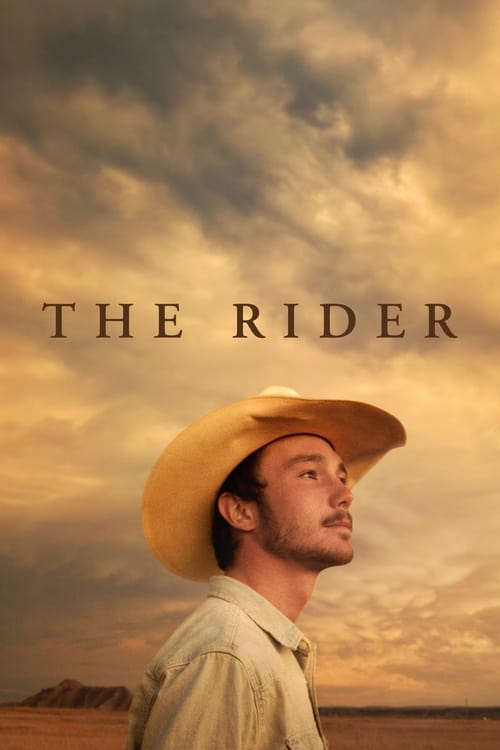
The Rider
2018 · Chloé Zhao
Lived the decade's whiplash arc — Nomadland's Best Picture sweep to Eternals' "first rotten Marvel movie" pile-on, plus erasure in China over old interview quotes — before the Hamnet redemption narrative. A case study people cite about auteurs and franchise machinery.
For a contemplative night when you want something honest and unhurried that will sit with you for days — a film to feel, not just watch. It's gentle in style but emotionally heavy, so come ready to ache a little.
What it's about
On the Pine Ridge Reservation in South Dakota, a young Lakota cowboy named Brady was a rising rodeo star and a gifted horse trainer until a bronc crushed his skull. Now, with a metal plate in his head and a doctor's warning that riding again could kill him, he drifts between a grocery-store job, a paralyzed friend in a care facility, and the horses he isn't supposed to touch — trying to figure out who he is if he can't be the one thing he's built for. It's played by the real people it happened to, lightly fictionalized, which gives every scene an unusual weight.
The experience
Quiet, patient, and quietly devastating — long prairie light, soft-spoken scenes, and an ache that builds instead of spikes. The horse-training sequences are mesmerizing, and the whole thing lands with the tenderness of a documentary that happens to break your heart.
Performances
Brady Jandreau, a real horseman playing a version of himself, gives one of the great non-professional performances — nothing in his face reads as acting, especially in the scenes where he's actually gentling horses on camera.
The craft
Chloé Zhao shoots real people in their real lives with a small crew and golden-hour naturalism, blurring documentary and fiction until the line stops mattering. The South Dakota badlands photography is genuinely stunning — big-screen worthy — and the horse work is unstaged and hypnotic to watch.
Why it matters
The film made Zhao's name and became a touchstone for a new wave of American filmmaking that casts non-actors as versions of themselves; it set up everything she did next.
Snapshot
The Rider is a Western told from inside a broken body. Brady Blackburn, a young Lakota horse trainer and saddle-bronc rider on the Pine Ridge Indian Reservation in South Dakota, survives a rodeo head injury that leaves him with a metal plate in his skull, a hand that seizes and locks, and a doctor's instruction never to ride again. The film follows the months in which he tries to metabolize that sentence: working a grocery-store shift, visiting a paralyzed friend in a care facility, breaking colts he is not supposed to be near, and circling back, again and again, to the chute.
Its distinguishing fact is that almost none of this is invented. Chloé Zhao cast Brady Jandreau, a real horseman she had met while shooting her first feature on the same reservation, as a lightly fictionalized version of himself, after his real skull fracture in the spring of 2016. His father and sister play his father and sister. His injured friend Lane Scott appears as himself. The film is therefore a hybrid: a scripted, precisely structured narrative performed by the people whose lives supplied it, shot in their homes, on their land, with their horses. That method — documentary substance inside classical dramatic architecture — is what made The Rider a pivotal American independent film of the late 2010s, and what Zhao would scale up two years later in Nomadland.
Industry & production
The Rider is a second feature made under second-feature conditions: small, independently financed, shot fast and locally, with a crew sized to fit inside the world it was filming. Zhao had made Songs My Brothers Taught Me (2015) on Pine Ridge and premiered it at Sundance; that film opened doors without opening budgets. Production on The Rider was assembled quickly around a real event — Jandreau's injury — and shot in the autumn of 2016 on and around the reservation and the surrounding Badlands, in and near the Jandreaus' actual living spaces.
The financing and producing structure combined American independent producers with European backing, and Zhao produced alongside directing and writing — the standard arrangement for a film at this scale, where the director's own labor absorbs costs a larger production would pay for. Specific budget figures circulating in trade coverage vary and are not reliably documented; what is clear from the film's texture is that it was made for a fraction of a conventional narrative feature's cost.
Its release path was the arthouse ladder rather than the Sundance one. The Rider premiered in the Directors' Fortnight at Cannes in 2017, where it won the sidebar's Art Cinema Award, then traveled the festival circuit for close to a year before Sony Pictures Classics opened it in North America in April 2018 as a platform release. That long gap between premiere and release is itself an industrial signature of the period: a small film with no stars and no genre hook needed a year of accumulated reviews to be sellable at all. The strategy worked critically and modestly commercially — it played longer and wider than most films of its size — but the film received no Academy Award nominations, an omission widely noted at the time and retroactively striking given that Zhao's next film swept the same body.
Technology
The Rider belongs to the first full generation of American independent films for which high-quality digital capture was simply the ambient condition rather than a compromise. That fact is not incidental to the film's method; it is nearly the precondition for it.
Three technological affordances shape what is on screen. First, sensor latitude: the film lives at dusk and dawn, in the long horizontal light of the northern plains, and inside dim trailers and hospital rooms lit by practicals — television glow, headlights, a phone screen. A photochemical production at this budget would have had to add light to most of these setups; digital capture let the crew shoot what was there, which in turn let the camera stay small and the environment stay uncontrolled.
Second, crew scale. Lightweight digital packages permit a shooting unit of a size that can enter a family's actual home and a working corral without transforming either into a set. When your leads are non-professionals performing versions of their own lives, the size of the apparatus pointed at them is a dramaturgical variable, not just a logistical one.
Third, and most consequential: the collapse of per-take cost. Zhao's approach depends on rolling long, letting non-actors find a line's rhythm over many attempts, and — critically — on filming genuinely unrepeatable events, such as a colt's first acceptance of a saddle, where the only way to get the shot is to have the camera already running through an unpredictable stretch of real time. Film stock economics would have made that approach untenable at this budget. The horse-breaking sequences in particular are a direct product of a shooting regime in which the camera can simply stay on.
Detailed equipment records for the production are thin in the accessible literature, and it would be an invention to specify camera or lens packages here. What can be said from the images is that the film was shot in a wide, scope-proportioned frame with a mobile, mostly handheld camera, favoring available light and long golden-hour windows.
Technique
Cinematography
Joshua James Richards, Zhao's regular cinematographer, builds the film out of two opposed spatial registers. Outdoors, the frame is horizon-dominated: a low, hard line of prairie with an enormous sky above it, figures rendered as silhouettes at magic hour, backlit dust and horsehair catching the sun. These images quote the pictorial Western — and, more specifically, the Malick lineage of harvest-light American landscape — but they are stripped of grandeur by the camera's proximity. Richards shoots the plains handheld from just behind Brady's shoulder, so the vista is never a proscenium; it is what a man sees while working.
Indoors, the register inverts: cramped trailer interiors, close framing, faces held slightly too long, the camera at the eye level of someone sitting down. The film's emotional logic is carried by this alternation. Brady is enormous and legible on a horse and small and inarticulate at a kitchen table.
Richards's most distinctive choice is his treatment of the hands. The film returns compulsively to Brady's right hand — gripping a rope, locking in a seizure, being pried open finger by finger. Shooting a disability at the scale of the body part rather than the whole figure keeps the injury from becoming a symbol; it stays a mechanical fact that interferes with work.
Editing
Alex O'Flinn cuts the film episodically, in a chronicle rhythm rather than a rising-action one. Scenes begin late and end early; days accumulate; the plot advances through repetition with variation — another shift, another visit to Lane, another horse. The result is a shape closer to seasonal observation than to the three-act recovery arc the premise invites.
Two editorial decisions define the film. The first is the withholding of the accident. The Rider never dramatizes the injury as spectacle; when the fall finally appears it arrives secondhand, as low-resolution footage watched on a phone, and the cut treats it as information rather than climax. The second is the preservation of duration in the training sequences, where the editing declines to compress. Watching Brady work a nervous horse across several unbroken minutes is the film's central argument — that this is a form of expertise, of intelligence, of love — and no montage could make it.
Mise-en-scène / staging
The production designs almost nothing. The Blackburn trailer is the Jandreau trailer; the grocery store is a real reservation store; the buckles, saddles, hats, and scars are the subjects' own. What Zhao stages is placement within the real: where a body stands relative to a fence, a doorway, a corral rail. Fences and chutes recur as a visual system — Brady constantly on the wrong side of a barrier that separates him from the work he was built for. The rodeo arena, when it appears, is shot as a bright, loud, enclosed rectangle, formally opposed to the open range.
The film's most controlled staging is in the care facility with Lane Scott, where the two men communicate through hand signs, gesture, and old competition footage. The blocking there is minimal and frontal, and the effect is devastating precisely because it refuses to move.
Sound
The soundtrack is built from wind, hooves, breath, and the small mechanical noises of tack. Zhao's non-professionals speak quietly and often incompletely, and the mix respects that — dialogue sits low, close, and unpolished, with room tone and prairie wind never scrubbed out. The rodeo sequences introduce the film's only sonic aggression: PA announcers, crowd noise, distorted country-rock, an environment of noise that Brady's damaged head can no longer tolerate.
Nathan Halpern's score is sparing and mostly textural — sustained strings and guitar figures that enter to mark interiority rather than to underline events. Diegetic music does heavier lifting: radio in trucks, singing among friends around a fire, the ambient country of the region functioning as cultural fact rather than needle-drop.
Performance
This is the film's most-discussed element and its riskiest. Jandreau is not "playing himself" in any naive sense; he is executing a written script in a constructed situation, and his performance has clear technique — a stillness in the face, a withheld quality that makes the rare moments of expression land hard. What non-professional casting supplies is not authenticity in the abstract but two specific things: a physical vocabulary around horses that no trained actor could counterfeit, and a body that carries the actual evidence of the story, including the scar, the plate, and the seizures.
The supporting performances are more uneven and more moving for it. Tim Jandreau's version of the father is gruff, evasive, and unglamorous in ways a professional would smooth. Lilly Jandreau, who is autistic, plays her sister role without the film ever pathologizing or sanctifying her — a rare piece of representation. Lane Scott's scenes are the ethical crux of the film: he is a severely disabled man filmed at length in a rehabilitation setting, and the film's decision to give him extended screen time as a person rather than a lesson is defensible but not costless. It is also worth recording that Scott's injuries were reported to have resulted from a car accident rather than from a bull-riding fall, and that the film allows a rodeo-injury reading to stand — the clearest instance of its fictionalizing pressure on real material.
Narrative & dramatic mode
The Rider takes the shape of a recovery narrative and refuses the payoff at both ends: Brady neither heals and triumphs nor collapses into ruin. The dramatic engine is a single unresolvable equation, stated in the film's most quoted idea — that when a horse is broken past use it is put down, but a man is expected to go on living. Everything else follows from that asymmetry.
The mode is processual and behavioral. Character is revealed through work, not through confession; the closest thing to a soliloquy is a wordless horse-training sequence. Zhao borrows the classical Western's structural furniture — the wounded rider, the reckoning at the arena — and defuses each one. Where the genre would place a final ride, the film places a refusal: Brady prepares to compete, his family arrives, and he steps down. It is an anticlimax that functions as a climax, because the entire film has established how much that dismount costs.
The film is also, quietly, a melodrama that declines its own register. The material — brain injury, poverty, a dead mother, a gambling father, a paralyzed friend — would in another treatment be relentlessly cued. Here the crying is done by the audience, not the characters.
Genre & cycle
The film sits in the small, durable American subgenre of the rodeo picture: Nicholas Ray's The Lusty Men (1952), J.W. Coop (1971), Peckinpah's Junior Bonner (1972), The Electric Horseman (1979), 8 Seconds (1994). That tradition has always been elegiac and always been about obsolescence — the cowboy as a man whose skill has outlived its economy — and Huston's The Misfits (1961) is the presiding ancestor for its linking of horse-wrangling to a dying model of manhood.
It also belongs to the twenty-first-century neo-Western of duration and diminishment, in which Kelly Reichardt is the central figure (Wendy and Lucy, Meek's Cutoff, Certain Women). Here the West is not a stage for violence but a place with bad jobs, long drives, and no exit. The Rider arrived amid a broader cycle of American regional realism — Debra Granik, Sean Baker, Andrea Arnold's American Honey (2016) — that fused non-professional casting, marginal-economy settings, and lyrical widescreen photography.
Its complicating membership is in the cinema of Indigenous North America, where it sits adjacent rather than inside. Pine Ridge and Lakota life are the film's ground, but the film is authored from outside, and it foregrounds cowboy identity over Lakota identity in ways critics debated. It should be read alongside, not as a substitute for, Indigenous-authored work from Smoke Signals (1998) through Sterlin Harjo's films and later Reservation Dogs.
Authorship & method
Zhao's biography is inseparable from her method: born in Beijing, educated in England and the United States, trained in NYU's graduate film program, and drawn as an outsider to a specific American place she then returned to across two films. Her working method — extended residence, casting from the community, writing the screenplay to the people she has met, then shooting that screenplay with rigor — is a recognizable descendant of Italian neorealism as filtered through American independents like Ramin Bahrani, and it shares DNA with the Chinese Sixth Generation's documentary-fiction hybrids.
The collaborations are unusually load-bearing. Joshua James Richards, Zhao's partner and cinematographer across her independent features, is effectively co-author of the visual grammar; his work on God's Own Country (2017) in the same period shows the same instinct for landscape as labor rather than scenery. Editor Alex O'Flinn shaped the chronicle rhythm and the crucial choice to let real time run. Nathan Halpern, whose background is substantially in documentary scoring, supplies music that behaves like documentary music — atmospheric, non-declarative. Zhao wrote the screenplay alone and produced.
Her subsequent trajectory retroactively defines The Rider as a hinge: Nomadland (2020) applied the identical method to a national subject and won Academy Awards for Best Picture, Director, and Actress; Eternals (2021) took her into Marvel's franchise system; Hamnet (2025) returned her to authored drama at prestige scale. The Rider remains the purest statement of the method before scale complicated it.
Movement / national cinema
The film is a specimen of late-2010s American independent cinema at its most artisanal: festival-financed, sidebar-premiered, specialty-distributed, and defined against both studio production and the emerging streaming economy that was, in exactly these years, absorbing mid-budget adult drama. Aesthetically it belongs to an international slow-realist tendency more than to a domestic school — its nearest relatives are as likely to be found in contemporary European and Asian festival cinema as in American indie comedy-drama.
It is also, meaningfully, a film about a nation made by an immigrant filmmaker, and part of a broader pattern in which outsider directors have supplied some of the most searching recent images of the American interior.
Era / period
The Rider was shot in the autumn of 2016 and released in 2018, into a period of intense national argument about the American heartland — its economics, its politics, its resentments, and its representation on screen. The film participates in that conversation almost entirely by refusing its terms. There is no politics spoken aloud, no election, no thesis about the region. What it registers instead is material: an economy in which a young man's viable options are livestock work that will kill him, a minimum-wage retail shift, or nothing; healthcare that stabilizes a skull and then withdraws; a community held together by unpaid mutual care.
Contextually it sits with Certain Women (2016), American Honey (2016), The Florida Project (2017), and Leave No Trace (2018) — a cluster of films about American precarity photographed with unusual beauty, a combination that drew both admiration and the charge of aestheticizing poverty.
Themes
Masculinity as a script that outlives its usefulness. Brady has been trained, by family and region and genre alike, in a single definition of manhood: ride, don't complain, get back on. The film's drama is the search for a version of himself that survives the loss of the only proof of worth he was ever given.
The body as a limit. Disability here is neither metaphor nor tragedy but a set of concrete mechanical facts — a hand that won't open, a head that can't take noise, a doctor's clear prognosis — that the surrounding culture has no vocabulary for.
Work as identity, and love as a form of skill. The horse-training sequences argue that Brady's expertise is a kind of moral intelligence: patient, attentive, non-coercive. That the world has no use for it is the film's deepest grief.
The animal and the human. The euthanasia logic applied to injured horses, set against the expectation that a damaged man persist, organizes the entire film.
Place as inheritance. The land is beautiful and it is a trap, and the film declines to resolve that contradiction.
Reception, canon & influence
Critical reception was close to unanimous. Reviews from Cannes onward treated the film as a major arrival, and by the end of 2018 it had appeared on an unusually large number of year-end lists and topped several, with particular praise for Jandreau's presence, Richards's photography, and Zhao's ethical care with non-professional subjects. Dissent was minor and mostly took the form of the reasonable question of whether a non-Indigenous filmmaker's beautiful images of reservation hardship risked aestheticizing what they documented, and whether filming Lane Scott at such length was fully consented-to portraiture. The film's total absence from the Academy Awards became a small standing indictment of that body's blind spots.
Backward. Its inheritances are legible: the rodeo elegy from The Lusty Men and Junior Bonner; The Misfits for horses and spent masculinity; Malick for magic-hour landscape and interiorized narration-by-image; neorealism for casting; Reichardt for pace and anti-climax; Bahrani and Granik for the specific American practice of building fiction from a real community's labor. The Western's revisionist wing — the strand that treats the myth as a wound rather than a boast — is its genre parent.
Forward. The most direct legacy is Nomadland, which took The Rider's method wholesale (real subjects playing themselves, a professional lead embedded among them, Richards shooting, landscape as economics) and carried it to the Academy Awards — an outcome that legitimized non-professional hybrid realism inside the industry in a way little else had. The success also opened the indie-to-franchise pipeline for Zhao personally, a career pattern that became a defining industrial story of the early 2020s.
More diffusely, The Rider strengthened a working proposition for a generation of low-budget filmmakers: that fiction built out of a real community's expertise, shot cheaply on location with the people who possess it, can compete at the highest level of festival and awards prestige. Its shadow is visible across the continuing neo-Western revival of the period — First Cow (2019), The Power of the Dog (2021) — and across a broad body of subsequent American independent work that casts non-professionals not for texture but as the film's actual center of gravity. Barely a decade old, it already reads as a canonical American film of the 2010s.
A Deleuzian reading
Brady's right hand closes on a rope and won't open.
The full Deleuzian reading of The Rider →
Reception
In 2018 it was the acclaimed little indie that critics adored and almost nobody saw — then Nomadland won Best Picture and everyone circled back, with 'The Rider is actually Zhao's best film' becoming one of Letterboxd's most reliable takes.
How The Rider was received, from release to now →
How to watch The Rider: what to notice on a first viewing
- Watch how often the camera isolates just Brady's hand. The film keeps returning to his right hand alone: gripping a rope, locking in a seizure, being pried open finger by finger, rather than showing his whole body reacting. Shooting the injury at the scale of one hand keeps it a mechanical fact, not a symbol you're told to feel.
- Track the camera sitting just behind Brady's shoulder outdoors. Richards shoots the plains handheld from over Brady's shoulder rather than from a wide, scenic distance, so you get what a man sees while working, not a postcard view. The landscape stays a workplace instead of becoming a pretty backdrop.
- Notice how often a fence sits between Brady and a horse. Fences, gates, and corral rails keep recurring in the frame, and Brady keeps landing on the wrong side of them, separated from the work he was built for. The barrier is doing the emotional work here, not a line of dialogue.
- Follow a horse-training sequence that runs without a cut. O'Flinn lets you watch Brady work a nervous horse across several unbroken minutes instead of compressing the process into a quick montage of highlights. The uncut duration is the argument: that this patience and skill is a form of intelligence no summary could prove.
- Watch how still Jandreau keeps his face through most scenes. Jandreau plays Brady with a withheld quality, a stillness that makes the rare moments when his expression breaks land much harder than a more demonstrative performance would. The restraint is a technique, not simply a nonprofessional's limitation.
The whole guide to watching The Rider, with the keys for a rewatch →
Influences: the films it descends from and the films it influenced
- Bicycle Thieves (1948) — Set the neorealist casting rule Zhao follows literally — the performer is chosen for the body and trade the role requires rather than for acting craft — so Brady Jandreau's actual horsemanship, like Lamberto Maggiorani's laborer's frame, is the performance instead of a simulation of it.
- The Lusty Men (1952) — The founding rodeo-picture template of the broken ex-champion who can no longer ride, built by intercutting documentary arena footage with staged drama and filming the behind-the-chutes economy — entry fees, borrowed gear, injury as career arithmetic — which is exactly the register of Zhao's fence-and-chute scenes.
- The Misfits (1961) — Huston shot the mustang round-up as unfaked physical labor with real wranglers and horses in long, uncut takes; Zhao's gentling sequences with Apollo use the same principle — the camera waits on the animal's actual behavior in real duration rather than cutting around it.
- Junior Bonner (1972) — Staged its fiction inside the live Prescott Frontier Days rodeo among actual competitors and crowds, so the event footage is documentary and the drama is grafted onto it — the same substrate Zhao obtains by filming Brady among working South Dakota rodeo hands.
- Days of Heaven (1978) — The magic-hour, available-light grammar Joshua James Richards inherits — exteriors compressed into the twenty usable minutes of dusk, figures silhouetted against a live sky, landscape lit by the world rather than by units — plus the habit of carrying narrative in image and ambient sound instead of dialogue.
- Rosetta (1999) — Codified the handheld over-the-shoulder rig that stays behind a working body at nape-and-hands distance so labor registers as process from within; Richards uses the identical proximity on Brady braiding rope, saddling, and prying open his seizing hand.
- Chop Shop (2007) — The American practice of writing a screenplay to a real working community and casting its members to perform their own trade on their own site — the direct precedent for Zhao building a script out of Pine Ridge rodeo labor and shooting it in the actual pens and yards.
- Wendy and Lucy (2008) — Reichardt's anti-climactic architecture — the film withholds the event it has been building toward and spends its running time on unglamorous process instead — is the structural model for Zhao's refused final ride.
- Winter's Bone (2010) — Granik cast Ozark locals for their faces, speech rhythms and know-how and staged scenes around genuine regional labor (skinning, hauling), establishing the fieldwork-to-fiction pipeline Zhao runs on Pine Ridge and later inverts in Nomadland by dropping one professional into it.
- Songs My Brothers Taught Me (2015) — Zhao's first pass at the method on the same reservation with the same cinematographer — residency-based casting, episodic chronicle rather than plot, ambient-sound naturalism, low unpolished dialogue — which The Rider tightens around a single injured body.
- American Honey (2016) — Street-cast non-professionals playing near-versions of themselves, a boxy handheld camera held at skin distance on hands and necks, and an episodic road chronicle with no plot machinery — the same wager that a real subculture's behavior in available light can carry a feature.
- Beasts of the Southern Wild (2012) — Non-professionals playing versions of themselves inside a natural-light Western landscape with Malick-lyric handheld — the regional-rootedness strain Beasts helped validate.
- Nomadland (2020) — Takes The Rider's method wholesale — real workers (Linda May, Swankie, Bob Wells) playing themselves, Richards shooting dusk exteriors in available light, episodic chronicle structure, landscape rendered as economics — with a single embedded professional as the only fiction, and proves the model at Academy scale.
- Jockey (2021) — The closest inheritor: an aging rider whose body has stopped permitting the only work he knows, playing opposite real jockeys cast as themselves, shot on the backside at dawn and dusk in silhouetted available light, and ending on a race the film declines to show — the refused final ride restaged.
- War Pony (2022) — Made on Pine Ridge with Oglala non-professionals who co-wrote their own material from lived incident, it is the most direct methodological heir to Zhao's residency-and-community-casting practice on the same land — and a response to the authorship question The Rider raised.
- Sing Sing (2023) — Casts formerly incarcerated RTA alumni as versions of themselves around one embedded professional, making the ensemble's real expertise the film's center of gravity rather than texture — The Rider's autofiction contract, including shared profit participation, carried into an institutional setting.
- Hamnet (2025) — Establishes Zhao's available-light, non-professional-texture method of filming labor and weather as interior states — the grammar she imports to Agnes's herb-and-field world.
- God's Own Country (2017) — Richards shot it the same period with the identical instinct: Yorkshire hills framed as a workplace rather than scenery, lambing and birthing filmed as unsimulated animal handling in close body-part framing, faces read in cold available light.
- First Cow (2019) — Builds a Western whose suspense is whether a batch of oily cakes will rise, filmed in real duration — the same substitution of craft-under-observation for genre incident that Zhao makes by giving the film's most sustained set piece to a horse being gentled.
- The Power of the Dog (2021) — Films Phil's rope-braiding, castrating and saddle work as genuine unhurried manual craft in tight body-part framing, letting hands and hide carry characterization — the revisionist Western rebuilt, as in Zhao, out of documented competence rather than confrontation.
- The Florida Project (2017) — Non-professionals playing fictionalized versions of themselves within a social-realist frame, the same blurring of cast and community Baker practices.
- The Mastermind (2025) — Regional behavioral understatement drawn from near-non-professional performance and static, desaturated observation of economic precarity — the contemporary American-minimalist current Reichardt's film runs alongside.
- Never Rarely Sometimes Always (2020) — Nonprofessional newcomers enacting versions of their own lives in natural light, restraint over melodrama — the newcomer-performance ethic Hittman uses with Sidney Flanigan.
- The Death of Robin Hood (2026) — A naturalistic, photographic-naturalist study of a man of physical prowess confronting the end of his usefulness — the wounded-hero-facing-obsolescence framed through unshowy, close observation.
- Left-Handed Girl (2025) — Docu-fiction naturalism casting nonprofessionals to play lightly fictionalized versions of themselves inside their real milieu.
- Certain Women (2016) — Joshua James Richards films real horse-breaking in long unbroken takes with non-professionals performing their own occupations — the same wager Reichardt makes by letting Gladstone's ranch work play out in continuous time rather than montage.
Similar films
- The Power of the Dog (2021) — influence & lineage
- Nomadland (2021) — same viewing thread
- The Wounded Rider (2017) — shared sensibility
- An Elephant Sitting Still (2018) — shared sensibility
- Certain Women (2016) — shared sensibility
- True Grit (2010) — shared sensibility
- Spirit: Stallion of the Cimarron (2002) — shared sensibility
- Brokeback Mountain (2005) — shared sensibility
All the films related to The Rider →
Watch it with: curated runs of related films
- Grief with Nowhere to Land — Watch these together when you can sit with loss — widows, addicts, and lost children drifting through worlds that refuse to hold still.