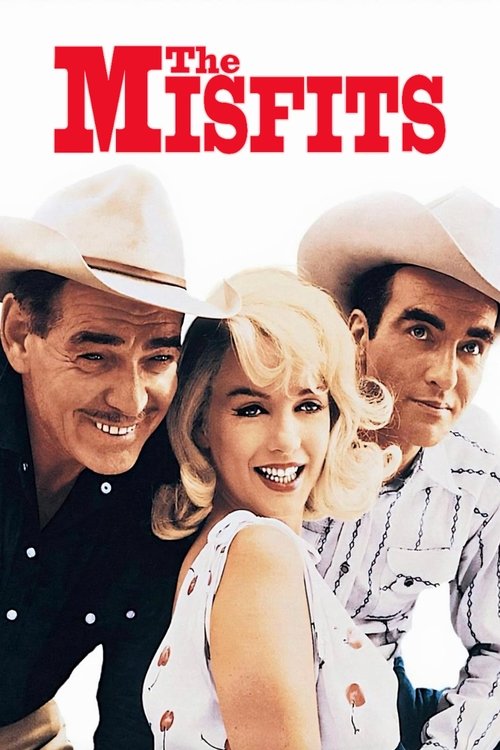
The Misfits
1961 · John Huston
For a melancholy night when you want to sit with beautiful, broken people — a film to reach for when you're in the mood to ache a little and think about what gets left behind. Challenge more than comfort.
What it's about
In Reno for a divorce, Roslyn — beautiful, adrift, and rawly sensitive — falls in with an aging cowboy, a former war pilot, and a battered rodeo rider, and the four drift into the Nevada desert together. What starts as an improvised, half-romantic escape leads to a mustang hunt that forces every one of them to face what their freedom actually costs.
The experience
Slow-burning and elegiac, with a loneliness that seeps into you — long desert silences, wounded conversations, and an ending stretch of startling physical intensity. It feels less like a Western than a lament for the people Westerns used to celebrate.
Performances
Clark Gable, in his final film, gives arguably the most vulnerable performance of his career, and Marilyn Monroe — also in her last completed picture — is heartbreaking, her fragility fully in service of the role. Montgomery Clift's bruised rodeo rider and Thelma Ritter round out an astonishing ensemble.
The craft
Arthur Miller wrote the screenplay, and it shows — the dialogue carries a playwright's weight without losing the dust and heat of the locations. John Huston shot it in stark black and white around Reno and Pyramid Lake, and the desert compositions, especially in the final act, are made for a big screen.
Why it matters
Tepidly received in 1961, it has been reappraised as one of the great American films of its moment — the last screen work of two Hollywood legends and a definitive elegy for the myth of the cowboy.
Snapshot
The Misfits is an elegiac chamber Western in which four damaged people — a divorcée, two aging cowboys, and a battered rodeo rider — collide in the Nevada desert and end up chasing wild mustangs to sell for slaughter. Directed by John Huston from Arthur Miller's screenplay, it stars Clark Gable, Marilyn Monroe, Montgomery Clift, Eli Wallach, and Thelma Ritter. Shot in stark black and white on location around Reno, Dayton, and Pyramid Lake in the punishing summer of 1960, the film carries an almost unbearable freight of biography: it was the last completed film of both Gable, who died of a heart attack days after the shoot wrapped, and Monroe, whose marriage to Miller dissolved during and around the production. Received tepidly on release, it has since been reappraised as one of the most searching American films of its moment — a meditation on obsolescence, tenderness, and the closing of the frontier disguised as a modern-dress Western.
Industry & production
The film emerged from the independent-minded corner of the studio system that flourished as the old order weakened. It was produced by Frank E. Taylor for Seven Arts Productions and released through United Artists — the distributor that had built its postwar identity around financing filmmaker-driven projects rather than owning a studio machine. The origin was literary: Miller published a short story called "The Misfits" in Esquire in 1957 and expanded it into a screenplay, frequently described as his only original work written directly for the screen. He conceived the central role of Roslyn as a gift and a serious dramatic vehicle for Monroe, then his wife.
The production is legendary for its difficulty, and here the historical record is unusually thick and well corroborated by participants. Filming ran through the summer and autumn of 1960 in the Nevada desert under extreme heat. Monroe's ill health and dependence on medication produced repeated delays, and the production was suspended at one point while she was hospitalized. The Miller–Monroe marriage was visibly disintegrating on set, with Miller continuing to revise pages even as the personal relationship collapsed; the couple separated around the film's completion and divorced in early 1961, shortly before release. The film is often cited as among the more expensive black-and-white productions of its era, though precise budget figures reported in the literature vary, and I will not fix a single number here. What is not in dispute is that the shoot became a byword for a runaway, star-driven production straining against its own weight.
The making of the film was itself extensively documented: photographers from the Magnum agency, including Inge Morath — who would later marry Miller — Eve Arnold, and Henri Cartier-Bresson, recorded the production, producing one of the most famous behind-the-scenes photo essays in Hollywood history.
Technology
The Misfits was made with the standard professional apparatus of 1960 Hollywood — 35mm black-and-white photography, direct location shooting supported by studio interiors, and post-synchronized sound — but its notable technological decision is a negative one. At a moment when color and widescreen were becoming the commercial default, Huston shot in black and white and in the conventional (non-anamorphic) frame. That choice was aesthetic rather than economic, aligning the film with documentary austerity and with the elegiac tradition of the monochrome Western rather than with the plush color spectacle then dominating the market.
The most demanding technical element was the mustang-roundup climax, staged in the open desert with trucks, ropes, and a light aircraft flown by the character Guido to drive the horses. Coordinating live animals, vehicles, and performers — several of whom, notably Gable, performed physically strenuous work in extreme heat — placed real logistical and safety strain on the production, and the sequence's raw physicality is a large part of its lasting force.
Technique
Cinematography
Russell Metty photographed the film, and his work is central to its meaning. Metty was a versatile studio craftsman — the same period saw him move between the baroque shadow of Orson Welles's Touch of Evil and the color epic scale of Spartacus — and here he supplies a hard, high-key desert light that flattens and exposes rather than romanticizes. The Nevada exteriors are rendered as bleached, unforgiving space; the human figures are small against salt flats and mountains. Interiors and night scenes carry a plainer, more intimate register suited to the film's long conversational passages. The overall visual argument is anti-picturesque: this is Western landscape stripped of grandeur, a place where the mythic scenery has become merely a hard place to make a living.
Editing
The film was cut by George Tomasini, best known as Alfred Hitchcock's regular editor of the period — he cut Psycho, released the same year, as well as Vertigo and North by Northwest. In The Misfits his work is comparatively unshowy, giving Miller's dialogue room to breathe in sustained scenes, then shifting decisively into kinetic, cross-cut rhythm for the horse chase, where the collision of men, trucks, and animals is built through fragmentation and impact. The contrast between the film's patient dramatic stretches and its violent physical climax is largely an editorial achievement.
Mise-en-scène / staging
Huston stages the film around thresholds and improvised domesticity: bars, a courtroom, a rodeo, and above all Guido's unfinished desert house, where the mismatched group briefly cohabits. The recurring image is of people temporarily sheltering in spaces that do not quite belong to them. The desert functions as both literal setting and moral arena — the place where the characters' evasions are burned away. Staging repeatedly isolates figures within the frame even when they are together, dramatizing loneliness as a spatial condition.
Sound
Alex North's score is discussed under Authorship below. On sound design more broadly the scholarly record is thinner, and I will not overstate it: the film relies on conventional post-synchronized dialogue and effects, with the natural sounds of wind, engines, and terrified horses given prominence in the roundup to intensify its documentary shock. The dominant auditory texture elsewhere is simply Miller's talk — the film trusts language to a degree unusual for a Western.
Performance
Performance is where the film's reputation ultimately rests, and it stages a fascinating clash of acting cultures. Gable embodies a classical Hollywood star persona — weathered, easy, authoritative — now inflected with genuine age and vulnerability; it is widely regarded as among his finest and most exposed work. Monroe, coached in and associated with the Method through the Actors Studio, gives what many consider her most substantial dramatic performance as Roslyn, a role built to draw on her own tenderness and fragility. Montgomery Clift, himself in physical and personal decline, brings a bruised delicacy to Perce that mirrors the film's themes. Eli Wallach, a stage-trained Actors Studio actor, and the reliably sharp Thelma Ritter round out the ensemble. The friction between Gable's studio-era classicism and the interior, Method-inflected styles around him is often read as productive rather than incoherent — a formal echo of the film's subject, the old West meeting a newer, more neurotic modernity.
Narrative & dramatic mode
Structurally the film is closer to a Miller stage play than to a genre Western. It is character-driven, dialogue-heavy, and thematically explicit, progressing not through plot mechanics but through a deepening exposure of its four principals. The dramatic mode is realist and symbolic at once: the wild horses are simultaneously a literal livelihood and a transparent metaphor for the characters — the "misfits" of the title are the small, unbroken mustangs, no longer worth riding and fit only to be sold for pet food, and by clear extension the people who catch them. The narrative builds toward a moral crisis at the roundup, when Roslyn's revulsion forces the men to confront what they are doing, and resolves in a fragile, provisional hope rather than triumph. This literary, essayistic mode was part of what divided contemporary audiences.
Genre & cycle
The Misfits belongs to the elegiac, revisionist Western — the modern-dress "anti-Western" that mourns the frontier's foreclosure. It arrived within a remarkable early-1960s cycle preoccupied with the cowboy's obsolescence: Sam Peckinpah's Ride the High Country (1962), John Ford's The Man Who Shot Liberty Valance (1962), and Lonely Are the Brave (1962), among others, all interrogate the myth of the West as it passes into memory or is crushed by modernity. The Misfits pushes furthest toward contemporary realism, setting its cowboys in a present of divorce courts, wage labor, and highways where their skills have curdled into a grim trade. It is also, generically, a hybrid — part Western, part social-realist relationship drama — which is precisely why it resists easy classification and why period audiences expecting a conventional oater were disoriented.
Authorship & method
The film is a genuine dual authorship. Huston's sensibility — his lifelong attraction to men tested against nature and against their own failures, from The Treasure of the Sierra Madre to The Red Badge of Courage — shapes the physical and existential dimension: the roundup as an ordeal that reveals character. His method was hands-on, location-based, and famously hard-living, well suited to a punishing desert shoot, though it also meant presiding over a production buffeted by its stars' crises.
Miller's authorship is equally decisive. The screenplay's density, its symbolic scheme, and its faith in dialogue mark it unmistakably as the work of America's foremost social dramatist, and its emotional core is inseparable from his relationship with Monroe, for whom Roslyn was written. Among key collaborators: Russell Metty's cinematography supplies the film's austere visual grammar; George Tomasini's editing shapes its rhythm; and Alex North's score threads a restrained, melancholy Americana through the drama without swamping it — North being one of the era's most respected film composers, associated with a modernist, jazz-inflected sensibility in Hollywood scoring. Producer Frank Taylor held this volatile combination together. The result is a rare film in which a literary author and a veteran action director are audibly, sometimes tensely, co-present.
Movement / national cinema
The film is a product of late-classical Hollywood in transition — the moment when the studio system's certainties were breaking down and independent, filmmaker- and star-driven production was rising. It has no formal affiliation with a movement like the French New Wave, then cresting abroad, but it shares that era's broader impulse toward psychological realism, location authenticity, and the deromanticizing of national myth. As an artifact of American national cinema it is unusually self-critical, turning the Western — Hollywood's foundational myth of national character — into an instrument for examining American loneliness and the exhaustion of the frontier ideal.
Era / period
Made in 1960 and released in 1961, The Misfits sits at a hinge between the Eisenhower and Kennedy years, between the classical studio era and the New Hollywood to come. Its anxieties — obsolescence, rootlessness, the commercialization of a once-heroic way of life — are of that transitional moment. It is also, unavoidably, a period document of its own making: a film whose off-screen story of dying stars and a collapsing marriage has become inseparable from its on-screen meaning, so that it now reads as an elegy not only for the West but for a passing age of Hollywood itself.
Themes
The film's governing themes are obsolescence and endurance. Its cowboys have outlived their world; their freedom has become a kind of homelessness, and their trade has degraded from heroic labor to killing horses for money. Against this runs a countertheme of connection and mercy, embodied in Roslyn, whose refusal to accept cruelty as the price of survival is the film's moral center. Loneliness pervades every character, and the desert externalizes it. The wild horses carry the film's deepest idea: that the "misfits" — creatures and people no longer valued by a modernizing, commercializing society — retain a dignity that the market cannot price. Underlying it all is a meditation on how one goes on living without illusions, which gives the film its wary, hard-won final note of hope.
Reception, canon & influence
Contemporary reception was mixed to disappointed. Reviewers and audiences of 1961 found the film slow, talky, and downbeat, and it was not a commercial success; the specific figures reported vary across sources, and I will not assert a single box-office number. Its immediate reputation was also distorted, then and now, by the tragic aura surrounding it as Gable's and Monroe's final completed work.
Its influences run backward into two traditions: the Western's long meditation on the closing frontier, and Miller's own social-realist theater, which supplied the film's literary architecture and moral seriousness. Huston's earlier studies of men undone by their own quests form the other clear lineage.
Its forward legacy is substantial and largely a matter of reappraisal. Over subsequent decades critics came to regard The Misfits as a major achievement — a landmark revisionist Western and a peak in the film careers of its stars, especially Monroe, whose dramatic gifts it did more to honor than almost any other film. It stands as a key early entry in the 1960s cycle of elegiac Westerns that culminated in the work of Peckinpah and late Ford, helping legitimize the modern, deromanticized treatment of frontier myth that would run through New Hollywood. The Magnum photographs of its production became iconic in their own right, feeding a durable cultural fascination with the shoot. If its influence is measured less in direct imitation than in reputation, that reputation is now secure: a somber, ambitious film that used the machinery of the Western to grieve for everything the Western had promised.
A Deleuzian reading
A light plane comes in low and the horses break.
The full Deleuzian reading of The Misfits →
Reception
A box-office disappointment with mixed reviews in 1961, it's since been reappraised as an elegiac masterpiece — the mournful final bow of old Hollywood, now inseparable from the deaths of Gable and Monroe that bookended it.
How The Misfits was received, from release to now →
Influences: the films it descends from and the films it influenced
- The Treasure of the Sierra Madre (1948) — Huston's template of men undone by their own obsessive quest, with a punishing location shoot used as an ordeal that strips characters down and exposes them — the same method Huston applies to the mustang roundup.
- The Asphalt Jungle (1950) — Huston's ensemble of doomed 'misfits' — dreamers and losers whose scheme reveals their inner ruin — and the film that first showcased Monroe, prefiguring Roslyn's outsider empathy amid broken men.
- Red River (1948) — Renders the animal drive as grueling, sweat-and-dust physical labor that frays and reveals male character, the documentary-real approach to livestock work that the mustang chase inherits (with Clift carrying it into both).
- The Ox-Bow Incident (1943) — The anti-Western's moral seriousness — frontier myth stripped of heroism and turned into indictment — supplying the deromanticized, guilt-laden template Miller's screenplay extends.
- The Gunfighter (1950) — Codifies the elegy of obsolescence: the aging Westerner outlived by his own myth, the melancholy-of-the-anachronistic-frontiersman that Gable's Gay Langland embodies.
- A Streetcar Named Desire (1951) — Stages the collision of Actors Studio Method (Clift-Monroe-Wallach) against classical technique (Gable), and carries Alex North's debut jazz-inflected modernist score — the same composer threading restrained Americana through The Misfits.
- Death of a Salesman (1951) — Miller's own dramaturgy of the obsolete working man — dense, symbol-laden, dialogue-driven literary architecture — transposed from stage tragedy of obsolescence into the film's moral spine.
- The Lusty Men (1952) — Extends Ray's theme of the frontier's tawdry commercial afterlife: aging cowboys reduced to roping mustangs for dog-food money, rootless men circling an unattainable domesticity.
- Lonely Are the Brave (1962) — The modern cowboy rendered an anachronism trapped in a contemporary, mechanized West — black-and-white, horse-versus-machine — extending the frontier-elegy into present-tense obsolescence exactly as The Misfits does.
- Ride the High Country (1962) — Peckinpah's inaugural elegy for aging frontiersmen outlived by the country they tamed, launching the 1960s obsolescence cycle The Misfits helped legitimize.
- The Man Who Shot Liberty Valance (1962) — Late-Ford elegy mourning the death of frontier myth from inside the genre's own machinery — the deromanticized reckoning with what the Western promised that The Misfits pioneered a year earlier.
- Hud (1963) — Anti-picturesque black-and-white (James Wong Howe) of a modern cattle West in decline, using widescreen emptiness and spatial loneliness to indict a vanishing way of life.
- The Wild Bunch (1969) — Men fatally out of their time on a closing frontier, escalating the kinetic cross-cutting Tomasini modeled into full multi-angle montage while carrying forward the obsolescence theme.
- Junior Bonner (1972) — The rodeo cowboy as living relic in a bulldozed modern West — a near-direct descendant of Wallach and Gay's mustanging as the last gasp of a vanishing frontier trade.
- The Last Picture Show (1971) — Black-and-white elegy for a dying Western town, using austere anti-picturesque monochrome and empty compositions to grieve obsolescence in the mode The Misfits set.
- Fat City (1972) — Huston's own late return to the milieu of broken, obsolete men in a bleached, unromantic landscape — the same character-through-physical-ordeal study transposed from mustangers to washed-up boxers.
- Monte Walsh (1970) — Aging cowboys watching mechanization erase their livelihood, extending the frontier-elegy's central image of the working Westerner made economically obsolete.
- Desert Hearts (1985) — Establishes the exact Reno divorce-ranch milieu and treats the Nevada desert in monochrome wide compositions as emotional space — the transient, waiting-for-a-decree world Desert Hearts inherits wholesale.
- The Rider (2018) — Huston shot the mustang round-up as unfaked physical labor with real wranglers and horses in long, uncut takes; Zhao's gentling sequences with Apollo use the same principle — the camera waits on the animal's actual behavior in real duration rather than cutting around it.
- Touch of Evil (1958) — Russell Metty's austere, high-contrast deep-focus black-and-white — the same cinematographer's anti-glamour visual grammar, favoring stark tonal fields over picturesque prettiness.
- Psycho (1960) — George Tomasini's kinetic cross-cutting and precision rhythm as an editorial signature — the same cutter shaping The Misfits' roundup tempo the year prior.
Similar films
- The Man Who Shot Liberty Valance (1962) — influence & lineage · same viewing thread
- Ride the High Country (1962) — influence & lineage · same viewing thread
- The Asphalt Jungle (1950) — influence & lineage
- The Treasure of the Sierra Madre (1948) — influence & lineage
- The Ox-Bow Incident (1943) — influence & lineage
- Red River (1948) — influence & lineage
- The Wild Bunch (1969) — influence & lineage · same viewing thread
- The Gunfighter (1950) — influence & lineage · same viewing thread
All the films related to The Misfits →
Watch it with: curated runs of related films
- Print the Legend — A run of frontier myths and their unmaking — town-taming marshals, aging gunfighters, and the stories the newspapers chose to print instead of the truth.