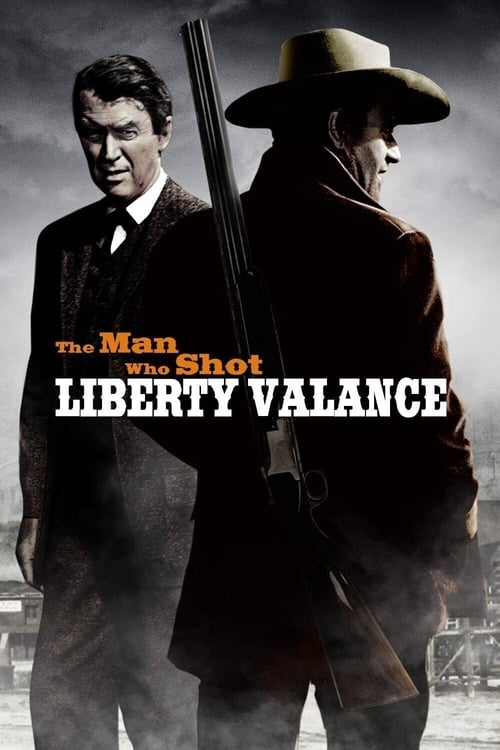
The Man Who Shot Liberty Valance
1962 · John Ford
For when you want a film to chew on for days — one that starts as a classic Western and ends as a question about every story your country tells about itself. Challenge more than comfort, but deeply rewarding.
What it's about
A U.S. senator returns to a dusty frontier town to attend the funeral of a nobody — a forgotten local rancher — and a newspaperman wants to know why. The answer unspools in flashback: decades earlier, the senator arrived as an idealistic young lawyer, was beaten and humiliated by the sadistic outlaw Liberty Valance, and found the town's only real protection was a rancher who lived by the gun the lawyer despised. It's a story about how the West was tamed, and about what the official version leaves out.
The experience
Slow-burning, talky, and quietly devastating — less a shoot-em-up than a moral argument that tightens around you. It plays like a memory: stagey, stark, deliberate, with an ache of regret underneath that sneaks up and stays.
Performances
James Stewart and John Wayne play their own screen personas against each other — Stewart's decency curdling into something more complicated, Wayne carrying an entire tragedy in his posture. Lee Marvin's Liberty Valance is pure menace, a bully whose violence feels genuinely dangerous.
The craft
Ford shot it in stark black-and-white on enclosed studio sets at the height of the color-widescreen era — a deliberate choice that makes the whole film feel like legend under interrogation. The staging is spare and theatrical, every composition doing moral work.
Why it matters
Its famous line about printing the legend became shorthand for how nations mythologize their past, and the film opened the door to the revisionist Westerns that followed — a genre master turning the genre's own myths inside out.
Snapshot
The Man Who Shot Liberty Valance is John Ford's great elegy for the frontier and, equally, for the myths the frontier left behind. Built as an extended flashback — Senator Ransom Stoddard (James Stewart) returns to the small town of Shinbone to bury an obscure local named Tom Doniphon (John Wayne), and a newspaperman presses him to explain why a U.S. senator would attend so humble a funeral — the film reconstructs how a tenderfoot lawyer became famous as the man who killed the outlaw Liberty Valance (Lee Marvin), and how that fame rested on a lie. Shot in stark black-and-white on enclosed studio sets at the height of the color-widescreen era, it is one of Ford's most deliberately stylized and most thematically explicit works: a meditation on law versus the gun, civilization versus wilderness, and the troubling exchange by which a society manufactures the heroes it needs. Its closing aphorism — "When the legend becomes fact, print the legend" — has become one of the most quoted lines in American cinema and a shorthand for the whole problem of national mythology.
Industry & production
The film was produced through Ford's own production arrangement and released by Paramount Pictures in 1962, a moment when Ford was in the late phase of a career that stretched back to the silent era. By this point the economics of the studio Western had shifted: the genre was migrating to television, budgets for theatrical Westerns were tightening, and Ford himself was an aging figure whose commercial standing no longer guaranteed lavish resources. The most consequential production decisions — black-and-white photography and largely soundstage-bound shooting rather than Ford's signature location work in Monument Valley — are generally attributed to a combination of budget constraint and aesthetic intent. The result looks, by design or necessity, more theatrical and contained than the expansive outdoor Fords that preceded it.
The casting compounded this enclosed quality. James Stewart and John Wayne were both in their early-to-mid fifties when they played men meant to be considerably younger in the central flashback, and contemporary viewers noticed the strain between the stars' visible age and the youth of their characters. Many later critics have come to read this not as a flaw to be excused but as part of the film's elegiac texture — the West being remembered rather than lived, refracted through old men's recollection. The production assembled much of Ford's habitual stock company alongside the two leads. Precise budget and box-office figures are not something I will assert here, as the reliably documented record on this film's exact financials is thin; what is clear is that it was made economically by the standards of a major-star Western of its day.
Technology
The defining technological choice is the refusal of contemporary technology. By 1962 the prestige Western was overwhelmingly a color, widescreen proposition — the visual scale was much of the selling point against television. Ford instead shot in black-and-white, a choice that registered as archaic and, to some reviewers at the time, cheap-looking. Read more generously, monochrome serves the film's status as memory and parable: it strips the spectacle from the Western and throws weight onto faces, shadow, and the moral chiaroscuro of the story. The night confrontation in the street — staged so that we eventually learn the "real" geometry of the killing — depends entirely on controlled studio lighting and the expressive blacks that the format allows, an effect that would have been diluted by color realism.
One persistent point of confusion belongs under technology and tie-in marketing rather than the film itself: the popular song "The Man Who Shot Liberty Valance," written by Burt Bacharach and Hal David and recorded by Gene Pitney, was a 1962 hit associated with the title but does not appear in the picture. The film's actual score is orchestral, not pop-song-driven.
Technique
Cinematography
The black-and-white photography is credited to William H. Clothier, a frequent collaborator of both Ford and Wayne. The visual approach is notably restrained and interior compared with Ford's vista-driven Westerns: much of the drama unfolds in the saloon, the newspaper office, the kitchen, the schoolroom, and the darkened street. Clothier and Ford use deep, theatrical staging and pools of light against heavy shadow, concentrating attention on performance and on the architecture of rooms rather than landscape. The film's most famous technical maneuver is the restaging of the central gunfight from a second vantage point late in the picture, which reveals the true line of fire; the cinematography quietly withholds and then discloses the spatial information on which the entire legend turns.
Editing
Otho Lovering is credited with the editing. The film's structure is fundamentally an editorial conception: a present-day frame (the funeral and the interview) brackets a long flashback, and the climactic killing is presented twice — once as the town experiences and mythologizes it, and once as it "really" happened. The power of "print the legend" is delivered through this doubling, and the cut back to the framing present, after the truth has been told and then set aside, is what gives the ending its melancholy weight. The editing's discretion — letting us believe one version before supplying another — is the mechanism of the film's central irony.
Mise-en-scène / staging
The staging is the most discussed formal element. The soundstage sets, the relatively confined spaces, and the heightened, almost stage-play blocking give the film a deliberately constructed feel, as if the West here is a set of remembered tableaux rather than a real geography. Recurring spatial motifs — the meal Hallie serves, the law books, the schoolroom where Stoddard teaches literacy and civics, the saloon as the outlaw's domain — organize the film's argument visually: literacy, domesticity, and law on one side; the gun and intimidation on the other. The cactus rose, a humble flower associated with Doniphon and Hallie, recurs as a quiet emblem of the wild West that civilization displaces, and it returns pointedly in the framing story.
Sound
The orchestral score is credited to Cyril J. Mockridge. It is widely noted that the film draws on Alfred Newman's tender "Ann Rutledge" theme, originally written for Ford's Young Mr. Lincoln (1939); its reuse here forges an explicit musical bridge between Stoddard's frontier idealism and the Lincolnian mythology of American law and self-government. (Readers should treat the precise extent of that musical borrowing as an attribution often repeated in the literature rather than something I can quote chapter and verse on.) Otherwise the soundscape is spare and functional, in keeping with the film's interior, dialogue-driven design.
Performance
Performance carries the film. James Stewart plays Stoddard as an earnest, sometimes priggish believer in law and literacy, his characteristic decency shading into stubbornness and, by the end, into the guilty discomfort of a man who has lived off a reputation he did not earn. John Wayne, as Doniphon, gives one of his most melancholy performances: a man of the old order whose competence and code make civilization possible but leave no place for himself within it — the film's true, unrewarded hero, who fades into obscurity and a pauper's coffin. Lee Marvin's Liberty Valance is a vivid study in sadistic menace, and the supporting ensemble is rich: Vera Miles as Hallie, the woman caught between the two men; Edmond O'Brien as the drink-prone, eloquent newspaper editor Dutton Peabody; Andy Devine as the cowardly marshal; Woody Strode as Doniphon's loyal Black companion Pompey; and Ford regulars including John Carradine, Lee Van Cleef, and Strother Martin in smaller roles.
Narrative & dramatic mode
The dramatic mode is tragic and retrospective rather than heroic and forward-driving. The flashback frame establishes from the outset that the story is already over, already lost — we are at a funeral — so the energy of the picture is mournful and investigative rather than suspenseful in a conventional sense. The narrative withholds the true authorship of the killing until late, structuring the film as a gradual exposure of a foundational falsehood. Crucially, the film stages the revelation only to have its journalist auditor refuse to publish it: the truth is spoken, acknowledged, and then suppressed in favor of the legend. This makes the dramatic arc not redemptive but ironic — knowledge is gained, and then deliberately set aside in the name of social need.
Genre & cycle
Liberty Valance sits at the threshold between the classical Western and its revisionist successors. It retains classical materials — the gunman, the marshal, the saloon, the showdown — but turns them into objects of analysis. It belongs to the cycle of "twilight" or elegiac Westerns that interrogate the genre's own myths, and within Ford's career it stands near the end of his Western output (his final Western, Cheyenne Autumn, followed in 1964). The film is in explicit dialogue with the earlier classical Ford Westerns built around Wayne and around frontier community-building; here those same building blocks are reframed to ask what was paid, and by whom, for the orderly civic future the genre usually celebrates without question.
Authorship & method
The film is a paradigmatic late-Ford work. The screenplay is credited to James Warner Bellah and Willis Goldbeck, adapting a short story by Dorothy M. Johnson — a literary source consistent with Ford's habit of drawing on Western fiction. Ford's method is visible in the assembly of his stock company: Wayne, the indispensable Ford star; character players like Andy Devine, John Carradine, and Strother Martin; and, significantly, Woody Strode as Pompey, a role that gives the film a quiet racial dimension — Pompey is barred from the saloon, and his exclusion from the very civic life Stoddard preaches is one of the picture's sober undercurrents. Among key collaborators, cinematographer William H. Clothier shapes the monochrome, interior look; editor Otho Lovering executes the doubled-climax structure; and the score under Cyril J. Mockridge, with its Lincolnian musical allusion, ties the frontier story to the larger American civic myth. The film is also notable for self-consciously thematizing Ford's own lifelong project: a director famous for romanticizing the West here interrogates the act of romanticization itself.
Movement / national cinema
This is quintessential American studio cinema and a central text of the Hollywood Western, the United States' most distinctive national genre. It is also, however, a film admired early and seriously by European critics — French auteurist critics in particular took Ford's late work as the mature statement of a major author — and that critical reception abroad helped secure its standing at a time when domestic reviewers were more divided. It thus sits at the intersection of American genre filmmaking and the international auteurist criticism that was, in the early 1960s, reshaping how such films were valued.
Era / period
The film is set in an unspecified late-frontier past, during the territorial period when statehood, railroads, and the question of open-range cattle interests versus settled, fenced, law-governed community were being decided. Stoddard's literacy classes and the debate over a statehood convention place the story at the historical hinge where the West is being absorbed into the constitutional, electoral United States. Made in 1962, the film looks back on that hinge from the vantage of a modern America (the framing story features a railroad and a sense of vanished frontier), and the gap between the two periods — the lost world of Doniphon and the bureaucratic present of Senator Stoddard — is the source of the film's pervasive sense of loss.
Themes
The governing theme is the cost of civilization: the orderly, literate, lawful society Stoddard represents can only be founded on an act of violence performed by a man (Doniphon) who has no place in the world he makes possible. Closely bound to this is the film's meditation on myth and history — the explicit argument, crystallized in "print the legend," that societies prefer and require usable myths over inconvenient truths, and that public memory is a deliberate construction. Other major threads include law versus the gun (the book and the ballot against the six-shooter); literacy and the press as instruments of civilization; the displacement and self-erasure of the frontier hero; unfulfilled love (the triangle of Hallie, Doniphon, and Stoddard, with the cactus rose as its emblem); and, in Pompey's marginalization, the exclusions written into the founding of the new order. The film's tone toward all of this is ambivalent rather than triumphant: it honors the civilization achieved while mourning what — and who — was sacrificed and then forgotten to achieve it.
Reception, canon & influence
Critical reception in 1962 was mixed. A significant strand of contemporary opinion found the film stage-bound and visually impoverished — the studio sets and black-and-white photography read to some as cheapness, and the obvious age of Stewart and Wayne in the flashback drew comment. Yet the film also had serious early admirers, particularly among auteurist critics who recognized it as a deeply considered statement rather than a tired one. Over the following decades the critical consensus shifted decisively in its favor, and it is now routinely ranked among Ford's finest films and among the essential American Westerns; its perceived limitations have been reinterpreted as deliberate, expressive choices. It was selected for preservation in the United States National Film Registry (in 2007, by the reliably reported record), a marker of its canonical status.
On the question of influences on the film (backward): it grows out of Ford's own prior Westerns and their community-founding plots, out of the literary Western tradition represented by Dorothy M. Johnson's source story, and out of the broader American mythology of frontier law and Lincolnian self-government that the score's allusion underlines. Its influence forward is substantial and largely conceptual. "When the legend becomes fact, print the legend" passed into general usage as a touchstone for discussions of myth, journalism, and national memory well beyond film criticism. The film became a key reference point for the revisionist Westerns that followed, which took up its skepticism about heroism and its scrutiny of the genre's founding violence, and it has been a perennial subject for scholars writing on Ford, on the Western, and on the cinema of American myth. Its central insight — that nations and genres alike are built on stories they choose to keep telling — has proven more durable than any single plot point, and it is the reason the film continues to be taught and re-examined rather than merely admired.
A Deleuzian reading
The street, the second time.
The full Deleuzian reading of The Man Who Shot Liberty Valance →
Reception
Dismissed by some 1962 critics as stagey, studio-bound late Ford — a black-and-white western in the age of widescreen color — it's since been reappraised as one of his supreme masterpieces and the great elegy for the genre itself.
How The Man Who Shot Liberty Valance was received, from release to now →
Influences: the films it descends from and the films it influenced
- Stagecoach (1939) — Founded the Ford stock-company method this film consummates — recurring character players (Devine et al.) and the discovery of Wayne — staging the frontier journey through ensemble types rather than a lone star.
- Young Mr. Lincoln (1939) — Established Ford's Lincolnian civic-myth iconography and the lawyer-as-civilizer figure, directly underwriting Stoddard's rule-of-law idealism and Mockridge's Lincoln musical allusion.
- My Darling Clementine (1946) — Built the elegiac frontier-town-as-moral-stage that Liberty Valance interiorizes: the lawman who clears the way for church, school, and the schoolmarm's civilization he himself can't enter.
- Fort Apache (1948) — First dramatized Ford's myth-over-truth thesis — Wayne knowingly upholding a false heroic legend for the good of the institution — the conceptual seed of 'print the legend.'
- The Searchers (1956) — Crystallized the melancholy-Wayne archetype: the indispensable man of violence framed and excluded from the domestic community his violence makes possible, recapitulated in Tom Doniphon.
- Citizen Kane (1941) — Supplied the retrospective flashback-frame architecture and withheld-vantage narration — a man's life reconstructed after his death to expose the gap between public legend and suppressed fact.
- Rashomon (1950) — Modeled the contested-testimony flashback in which the 'true' account of a killing is deliberately withheld and reframed, anticipating the doubled-climax reveal of who really shot Valance.
- The Gunfighter (1950) — Established the elegiac gunman trapped by his own reputation — the legend that outlives and condemns the man — the fatalism Doniphon's effacement turns inside out.
- Sergeant Rutledge (1960) — Reuses the flashback-testimony framing device and Woody Strode's loyal-retainer presence to interrogate the frontier legend, the companion piece in Ford's late self-revision.
- The Misfits (1961) — Late-Ford elegy mourning the death of frontier myth from inside the genre's own machinery — the deromanticized reckoning with what the Western promised that The Misfits pioneered a year earlier.
- Destry Rides Again (1939) — A tragic rewrite of the same premise — the man who won't carry a gun in a town owned by a bully — that keeps Destry's civic staging but reveals the victory as fraudulent, converting Marshall's optimistic answer about law replacing force into a lie the town agrees to print.
- Cheyenne Autumn (1964) — Ford's own immediate follow-through on the revisionist threshold, turning his stock-company craft to interrogate, rather than romanticize, the frontier's foundational injustices.
- Once Upon a Time in the West (1968) — Extended the elegiac-Western lament for the gunman superseded by railroad and settlement, using Morricone leitmotifs the way Mockridge's score allusively ties violence to advancing civic myth.
- The Wild Bunch (1969) — Took up the scrutiny of the genre's founding violence and obsolete men of action (Strother Martin carrying over), pushing Ford's elegy into open revisionist critique.
- The Last Picture Show (1971) — Adopted Liberty Valance's deliberate black-and-white, withheld-grandeur monochrome as an elegy for a vanishing frontier and the picture-house that mythologized it.
- The Shootist (1976) — Completed the melancholy-Wayne self-elegy, building its whole drama on the aging star's persona and the dying gunfighter's reckoning with his own legend.
- Unforgiven (1992) — Literalized 'print the legend' through the dime-novelist Beauchamp, dramatizing the manufacture of Western myth against the squalid, suppressed truth of the killing.
- The Assassination of Jesse James by the Coward Robert Ford (2007) — Inherited the retrospective-elegy and ironic-suppressed-truth structure, anatomizing how celebrity legend is built atop, and falsifies, the actual act of killing.
- The Good, the Bad and the Ugly (1966) — Ford's 'print the legend' revelation—that the heroic myth is a deliberate fiction built over a squalid truth—is the narrative demythologization thesis GBU inherits and radicalizes by removing the squalid truth entirely, leaving only the myth's hollow performance.
- 24 Hour Party People (2002) — Supplies the film's governing thesis verbatim — Tony Wilson quotes 'when you have to choose between the truth and the legend, print the legend' to camera, importing Ford's print-the-legend ethics of myth-making as an organizing structural principle.
- The Death of Robin Hood (2026) — The 'print the legend' meditation on how myth outlives and misrepresents the man — the elegiac interrogation of heroic legend that underwrites the revisionist-legend approach.
- Tombstone (1993) — Its 'print the legend' myth-affirming ethos and framing-narration device prefigure Mitchum's voiceover and Tombstone's deliberate embrace of legend over revisionism.
- Silverado (1985) — The legend-versus-civic-law split and the villain whose menace arrives as amused charm descend from Ford and Marvin; Dennehy's Cobb is Valance rewritten as the town's own sheriff, genial right up to the draw.
- High Noon (1952) — Pioneered the stripped, near-stage-bound anti-spectacle Western built on a reluctant lawman's moral test, validating Ford's deliberately soundstage, monochrome austerity over open-range grandeur.
- Shane (1953) — Dramatized founding violence as the prerequisite the homesteaders must disavow, the gunman departing so settled civilization can pretend it was never needed.
- Ride the High Country (1962) — Released the same year, it is the other great closing-frontier elegy — the printed legend versus the squalid truth, the West passing into obsolescence, told through aged star bodies.
Similar films
- My Darling Clementine (1946) — influence & lineage · same viewing thread · often watched together
- High Noon (1952) — influence & lineage · same viewing thread · often watched together
- Shane (1953) — influence & lineage · same viewing thread
- Stagecoach (1939) — influence & lineage · often watched together
- Once Upon a Time in the West (1968) — influence & lineage · often watched together
- The Assassination of Jesse James by the Coward Robert Ford (2007) — influence & lineage · often watched together
- Fort Apache (1948) — influence & lineage
- The Searchers (1956) — influence & lineage
All the films related to The Man Who Shot Liberty Valance →
Watch it with: curated runs of related films
- Print the Legend — A run of frontier myths and their unmaking — town-taming marshals, aging gunfighters, and the stories the newspapers chose to print instead of the truth.