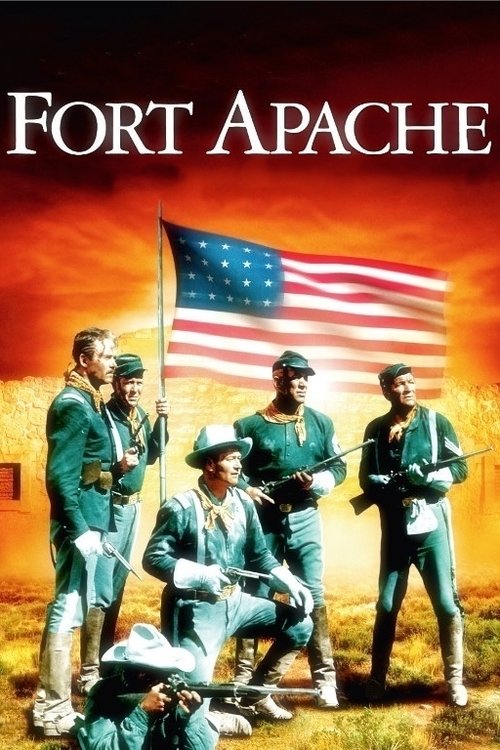
Fort Apache
1948 · John Ford
For when you want a classic Western with something on its mind — big landscapes and cavalry pageantry, but also a story about ego, duty, and how history gets written. Comfort viewing that sneaks in a challenge.
What it's about
A vain, by-the-book lieutenant colonel arrives to command a remote Arizona cavalry post he considers beneath him, dragging his spirited daughter along. Convinced glory lies in crushing the Apache leader Cochise, he ignores the hard-won counsel of a captain who actually knows the country and the people. Around this collision, the film paints the whole life of a frontier garrison — its dances, courtships, rituals, and loyalties.
The experience
Warm and communal for long stretches, almost a hangout film about army life, with a gathering sense of doom as pride overrides judgment. It ends on a note that's genuinely haunting — quiet, ambivalent, and built to be argued over.
Performances
Henry Fonda, cast brilliantly against his decent-man image, makes the colonel's rigidity chilling without ever playing a villain; John Wayne gives one of his most restrained, watchful performances as the captain who sees the disaster coming.
The craft
John Ford stages Monument Valley vistas and massed cavalry movements with a painter's eye, in crisp black and white that rewards the biggest screen you can find. The film's real craft is structural: an unhurried portrait of community that makes the military spectacle feel earned rather than empty.
Why it matters
The first film of Ford's Cavalry Trilogy and a founding work of the mature postwar Western, its clear-eyed take on the Custer legend — and on how nations prefer myth to truth — echoes through decades of revisionist Westerns.
Snapshot
Fort Apache is the first panel of John Ford's so-called Cavalry Trilogy — followed by She Wore a Yellow Ribbon (1949) and Rio Grande (1950) — and one of the founding texts of the mature postwar Western. Adapted from James Warner Bellah's Saturday Evening Post story "Massacre," it transplants the Custer legend to a fictional Arizona outpost, casting Henry Fonda as Lieutenant Colonel Owen Thursday, a martinet whose vanity and contempt for the Apache lead his regiment into annihilation, and John Wayne as Captain Kirby York, the experienced subordinate who survives to inherit — and burnish — Thursday's reputation. The film is celebrated for two things at once: its lyrical communal portrait of frontier-army life, and its startlingly self-aware coda, in which York consciously chooses to preserve a heroic myth he knows to be false. That gesture makes Fort Apache a key early instance of Ford interrogating the very legends his cinema helped build, anticipating by fourteen years the explicit thesis of The Man Who Shot Liberty Valance (1962).
Industry & production
The film was produced by Argosy Pictures Corporation, the independent company Ford had formed with producer-director Merian C. Cooper, and released through RKO Radio Pictures. Argosy's model gave Ford unusual autonomy within the studio system of the late 1940s: he assembled his own repertory of actors and craftspeople, controlled casting and locations, and shot largely on his preferred ground in Monument Valley on the Arizona–Utah border. The screenplay was the first Ford collaboration with Frank S. Nugent, a former New York Times film critic who would become Ford's most important postwar writer; Nugent reportedly prepared extensive biographical notes on the characters, a method consistent with the film's dense ensemble texture, though specific accounts of his preparation should be treated as part of the Ford legend rather than firmly documented fact.
Casting drew on Ford's stock company and on Hollywood's commercial logic. Fonda, recently returned from naval service in the war, took the unsympathetic lead; Wayne, by 1948 a major star and a Ford veteran since Stagecoach (1939), played the moral center. Shirley Temple, attempting an adult career, was cast as Thursday's daughter Philadelphia, opposite her then-husband John Agar as Lieutenant Michael O'Rourke. Ward Bond, Victor McLaglen, Pedro Armendáriz, George O'Brien, Anna Lee, and Irene Rich fill out the regimental world. The picture was shot in 1947 and released in 1948. Reliable, audited box-office figures from this period are scarce, so claims about precise grosses should be treated cautiously; contemporary trade reception, however, was strong, and the film's success underwrote the two sequels.
Technology
Fort Apache was made in standard 35mm black-and-white at the Academy ratio, the dominant format of the pre-widescreen era. Ford's decision to shoot in monochrome is significant given that he would render She Wore a Yellow Ribbon the following year in Technicolor; the black-and-white here serves a harder, more documentary register, with high-contrast desert light and deep skies. Production relied on conventional studio interiors for the fort's domestic spaces combined with extensive location work in Monument Valley, where the logistics of moving cast, horses, and equipment into a remote landscape were themselves a considerable undertaking. There is no exotic technological innovation to claim for the film; its achievement is one of craft applied to mature, fully developed tools rather than of technical novelty.
Technique
Cinematography
The principal cinematographer was Archie Stout, a frequent Ford collaborator with long experience in outdoor and Western photography. The film's visual signature is the contrast between the vast, sculptural emptiness of Monument Valley — towering buttes, low horizons, riders reduced to specks against rock and sky — and the cramped, shadowed interiors of the fort. Ford composes the landscape in deep, static frames that monumentalize the cavalry as small figures moving through an indifferent geography, while the action set-pieces, especially the climactic massacre, use dust, distance, and silhouette to convey scale and doom rather than spectacle. The photography is frequently described as evoking the frontier paintings of Frederic Remington, an analogy Ford himself encouraged across the trilogy; the framing of mounted columns and the treatment of dust and light recall that pictorial tradition, and the comparison is well established in the critical literature on Ford.
Editing
Editor Jack Murray, another Ford regular, cut the film. The editing's most notable quality is its tonal management: Fort Apache moves fluidly between comic regimental interludes (the noncoms' drinking, the social dance, courtship subplots) and grave dramatic and military passages, and the cutting sustains this oscillation without rupture. The massacre sequence is built less through rapid montage than through controlled alternation of scale — long shots of the disappearing column against intimate reaction shots — so that the catastrophe registers as inexorable rather than chaotic. The film's celebrated final scene, set years later, depends on editing and staging that allow York's myth-making to land as a deliberate, weighted choice.
Mise-en-scène / staging
Mise-en-scène is where Ford's genius is most visible. The fort is rendered as a complete social organism: officers and enlisted men, wives and daughters, the Irish-American noncommissioned community, all occupying distinct but interlocking spaces. Ford stages ceremony with particular care — the regimental dance, the arrival of the new commander, the formal dinners — using ritual to express the values of duty, hierarchy, and belonging that the film both honors and questions. The recurring motif of the parade-ground column, framed through doorways and against the valley, ties the human community to the landscape that may swallow it. Domestic interiors are warm and crowded; the desert is austere and lethal; the architecture of the film is the tension between them.
Sound
The film uses sound and especially music to reinforce its communal and elegiac dimensions. Period and folk songs — cavalry and Irish ballads characteristic of Ford's army pictures — recur as expressions of regimental identity, and diegetic music at the dance and in the barracks deepens the sense of a self-contained world. Dialogue is staged for ensemble overlap and comic timing among the noncoms, contrasted with the clipped formality of Thursday's commands. The original score is by Richard Hageman.
Performance
Fonda's Thursday is the film's most analyzed performance: rigid, courteous, and quietly poisonous, he embodies a class-bound professionalism curdled into vanity, and Fonda resists making him a simple villain — his courage in the final charge is real even as his judgment is catastrophic. Wayne's York is the counterweight, warm and pragmatic, and the role marks an important stage in Wayne's development of the weathered, morally serious frontier figure he would refine under Ford through the 1950s. The supporting ensemble — McLaglen's broad comedy, Armendáriz's dignity, Bond's solidity, Temple and Agar's youthful romance — gives the regiment its lived-in density, which is essential to the tragedy's weight.
Narrative & dramatic mode
The dramatic mode is tragic with a strong communal-comic substrate, an unusual and characteristically Fordian blend. The central tragedy follows a classical arc: a flawed leader whose hubris destroys him and those under his command. But Ford embeds this within a leisurely, episodic portrait of community life, so that roughly the first two-thirds of the film accumulate texture and affection before the catastrophe. The decisive structural masterstroke is the epilogue. Years after the massacre, York — now commanding the regiment — meets reporters who praise the fallen Thursday as a hero, and he affirms the legend, declining to correct the record. This double ending transforms the film from a straightforward tragedy into a meditation on how history is authored, making the audience complicit in, and conscious of, the myth's construction.
Genre & cycle
Fort Apache belongs to the cavalry Western, a subgenre Ford effectively codified across his trilogy, and more broadly to the postwar Western's turn toward psychological and moral complexity. Where many earlier Westerns treated the Indian Wars as uncomplicated frontier triumph, Fort Apache foregrounds the army's own failures — its arrogance, its bad faith in dealing with the Apache, its bureaucratic corruption via the dishonest Indian agent — and grants the Apache leadership a measure of dignity and legitimate grievance. The film thus sits at an important transitional point in the genre's cycle, retaining the communal romance of the traditional Western while opening the critical, revisionist space that later filmmakers would widen. Its sympathetic, if still limited, treatment of the Apache cause distinguishes it from much of its era's output, even as it remains a film told overwhelmingly from the cavalry's point of view.
Authorship & method
The film is a paradigm of Ford's authorship and his repertory method. Working through Argosy with collaborators he trusted and reused — writer Frank Nugent, cinematographer Archie Stout, editor Jack Murray, composer Richard Hageman, and a stock company of actors — Ford built films through accumulated ensemble familiarity rather than through any single dominant element. His method favored carefully composed master shots over coverage, on-location authenticity in Monument Valley, and the interweaving of comedy, ceremony, song, and tragedy. Fort Apache also exemplifies the central paradox of Ford's authorship that critics have long debated: he is simultaneously the great romantic mythologizer of the American frontier and a filmmaker capable of exposing the falseness of those myths, sometimes within the same work. The collaboration with Nugent, beginning here, gave Ford a writer attuned to character nuance and to the ironies of the legend-versus-truth theme that the director would pursue for the rest of his career.
Movement / national cinema
The film is a quintessential product of classical Hollywood, made within — but at the relatively autonomous edge of — the studio system through Ford's independent Argosy unit. It is central to American national cinema in the deepest sense: the Western was the genre through which Hollywood narrated the United States' founding mythology, and Ford was its preeminent author. Fort Apache participates directly in the construction of American national self-image — the frontier army, sacrifice, community on the edge of wilderness — while also subjecting that image to scrutiny. It does not belong to a formal aesthetic movement; its significance is as a high point of the American studio tradition's vernacular art.
Era / period
Released in 1948, the film is a product of the immediate postwar moment, and that context informs its concerns. Made by a director and stars who had served in the war, it reflects on military duty, leadership, obedience, and the gap between command vanity and the sacrifices of ordinary soldiers — themes with obvious postwar resonance. Its skepticism toward glory-seeking commanders and its insistence on the dignity of the rank and file can be read against the backdrop of a nation absorbing the costs of recent conflict. At the same time, it is set in the post–Civil War frontier of the 1870s, and its treatment of the Indian Wars carries the assumptions and the emerging self-questioning of mid-century America.
Themes
The film's governing theme is the relationship between truth and legend — how heroic myths are manufactured, and who chooses to sustain them. Closely bound to this is the critique of leadership: Thursday's failure is one of character, of class-bound arrogance and racial contempt overriding the practical wisdom of subordinates. Duty and the regiment-as-community form a third major strand; Ford treats the cavalry as a family with its own rituals, songs, and hierarchies, and the film's affection for that community is genuine even as it indicts the leadership. The treatment of the Apache raises the theme of justice and bad faith on the frontier, with the dishonest Indian agent embodying institutional corruption. Finally, the film meditates on continuity and inheritance — York carrying forward both the regiment and the myth — making memory itself a central subject.
Reception, canon & influence
Fort Apache was well received on release and has since become firmly canonical, regularly cited among Ford's major works and as a cornerstone of the Western. Critical writing on Ford — from the auteurist appraisals of Andrew Sarris and the early monograph by Lindsay Anderson to the detailed scholarship of Tag Gallagher and others — has consistently treated the Cavalry Trilogy, and Fort Apache in particular, as central to understanding Ford's ambivalent relationship to American myth. Critics have especially fixed on the film's ending as evidence that Ford was a far more self-conscious and ironic artist than his reputation as a sentimental nationalist once suggested.
Influences on the film run backward into several traditions: the immediate source is James Warner Bellah's story "Massacre," itself drawing on the historical Indian Wars and on the Custer legend, with Thursday's fatal charge a transparent analog to Little Bighorn; the visual style consciously evokes the frontier painting of Frederic Remington; and the film extends Ford's own prior Westerns and his long-running fascination with military and communal ritual. Its legacy forward is substantial. The film inaugurated the cavalry Western as Ford developed it, established the template of the army outpost as a complete social world, and — most influentially — planted the truth-versus-legend theme that Ford would make explicit in The Man Who Shot Liberty Valance, whose famous formulation about printing the legend is the direct descendant of York's choice. More broadly, Fort Apache's willingness to make the U.S. cavalry's own commander the agent of disaster, and to grant the Apache a measure of legitimacy, helped open the path toward the revisionist Westerns of subsequent decades. It remains a touchstone for filmmakers and critics concerned with how cinema both makes and unmakes national myth.
A Deleuzian reading
Watch how often Ford frames the cavalry through a doorway.
The full Deleuzian reading of Fort Apache →
Reception
A hit in 1948 and taken then as a sturdy cavalry picture, it's since been reappraised as one of Ford's most self-questioning films — a western about how armies and nations manufacture their own legends, made a full decade before 'revisionist westerns' were supposed to exist.
How Fort Apache was received, from release to now →
Influences: the films it descends from and the films it influenced
- The Lost Patrol (1934) — Ford's first study of a doomed military detachment whose officer's misjudgment seals their fate establishes the besieged-unit dramaturgy and ritualized attrition that Fort Apache transplants to the cavalry outpost.
- Stagecoach (1939) — Ford codified the Monument Valley landscape grammar — tiny figures dwarfed by buttes, the moving community as social microcosm — that Fort Apache inherits wholesale for its column rides and outpost geography.
- Drums Along the Mohawk (1939) — Its frontier settlement rendered as a single breathing organism, with militia musters, dances, and communal labor staged as ceremony, is the direct rehearsal for Fort Apache's community-as-organism staging.
- They Were Expendable (1945) — Ford's elegy to military defeat — duty and sacrifice dignified through ceremony rather than victory, with documentary texture to the routines of service — supplies Fort Apache's reverence for the institution even as command fails it.
- The Birth of a Nation (1915) — Griffith's cross-cut cavalry ride, alternating wide masses of horsemen with isolated faces to build the charge's momentum, is the editing template behind Fort Apache's scale-alternation handling of Thursday's massacre.
- The Searchers (1956) — Ford deepens Fort Apache's racial ambivalence and Monument Valley vocabulary into the doorway-framed tragedy of a hero whose hatred curdles, extending the 'curdled vanity' performance mode Fonda's Thursday inaugurated.
- Sergeant Rutledge (1960) — It fuses the cavalry outpost with a courtroom truth-versus-testimony structure, turning Fort Apache's interrogation of how the record gets written into the film's literal narrative engine.
- The Man Who Shot Liberty Valance (1962) — York's choice to preserve Thursday's heroic lie becomes the explicit 'print the legend' thesis — Ford's direct sequelization of Fort Apache's double-ending epilogue about myth manufacture.
- Cheyenne Autumn (1964) — Ford recenters the camera on the Native side of the Indian Wars, expanding the 'measure of legitimacy' Fort Apache granted the Apache into a feature-length apology and reversing the cavalry's moral position.
- Little Big Man (1970) — Penn's vainglorious, self-destroying Custer is the satirical heir of Fonda's Thursday — the commander whose pride is the agent of his column's annihilation — recast as overt revisionist indictment.
- The Wild Bunch (1969) — Peckinpah radicalizes Fort Apache's scale-alternation massacre editing — cutting between wide carnage and isolated faces — into multi-speed montage, inheriting Ford's tonal oscillation between camaraderie and slaughter.
- Ulzana's Raid (1972) — Aldrich's hard revisionist cavalry film answers Fort Apache directly, retaining the outpost-as-social-world and patrol structure while stripping the ceremony to expose the racial violence Ford only ironized.
- Apocalypse Now (1979) — Kilgore's helicopter assault — cavalry hats, bugle calls, and an air-cav charge scored to brass — transposes Fort Apache's regimental-ritual iconography into Vietnam as deliberate, ironic homage to Ford's cavalry.
- Zulu (1964) — Modeled the regimental procedural — drill, roll-call, ritual and command friction of professional soldiers on the imperial frontier facing an indigenous nation — the professionalism-and-discipline texture and the imperial gaze Zulu carries.
- She Wore a Yellow Ribbon (1949) — The trilogy's middle film makes literal the Remington pictorialism latent in Fort Apache, shooting cavalry columns under storm skies in Technicolor explicitly composed after Remington's frontier canvases.
- Rio Grande (1950) — Completing the Cavalry Trilogy, it carries forward the regimental ritual and Sons-of-the-Pioneers/Irish balladry as a sound-world binding the outpost community, the same musical-ceremonial fabric Hageman scored into Fort Apache.
- Wagon Master (1950) — Ford strips the same repertory method to a migrating community defined by song, dance, and communal ordeal, distilling Fort Apache's community-as-organism into its purest form.
- Red River (1948) — Fonda's Colonel Thursday stages Hawks' same dramatic problem in cavalry dress — a rigidly commanding officer whose refusal to adapt leads to catastrophe, with the regiment as collective moral witness — making both films simultaneous explorations of institutional authority's self-destruction.
- My Darling Clementine (1946) — Ford's immediate continuation of the Monument Valley B&W grammar, with Archie Stout extending Clementine's deep-space butte-anchored compositions into the cavalry genre; both films stage the gap between sanctified national myth and morally compromised historical record, Fort Apache's ambiguous closing salute anticipating Liberty Valance's explicit legend-printing.
Similar films
- Stagecoach (1939) — influence & lineage
- Sergeant Rutledge (1960) — influence & lineage
- The Man Who Shot Liberty Valance (1962) — influence & lineage
- Wagon Master (1950) — influence & lineage
- The Searchers (1956) — influence & lineage
- Red River (1948) — shared sensibility
- My Darling Clementine (1946) — shared sensibility
- Hostiles (2017) — shared sensibility