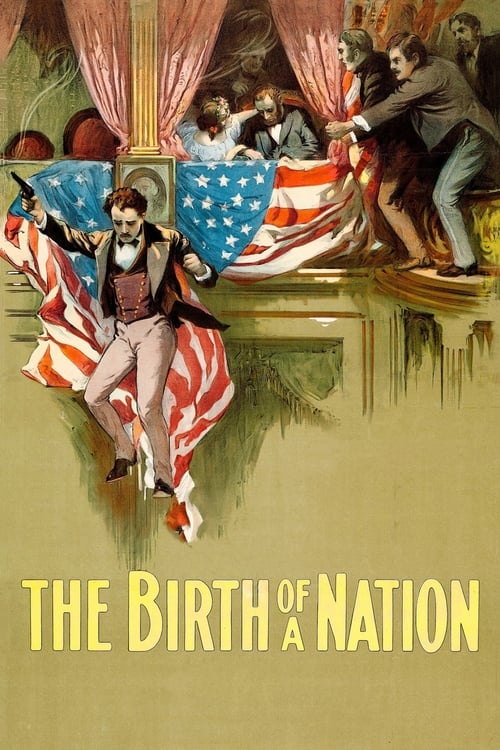
The Birth of a Nation
1915 · D.W. Griffith
This is a study watch, not an evening's entertainment — reach for it when you want to understand where American cinema's techniques and its original sins come from, ideally with context or company to argue with afterward. Firmly on the challenge end of the spectrum.
What it's about
A three-hour silent epic following two families — Northern abolitionists and Southern planters — through the Civil War and Reconstruction, it stages vast battle scenes and national tragedy before curdling into open racist propaganda: its final act presents the Ku Klux Klan as heroes riding to 'redeem' the South. It is both the founding blockbuster of American cinema and its most poisonous artifact, and any honest viewing has to hold those two facts at once.
The experience
Watching it is a genuinely disturbing double exposure: the battlefield spectacle and cross-cut climaxes still demonstrate real filmmaking power, while the racial caricature and Klan heroics are repellent — and were meant to thrill. Expect to feel implicated, not entertained.
The craft
Griffith consolidated the basic grammar of narrative film at feature length — cross-cutting between storylines to build suspense, close-ups for emotion, huge orchestrated battle panoramas — on a scale no American picture had attempted. The craft is precisely the problem: the film is a masterclass in how technique can be used to make a lie feel stirring.
Why it matters
It proved the feature film could be a national event and shaped Hollywood storytelling for decades — while fueling the real-world revival of the Ku Klux Klan and drawing NAACP protests from its first screenings. Its legacy is the permanent case study in cinema's power to do harm.
Snapshot
The Birth of a Nation is the most consequential and the most damning film of the silent era — a work that simultaneously consolidated the grammar of narrative cinema and weaponized it in service of white-supremacist mythology. Adapted from Thomas Dixon Jr.'s novel and play The Clansman (with its title later drawn from Dixon's framing), Griffith's roughly three-hour epic follows two families, the Northern Stonemans and the Southern Camerons, across the Civil War and Reconstruction, culminating in the founding of the Ku Klux Klan as the film's heroic agent of "redemption." Its technical ambition was matched only by the venom of its racial politics. The picture demonstrated, on a scale no prior American film had attempted, that cinema could sustain feature-length historical drama with the emotional and structural complexity of the novel — and it embedded that demonstration in a narrative that valorized lynching and the Klan. To study it is to confront the inseparability of formal achievement from ideological harm. It was a massive commercial phenomenon, drew immediate protest from the NAACP and Black communities, and has remained, for over a century, the central case study in any reckoning with cinema's capacity for both art and propaganda.
Industry & production
The film was produced through Griffith's association with the Epoch Producing Corporation, formed specifically to finance and distribute the picture, with Harry Aitken among the principal backers. It emerged at a transitional moment in the American industry: the feature-length film was displacing the one- and two-reel short, exhibition was moving toward purpose-built picture palaces, and the economics of cinema were being rewritten by the prospect of long-form, roadshow presentation. The Birth of a Nation was central to that shift. It was exhibited as a prestige event — reserved-seat engagements, orchestral accompaniment, elevated ticket prices — modeling the roadshow strategy that would define the epic for decades.
The production was unusually long and costly by the standards of 1914–1915, shot largely in and around Los Angeles. Precise budget and box-office figures are frequently cited but vary widely across sources and should be treated with caution; the film was, by any account, an extraordinary financial success and one of the most profitable films of the silent era, though the often-repeated specific dollar totals are not reliably documented. What is firmly established is the scale of its returns and its role in proving the commercial viability of the long, expensive prestige feature.
The film also generated immediate political controversy that shaped its distribution. The NAACP organized protests and sought to have it banned or censored in numerous cities; some jurisdictions cut scenes or refused exhibition. A private White House screening for President Woodrow Wilson is part of the historical record, though the famous "writing history with lightning" quotation attributed to Wilson is apocryphal and not reliably sourced — a caution worth stating plainly.
Technology
The Birth of a Nation was produced on orthochromatic black-and-white film stock, hand-cranked cameras, and the lighting and laboratory technology of the mid-1910s. Griffith and his collaborators exploited tinting and toning — the era's standard method of color suggestion — applying amber, blue, and red washes to differentiate day from night, interior from exterior, and to heighten emotional register; the red-tinted "burning" and battle passages are frequently noted. The film was conceived for orchestral accompaniment, with a compiled score (assembled with Joseph Carl Breil) that fused original composition, classical borrowings, and popular and patriotic airs, including the notorious use of Wagner's "Ride of the Valkyries" to underscore the Klan's ride.
No single technological invention belongs to the film; rather, its significance is the marshaling of existing tools at unprecedented scale and with unprecedented coordination — the synchronization of image, tint, and live music into a unified large-format presentation.
Technique
Cinematography
The cinematography, by G.W. "Billy" Bitzer — Griffith's indispensable collaborator across his Biograph years and after — is the film's most defensible claim to greatness. Bitzer's camera ranges from intimate, soft-focus close-ups to vast, deep-staged battle panoramas. The film is celebrated for its compositional control: the use of the iris to open and close on detail, masking to reshape the frame, and the placement of figures in depth across a wide pictorial field. Battle sequences employ extreme long shots that situate small human figures against smoke-wreathed landscapes, intercut with closer views that locate individual experience within the mass. Bitzer's lighting — including effects suggesting firelight and night — and his control of focus contributed to a pictorial sophistication that exceeded contemporary norms. The collaboration between Griffith's staging and Bitzer's eye is so close that authorship of specific innovations is difficult to disentangle, a point the historical record itself leaves somewhat open.
Editing
Editing is where the film's historical importance is most concentrated. Griffith did not single-handedly invent the techniques he deploys — many had antecedents in his own Biograph shorts and in the work of others — but The Birth of a Nation synthesized them into a sustained narrative system of immense power. The film orchestrates parallel editing (crosscutting) across multiple lines of action, building to the celebrated "last-minute rescue" climaxes in which the Klan rides to relieve besieged whites while imperiled characters await. The crosscutting accelerates — shots shorten, the cutting rhythm tightens — to generate suspense through tempo as much as content. The film moves fluidly between scales (long shot to close-up), between locations, and across time, training the audience in a continuity of attention that the feature form required. This editorial architecture — the management of suspense, the modulation of rhythm, the binding of dispersed events into a single dramatic arc — is the film's foundational and most imitated contribution. That its most virtuosic passage is also its most morally repugnant, mobilizing all this craft to make the audience root for the Klan, is the central interpretive fact of the film.
Mise-en-scène / staging
Griffith's staging deployed large numbers of performers and extensive sets and locations to render historical tableaux — the Civil War battlefields, the Reconstruction-era South Carolina legislature, the assassination of Lincoln at Ford's Theatre. Several sequences are explicitly framed as "historical facsimiles," reconstructions presented as documentary-grade re-enactments, lending the film a spurious authority. Griffith staged action in depth and across breadth, choreographing crowds and battle movement while reserving the foreground for individuated drama. The contrast between the intimate domestic scenes of the two families and the panoramic public events organizes the film's rhetoric, binding personal sentiment to national myth.
Sound
As a silent film, The Birth of a Nation carried no recorded soundtrack; its aural dimension was the live orchestral accompaniment performed to the compiled Breil score. That score is integral rather than incidental — its leitmotifs, its patriotic and classical borrowings, and its calculated use of Wagner during the Klan's ride were designed to fuse with the cutting to produce emotional crescendo. The music is part of the film's persuasive machinery and cannot be bracketed as mere accompaniment.
Performance
Performance styles are transitional, mixing the broader gestural idiom inherited from theatrical and early-cinema convention with the more restrained, internalized playing that the close-up was making possible. Lillian Gish, as Elsie Stoneman, exemplifies the delicate, expressive register Griffith cultivated in his actresses and would extend in later films. Henry B. Walthall as Ben Cameron ("the Little Colonel") anchors the Southern family's arc. The film's most disgraceful performance dimension is its use of white actors in blackface for major Black roles — including Silas Lynch and Gus — a convention that is inseparable from the film's dehumanizing characterization of Black figures as either fawning loyalists or predatory threats.
Narrative & dramatic mode
The film operates in the mode of the historical melodrama, mapping vast public history onto the fortunes of two intertwined families. This structure — the personal as synecdoche for the national — allows Griffith to translate political argument into emotional identification. The first half, covering the Civil War, is the more conventionally sympathetic, dwelling on shared suffering, broken families, and the longed-for reconciliation of North and South. The second half, on Reconstruction, turns that reconciliation into a racial compact: it constructs a paranoid narrative of Black political power as menace and of the Klan as restorer of order, deploying the melodramatic machinery of imperiled white womanhood and last-minute rescue to make its argument felt rather than reasoned. The dramatic mode is thus inseparable from the ideology: melodrama's logic of innocence and villainy is mapped directly onto race.
Genre & cycle
The film stands at the head of the American historical epic and the Civil War film, establishing conventions — the divided family, the sweep from battlefield to home front, the reconciliation narrative — that would echo through later works up to and including Gone with the Wind (1939). It belongs as well to a cycle of Reconstruction "Lost Cause" narratives, drawing directly on Dixon's fiction and the broader cultural project of recasting the Confederacy and Reconstruction in white-supremacist terms. Its commercial success helped legitimate the feature-length prestige picture as a genre-defining commercial form.
Authorship & method
The Birth of a Nation is the central monument of Griffith's auteurship, and it exemplifies his method: an accretive, improvisatory approach refined across hundreds of Biograph shorts, in which narrative technique was developed through practice rather than from a written shooting script in the modern sense. Griffith worked closely and repeatedly with a core team. G.W. Bitzer was his cinematographer and the technical partner in his pictorial innovations. Joseph Carl Breil collaborated on the compiled musical score. The screenplay was adapted by Griffith with Frank E. Woods from Thomas Dixon Jr.'s The Clansman; Dixon's source material is the ideological engine of the film and his involvement is essential to understanding its politics. The editing — Griffith's signature domain — was central to his authorship, developed in partnership with his long-standing creative circle. Griffith would answer the firestorm of criticism the following year with Intolerance (1916), a still more formally ambitious film often read, in part, as a response to charges of bigotry — though it is not an apology for this film's content.
Movement / national cinema
The film is a foundational work of American narrative cinema and a key text in the emergence of Hollywood as the center of world film production. It did not belong to a self-conscious aesthetic movement in the manner of later European avant-gardes; rather, it helped define the classical narrative system that those movements would later react against and that Soviet filmmakers in particular would study. Its influence on the development of Soviet montage theory is part of the historical record — Sergei Eisenstein and Vsevolod Pudovkin engaged seriously with Griffith's crosscutting, even as they reconceived editing toward dialectical rather than narrative-suspense ends. As American national cinema, the film is inseparable from the national mythologies it propagated; it is a document of how Hollywood's formative self-image was entangled with the Lost Cause.
Era / period
Produced in 1914–1915 and released in 1915, the film sits at the hinge between early cinema and the classical Hollywood era. It arrived as the industry consolidated around features, narrative continuity, and star performance, and as motion pictures claimed cultural respectability and mass audiences. Its release coincided with — and contributed to — a period of intense racial reaction in the United States, including the revival of the Ku Klux Klan, which drew directly on the film's imagery and mythology. The film cannot be understood apart from this historical moment of resurgent white supremacy, Jim Crow consolidation, and the cultural ascendancy of Lost Cause memory.
Themes
The film's overt themes are reconciliation, sectional reunion, and the restoration of order — all of which it constructs explicitly as a white racial project. It thematizes the family as the unit of national meaning, womanhood as the symbolic stake of social order, and history itself as a contest over memory. Beneath these lies its governing ideology: a fantasy of white innocence imperiled by Black political and sexual menace, redeemed by extralegal violence. The film treats the Klan not as terror but as chivalric salvation, and Reconstruction not as a democratic experiment but as catastrophe. Any honest thematic account must name this directly: the film's "unity" is a unity premised on Black subjugation, and its emotional power is marshaled to make that premise feel like justice.
Reception, canon & influence
Critical and popular reception in 1915 was sharply divided along lines that the film itself drew. It was widely praised as an artistic and technical landmark and was a sensational commercial success; it was also met with immediate, organized protest. The NAACP campaigned against it, Black communities and allies mobilized in numerous cities, and the film was banned or censored in some jurisdictions. Figures including Jane Addams voiced public objection. This protest is itself historically significant as an early instance of organized resistance to racist mass media.
Influences on the film run backward to Dixon's The Clansman and the Lost Cause literature, to Griffith's own Biograph shorts where he developed his techniques, to the tableau and "historical facsimile" traditions of nineteenth-century visual culture, and to the melodramatic stage. Its legacy forward is double and inseparable. Formally, it shaped the development of narrative editing, the historical epic, the roadshow feature, and the very grammar of suspense; it was studied by filmmakers worldwide, including the Soviet montagists who built their own theories partly in dialogue with it. Politically, it is directly implicated in the 1915 revival of the Ku Klux Klan and contributed to the entrenchment of Lost Cause mythology in American popular culture for generations.
In the canon, the film occupies a singular and unstable position: it is unavoidable in any history of film form and indefensible in its content. The modern scholarly consensus does not resolve this tension but insists on holding both truths at once — that The Birth of a Nation is foundational to cinema as an art and that it is a work of racist propaganda whose harms were real and lasting. It endures less as a film to be admired than as one that must be reckoned with: the permanent reminder that mastery of form carries no guarantee of moral worth, and that cinema's earliest demonstration of its own power was also a demonstration of its danger.
A Deleuzian reading
Watch the last act with the sound up.
The full Deleuzian reading of The Birth of a Nation →
Reception
In 1915 it was an unprecedented blockbuster — the film that convinced America movies could be an art form and event — and it reigned as the highest-grossing film for over two decades. Today it's the canon's great asterisk: still taught for what it invented, condemned for what it says, and its racism is treated as central to the work rather than a footnote.
How The Birth of a Nation was received, from release to now →
Influences: the films it descends from and the films it influenced
- The Lonedale Operator (1911) — Griffith's own Biograph one-reeler where he perfected the last-minute-rescue built on tightening crosscuts between trapped heroine and onrushing rescuers — the exact parallel-editing engine he scaled to the Klan ride in the feature.
- The Great Train Robbery (1903) — Porter's intercutting of the telegraph office and the fleeing bandits established the cross-cut between simultaneous, spatially separate actions that Griffith systematized into a suspense grammar.
- Judith of Bethulia (1914) — Griffith's first four-reel feature, where he first tested sustained multi-line narrative, massed-extra battle staging, and the historical-facsimile tableau on a feature canvas before Birth.
- Cabiria (1914) — Pastrone's slow tracking moves through monumental deep-staged sets ('carrello' shots) modeled the historical epic's architectural spectacle and three-dimensional staging Bitzer answered with his deep compositions.
- Quo Vadis (1913) — The Italian super-spectacle proved a feature-length roadshow historical epic with cast-of-thousands set pieces was commercially viable, the exhibition model and scale Griffith adopted.
- The Last Days of Pompeii (1913) — Italian disaster-spectacle whose painterly recreation of a historical catastrophe fed the 'historical facsimile' tradition Griffith cited via his recreated-from-photographs tableaux.
- Intolerance (1916) — Griffith's immediate follow-up extends Birth's crosscutting from two lines to four parallel epochs intercut by thematic rhyme, accelerating them into a single unified climax — the rescue grammar pushed to abstraction.
- Battleship Potemkin (1925) — The Odessa Steps sequence answers Griffith's accelerated rescue-montage by collision: Eisenstein dissects continuous action into rhythmically conflicting fragments, theorizing dialectical montage explicitly in dialogue with Griffith's parallel cutting.
- Mother (1926) — Pudovkin's ice-floe finale builds 'linkage' montage — accelerating cuts between the marching demonstrators and breaking river — directly out of Griffith's last-minute-rescue accelerando, which he credited in his writing on editing.
- Napoléon (1927) — Gance scales Griffith's historical epic with triptych Polyvision, rapid-fire superimposed montage, and the compiled-orchestral synchronized score, extending the roadshow spectacle and historical-facsimile mode.
- Gone with the Wind (1939) — The direct generic heir: a Civil War / Reconstruction historical melodrama that inherits Birth's Lost Cause mythology and its fusion of personal romance with sweeping facsimile-historical tableaux (the burning of Atlanta as set-piece).
- The Covered Wagon (1923) — The first major Western epic transplants Griffith's massed-extra historical-pageant staging and frontier-facsimile spectacle into the founding template of the American epic Western.
- October (Ten Days That Shook the World) (1928) — Eisenstein's reconstruction of 1917 turns Griffith's historical-facsimile reenactment toward 'intellectual montage,' editing staged history into conceptual argument — the propaganda potential of edited history that Birth first demonstrated.
- Seven Samurai (1954) — Griffith's cross-cutting grammar in the climactic Klan-rescue siege — simultaneous intercutting between besieged defenders and approaching forces building to a single decisive action — is the parallel-construction template Kurosawa inherits and transforms in the bandit assault sequence.
- Stagecoach (1939) — Griffith's last-minute cavalry rescue through cross-cutting between pursuer, victim, and relief force is the direct structural model for Stagecoach's climactic Apache-attack sequence; Ford inherits and tightens this parallel-editing grammar into a single sustained kinetic period.
- Strike (1925) — Griffith's methods for choreographing hundreds of extras as a unified visual mass in wide-angle long shots, punctuated by extreme close-ups, gave Eisenstein the compositional grammar he transformed into constructivist crowd staging.
- Spies (1928) — Griffith's alternating montage — cross-cut sequences compressing time toward a last-minute rescue — is absorbed wholesale into Spies' action sequences, where parallel editing between pursuer and quarry constitutes the film's primary suspense grammar, explicitly cited in its 'Griffithian crosscutting' facet.
- BlacKkKlansman (2018) — Griffith's race-war intercutting — simultaneous storylines spliced to generate false moral equivalence — is the precise formal technique BlacKkKlansman inverts in the sequence pairing Harry Belafonte's eyewitness testimony against a Klan rally screening of Griffith's own film, citing the instrument of harm to dismantle it.
- The Big Parade (1925) — Vidor weds intimate melodrama to mass battle spectacle on the same historical-epic scale, deploying Griffith's parallel cutting between home-front and front-line to wring suspense from a national-historical canvas.
- Greed (1924) — Stroheim, who acted and assisted under Griffith, carried forward the feature-length naturalist epic and obsessive location-facsimile staging, extending Griffith's ambition for the long-form American narrative film.
- Way Down East (1920) — Griffith reprises his own ice-floe last-minute rescue, crosscutting Lillian Gish on the breaking river with her pursuer — the purest later distillation of the accelerated parallel-rescue device Birth canonized.
Similar films
- Battleship Potemkin (1925) — influence & lineage · often watched together
- Gone with the Wind (1939) — influence & lineage · often watched together
- BlacKkKlansman (2018) — same viewing thread
- Greed (1924) — influence & lineage · often watched together
- Napoleon (1927) — influence & lineage · often watched together
- Intolerance: Love's Struggle Throughout the Ages (1916) — often watched together
- 12 Years a Slave (2013) — often watched together
- Triumph of the Will (1935) — shared sensibility
All the films related to The Birth of a Nation →
Watch it with: curated runs of related films
- Reckoning with the Color Line — A run through a century of American film on race — from the movie that industrialized screen racism to the ones that talk back to it — best watched in rough chronological conversation.