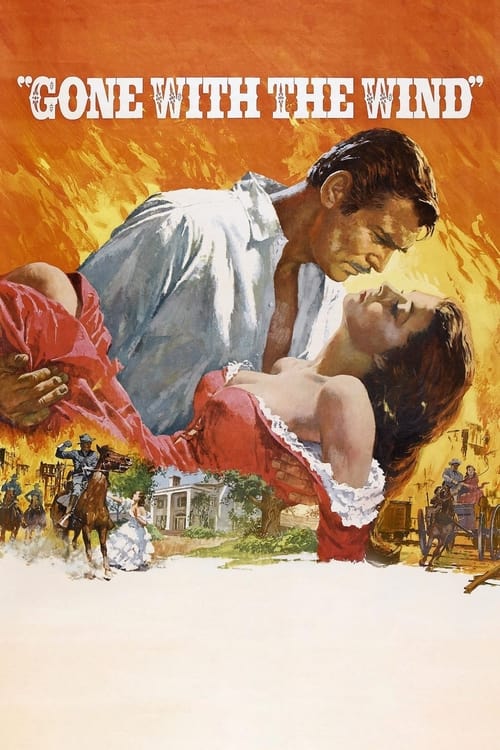
Gone with the Wind
1939 · Victor Fleming
For when you want a full-evening epic — an event, not a movie — with grand passion, gorgeous excess, and a heroine you'll love and hate in equal measure. Go in aware that its rose-tinted picture of the slaveholding South demands a critical eye; it's a film to engage with, not just sink into.
What it's about
The willful, spoiled daughter of a Georgia plantation owner schemes, survives, and loves her way through the American Civil War and its aftermath, as the world she was raised in collapses around her. At the center is her tempestuous, decades-spanning entanglement with a cynical profiteer who sees through her — and wants her anyway.
The experience
Enormous in every direction — nearly four hours of sweeping romance, spectacle, ruin, and obsession, engineered to overwhelm. It's melodrama at maximum voltage: lush, feverish, and genuinely gripping even when you're arguing with it.
Performances
Vivien Leigh's Scarlett O'Hara is one of the most ferocious star performances ever put on film — vain, ruthless, and impossible to look away from — matched by Clark Gable's effortless, knowing charm as Rhett Butler. Hattie McDaniel became the first Black performer to win an Academy Award for her work here.
The craft
The pinnacle of the Hollywood studio system's prestige machine: blazing Technicolor, monumental production design, a famous burning-city setpiece, and producer David O. Selznick's obsessive control over every frame. It practically invented the roadshow super-production, and it still demands the biggest screen you can find.
Why it matters
Adjusted for inflation it remains the highest-grossing film ever made, and it defined what a Hollywood epic could be — while standing today as the most prominent example of how the movies romanticized the Lost Cause myth of the Confederate South, a legacy now inseparable from its spectacle.
Snapshot
Gone with the Wind is the most commercially successful motion picture ever made when receipts are adjusted for inflation, and it remains the defining artifact of Hollywood's so-called "prestige" mode at the close of the studio system's greatest year. Adapted from Margaret Mitchell's 1936 best-seller, it is at once a sweeping Civil War melodrama, a star vehicle of staggering scale, and a producer's film — the personal obsession of David O. Selznick, whose fingerprints are arguably more decisive than those of any of the three directors who worked on it. Running close to four hours with overture, intermission, and entr'acte, it pioneered the roadshow super-production and set durable expectations for what a "big" picture could be. It is also, inseparably, a monument to the Lost Cause: a lavishly mounted romance whose nostalgia for the antebellum plantation and its depiction of slavery have made it one of the most contested objects in American film culture. Any honest account must hold its technical achievement and its ideology in the same frame.
Industry & production
The film was produced by Selznick International Pictures and released through MGM, an arrangement Selznick struck partly to secure Clark Gable, MGM's contract star, in exchange for distribution rights and a share of profits. Selznick had bought the screen rights to Mitchell's novel in 1936 for a sum that was notable for an untested property by a first-time author, and the subsequent "search for Scarlett" became one of the most elaborate publicity campaigns in studio history, sustaining public interest for the better part of two years while the lead remained uncast.
Production was famously turbulent. George Cukor, long attached to the project, directed for a matter of weeks before Selznick removed him; the reasons remain debated in the historical record, with accounts citing creative friction over pace and Gable's reported discomfort, though no single explanation is documented beyond dispute. Victor Fleming, pulled from The Wizard of Oz, took over and received sole directorial credit. When Fleming reached exhaustion, Sam Wood directed for a period; Cukor, meanwhile, is widely reported to have continued privately coaching Vivien Leigh and Olivia de Havilland. The screenplay passed through many hands — Sidney Howard received sole screen credit (and a posthumous Academy Award, having died in a farm accident in 1939), but Ben Hecht, Jo Swerling, Oliver H.P. Garrett, and Selznick himself contributed to revisions, with Selznick issuing voluminous memos throughout. The picture premiered in Atlanta on December 15, 1939, an event from which Hattie McDaniel, by the conventions of segregation, was excluded — a fact that has become inseparable from the film's history. It swept the Academy Awards held in early 1940, taking eight competitive Oscars including Best Picture, Director, Actress, Supporting Actress, and Screenplay, alongside the Irving G. Thalberg Memorial Award to Selznick and an honorary plaque to William Cameron Menzies for his use of color.
Technology
The film's most consequential technical commitment was three-strip Technicolor, then still a young and costly process. Selznick had already gambled on Technicolor for earlier productions, but Gone with the Wind deployed it on an unprecedented narrative scale, demanding enormous light levels, careful color control, and the on-set supervision typical of Technicolor's house consultants. The result helped normalize color for major dramatic features rather than confining it to fantasy or spectacle. The production also relied on extensive in-camera and optical effects, matte work, and the orchestration of large-scale physical action — most notoriously the burning of the Atlanta depot, staged on the studio backlot by setting fire to old standing sets (the record commonly notes that this footage was shot before Leigh was cast). Beyond these specifics, much of the film's "technology" was logistical: the coordination of color cinematography, vast crowd scenes, and a then-extraordinary post-production schedule to ready a roadshow print.
Technique
Cinematography
Ernest Haller is credited as director of photography, with Ray Rennahan as Technicolor co-cinematographer; Lee Garmes shot substantial early material before departing and went uncredited, a detail the historical record generally affirms though the precise division of footage is not always cleanly attributable. The photography is built around a saturated, painterly palette — sunset oranges and silhouetted figures, the deep reds and greens of interiors — that treats color as dramatic and emotional shorthand rather than mere fidelity. The film's most celebrated image, the crane shot pulling back from Scarlett amid a sea of wounded and dying Confederate soldiers at the Atlanta railyard to reveal a tattered flag, is a cinematographic and design statement at once: scale made to register as moral weight.
Editing
Hal C. Kern and James E. Newcom won the Academy Award for editing, shaping a nearly four-hour narrative into a structure that sustains momentum across two distinct halves — the war and the Reconstruction. The cutting favors classical clarity and the legible build of melodramatic set pieces; the editing's achievement is less stylistic flourish than the disciplined management of enormous coverage and conflicting directorial footage into a coherent whole.
Mise-en-scène / staging
This is the department where the film's authorship is most singular. Menzies, credited as "production designer" — a title essentially elevated to prominence by his role here — pre-visualized the picture in extensive continuity sketches that planned color, composition, and camera placement scene by scene, an approach closer to storyboarding the entire film than was then customary. The art direction by Lyle Wheeler, working under Menzies' overall design, produced the iconic Tara and Twelve Oaks, the burning city, and the Atlanta interiors. The staging consistently subordinates realism to a heightened, tableau-like grandeur: figures posed against skies, doorways and staircases framing emotional confrontations, the plantation rendered as idealized myth.
Sound
The film uses sound conventionally for its era but effectively, integrating dialogue, effects (the roar of the depot fire, the chaos of the falling city), and a near-continuous musical underscore. The documented record on its sound engineering is comparatively thin relative to the attention lavished on color and design, and I will not overstate it.
Performance
Vivien Leigh's Scarlett O'Hara is the engine of the film — a performance of remarkable stamina and modulation that refuses easy sympathy, holding willfulness, vanity, and survival-instinct in tension across the character's long arc. Clark Gable's Rhett Butler trades on his established star persona of roguish charm while admitting flashes of wounded feeling. Olivia de Havilland's Melanie supplies the film's moral ballast, and Leslie Howard's Ashley its romantic abstraction. Hattie McDaniel's Mammy is the film's most discussed performance: technically commanding and the basis for her historic Academy Award — the first won by an African American performer — yet built within, and constrained by, a role that the film conceives through the racial stereotype of the loyal house servant. Butterfly McQueen's Prissy is similarly fraught, a skilled comic turn yoked to demeaning material. The performances cannot be evaluated apart from the parts the screenplay allotted.
Narrative & dramatic mode
The film operates in the register of the historical romance-melodrama, organizing private passion against the backdrop of national catastrophe. Its dramatic spine is Scarlett's pursuit of the unattainable Ashley and her combative, on-again entanglement with Rhett, structured so that personal desire and the collapse and reinvention of a social order mirror one another. The mode is expansive and episodic, built from large emotional climaxes — declarations, deaths, the famous curtain-line refusal — rather than tight causal economy. Scarlett is an unusually unsentimental melodramatic protagonist, and the film's willingness to end on rupture rather than reconciliation ("After all, tomorrow is another day") gives its romanticism a harder edge than its surface suggests.
Genre & cycle
Gone with the Wind belongs to the cycle of prestige literary adaptations that defined late-1930s Hollywood ambition, and within that to the historical epic and the "woman's picture" melodrama. It crystallized the roadshow super-production — the long-form, reserved-seat event film with intermission — as a commercial format that Hollywood would return to repeatedly in subsequent decades. It also stands within a longer tradition of Civil War and plantation films stretching back to The Birth of a Nation (1915), inheriting and amplifying that tradition's Lost Cause framework.
Authorship & method
The presiding author of Gone with the Wind is its producer. Selznick conceived the project, controlled the adaptation, hired and fired directors, and supervised editing and design through his celebrated flood of memos; the film is the central exhibit for the proposition that, in the studio era, a producer could be the decisive creative voice. Victor Fleming, the credited director and Oscar winner, brought professional command to a production already heavily pre-designed, and shares the directorial reality with the uncredited Cukor and Wood. Menzies, as production designer, exercised authorship over the look and shot-by-shot conception to a degree unusual for the role. Ernest Haller (with Rennahan and the uncredited Garmes) realized the color photography. Sidney Howard provided the credited screenplay atop the contributions of several others. Max Steiner composed the score, among the longest and most thematically dense of its day, anchored by the sweeping "Tara's theme" and a leitmotif structure that binds the film's emotional throughline. Hal Kern and James Newcom edited. It is, in sum, a film whose authorship is genuinely collective and producer-driven rather than the expression of a single directorial sensibility.
Movement / national cinema
The film is a quintessential product of classical Hollywood at the height of the studio system, and is not affiliated with any avant-garde or art-cinema movement. Its significance to American national cinema is twofold: as a benchmark of industrial craft and commercial reach, and as a powerful vector for a particular, sectional mythology of the national past. It is American cinema speaking to America about America's most divisive history — which is precisely why it has remained so contested.
Era / period
Released at the close of 1939 — routinely cited as Hollywood's annus mirabilis — the film arrived at the peak of studio confidence and Production Code enforcement. Its famous closing line tested the Code's prohibitions on profanity, and the record reflects that the retention of "damn" was a notable negotiation, though accounts of the exact mechanism vary and I will not assert a single version as definitive. Set across the 1860s and the Reconstruction that followed, the film looks back at the Civil War from the vantage of a 1930s America shaped by the Depression and by a popular culture still steeped in the romance of the Old South.
Themes
The film's overt themes are survival, endurance, and adaptation — Scarlett's refusal to be destroyed by war and ruin, dramatized in her vow never to go hungry again — alongside the tension between idealized romantic longing (Ashley, the lost world of Tara) and pragmatic appetite (Rhett, the postwar economy of the profiteer). Land, embodied in Tara, functions as the film's recurring image of rootedness and worth. Beneath these lies the film's governing and most troubling theme: the elegiac mourning of a vanished plantation order, presented as a "civilization gone with the wind." That elegy depends on rendering slavery benign and the enslaved as content, loyal, or comic — the moonlight-and-magnolias mythology that the film does not merely reflect but actively beautifies and recommends.
Reception, canon & influence
On release the film was a critical and commercial phenomenon, embraced as a landmark of scale and craft and rewarded with its sweep of Academy Awards; it became and remains, by inflation-adjusted measures, the top-grossing film in history. Its standing in the popular canon — recurring restorations, reissues, and home-video releases — has been continuous.
Its influences run backward to Mitchell's novel and to the plantation-melodrama and Civil War traditions that preceded it, including the deeply problematic precedent of The Birth of a Nation, whose Lost Cause ideology Gone with the Wind extends in a glossier, more sympathetic-seeming key. Forward, its legacy is double. Technically and industrially it shaped the historical epic, the roadshow event film, the prominence of the production designer, and the ambition of color dramatic filmmaking; Menzies' pre-visualization methods and Steiner's leitmotif scoring left durable marks on Hollywood practice.
But its forward influence is also the long argument it provoked. From the outset, Black critics and the NAACP raised objections to its depiction of slavery and Black characters, and that critique has only deepened. Hattie McDaniel's historic Oscar and her exclusion from the Atlanta premiere together encapsulate the contradiction the film embodies. In 2020 the film was briefly withdrawn from a major streaming service and reinstated with added historical context — an episode that crystallized its modern status as a work studied as much for what it reveals about American racial memory as for its undeniable craft. The honest summary is that Gone with the Wind is canonical on two grounds at once: as a high-water mark of studio-era filmmaking, and as one of the most influential and durable propagators of the Lost Cause in popular art.
A Deleuzian reading
Start with the shot everyone remembers.
The full Deleuzian reading of Gone with the Wind →
Reception
The biggest box-office phenomenon of its era — still the highest-grossing film ever adjusted for inflation, with 8 Oscars including Best Picture — it's now the canon's most contested title, its romanticized Lost Cause vision of the antebellum South making it a case study in how classics get re-examined rather than simply revered. When HBO Max briefly pulled it in 2020 before restoring it with contextual framing, the whole culture relitigated it in real time.
How Gone with the Wind was received, from release to now →
Influences: the films it descends from and the films it influenced
- The Birth of a Nation (1915) — Supplies the Lost Cause melodrama template and the large-scale Civil War siege/spectacle staging — the sympathetic-Confederate framing GWTW reworks in a glossier key.
- Intolerance (1916) — Pioneered the monumental crane move over vast crowded sets that GWTW echoes in the Atlanta depot pull-back craning up over the field of wounded soldiers.
- Becky Sharp (1935) — First full three-strip Technicolor feature; established color as dramatic staging tool rather than decoration, the practice GWTW's saturated palette extends.
- The Garden of Allah (1936) — Selznick's own earlier three-strip Technicolor production where his studio learned to control color dramaturgy and the Kalmus consultancy that would shape GWTW.
- A Star Is Born (1937) — Selznick's earlier producer-driven Technicolor prestige picture, also production-designed by Menzies — the industrial and authorship template for GWTW.
- Things to Come (1936) — Menzies' shot-by-shot pre-visualized design authorship — the storyboarded continuity method he then brought to GWTW as production designer.
- King Kong (1933) — Max Steiner's wall-to-wall symphonic leitmotif scoring, the structural model for the Tara's-theme leitmotif binding GWTW's emotional throughline.
- So Red the Rose (1935) — Immediate plantation-and-Civil-War melodrama precedent in the same nostalgic Old-South register GWTW would monumentalize.
- Rebecca (1940) — Selznick's very next memo-governed, producer-driven literary adaptation, carrying forward the model of producer-as-decisive-author over a hired director.
- Duel in the Sun (1946) — Selznick's deliberate attempt to remanufacture the GWTW formula — Technicolor, producer-driven, sweeping erotic-historical melodrama scaled as a roadshow event.
- Raintree County (1957) — MGM's explicit bid to replicate GWTW: a Civil War romance built as a wide-gauge roadshow super-production around a Southern-belle figure.
- Giant (1956) — Saturated-color generational epic organized around land, endurance, and a willful heroine — extending GWTW's Tara survival-through-the-soil theme.
- Lawrence of Arabia (1962) — Roadshow historical super-production whose extreme-wide tableau grandeur and crane vistas inherit GWTW's epic-scale staging ambition.
- Doctor Zhivago (1965) — Historical-romance melodrama of a private love swept through national catastrophe, driven by a single recurring leitmotif (Lara's theme) just as Tara's theme anchors GWTW.
- Titanic (1997) — The modern GWTW: a runaway-budget historical-romance super-production staging a doomed love affair against a catastrophic period spectacle as a roadshow-scale event film.
- Black Narcissus (1947) — As the flagship three-strip Technicolor prestige production, it codified the color-harmony conventions (Natalie Kalmus's supervisory system) that Cardiff deliberately violated to achieve psychological expressionism rather than decorative naturalism.
- Senso (1954) — Three-strip Technicolor applied to a war-costume melodrama, establishing the saturated period-epic palette Senso appropriates for the Risorgimento.
- Ben-Hur (1959) — Pioneered the prestige roadshow exhibition model — reserved-seat, intermission, premium-priced single-feature engagements — that financed and shaped Ben-Hur's economics and runtime.
- Now, Voyager (1942) — Steiner's sweeping signature-theme approach, in which a single recurring melody becomes the film's emotional brand, set the template for the Now, Voyager love theme that escaped the film as a pop standard.
- Indochine (1992) — Supplies the template of a plantation-mistress's romantic fortunes staged as allegory for a doomed social order, the personal-loss-mirrors-civilizational-collapse melodrama Éliane's arc inherits.
- The Adventures of Robin Hood (1938) — Shares the saturated three-strip Technicolor palette under Technicolor consultant Natalie Kalmus, the late-'30s color-spectacle craft GWTW perfected.
- The Wizard of Oz (1939) — Same director and same studio peak year, a parallel three-strip Technicolor showcase Fleming was shuttled between mid-production.
- The Outsiders (1983) — The saturated three-strip Technicolor sunset silhouette and romantic-epic sweep is the classical 'big' visual grammar Coppola deliberately grafts onto 'small' intimate material.
Similar films
- The Birth of a Nation (1915) — influence & lineage · often watched together
- Titanic (1997) — influence & lineage
- The Wizard of Oz (1939) — influence & lineage
- A Streetcar Named Desire (1951) — same viewing thread
- Cat on a Hot Tin Roof (1958) — same viewing thread
- The Help (2011) — same viewing thread
- The Color Purple (1985) — same viewing thread
- Selma (2014) — same viewing thread
All the films related to Gone with the Wind →
Watch it with: curated runs of related films
- Heat and Reckoning in the American South — A run of Southern dramas where family, race, and old money simmer under the same unbearable heat — watch them together to trace the region from the plantation myth through the civil-rights march.