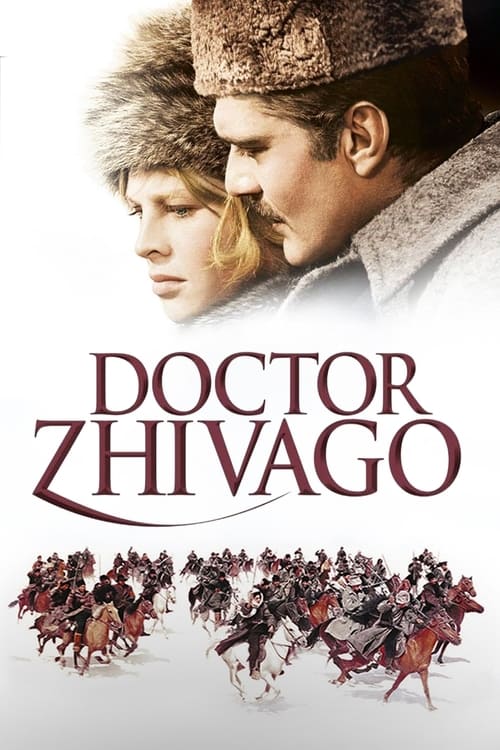
Doctor Zhivago
1965 · David Lean
For a long winter evening when you want to be swept away — grand doomed romance, gorgeous landscapes, and a lump in your throat. Comfort viewing on an epic scale, best with the phone in another room.
What it's about
Yuri Zhivago is a physician and poet in Russia whose life — and divided heart — gets swept up in the century's great convulsions: the First World War, the 1917 Revolution, and the brutal years after. Married to one woman and irresistibly drawn to another, Lara, the wife of a political firebrand, he's carried back and forth across a transforming country as private happiness and public history collide. It's a three-hour-plus epic built from Boris Pasternak's novel, complete with overture and intermission.
The experience
It's immersive the way only the great roadshow epics are — you sink into it for an evening and come out having lived through decades of snow, upheaval, and longing. Sweeping and romantic on the surface, with a persistent ache of loss underneath.
Performances
Omar Sharif gives Zhivago a watchful, wounded tenderness — much of the performance lives in his eyes — and Julie Christie makes Lara luminous without ever letting her become a mere object of longing. Rod Steiger, as the cynical opportunist Komarovsky, steals scenes with unsettling ease.
The craft
David Lean, fresh from Lawrence of Arabia and working with much of the same team, stages intimate romance against continental upheaval with unmatched pictorial command — frozen landscapes, ice-sheathed interiors, crowds surging through revolutionary streets. Maurice Jarre's score, built around the inescapable 'Lara's Theme,' does as much storytelling as the dialogue. Made for the widest screen available; watch it big.
Why it matters
Bruised by critics on release but a colossal box-office success and winner of five Academy Awards, it became the definitive personal epic — the model for filtering vast historical upheaval through one love story — and its theme music lodged permanently in popular memory.
Snapshot
Doctor Zhivago is David Lean's adaptation of Boris Pasternak's 1957 novel, a three-and-a-quarter-hour roadshow epic that filters the Russian Revolution and the chaos that followed through the divided heart of one man: Yuri Zhivago, physician and poet, married to one woman and bound by passion to another. Made by MGM at the peak of the wide-screen epic cycle and released as a reserved-seat attraction with overture and intermission, it followed Lean's Lawrence of Arabia (1962) and reassembled much of that film's creative team. Critically bruised on release but a colossal commercial success, it won five Academy Awards and lodged Maurice Jarre's "Lara's Theme" permanently in popular memory. It remains the definitive example of the personal-epic mode: intimate romance staged against continental upheaval, the private life of feeling set against the impersonal machinery of history.
Industry & production
The project originated with Italian producer Carlo Ponti, who acquired film rights to Pasternak's novel and brought it to MGM, with David Lean attached to direct on the strength of Lawrence of Arabia. The novel itself carried extraordinary political weight: rejected by Soviet publishers, it was smuggled to Italy and first published by Giangiacomo Feltrinelli in 1957; Pasternak was awarded the 1958 Nobel Prize in Literature but, under intense pressure from Soviet authorities, declined it. The book was banned in the USSR. This history made the film both a prestige property and a Cold War impossibility to shoot anywhere near its actual settings.
Because filming in the Soviet Union was out of the question, production was based largely in Spain, where a vast Moscow street was constructed on the outskirts of Madrid, with additional location work for winter and landscape sequences. The shoot was famously beset by weather that refused to cooperate: Spain's winter proved unusually mild, forcing the production to manufacture snow and ice with artificial materials for sequences that demanded a frozen Russia, with some location work elsewhere to secure authentic snow and ice. The much-discussed frozen "ice palace" at Varykino was a constructed effect rather than a found location.
Ponti reportedly hoped his wife, Sophia Loren, would play Lara; Lean resisted, judging her wrong for the part. The eventual casting drew on Lean's recent collaborators and on emerging British talent. The production was large, long, and expensive, and MGM positioned it as a marquee roadshow release. Against early critical skepticism, it became one of the major commercial successes of its era — among the top earners of the decade and frequently cited, in inflation-adjusted terms, among the highest-grossing films in North American history, though precise figures vary by source and should be treated cautiously.
Technology
Doctor Zhivago was photographed in Super Panavision 70 — a 65mm large-format negative system yielding a roughly 2.2:1 frame — and exhibited in 70mm in its premier roadshow engagements, with 35mm anamorphic reductions for general release. The large negative delivered the fine grain and resolution that the film's sweeping landscapes and deep, detailed sets required, processed in MetroColor. The format was part of the period's arms race of theatrical spectacle, in which studios answered television with image scale, color, and stereophonic sound that the home set could not reproduce.
The technological challenge was less optical than environmental: building and dressing a believable revolutionary Russia in Spain, and faking deep winter in a mild climate. The artificial-snow and ice effects, the constructed Moscow thoroughfare, and the frozen Varykino interiors represent the film's most distinctive "technology" — practical, physical illusion at enormous scale rather than optical trickery.
Technique
Cinematography
Freddie Young, who had shot Lawrence of Arabia, photographed Doctor Zhivago and won the Academy Award for Cinematography. Where Lawrence exploited desert emptiness and heat haze, Zhivago works in the opposite register — cold, crowd, and color. Young uses the wide 65mm frame both for grand movement (the cavalry charge, the massed demonstration cut down in the street, troop trains crawling across white expanses) and for compositions that isolate faces and small gestures within vast spaces, dramatizing the individual's smallness before history. Long lenses compress distance and weather into painterly planes; color is keyed emotionally, from the warm interiors and the famous field of flowers to the blue-white desolation of the Varykino winter. The film's images of ice, frost, and breath are among its signature achievements, all the more so given the artificial means by which much of that cold was produced.
Editing
Norman Savage edited the film. The central structural problem was Pasternak's sprawling, coincidence-laden novel, which spans decades and a large cast. The film manages duration through roadshow architecture — overture, intermission, entr'acte — and through a framing device that lets the narrative move in long retrospective movements rather than strict chronology. The cutting favors clarity and sweep over rapid montage, holding on Young's wide compositions and allowing set-pieces to build; the pace is deliberately stately, a choice that contemporary critics read as ponderousness and later audiences embraced as immersive scale.
Mise-en-scène / staging
Production designer John Box — another Lawrence veteran — won the Academy Award for Art Direction (shared with Terence Marsh and set decorator Dario Simoni), and his work is central to the film's authority. The Moscow street built near Madrid, the bourgeois interiors, the requisitioned and subdivided family house, the partisan forest, and the frozen dacha at Varykino all establish a coherent material world that carries the story's meaning: the contraction of private space as the Revolution advances, rooms divided and crowded, warmth besieged by cold. Lean stages history as encroachment — the personal interior repeatedly invaded by the political exterior. Phyllis Dalton's costumes, also Oscar-winning, track class and time, from imperial finery to revolutionary uniform to the threadbare survival of the civil-war years.
Sound
The film was presented with multi-channel stereophonic sound in its 70mm engagements, but its sonic identity belongs overwhelmingly to Maurice Jarre's score (below). Diegetically, Lean exploits the contrast of silence and noise — the hush of snow against the clamor of crowds, trains, and gunfire — to mark the intrusion of the public world upon the private. The balalaika motif recurs as a near-diegetic thread tying Lara, the lost daughter, and the frame story together.
Performance
Omar Sharif, whom Lean had elevated in Lawrence of Arabia, plays Zhivago as a watcher more than an actor — a sensitive, largely passive center whose poetry registers as inwardness rather than speech. Julie Christie's Lara is the film's vital presence, embodying a woman repeatedly seized and shaped by men and history. Rod Steiger plays the predatory, cynical survivor Komarovsky with worldly force; Tom Courtenay charts Pasha's transformation from idealist to the hardened revolutionary Strelnikov; Geraldine Chaplin (in a prominent early role) plays Zhivago's wife Tonya with wounded decency. Alec Guinness frames the entire narrative as Yevgraf, Zhivago's half-brother and a Soviet official, interrogating a young woman (Rita Tushingham) who may be the lost child. Ralph Richardson and Siobhán McKenna round out the household. The performances are calibrated to the wide format — held, composed, legible across distance.
Narrative & dramatic mode
The film is built as a frame narrative: years after the events, the Bolshevik official Yevgraf recounts his half-brother's life to a young woman he believes may be Yuri and Lara's daughter, searching for confirmation of her parentage. This device — a screenwriting solution by Robert Bolt to a near-unfilmable novel — converts Pasternak's diffuse epic into a story being reconstructed and told, justifying its retrospective sweep and its reliance on fateful coincidence. The dramatic mode is melodrama in the serious sense: love thwarted by circumstance, fidelity tested, lives bent by forces beyond the characters' control. Coincidental encounters and recurrences (the recurring figures crossing and recrossing one another's paths across years and geography) are not naturalistic but operatic, the machinery of a tragic romance in which private feeling persists, doomed, inside historical catastrophe.
Genre & cycle
Doctor Zhivago sits squarely within the 1950s–60s roadshow epic — the cycle of long, expensively mounted, reserved-seat spectacles (The Bridge on the River Kwai, Ben-Hur, Lawrence of Arabia, The Sound of Music) with which Hollywood differentiated theatrical experience from television. Within that cycle it is specifically a historical-romantic epic, distinct from the biblical and military strands: its spectacle serves a love story, and its battles and revolutions are backdrop to private fate. It also belongs to the prestige literary adaptation, the studio practice of mining canonical or controversial novels for cultural cachet. Lean, more than any other director, defined the personal-epic variant of the cycle, and Zhivago is its fullest realization.
Authorship & method
The film is the product of Lean's mature method: meticulous, slow, controlling, and built on a repertory of elite collaborators carried over from Lawrence of Arabia. Lean had begun in British editing rooms and made his name with intimate works (Brief Encounter, the Dickens adaptations) before turning, with Kwai and Lawrence, to the international epic; Zhivago consolidates that second career. His authorship is visible in the marriage of landscape and longing, the staging of the individual against overwhelming environment, and the patient accumulation of image.
His key collaborators here are nearly the same hands that made Lawrence: screenwriter Robert Bolt, who imposed dramatic shape and the frame device on Pasternak's novel and won the Adapted Screenplay Oscar (Bolt also wrote A Man for All Seasons and later Ryan's Daughter for Lean); cinematographer Freddie Young; production designer John Box; costume designer Phyllis Dalton; and composer Maurice Jarre, whose romantic, balalaika-inflected score and central "Lara's Theme" won the Original Score Oscar and, with lyrics added, became the pop standard "Somewhere My Love." Editor Norman Savage cut the film. This concentration of talent under Lean's exacting supervision is the film's authorial signature: epic cinema as collective craft directed by a single controlling sensibility.
Movement / national cinema
Doctor Zhivago is an artifact of a particular hybrid: a British-directed, British-crewed film financed and distributed by an American studio (MGM), produced by an Italian, shot in Spain, depicting Russia. It belongs to the tradition of British epic filmmaking that Lean and producers like Sam Spiegel exported to the world market, drawing on the depth of British craft (Shepperton/Pinewood-trained designers, cinematographers, and technicians) while operating on Hollywood capital and scale. It is therefore less a product of any single national cinema than of the internationalized, runaway-production economy of 1960s English-language filmmaking — a transnational mode that used European locations and crews to make American-financed spectacle.
Era / period
The film is doubly a period piece. Its subject is the era from the eve of World War I through the Revolution and Civil War; its making belongs to the mid-1960s high-water mark of the studio roadshow, just before the collapse of that model and the arrival of New Hollywood at the decade's end. The Cold War shaped it at every level: the impossibility of Soviet locations, the political charge of Pasternak's banned novel, and the Western reception of a story that depicted the Revolution as a force that crushed private life and lyric sensibility. Released in late 1965, it stands near the apex — and the approaching exhaustion — of the long-form epic before changing audiences and economics made such films harder to sustain.
Themes
At its center is the collision of the individual with history: the poet-physician who wants only to love, heal, and write, caught and ground down by ideological forces indifferent to private feeling. The film repeatedly opposes the lyric and the political — poetry against the slogan, the warm interior against the frozen exterior, fidelity and desire against duty and doctrine. Love is figured as both transgression and the last refuge of the human amid collapse; the Revolution, sympathetically introduced through Pasha's idealism, is shown hardening into the impersonal cruelty embodied by Strelnikov. Other recurrent Lean preoccupations surface: longing as a structuring emotion, landscape as the mirror of feeling, and the smallness of persons within vast, beautiful, hostile space. The frame story adds a theme of loss and reconstruction — a life, and a child, recoverable only as story.
Reception, canon & influence
The influences on the film are clear: Pasternak's novel and its charged political afterlife supplied the material and the prestige; Lean's own Lawrence of Arabia supplied the method, the crew, and the model of the personal epic; and the broader roadshow cycle supplied the commercial form. Bolt's screenwriting craft, honed on historical drama, shaped the adaptation.
Critical reception on release was notably mixed to hostile. A number of influential American critics found the film overlong, slow, and emotionally cool, judging that spectacle had swamped the intimate story and that Sharif's Zhivago was too passive a center. Yet the film won broad industry favor — five Academy Awards (Adapted Screenplay, Cinematography, Art Direction, Costume Design, and Original Score) from ten nominations, along with major Golden Globe recognition — and it became one of the defining popular successes of the decade, with an audience embrace that decisively outran the reviews.
Its legacy forward is substantial. Jarre's score, and "Lara's Theme" in particular, became a pervasive piece of mid-century popular music, far outliving debates about the film. Doctor Zhivago helped fix the template of the sweeping historical romance — the love story staged across war and revolution — that later epics and television miniseries would draw upon, and it remains a touchstone for the "personal epic" as a form. Within Lean's career it is the bridge between Lawrence and Ryan's Daughter, confirming the late style for which he is now canonized. Over time its critical standing recovered considerably; it is widely regarded as one of the central achievements of 1960s epic cinema and a key text in any account of David Lean's authorship, even as the precise balance of its romance and its spectacle continues to be debated.
A Deleuzian reading
Start with the breath.
The full Deleuzian reading of Doctor Zhivago →
Reception
Critics savaged it in 1965 as a bloated soap opera in epic dress — Pauline Kael was merciless — while audiences made it one of the highest-grossing films ever (still top-ten all time adjusted for inflation). Time has been kind: it's now firmly a classic, even if it still lives in Lawrence of Arabia's shadow.
How Doctor Zhivago was received, from release to now →
Influences: the films it descends from and the films it influenced
- Lawrence of Arabia (1962) — Reassembles the same repertory (Young, Bolt, Box, Jarre) and the Super Panavision 70 'personal epic' method of isolating one figure against vast hostile space via long-lens horizon shots and dissolves into landscape.
- The Bridge on the River Kwai (1957) — Lean's first international epic, establishing the patient accumulation of widescreen location imagery and large-scale physical construction governed by a single controlling sensibility.
- Brief Encounter (1945) — Lean's doomed-adulterous-love structure scored to a single recurring classical theme (Rachmaninoff) — the intimate melodrama engine that Zhivago expands to epic scale with Jarre's 'Lara's Theme.'
- Gone with the Wind (1939) — Fixes the template of a private romance staged across a society's wartime collapse, presented in the overture-and-intermission roadshow historical-romance form Zhivago inherits.
- Citizen Kane (1941) — Supplies the retrospective frame-investigation device — a survivor reconstructing a dead protagonist's life — that Bolt reworks into Yevgraf's interrogation of Lara's daughter.
- Ben-Hur (1959) — The MGM 65/70mm super-production model — overture, intermission, exit music, sustained running time — that dictated Zhivago's roadshow release architecture.
- October: Ten Days That Shook the World (1928) — Models the staging of surging revolutionary crowds and street demonstrations that Lean restages for the Moscow uprising sequences.
- Ballad of a Soldier (1959) — Makes railway journeys across a war-torn Russia the literal spine of a personal elegy, staging romance and history inside trains and transit — Ballad's confined-intimacy-in-transit motif at epic scale.
- Ryan's Daughter (1970) — Lean again convenes the same team (Young, Bolt, Jarre) to set private passion against political upheaval, with weather and coastline as the encroaching landscape spectacle.
- Nicholas and Alexandra (1971) — Directly imitates Zhivago's formula of intimate drama played against the fall of Tsarist Russia, in matching roadshow presentation and production design idiom.
- Reds (1981) — Carries a love story across the Russian Revolution as individual-versus-history, with Storaro's sweeping landscape and a melodic throughline organizing the epic.
- Out of Africa (1985) — Wide-frame romance dwarfing the lovers within colonial landscape, with John Barry's single recurring theme functioning exactly as Jarre's 'Lara's Theme' does for Zhivago.
- The Last Emperor (1987) — Bertolucci/Storaro epic of a private individual helplessly swept by twentieth-century revolution, structured around a retrospective frame and composed-for-format pageantry.
- The English Patient (1996) — Explicit Lean homage: a frame-story flashback to a doomed wartime love affair, desert/landscape isolation of figures, and prestige roadshow-scale ambition.
- Titanic (1997) — Encloses a doomed romance in an aged-survivor frame narration set against a historical catastrophe, sustaining the roadshow scale and single-theme score model.
- Gandhi (1982) — Lean and Young's use of dissolves to compress decades of political upheaval into a single transition — cutting from a young Zhivago to middle age against Russian winter — establishes the cross-decade dissolve grammar that John Bloom deploys throughout Gandhi to bridge fifty years of activism.
- Patton (1970) — Freddie Young's 65mm Panavision roadshow with multi-channel magnetic stereo established the prestige biographical epic's technical baseline — wide-gauge depth, surround sound design, overture structure — that Goldsmith's Patton score recording and Koenekamp's cinematography directly followed as an inherited production template.
- The Mission (1986) — Bolt's technique of framing private moral fate against the sweep of historical catastrophe, paced to a single recurring musical theme, is the structural inheritance behind The Mission's epic-intimate counterpoint.
- Gorky Park (1983) — Pioneers the surrogate-geography strategy (Finland and Spain standing in for Russia) and the staging of human figures isolated against vast snowfields that Apted recreates from Helsinki and Stockholm.
- Hamlet (1996) — Lean's romantic period epic paired sweeping large-format imagery with a lush recurring Jarre theme, the exact fusion of 19th-century visual splendor and wall-to-wall romantic scoring Branagh and Doyle reproduce.
- War and Peace (1966) — Contemporaneous Soviet adaptation staging individual lives engulfed by Russian historical cataclysm at maximal 70mm scale with massed-extra battle staging.
- Barry Lyndon (1975) — Long-lens, painterly historical epic of an individual carried by history's currents — the ironic, cool counter-tradition to Lean's romanticism using the same widescreen landscape compression.
- Days of Heaven (1978) — Extends Freddie Young's telephoto long-lens compression and magic-hour landscape isolation, reducing human figures to small forms within overwhelming natural scale.
- War and Peace, Part II: Natasha Rostova (1966) — A contemporaneous large-format Russian-literature adaptation that solves the same problem by opposite means — front-projected and Spanish-built Russia, a leitmotif score, domestic melodrama scaled to roadshow length — making it the direct international competitor Bondarchuk's material accuracy was measured against.
Similar films
- Brief Encounter (1945) — influence & lineage · same viewing thread
- Lawrence of Arabia (1962) — influence & lineage
- The English Patient (1996) — influence & lineage
- Ben-Hur (1959) — influence & lineage
- The Bridge on the River Kwai (1957) — influence & lineage
- Out of Africa (1985) — influence & lineage · same viewing thread
- Two for the Road (1967) — same viewing thread
- Nostalgia (1983) — often watched together
All the films related to Doctor Zhivago →
Watch it with: curated runs of related films
- Love, Memory, and the Long Journey — A run of love films where a journey — by car, by rail, or through memory — quietly lays bare what two people are, or were, to each other.