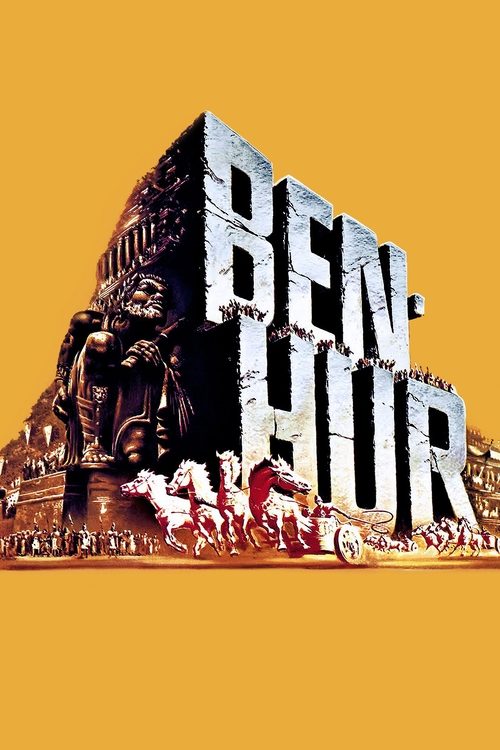
Ben-Hur
1959 · William Wyler
For a long rainy Sunday when you want to be swept up by the biggest thing Hollywood ever built — comfort viewing at monumental scale. Ideal with an intermission and snacks.
What it's about
In Roman-occupied Jerusalem, Judah Ben-Hur — a Jewish prince — welcomes home his childhood friend Messala, now a Roman tribune. Their reunion curdles into a betrayal that sends Judah to the slave galleys and his mother and sister to a dungeon, launching a years-long odyssey of survival and revenge that keeps brushing against the life of Christ at its edges.
The experience
Grand, unhurried, and genuinely stirring — three and a half hours that earn their length, building to a chariot race that still makes audiences hold their breath seventy years on. Old-fashioned in the best sense: sincere, sweeping, emotionally direct.
Performances
Charlton Heston's granite intensity as Judah won him the Oscar, and Stephen Boyd makes Messala's slide from friend to enemy sting — the friendship-turned-hatred between them is the film's real engine.
The craft
Shot in ultra-wide 65mm with sets and crowds of staggering scale, it climaxes in a chariot race staged for real — no shortcuts — that remains one of the greatest action sequences ever filmed, carried by Miklós Rózsa's thunderous score. See it on the largest screen you can find.
Why it matters
It won a record eleven Academy Awards, rescued MGM from financial ruin, and became the definitive Hollywood biblical epic against which all others are measured.
Snapshot
Ben-Hur is the apotheosis of the Hollywood roadshow epic: a three-and-a-half-hour, 65mm widescreen adaptation of Lew Wallace's 1880 novel Ben-Hur: A Tale of the Christ, produced by MGM as a deliberate, near-existential financial gamble and directed by William Wyler, a filmmaker whose reputation rested on intimate, character-driven drama rather than spectacle. The film follows Judah Ben-Hur, a Jewish prince of Jerusalem under Roman occupation, whose boyhood friendship with the Roman tribune Messala curdles into betrayal, condemning Judah to the galleys and his mother and sister to a dungeon. His path from slave to avenger to convert runs parallel to, and finally intersects with, the life of Christ, whose presence frames the narrative without ever fully entering it. The picture won eleven Academy Awards from twelve nominations — a record unmatched until Titanic (1997) and The Lord of the Rings: The Return of the King (2003), both of which tied but did not surpass it. Its centerpiece chariot race remains one of the most studied and imitated action sequences in cinema. Ben-Hur is simultaneously a monument to the studio system at its most lavish and an early sign of that system's terminal strain.
Industry & production
Ben-Hur was conceived in conditions of corporate desperation. By the mid-1950s MGM, the most prestigious of the Hollywood majors, was in serious decline, squeezed by television, the divestiture of theater chains following the 1948 Paramount decree, and a string of costly underperformers. The studio resolved to remake its own 1925 silent Ben-Hur — itself a troubled, expensive production that had nonetheless become a landmark — as a roadshow event picture, betting that scale and spectacle were the one thing television could not replicate. The budget was enormous by the standards of the day, among the largest committed to a single film up to that point, and the production was understood within the industry as a make-or-break proposition for the studio.
Principal photography took place largely at Cinecittà Studios in Rome, where vast sets — most famously the circus arena for the chariot race — were constructed on a scale that absorbed much of the budget and a great deal of the schedule. The shoot ran long and the logistics were formidable, involving thousands of extras and an extended second-unit campaign for the action sequences. Wyler, a meticulous and famously demanding director, shot at his customary deliberate pace, which on a production of this magnitude translated into months of work.
The gamble paid off. Ben-Hur was an enormous commercial success and is routinely credited with stabilizing MGM's finances at a critical moment, though it is more accurate to say it bought the studio time than that it reversed its longer decline. The film's success also reinforced the late-1950s and early-1960s industry strategy of the blockbuster roadshow epic — fewer films, bigger budgets, reserved-seat presentations — a strategy that produced both triumphs and, within a few years, the catastrophic overreach of pictures like Cleopatra (1963).
Technology
Ben-Hur was photographed in MGM Camera 65, the studio's large-format process using 65mm negative (projected on 70mm prints with magnetic stereophonic sound), and in color by Technicolor. The wide negative and the anamorphic element of the system produced an extremely broad, high-resolution image well suited to the film's architectural sets and crowd spectacle. The large format was central to the roadshow proposition: it offered an image television and conventional 35mm exhibition could not match, justifying premium presentation in equipped theaters.
The picture was structured for roadshow exhibition with an overture, an intermission, and entr'acte music — conventions that treated the film as a theatrical event rather than ordinary programming. The combination of large-format photography, stereophonic sound, and reserved-seat presentation represents the era's technological answer to the threat of television, and Ben-Hur is among its most fully realized examples.
Technique
Cinematography
Robert Surtees, the film's cinematographer, won one of its eleven Oscars. His work negotiates the central problem of the large format — its appetite for breadth and its difficulty with intimacy — by alternating expansive, deep-staged compositions of architecture and crowds with carefully controlled close work on the principal actors. The film's palette is rich but disciplined, and Surtees and Wyler use the width of the frame both for spectacle (the harbor, the arena, the great houses of Jerusalem and Rome) and for the staging of relationships across the horizontal plane, placing figures in opposition or alliance within a single composition. The chariot race, much of it the work of the second unit, is shot for clarity and kinetic legibility rather than confusion, with sustained coverage that lets the audience track the geography of the contest.
Editing
The editing, by Ralph E. Winters and John D. Dunning, also won an Academy Award, and its reputation rests overwhelmingly on the chariot race — a long sequence cut for sustained tension and spatial coherence, building rhythm through the accumulation of laps, collisions, and incidents while keeping the relative positions of Judah and Messala clear. The achievement is the maintenance of clarity at high speed and over a long duration; the sequence is frequently cited in discussions of action editing precisely because it privileges legibility over disorientation. Across the film as a whole the cutting is patient, consonant with Wyler's preference for letting scenes play, and the contrast between that overall deliberateness and the race's velocity is part of the picture's design.
Mise-en-scène / staging
Wyler's staging is the film's quiet signature. A director associated with the long take and the deep-focus compositions he developed with Gregg Toland in the 1940s, Wyler brings to the epic a sensibility trained on the dramatic arrangement of figures in space. Confrontations — the reunion-turned-rupture between Judah and Messala, the scenes in the house of Hur — are blocked so that physical proximity and distance carry emotional weight. The enormous sets are used not merely as backdrop but as pressure: Roman power is expressed architecturally, and the human figures are repeatedly dwarfed by the structures of empire.
Sound
The film was presented with stereophonic sound as part of its roadshow format. Beyond Miklós Rózsa's score (discussed below), the sound design of the action sequences — the galley, the sea battle, and above all the chariot race, with its hooves, wheels, and crowd — contributes substantially to their impact. The record on the granular technical detail of the sound work is thinner than for the photography and music, and I will not overstate it.
Performance
Charlton Heston's Judah Ben-Hur is a performance of physical authority and moral solemnity; it won him the Best Actor Oscar and became, with The Ten Commandments (1956), foundational to his screen persona as the figure of the heroic ancient. Stephen Boyd's Messala supplies the film's most psychologically charged playing, his charm shading into menace as friendship turns to political and personal enmity. Hugh Griffith won Best Supporting Actor as the genial Sheik Ilderim, a performance whose comic warmth is now complicated for modern viewers by the era's casting conventions. Haya Harareet plays Esther, and Jack Hawkins brings gravity to Quintus Arrius. The ensemble works within the register of dignified epic acting, with Wyler — known for extracting performances through exhaustive repetition of takes — shaping the principals toward restraint amid the surrounding spectacle.
Narrative & dramatic mode
Ben-Hur operates in the mode of the providential historical melodrama. Its engine is personal — the rupture of a friendship and the long arc of revenge — but that personal story is continually placed within, and finally subordinated to, a religious frame. The structure is one of fall and restoration: Judah's descent into slavery and his rise to vengeance occupy the bulk of the running time, but the narrative ultimately reframes vengeance as insufficient, redirecting the protagonist from retribution toward forgiveness and faith. The figure of Christ is handled with deliberate reticence — seen partially, his face withheld, present at the narrative's margins until the Crucifixion — so that the spiritual story remains a frame around the human drama rather than displacing it. The film's subtitle in Wallace's novel, A Tale of the Christ, signals this dual structure, in which a conventional adventure of betrayal and revenge is enclosed by a story of salvation.
Genre & cycle
The film belongs squarely to the cycle of biblical and ancient-world epics that flourished in 1950s Hollywood — Quo Vadis (1951), The Robe (1953), The Ten Commandments (1956), and others — a cycle in which the industry deployed scale, color, and widescreen against the competitive threat of television, often wrapping commercial spectacle in the respectability of religious or classical subject matter. Within that cycle Ben-Hur is the prestige summit, the film that pushed the form's budget, length, and ambition furthest and was most lavishly rewarded. It is also a remake, descended directly from the 1925 MGM silent and, before that, from a celebrated stage adaptation of Wallace's novel, situating it within a long popular tradition of Ben-Hur spectacle reaching back into the nineteenth century.
Authorship & method
William Wyler is the film's defining authorial presence, and the casting of so intimate a dramatist on so vast a project is itself significant. A three-time Best Director winner (for Mrs. Miniver, The Best Years of Our Lives, and Ben-Hur), Wyler was renowned for psychological precision, for the long take and deep staging, and for a punishing method of many takes in pursuit of unaffected performance. There is a documented personal connection to the material: Wyler had worked in a junior capacity on the 1925 silent version, one of numerous assistants on that troubled production, which lent his return to the property a biographical resonance.
The screenplay credit went solely to Karl Tunberg, but the script's authorship is genuinely contested and is one of the better-known credit disputes of the period. Gore Vidal and the British playwright and poet Christopher Fry both worked extensively on the dialogue, and others contributed as well; Fry in particular was present throughout much of the shoot. Vidal later claimed to have introduced a deliberate homoerotic subtext into the Judah–Messala relationship, saying he had taken Boyd into his confidence while keeping Heston unaware — a claim Wyler and Heston disputed and which remains unresolved, more a matter of competing recollections than settled fact. The Writers Guild ultimately credited Tunberg alone, and the film's lone loss among its twelve nominations came in the Adapted Screenplay category.
The cinematographer Robert Surtees and the editors Ralph Winters and John Dunning were central collaborators, but the most celebrated craft contribution after Wyler's is Miklós Rózsa's. Rózsa, MGM's leading composer and a specialist in the historical epic, won the Oscar for a score of great scale and thematic richness, drawing on his interest in antique and modal idioms to give the film a sound that influenced the genre for years afterward. The chariot race was realized largely by the second-unit director Andrew Marton together with the legendary stunt coordinator Yakima Canutt, whose expertise with horses and vehicles was decisive; the most famous moment of the race, in which a chariot vaults an obstacle, involved Canutt's son Joe, and the sequence stands as a monument to second-unit craft as much as to Wyler's authorship.
Movement / national cinema
Ben-Hur is a product of the Hollywood studio system in its late-classical phase — specifically of MGM, the most prestige-conscious of the majors — and does not belong to any avant-garde or national-cinema movement. It is, however, a transatlantic production in practice: shot in Italy at Cinecittà, it exemplifies the era's "runaway production" pattern, in which American studios filmed abroad to exploit lower costs, large-scale facilities, and favorable financial arrangements. The film thus sits at the intersection of Hollywood capital and European production infrastructure that characterized the international epic of the period.
Era / period
The film is a definitive artifact of Hollywood's transitional moment between the collapse of the classical studio system and the New Hollywood of the late 1960s. Its strategy — the few-but-enormous roadshow blockbuster, presented as a theatrical event to lure audiences away from television — was the industry's characteristic response to the structural crises of the 1950s. Ben-Hur's triumph validated that strategy at its peak; within a handful of years the same logic, pursued without comparable discipline, would help produce the financial disasters that hastened the old studios' reorganization. The film therefore reads now as both the high-water mark and a harbinger of the end of an era.
Themes
At its center Ben-Hur dramatizes the corrosive logic of vengeance and its supersession by forgiveness. Judah's pursuit of retribution against Messala is granted full dramatic weight and even its cathartic victory in the arena, only for the narrative to insist that vengeance leaves its possessor unhealed — Messala's death resolves nothing of Judah's grief or his mother's and sister's affliction. Redemption arrives not through triumph but through the intersecting story of Christ, whose Passion the film offers as the true resolution. Subsidiary themes include the relationship between the personal and the political — friendship destroyed by the demands of empire and occupation — and the tension between Jewish identity under Roman rule and the universalizing Christian frame the narrative ultimately imposes. The film's treatment of faith is earnest and central rather than decorative, distinguishing it somewhat from the more purely spectacular entries in its cycle.
Reception, canon & influence
Ben-Hur was met on release with enormous commercial success and broad acclaim, and its haul of eleven Academy Awards — Best Picture, Director, Actor, Supporting Actor, Cinematography, Editing, Score, Art Direction, Costume Design, Sound, and Special Effects — set a record that has been tied twice but never broken. Critical opinion has always been more measured than the awards suggest: even at the time and increasingly since, commentators have weighed the film's length, its solemnity, and the contrast between its routine stretches and its set-piece brilliance, with the chariot race singled out as a sequence of enduring power within a film some find uneven. Its canonical standing rests heavily on that sequence, on Wyler's craft, on Rózsa's score, and on its status as the epitome of a vanished mode of filmmaking.
Looking backward, the film draws on Wallace's much-adapted novel, on the celebrated stage versions, and most directly on MGM's own 1925 silent — including the precedent of that film's own large-scale chariot race — as well as on the immediate template of the 1950s biblical-epic cycle. Looking forward, Ben-Hur's chariot race became a reference point for action direction and second-unit work, its influence frequently cited (the pod race of The Phantom Menace, among many others, is commonly traced to it). Its scale and roadshow model shaped the epic ambitions of the early 1960s, for better and worse. The property itself was adapted again, including a 2016 feature that landed without the cultural impact of its predecessor — a contrast that underscores how thoroughly the 1959 film remains the definitive Ben-Hur and a touchstone for the very idea of the Hollywood epic.
A Deleuzian reading
Two chariots come around the turn of the spina, one team white, one black, and at every instant you know which is which.
The full Deleuzian reading of Ben-Hur →
Reception
A colossal hit in 1959 — it rescued a struggling MGM and swept a then-record 11 Oscars. Today the chariot race is still spoken of with awe, but the film around it gets tagged as stately Golden-Age homework, admired more than adored.
How Ben-Hur was received, from release to now →
Influences: the films it descends from and the films it influenced
- Ben-Hur: A Tale of the Christ (1925) — MGM's own silent version supplied the literal blueprint — the multi-chariot arena race shot with massed cameras and real collisions — that Wyler's second unit re-staged shot-for-beat decades later, and Wyler himself had assisted on it.
- Intolerance (1916) — Established the grammar of the monumental built set and crowd-scaled historical tableau — towering practical architecture filled with thousands of extras choreographed in depth — that the biblical-epic cycle inherited.
- Quo Vadis (1951) — MGM's prior Roman blockbuster set the studio template Ben-Hur scaled up, and gave Miklós Rózsa his laboratory for the antique-modal, archaeologically-researched scoring idiom he refined here.
- The Ten Commandments (1956) — Codified the roadshow biblical epic — overture, intermission, religious spectacle staged as reverent tableau with a withheld or peripheral divinity — that Ben-Hur both adopts and disciplines.
- The Best Years of Our Lives (1946) — Wyler's deep-focus, long-take dramaturgy developed with Gregg Toland — staging actors in layered planes so a single uncut frame carries the drama — is the intimate technique he transplants onto the epic's vast sets.
- Stagecoach (1939) — Showcased Yakima Canutt's signature horse-and-vehicle stunt vocabulary — the falls, drags, and under-carriage transfers — that Canutt and son Joe brought directly to the chariot race's vaulting gag.
- Gone with the Wind (1939) — Pioneered the prestige roadshow exhibition model — reserved-seat, intermission, premium-priced single-feature engagements — that financed and shaped Ben-Hur's economics and runtime.
- Spartacus (1960) — The immediately following Roman epic, pursuing the same fusion of mass second-unit battle spectacle with character-scaled performance, made in Ben-Hur's commercial wake.
- El Cid (1961) — Carries forward Rózsa's epic scoring practice — modal medieval pastiche, leitmotif architecture — paired with Marton-style large-scale second-unit siege and cavalry staging.
- Lawrence of Arabia (1962) — Extends the 70mm roadshow epic toward Ben-Hur's ideal of restraint amid spectacle — vast widescreen vistas anchored by a contained, psychologically withheld central performance.
- Cleopatra (1963) — The runaway-production roadshow taken to ruinous extreme — Ben-Hur's overseas-shot, intermission-structured, escalating-budget model pushed past the point of viability.
- The Fall of the Roman Empire (1964) — A late-cycle Roman epic reuniting Rózsa's scoring and the genre's monumental forum sets, marking the exhaustion of the very roadshow formula Ben-Hur perfected.
- Gladiator (2000) — Revives the Roman arena epic's core machinery — vengeance-versus-empire melodrama climaxing in choreographed circus combat — recombining practical staging with digital crowd extension of Ben-Hur's amphitheater.
- Star Wars: Episode I – The Phantom Menace (1999) — The pod race is an explicit transposition of the chariot race's editing and shot logic — parallel sabotage, crashes, the lap-by-lap continuity of competing vehicles — into a sci-fi register.
- Ben-Hur (2016) — A direct remake whose CGI-augmented chariot race measures itself against — and is judged by — Andrew Marton and Canutt's practical 1959 staging as the definitive benchmark.
- The Lord of the Rings: The Return of the King (2003) — Yakima Canutt's chariot-race staging established the grammar of embedding cameras within the physical spectacle rather than observing from a remove — placing lenses at wheel-level, inside the action — a principle Jackson applies in the Rohirrim cavalry charge, with ground-level and in-formation cameras tracking the assault rather than recording it from elevated safety.
- Patton (1970) — Robert Surtees's Camera 65 roadshow release — with overture, intermission, and entr'acte — fixed the prestige event-cinema format and the figure-dwarfed-by-monumental-emblem framing grammar that Schaffner's flag-shot opening directly inherits: the individual rendered small before institutional iconography, then restored to commanding close-up.
- Doctor Zhivago (1965) — The MGM 65/70mm super-production model — overture, intermission, exit music, sustained running time — that dictated Zhivago's roadshow release architecture.
- Life of Brian (1979) — Supplies the widescreen Hollywood-epic grammar of Roman pomp, crowds and processional grandeur that Brian's staging mimics faithfully in order to puncture it.
- King of Kings (1961) — Inverts Ben-Hur's signature device of the withheld Christ — rendering the face and voice directly on screen — as a deliberate counter-strategy within the same epic moment.
Similar films
- Gladiator (2000) — influence & lineage
- Lawrence of Arabia (1962) — influence & lineage
- El Cid (1961) — influence & lineage
- Spartacus (1960) — influence & lineage
- Stagecoach (1939) — influence & lineage
- Raiders of the Lost Ark (1981) — shared sensibility
- Schindler's List (1993) — shared sensibility
- Braveheart (1995) — shared sensibility
All the films related to Ben-Hur →