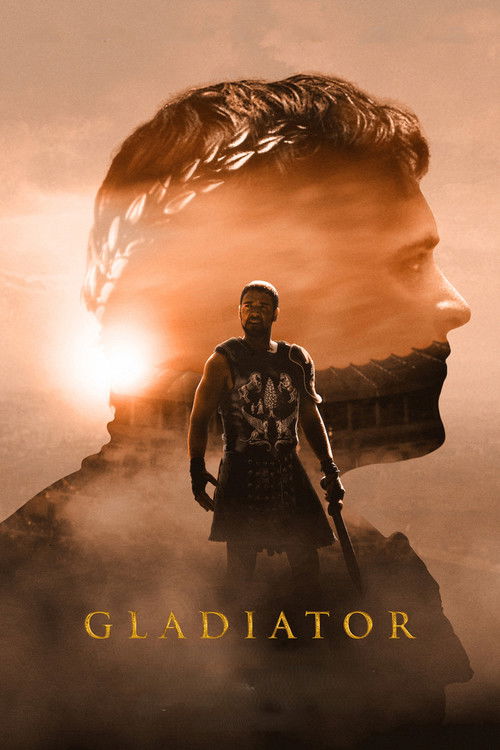
Gladiator
2000 · Ridley Scott
As famous now for press-tour belligerence ("go f— yourself" to historical accuracy critics of Napoleon) as for the films; Gladiator II's "are you not entertained" marketing and shark-in-the-Colosseum discourse kept him meme-central in his late 80s. The industry's most quotable octogenarian.
When you want a big, full-blooded epic — something to make you feel the old-fashioned emotions: honor, loss, vengeance, glory. A crowd-pleaser through and through, best watched loud.
What it's about
In second-century Rome, a beloved general is betrayed after the old emperor's death, loses everything, and is sold into slavery. Forced to fight as a gladiator, he battles his way from provincial arenas toward the Colosseum itself — and toward the new emperor who destroyed his life. It's a revenge story on the grandest possible scale, with an empire's future hanging on one man's rage and grief.
The experience
It moves like a freight train dressed in marble: brutal, sweeping battle scenes broken up by quiet moments of real sorrow. You come out stirred up — it's the kind of film that makes your chest tighten during the arena roars and again in the stillness after them.
Performances
Russell Crowe won the Oscar for a performance of coiled fury and surprising tenderness — he makes a nearly mythic hero feel like a grieving man. Joaquin Phoenix is unforgettable as the insecure, needy young emperor, one of the great pitiable villains.
The craft
Ridley Scott stages the ancient world with painterly grandeur — golden wheat fields, blue-gray battlefields, and a digitally rebuilt Colosseum that still holds up. Hans Zimmer and Lisa Gerrard's score became instantly iconic, and the whole thing is engineered for the biggest screen and loudest speakers you can find.
Why it matters
It won five Academy Awards including Best Picture, single-handedly revived the Hollywood historical epic after decades of dormancy, and set the template for a wave of sword-and-sandal spectacles that followed.
Snapshot
Ridley Scott's Gladiator is the film that singlehandedly resurrected the Hollywood historical epic after four decades of dormancy. A revenge narrative set in second-century Rome, it follows Maximus Decimus Meridius — general, slave, gladiator — from the German frontier to the sand of the Colosseum. Combining classical tragic structure with the kinetic grammar of the modern action blockbuster, it won five Academy Awards including Best Picture, launched a cycle of sword-and-sandal productions that defined the early 2000s, and remains one of the most commercially and institutionally influential films of its era.
Industry & production
Gladiator originated with a single image: David Franzoni, a screenwriter with credits on Amistad, encountered Jean-Léon Gérôme's 1872 painting Pollice Verso — a condemned gladiator awaiting the crowd's judgment — and persuaded DreamWorks to commission a script around it. The studio had been looking for a vehicle to compete with the spectacular digital filmmaking then reshaping blockbuster cinema, and the Roman arena offered the scale they sought.
The production was troubled in ways that have since become part of Hollywood legend. John Logan and later William Nicholson were brought in to substantially revise Franzoni's draft, and the script remained openly unfinished as cameras rolled. Russell Crowe, who signed on early, reportedly found the original pages inadequate, and the tension between a screenplay still in flux and an expensive production already in motion pushed Nicholson in particular toward the film's emotional core — the murdered family, the private grief beneath the public spectacle. The ending was not firmly resolved until late in the shoot.
Production moved across three countries: the opening battle in Germania was staged in Bourne Wood, Surrey; the North African province of Zucchabar was realized in Ouarzazate, Morocco; and the principal Roman sequences were shot on an elaborate set in Malta, where production designer Arthur Max constructed a partial Colosseum structure reported to stand over fifty meters at its highest elevation, representing roughly one third of the actual monument's circumference. The remainder of the arena — and the digital panorama of imperial Rome — would be supplied by visual effects.
The shoot was further marked by the death of Oliver Reed, who was playing the gladiatorial lanista Proximo, in Malta on 2 May 1999. Reed died of a heart attack before his final scenes were complete, and the production made the consequential decision to finish his arc digitally, blending existing footage with a body double and early face-replacement compositing. The film's closing dedication to Reed acknowledges both the loss and the method.
Technology
Gladiator stands at a significant threshold in the history of digital production. Mill Film, the visual effects house responsible for the project, delivered what was then the most ambitious recreation of an ancient cityscape attempted on screen — a sweeping aerial shot over a fully realized Rome that combined practical miniatures, matte paintings, and composited CGI crowds. The digital realization of the Colosseum, populated with tens of thousands of virtual spectators, was a foundational proof-of-concept for the crowd-simulation systems that subsequent productions would adopt routinely.
The Oliver Reed digital resurrection was equally consequential. While the technique was limited by the standards of even a few years later, the ethical and technical questions it raised — around posthumous likeness rights, actor consent, and the boundary between performance and simulation — seeded a debate that continues to animate the industry. Gladiator made that debate concrete rather than theoretical.
For battle sequences, Scott's team used multiple camera units shooting simultaneously, an approach that both guaranteed coverage of chaotic choreography and introduced inconsistencies of grain and angle that were understood as conferring documentary texture rather than presenting as flaws.
Technique
Cinematography
John Mathieson, working on his first major Hollywood production, established a visual language for the film rooted in desaturation and contrast. The palette of the gladiatorial sequences leans into ochre and dust, while Rome itself tends toward cooler, more marmoreal tones — a chromatic distinction that maps the film's spatial politics onto color temperature. Maximus's visions of his family and his Elysian death are rendered in washed golden warmth, functioning as a visual grammar of yearning. Mathieson's use of handheld cameras in the arena sequences — often operating at undercranked speeds to create stuttered, percussive motion — formalized a technique for staging ancient combat that subsequent films would borrow wholesale. The aesthetic is deliberately unpretty: faces are shot in tight close-up at unflattering angles during violence, anchoring the spectacle in sweat and impact.
Editing
Pietro Scalia, a frequent Scott collaborator, won the Academy Award for Film Editing for this work. His cutting in the action sequences is often cited as influential but is in fact more calibrated than its reputation for frenzy suggests. Within combat, cuts are frequent and disorienting; between combat passages and the film's political scenes, the pace opens substantially, allowing Phoenix and Harris long uninterrupted registers of performance. The film's structure alternates these two rhythms with enough regularity that the audience learns to read speed as a tonal signal.
Mise-en-scène / staging
Scott's staging throughout benefits from Arthur Max's production design, which gives the Roman sequences a lived-in, architecturally convincing weight that distinguishes the film from the backlot classicism of the peplum era. Commodus's Rome feels genuinely inhabited — the Senate chambers are cramped and politically dense, the arena is filthy, the slave quarters are unsentimental. The battle in Germania opens in fog and firelight, with a carefully managed transition from stillness to total chaos that has been studied and imitated. Scott's staging of the arena sequences exploits the Colosseum's geometry to create a constant sense of spectatorship-within-spectatorship: the crowd watching the gladiators, the emperor watching the crowd, the camera watching the emperor.
Sound
The sound design won a second Oscar for the production and earns it. The arena sequences layer impact sounds, crowd noise, and Hans Zimmer's score in a way that makes the sonic texture feel physical. The decision to treat the crowd roar as something that rises and falls with Maximus's perception — almost diegetically subjective — is one of the film's more formally interesting choices. The Germania battle opens in near-silence before the flaming catapult volleys break across the mix.
Performance
Russell Crowe's Maximus operates almost entirely through restraint — the character's emotional life is conveyed in the tension between a jaw that rarely unclenches and eyes that register everything. Crowe received the Academy Award for Best Actor, though the performance was not universally championed by critics at the time. The more immediately riveting work is Joaquin Phoenix's Commodus: needy, volatile, and genuinely frightening, Phoenix makes the emperor's cruelty inseparable from his wounded desire for approval. Richard Harris gives Marcus Aurelius a weary philosophical dignity in relatively little screen time. Oliver Reed's Proximo, shot in fragments and reconstructed posthumously, remains a coherent and affecting performance.
Narrative & dramatic mode
The film's narrative engine is classical tragedy filtered through the revenge Western. Maximus is a man whose entire motivation is disclosed in a single line of dialogue early in the second act, and from that point the film functions as an engine of delayed and complicated satisfaction. The structure owes more to Hamlet and the Roman revenge tragedies of Seneca — court corruption, filial treachery, the moral ambiguity of the avenger — than it does to the spectacle-driven plotting of the peplum cycle. The arena sequences provide episodic variation and escalating stakes, but the film's dramatic center is always the Commodus-Maximus axis, a private conflict inflated to public spectacle.
The Stoic philosophy of Marcus Aurelius — derived loosely from the actual emperor's Meditations — runs through the film as moral substrate, grounding its ideas about duty, service, and the proper relationship between private virtue and public life.
Genre & cycle
Gladiator is the founding text of the early-2000s historical epic revival. Before it, the sword-and-sandal tradition had been commercially moribund since the mid-1960s; after it, Troy (2004), Alexander (2004), Scott's own Kingdom of Heaven (2005), and Zack Snyder's 300 (2006) all emerged in direct succession. HBO's Rome (2005–2007) is unthinkable without it. The cycle played out quickly — Alexander was a significant commercial disappointment — but Gladiator's own box-office performance, grossing roughly $460 million worldwide against a production budget estimated at around $100 million, demonstrated sufficient appetite to drive several years of imitation.
Within Scott's own filmography, the film represents a pivot from the science-fiction and neo-noir registers of his earlier work toward a large-scale historical mode he would continue in Kingdom of Heaven and Exodus: Gods and Kings.
Authorship & method
Ridley Scott is a director who thinks primarily in visual terms — famously, he prepares what he calls "Ridleygrams," dense storyboards drawn in his own hand, which function as a planning document and a communication tool with his crew. The approach yields productions of unusual visual coherence even when, as here, the script is unstable. Scott's British background in advertising and television (he directed commercials for decades before The Duellists in 1977) informs a particular attention to the single composed frame: shots in Gladiator are frequently considered as images before they are considered as story beats.
John Mathieson's cinematography found its voice here and would continue with Scott on subsequent projects. Pietro Scalia had edited JFK for Oliver Stone and brought a political epic sensibility to the cut. Hans Zimmer and Lisa Gerrard's score is perhaps the film's most distinctive collaborative contribution: Gerrard's glossolalia vocals (the track "Now We Are Free," which closes the film) create an effect that is simultaneously ancient and unplaceable, a deliberate non-specificity that gives the film's emotional register a mythic rather than historical quality. The score's use of Armenian duduk, Middle Eastern percussion, and orchestral swell was influential on a generation of epic film composers.
Movement / national cinema
Gladiator is a Hollywood studio production — financed and distributed by DreamWorks and Universal — but its production culture is emphatically transatlantic. Scott is British; Mathieson is British; Oliver Reed, Richard Harris, Derek Jacobi, and Connie Nielsen represent British and European acting traditions; the principal sets were built in the UK and Malta. The film belongs to the long tradition of the "runaway production" in which American capital engages British craft infrastructure, a model that has sustained the British film industry since the 1960s and that gave the peplum revival its specific texture of European craftsmanship within American narrative convention.
Era / period
Gladiator arrived in May 2000 at a precise inflection point in the blockbuster era. Titanic (1997) had recalibrated expectations for spectacle and commercial scale; digital compositing was mature enough to be invisible but expensive enough to confer prestige; and the prestige-awards market had grown sufficiently that a film could be simultaneously a summer action release and a serious Oscar contender. Gladiator occupied both spaces — something that surprised many observers at the time — and demonstrated that spectacular action need not be categorically excluded from institutional recognition. The film's Best Picture win remains contested by some critics who viewed it as undeserved, but the win itself was historically significant as a validation of the action-epic form.
Themes
At its core, Gladiator is a film about the spectacle of power and its discontents. The Roman arena literalizes what the film argues about all political life: that authority requires performance, that legitimacy is manufactured through theater, and that the most dangerous thing a ruler can face is a spectacle that reflects his own illegitimacy back at him. Maximus wins the crowd; Commodus cannot.
Beneath the political argument is a meditation on grief as motive force. The film is unusually direct about the fact that Maximus does not primarily want justice or Rome restored — he wants his wife and son, and he wants Commodus dead. The Stoic vocabulary of duty and virtue is real but functions partly as a social shell around a more primal and less admirable drive. This tension gives the film more moral complexity than its genre conventions might suggest.
The afterlife as reunion — the film's recurring motif of Maximus reaching toward a wheat field, a wooden door, a wife's waiting hand — anchors its eschatology in Roman funerary tradition while translating it into the register of romantic longing.
Reception, canon & influence
Backward influences. The film's most direct predecessors are the Hollywood epics of the late 1950s and early 1960s: Anthony Mann's The Fall of the Roman Empire (1964), whose narrative and several characters Gladiator closely echoes, and Stanley Kubrick's Spartacus (1960), from which it inherits the enslaved warrior's relationship to Roman political corruption. William Wyler's Ben-Hur (1959) is present in the formal structure and the revenge motor. The chaos-of-battle aesthetic draws on Akira Kurosawa's late epics, particularly Ran (1985), and on the Vietnam war film tradition — specifically the disorienting handheld opening of Francis Ford Coppola's Apocalypse Now. Scott has also cited David Lean's sense of landscape and scale as an enduring reference.
Critical reception. Initial reviews were respectful but divided. Critics uniformly praised the visual achievement and the two lead performances; the screenplay attracted more skepticism, with several reviewers noting its relative thinness beneath the spectacle. Roger Ebert wrote favorably of the film's grandeur and of Crowe's physicality; other critics found the revenge plot schematic. The Academy's Best Picture decision was received with some surprise and a degree of resistance from those who considered it a category error — a recognition of craft and commercial appeal mistaken for cinematic distinction.
Legacy. The film's forward influence operates on multiple levels. Industrially, it demonstrated the commercial and awards viability of the historical epic and triggered a cycle of expensive productions that ran through the mid-2000s. Formally, the Germania battle sequence and the Colosseum combat established a template for choreographing ancient warfare — multiple cameras, undercranking, tight close-ups, directional sound design — that became so widely adopted as to now constitute a genre default. The Oliver Reed posthumous reconstruction, limited as it was technically, opened a practical and ethical door whose full implications are still being worked through in contemporary productions involving digital actors. And Zimmer and Gerrard's score created a tonal register for epic historical music — archaic, emotionally vast, culturally non-specific — that remains audible in blockbuster scoring to this day.
A sequel, Gladiator II, directed again by Ridley Scott, was released in 2024, an unusually long interval between franchise installments and a testament to the original's durability as a cultural reference point.
A Deleuzian reading
A hand moves low through the tops of the wheat.
The full Deleuzian reading of Gladiator →
Reception
A rare case of no reappraisal needed: a massive hit that won Best Picture and single-handedly resurrected the swords-and-sandals epic, and 25 years later it's still the one everyone means when they say 'they don't make them like this anymore.' If anything has shifted, it's that the film once dismissed by some critics as handsome pulp is now treated as the last great old-school Hollywood epic.
How Gladiator was received, from release to now →
Influences: the films it descends from and the films it influenced
- Spartacus (1960) — Kubrick originated the spectatorship-within-spectatorship device — patrician judges whose thumbs-up/thumbs-down verdict constitutes the arena's dramatic stakes — that Gladiator's 'are you not entertained?' confrontation directly inherits as both staging grammar and thematic argument.
- The Fall of the Roman Empire (1964) — Mann's film shares Gladiator's near-identical political engine — a dying Marcus Aurelius, a paranoid unworthy Commodus, a loyal general displaced by dynastic corruption — making it the direct structural source text that Franzoni and Logan rework rather than originate.
- The Wild Bunch (1969) — Peckinpah invented simultaneous multi-camera combat photography with variable frame rates and the percussive rhythmic alternation between fragmented close-up violence and wider held shots — the formal editing grammar Pietro Scalia inherits for the arena sequences.
- Once Upon a Time in the West (1968) — Leone's structural template of the grief-defined, near-silent stranger crossing alien territory toward a single predetermined act of revenge — combined with Morricone's choral, wordless vocal scoring as an expressionist register of interiority — is the western grammar Gladiator transposes wholesale into Rome.
- Raging Bull (1980) — Michael Chapman and Thelma Schoonmaker's use of distorted, suddenly attenuating crowd sound to register LaMotta's psychological dissociation mid-bout is the precise subjective-crowd-roar technique Gladiator's sound design applies to Maximus's dissociative arena states.
- Braveheart (1995) — John Toll's desaturated, multi-camera handheld battle photography and the template of a revenge-driven historical epic built around a charismatic warrior provided the immediate production model Scott followed; Gladiator is in direct formal dialogue with its battlefield aesthetic and genre legitimacy.
- Saving Private Ryan (1998) — Janusz Kamiński's D-Day sequence codified undercranked, desaturated, handheld close-combat cinematography as a grammar of historical violence; Mathieson transposed this technique directly into the Colosseum, converting a WW2 visual vocabulary into ancient Roman warfare.
- The Thin Red Line (1998) — Hans Zimmer's score for Malick's film — ambient, choral, deploying wordless voices as textures rather than melodies — is the immediate compositional laboratory for the glossolalia technique he develops further in Gladiator with Lisa Gerrard, where vocal sound registers grief as sensation rather than language.
- Ben-Hur (1959) — Revives the Roman arena epic's core machinery — vengeance-versus-empire melodrama climaxing in choreographed circus combat — recombining practical staging with digital crowd extension of Ben-Hur's amphitheater.
- Forrest Gump (1994) — Uses digital crowd replication to fill the Colosseum with multiplied extras, extending Gump's invisible technique of cloning sparse crowds into mass period spectacle.
- The Last of the Mohicans (1992) — Becomes the next benchmark for fusing historical spectacle with a hummable orchestral-electronic main theme and a fatalistic hero, the template Mohicans helped re-legitimize.
- Lion of the Desert (1981) — Revives the foredoomed-hero martyrology of the roadshow epic — the principled man destroyed by imperial power whose death is staged as moral vindication — for the modern spectacle era.
- Troy (2004) — Troy is the most direct industrial descendant of the sword-and-sandal revival: it inherits Gladiator's CGI army-simulation approach, multi-camera simultaneous shoot protocol for ancient combat, and the model of a Hollywood-scale transatlantic production mounted on the prestige of antiquity.
- Kingdom of Heaven (2005) — Scott's Crusades epic employs the same cinematographer (Mathieson), production designer (Arthur Max), and Ridleygrams storyboard methodology, making it the purest test of which elements of Gladiator's craft belong to the subject versus the authorial signature.
- The Lord of the Rings: The Two Towers (2002) — WETA Digital's MASSIVE crowd-simulation software — the industry-transforming system deployed for Helm's Deep — was developed in direct response to the standard Mill Film established for Gladiator's Colosseum populations; this is the primary technological descendant of the film's CGI crowd work.
- 300 (2006) — Snyder takes Gladiator's undercranking, desaturation, and slow-motion combat punctuation and converts them from a documentary-roughness register into the film's entire visual language, formalizing Mathieson's combat grammar into sustained expressionist stylization.
- The Last Samurai (2003) — Zwick adapts Gladiator's narrative template — a Western military man complicit in empire who finds authentic martial honor among an honorable defeated culture and chooses death over compromise — while John Toll's photography adopts Mathieson's desaturation-contrast approach for feudal Japanese settings.
- Batman Begins (2005) — Lee Smith's editing and Wally Pfister's handheld close-combat cinematography adapt Gladiator's disorienting undercranked fight grammar into the superhero film, making Batman Begins the transmission node through which the arena-combat aesthetic entered the dominant franchise action mode.
- Rogue One: A Star Wars Story (2016) — ILM's digital resurrection of Peter Cushing as Grand Moff Tarkin — face-replacement compositing over a living body double — is the direct industrial descendant of Gladiator's Oliver Reed completion, scaling into a starring role the technique the film made ethically and technically precedent-setting.
- The Last Duel (2021) — Production designer Arthur Max's oxidized-earth visual language for pre-modern spectacle carries directly into The Last Duel; Scott repurposes the same genre equipment — the arena, the institutional trial by combat — while systematically withholding the cathartic payoff Gladiator is structured to deliver.
- Hannibal (2001) — Supplies the exact carried-over craft team — DP John Mathieson, editor Pietro Scalia, composer Hans Zimmer — and the golden-light painterly monumentality applied here to genre horror.
- RRR (2022) — Pioneered CGI-augmented historical-epic crowds and arena scale as an emotional amplifier, the digital-spectacle-serving-melodrama approach RRR industrializes.
- Pirates of the Caribbean: At World's End (2007) — Hans Zimmer's brass-heavy, motif-driven epic scoring architecture is the template he extends into the pounding recurring themes (Davy Jones, the Kraken) that anchor the sequels' identity.
- Pirates of the Caribbean: The Curse of the Black Pearl (2003) — Zimmer's Media Ventures/Remote Control house style — ostinato strings and a swelling power-anthem built as a sound-identity — is the production-line score model Badelt executes for Pirates.
- The Lord of the Rings: The Return of the King (2003) — Mill Film's digital crowd-replication technique for the Colosseum sequences ran parallel to MASSIVE's development at Weta; both films solved the digital-mass-spectacle problem contemporaneously with different software solutions, making Gladiator the technological sibling that proved the digital army viable as a production tool before ROTK scaled it to unprecedented complexity.
- Black Hawk Down (2001) — Ridley Scott and editor Pietro Scalia developed the multi-camera kinetic action grammar — simultaneously shot angles, rapid spatial-disorientation cuts in the arena sequences — on this film, then applied the identical editorial architecture to BHD's firefights in the production immediately following.
- Alien: Covenant (2017) — Scott's own classical frieze-staging (the ash-frozen Pompeii tableau of the Engineer dead) and his late-career rapid multi-camera architectural-epic method.
- Napoleon (2023) — Scott's own template for the modern battle epic — multi-camera coverage cut into kinetic ellipsis — is here revisited and ironized; casting Joaquin Phoenix, his Commodus, reuses the same twitchy, wounded register to anatomize rule.
- Logan (2017) — Shares cinematographer John Mathieson, whose hard-light, desaturated anamorphic photography of weathered, aging men translates directly into Logan's sun-bleached texture.
- Titanic (1997) — Shares the late-90s breakthrough of seamlessly compositing digital crowd extras into a prestige period production, normalizing CGI multitudes in serious Oscar filmmaking.
- Pearl Harbor (2001) — A contemporaneous showcase of Hans Zimmer's surging, choral-romantic martial idiom — the same swelling string-and-voice grammar Zimmer deploys to sanctify Pearl Harbor's sacrifice.
- Star Wars: Episode I - The Phantom Menace (1999) — Reconstructs a vanished antique arena epic through CG set-extension and digital crowd replication, the same digitally-augmented spectacle logic applied to a historical rather than fantastical world.
Similar films
- Spartacus (1960) — influence & lineage
- Braveheart (1995) — influence & lineage
- Kingdom of Heaven (2005) — influence & lineage
- Gladiator II (2024) — shared sensibility
- The Last Duel (2021) — shared sensibility
- 300 (2007) — shared sensibility
- Ben-Hur (1959) — shared sensibility
- The Revenant (2015) — shared sensibility
All the films related to Gladiator →