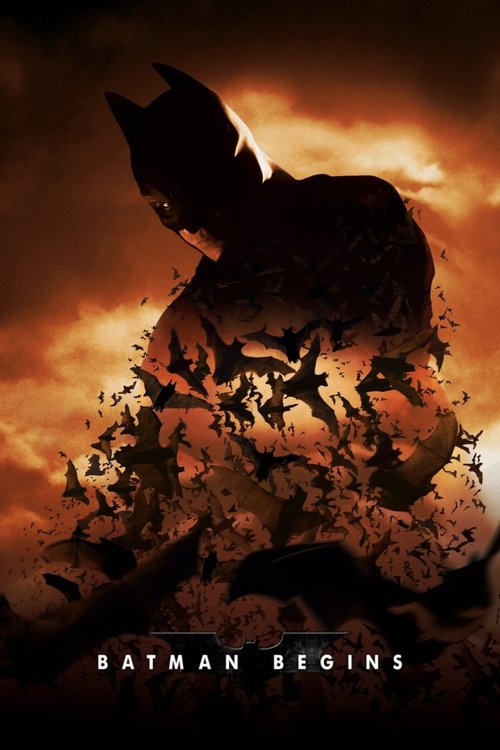
Batman Begins
2005 · Christopher Nolan
The director whose every release is treated as a referendum on theatrical cinema itself: Oppenheimer's IMAX-70mm pilgrimage culture, the Barbenheimer phenomenon, and now The Odyssey selling out screenings a full year in advance. Naming him signals you believe in the big screen; arguing about him (cold characters, muddy sound mixing) is its own cottage industry.
For when you want a blockbuster with a brain — big-scale action that still feels grounded and earned. Comfort-food scale, but with enough darkness and moral weight to chew on.
What it's about
After watching his parents die, billionaire heir Bruce Wayne disappears from Gotham to train among criminals and warrior monks, trying to understand fear from the inside. He comes home to a city rotted by corruption that the courts and police can't touch, and decides that if a man can't fix it, a symbol might. So he builds one — the Batman — piece by piece, from body armor to reputation.
The experience
Brooding and methodical rather than flashy — it takes its time building the man before the mask, then pays it off with hard-hitting, chaotic action and a creeping streak of fear-toxin horror. It plays more like a crime thriller than a comic-book romp, and it takes its hero's psychology dead seriously.
Performances
Christian Bale plays three men at once — the wounded orphan, the smug playboy decoy, and the growling vigilante — and keeps them all legible. Michael Caine gives Alfred real warmth and spine, Liam Neeson brings gravelly menace to the mentor role, and Cillian Murphy is quietly skin-crawling as a psychiatrist with unsettling side interests.
The craft
Nolan and co-writer David S. Goyer structure the origin as a character study, cutting between past and present so the mask feels inevitable rather than obligatory. The production favors muted realism — practical stunts, a Gotham built from real city textures — and the Hans Zimmer/James Newton Howard score thrums underneath like a pulse. It rewards a big screen and good bass.
Why it matters
It rescued a franchise that camp excess had killed and reset the terms of the modern superhero film, proving a serious-minded director could run a tentpole. The grounded, psychological origin story it pioneered became the genre's template for the next two decades.
Snapshot
Batman Begins is the film that reset the terms of the modern superhero movie. Arriving eight years after Joel Schumacher's Batman & Robin (1997) had effectively killed the Warner Bros. franchise with camp excess, it reconceived the character as the subject of a grounded psychological origin story — a study of fear, trauma, and the manufacture of a symbol — rather than a vehicle for villains and merchandising. Directed by Christopher Nolan from a screenplay he wrote with David S. Goyer, it occupies a hinge position in twenty-first-century commercial cinema: it proved that an auteur with art-house credibility could be entrusted with a tentpole property, and it established the template — origin-as-character-study, muted realism, moral seriousness — that the genre would follow for the next two decades. It is at once a crime drama, a martial-arts apprenticeship narrative, and a city-corruption thriller, and it treats the cape as the last thing the story arrives at rather than the first.
Industry & production
The production was Warner Bros.' deliberate attempt to rehabilitate a dormant and devalued asset. After years of stalled development that had cycled through other filmmakers and concepts (including a long-discussed Darren Aronofsky version and a Batman vs. Superman project), the studio turned to Nolan, who was coming off the critically esteemed Memento (2000) and Insomnia (2002). His pitch — a realistic, psychologically motivated origin — gave the studio a coherent creative direction after a period of drift.
Nolan and Goyer built the story partly from canonical comic sources, most explicitly Frank Miller and David Mazzucchelli's Batman: Year One (1987) and elements drawn from The Man Who Falls and Dennis O'Neil's run that introduced Ra's al Ghul and the League of Assassins. The casting signaled the film's prestige ambitions: Christian Bale in the lead, surrounded by an unusually deep bench of award-caliber actors — Michael Caine as Alfred, Liam Neeson as Henri Ducard/Ra's al Ghul, Gary Oldman as Sergeant Jim Gordon, Morgan Freeman as Lucius Fox, Cillian Murphy as Dr. Jonathan Crane/Scarecrow, Tom Wilkinson as crime boss Carmine Falcone, and Katie Holmes as Rachel Dawes.
Production was anchored at Shepperton Studios and Cardington (the former airship hangars in Bedfordshire, large enough to house the enormous Gotham and Batcave sets), with location work in Chicago and Iceland (the glacial sequences). Nolan's preference for tangible, large-scale physical sets and practical effects over green-screen environments was central to the film's identity and to its budget logic. The exact financial figures are part of the public record but I'll refrain from citing specific gross numbers I cannot verify precisely here; the relevant industry fact is that the film performed strongly enough to greenlight a sequel and to validate the entire approach — leading directly to The Dark Knight (2008) and The Dark Knight Rises (2012).
Technology
Batman Begins was shot on 35mm anamorphic film, consistent with Nolan's well-documented commitment to photochemical capture and his resistance to digital acquisition. The production made a virtue of physical engineering. The most consequential technological artifact is the Tumbler — the film's reimagining of the Batmobile as a militarized, bridging-vehicle prototype. Rather than a stylized prop, the production built functional, drivable Tumblers capable of real stunt driving, so that the Chicago rooftop-and-highway chase could be staged largely in-camera. This practical-vehicle philosophy would become a Nolan signature.
The film's effects work blended miniatures, full-scale builds, and restrained digital compositing — the goal being to keep the spectacle legible and weighty rather than weightless. The Batcave set, fed by real waterfalls, and the elevated-monorail Gotham infrastructure were physical constructions augmented by visual effects only where necessary. This is technologically conservative filmmaking by the standards of mid-2000s blockbusters, and the conservatism is the point: it reads on screen as solidity.
Technique
Cinematography
Wally Pfister, Nolan's regular collaborator of this period, shot the film and the work earned an Academy Award nomination for cinematography. The visual scheme is deliberately desaturated and tactile, favoring sodium-vapor oranges, steel grays, and deep shadow over the comic-book primaries of earlier Batman films. Pfister and Nolan render Gotham as a plausible, decaying metropolis rather than a stylized gothic fantasy. The anamorphic frame is used for both intimate close work (the Himalayan training, the interrogation scenes) and architectural scale.
A frequently noted weakness — and an honest one to record — is the legibility of the hand-to-hand combat. Nolan shoots much of the early fighting in tight, fragmented, fast-cut close-ups, partly to convey Batman as a terrifying, half-glimpsed predator from the criminals' point of view, and partly to mask choreography. Critics at the time were divided on whether this achieved menace or merely confusion; it is a genuine point of contention rather than a settled judgment.
Editing
Lee Smith edited the film, beginning a long partnership with Nolan. The structure is the film's boldest formal choice: it intercuts Bruce Wayne's present-day training and return to Gotham with fragmented flashbacks to his parents' murder and his childhood fall into the well (the origin of the bat motif). This non-linear assembly withholds the conventional chronological origin and instead reveals psychology associatively — fear, guilt, and resolve surfacing as memory. The cutting binds theme to form: the bat imagery recurs as intrusive recollection before it becomes a chosen identity.
Mise-en-scène / staging
The production design by Nathan Crowley (developed in close collaboration with Nolan, reportedly modeled in Nolan's own garage during pre-production) gives Gotham a layered architectural logic — the monorail Thomas Wayne built as civic philanthropy, the vertical contrast of corporate towers and the sunken slum of the Narrows. The staging consistently externalizes theme: Wayne Manor's grandeur and its hidden cave below literalize the divide between public heir and secret self. Costuming treats the Batsuit itself as a diegetic engineering problem — Lucius Fox's repurposed military prototypes — so the cowl arrives as the product of trial and iteration rather than fiat.
Sound
The sound design emphasizes the bat as an instrument of terror — the swarm, the wingbeats, the sudden absence and presence of the figure. The audio strategy supports the film's thesis that Batman is a psychological weapon: he is often heard, sensed, or felt before he is seen. The mix favors low-end weight for the Tumbler and the cave, reinforcing the tactile physicality of the production design.
Performance
Bale's performance is built on a tripartite split — the haunted private Bruce, the dissolute public playboy he performs as cover, and the guttural, frightening Batman — and the film makes the seams between them a deliberate subject. Caine's Alfred supplies warmth and moral ballast; Oldman's Gordon is a study in beleaguered decency, underplayed against the spectacle; Neeson lends gravity and paternal menace to Ducard, the mentor-turned-antagonist whose ideology gives the film its philosophical spine. Murphy's Scarecrow is unnervingly composed, his fear-toxin scenes among the film's most distinctive horror-tinged sequences. The ensemble's prestige weight is itself a strategy: serious actors signaling that this is a serious film.
Narrative & dramatic mode
The film operates as a Bildungsroman fused with a corruption thriller. Its dramatic mode is psychological realism applied to fantastical material: every fantastical element (the cave, the suit, the vehicle, the fear toxin) is given a plausible causal chain. The governing question is not "what will the hero do?" but "how is a hero — and specifically a symbol — manufactured from grief?" Fear is the structuring concept: Bruce must master his own fear (the bats, the well, his guilt over his parents' deaths) before he can weaponize fear against others, and the villains' scheme — to weaponize fear chemically against the whole city — is the dark mirror of his project. The three-act movement traces apprenticeship (the League), construction (the return and assembly of Batman), and test (the assault on Gotham), with the moral climax hinging on Bruce's refusal to execute, the ethical line that separates him from Ra's al Ghul.
Genre & cycle
Batman Begins belongs to the superhero film but reaches deliberately outside it — borrowing from the crime drama, the ninja/martial-arts training film, the urban thriller, and even disaster cinema (the threatened poisoning of Gotham). It arrived within a comic-book movie cycle already revitalized by Bryan Singer's X-Men (2000) and Sam Raimi's Spider-Man (2002), but it diverged sharply in tone. Where those films retained color, quip, and a measure of comic exuberance, Nolan pursued grit, restraint, and moral weight. In doing so it inaugurated a sub-cycle — the "grounded" or "realistic" superhero film — whose influence would be enormous and, eventually, much imitated to the point of cliché.
Authorship & method
The film is a clear statement of Nolan's authorial preoccupations as they had developed through Memento and Insomnia: fractured chronology, the unreliability and weight of memory, guilt, duality and performed identity, and a fascination with the mechanics of how people construct and deceive. His method is collaborative but consistent, drawing on a recurring company of craftspeople. Goyer, a writer steeped in comics, supplied genre fluency and structural scaffolding; Nolan supplied the psychological and tonal frame. The key collaborators here would become Nolan's repertory: cinematographer Wally Pfister, editor Lee Smith, production designer Nathan Crowley, and — for the score — the pairing of Hans Zimmer and James Newton Howard, who jointly composed the music. The Zimmer/Howard score is notable for its restraint and its refusal of a conventional, hummable hero theme, building instead from minimal motivic cells (the much-discussed two-note idea) and textural dread — a choice that mirrors the film's withholding of the cape until late. Nolan's practical-effects, location-and-set-driven, film-stock methodology is the throughline that binds these collaborators.
Movement / national cinema
Batman Begins sits at a transatlantic crossroads. It is a Hollywood studio product, but its director and much of its craft sensibility are British, and a great deal of it was made at British studios with British crews. Nolan is most usefully placed not in a national-cinema "movement" but within a generation of filmmakers who carried independent and art-cinema sensibilities into the blockbuster system in the 2000s. If there is a movement here, it is the broader "prestige blockbuster" tendency — the absorption of auteur seriousness into franchise filmmaking — of which Nolan became the defining figure.
Era / period
The film is legible as a post-9/11 American text, and many critics have read it that way. Its central anxieties — terrorism enacted through fear, the contamination of a city's water supply, the corruption of civic institutions, the tension between security and vigilante extralegality — resonate with the cultural climate of the mid-2000s United States. Ra's al Ghul's project to destroy a "decadent" city through engineered terror, and Batman's morally fraught extralegal response, place the film squarely within the decade's debates about fear, security, and the ethics of fighting terror. This thematic timeliness is part of why the film registered as more than entertainment.
Themes
The dominant theme is fear — its mastery, its manufacture, and its weaponization. Around it cluster several others: grief and its transformation into purpose (Bruce's parents' murder as the originating wound); justice versus vengeance, the distinction Rachel and Alfred press upon Bruce and that the narrative tests at every turn; identity and the symbol, the idea that a man is corruptible and mortal but a symbol can be "everlasting" and incorruptible; escalation, named explicitly in Gordon's closing scene, the notion that extraordinary measures provoke extraordinary responses; and the corruption of the city as a moral organism, with Gotham itself functioning as protagonist and patient. The refusal to kill — Bruce's break with the League over the execution of a prisoner — is the film's ethical keystone, the line that defines the hero against his mentor.
Reception, canon & influence
Critically, Batman Begins was widely received as a serious and successful reinvention — praised for its ambition, its cast, its tone, and its rescue of the character from camp, with the most common reservations concerning the choppy fight cinematography and a climactic action sequence some found less compelling than the character work that preceded it. It earned an Academy Award nomination for cinematography. Within the broader Nolan filmography and the superhero canon, however, it has tended to be somewhat overshadowed by its sequel, The Dark Knight, which is more frequently cited as the cycle's masterwork; Batman Begins is now generally regarded as the strong foundation that made that achievement possible.
Looking backward, the film's influences are traceable: the comics canon (Year One, the O'Neil/Ra's al Ghul material), the crime-cinema tradition for its Gotham and its Falcone subplot, the martial-arts training narrative for its first act, and Nolan's own prior interest in memory and duality. Looking forward, its influence is among the most consequential of any film of its decade. It established the grounded, psychologically serious origin story as the genre's default register; it proved the commercial viability of handing major franchises to distinctive directors; and it directly enabled the rest of Nolan's trilogy. Its tonal template was widely emulated — by Warner Bros.' own subsequent DC films, and arguably as a contrasting pole against which Marvel Studios defined its lighter house style. The "dark and realistic reboot" became, in the years after, both a proven strategy and eventually a critiqued formula — a measure of how thoroughly Batman Begins reshaped its field.
A Deleuzian reading
A boy falls into a dry well, and the dark comes alive — bats pouring up out of the earth in one panicked mass.
The full Deleuzian reading of Batman Begins →
Reception
A hit in 2005 that single-handedly rehabilitated Batman after the Schumacher era, it was almost immediately overshadowed by The Dark Knight — and has since been reclaimed by fans who argue the trilogy's first chapter is its most underrated.
How Batman Begins was received, from release to now →
Influences: the films it descends from and the films it influenced
- Superman (1978) — Established the comic-hero origin as a credible, mythically serious dramatic arc rather than camp — the 'verisimilitude' template Nolan extends by treating the cowl as earned biography.
- Batman (1989) — Anton Furst's stylized expressionist Gotham is the design pole against which Nathan Crowley's location-and-set-driven realist Gotham was deliberately conceived as a corrective.
- Blade Runner (1982) — Dense vertical noir cityscape built largely with practical miniatures and atmosphere — the production-design lineage for the Narrows and a grimy, lived-in Gotham.
- The French Connection (1971) — Documentary-grit urban crime realism and real-street vehicular pursuit — the grounded model for staging the Tumbler chase as weight and consequence rather than spectacle.
- Heat (1995) — Procedural crime-epic treatment of a city's cops and mob hierarchy — template for the Falcone underworld and the film's grounded crime-cinema register.
- Memento (2000) — Nolan's own fractured chronology and the weight of memory carried directly into Begins' non-linear flashback structuring of Bruce's trauma.
- American Psycho (2000) — Bale's performance of a hollow public mask layered over a hidden self — the direct precedent for his tripartite Bruce/Batman/playboy identity work.
- Enter the Dragon (1973) — The martial-arts training-and-mastery narrative that underpins the League of Shadows first act's structure of discipline, mentorship, and rite of passage.
- Death Wish (1974) — The urban-vigilante thriller's justice-versus-vengeance moral framework that Begins explicitly interrogates rather than endorses.
- Gladiator (2000) — Lee Smith's editing and Wally Pfister's handheld close-combat cinematography adapt Gladiator's disorienting undercranked fight grammar into the superhero film, making Batman Begins the transmission node through which the arena-combat aesthetic entered the dominant franchise action mode.
- Insomnia (2002) — The first franchise-scale deployment of the Nolan-Pfister anamorphic 35mm grammar developed in Insomnia: Pfister carries forward controlled-exposure approach, widescreen compositional coldness, and location-as-psychological-pressure, proving that the visual system built for an intimate character study scales to blockbuster production.
- Spider-Man (2002) — Inherits the sincere, psychologically weighted origin structure — earning the costume through character before spectacle — that Spider-Man proved audiences would take seriously.
- The Dark Knight (2008) — Escalates Begins' grounded crime register into a large-format IMAX-shot crime epic, extending the same practical-effects and repertory-crew methodology.
- Casino Royale (2006) — Applies the same strip-to-origins reboot logic — grounded, practical, psychologically serious — to Bond, trading gadget spectacle for bruised physicality.
- Iron Man (2008) — Inherits the serious, character-first origin-story register while defining the lighter Marvel house style as the deliberate contrasting pole.
- Man of Steel (2013) — Nolan-produced; transplants the desaturated palette and grounded-realism origin template onto Superman, treating powers as burden and biography.
- Skyfall (2012) — Extends the proven model of handing a franchise tentpole to a distinctive auteur (with Deakins' prestige cinematography), validated commercially by Begins.
- Joker (2019) — Pushes Gotham-as-real-1970s-crime-cinema to its limit, inheriting Begins' grounding of comic material in gritty urban character study.
- The Batman (2022) — Directly inherits the practical, location-driven noir Gotham and the detective-grounded, anamorphic-shot tonal seriousness Begins established.
- Star Trek (2009) — Provides the precise industrial blueprint for franchise reboot: origin story with young cast reconfiguring established mythology, tonal reset from prior excess, and narrative-continuity independence via timeline restart — adopted wholesale for the Kelvin Timeline.
- The Dark Knight Rises (2012) — Establishes the trilogy's complete photographic and sonic toolkit — Pfister's photochemical discipline, Zimmer/Howard's drone-based score vocabulary — and the katabasis narrative spine (Bruce's descent into isolation, training under a master, return to Gotham) that TDKR mirrors structurally with its literal pit imprisonment, rehabilitation, and comeback arc.
- The Amazing Spider-Man (2012) — Defines the 'grounded realist reboot' mode TASM adopts wholesale: a slow-burn psychological origin structure and a muted, desaturated palette that treats the superhero as trauma case study rather than four-color icon.
- The Bourne Supremacy (2004) — Fragmented, near-subjective close-quarters fight cutting — the same chaotic, disorienting combat coverage Begins adopts to render Batman as a perceptual terror.
Similar films
- The Dark Knight (2008) — influence & lineage · same viewing thread
- The Batman (2022) — influence & lineage · same viewing thread
- Man of Steel (2013) — influence & lineage · same viewing thread
- Superman (1978) — influence & lineage
- Iron Man (2008) — influence & lineage
- Joker (2019) — influence & lineage
- American Psycho (2000) — influence & lineage
- Memento (2000) — influence & lineage
All the films related to Batman Begins →
Watch it with: curated runs of related films
- The Superhero Movie Grows Up — Watch these as one arc — Raimi's warmth into Nolan's gravity into Logan's elegy and The Batman's rain-soaked noir — the two decades the comic-book film reached for real weight.