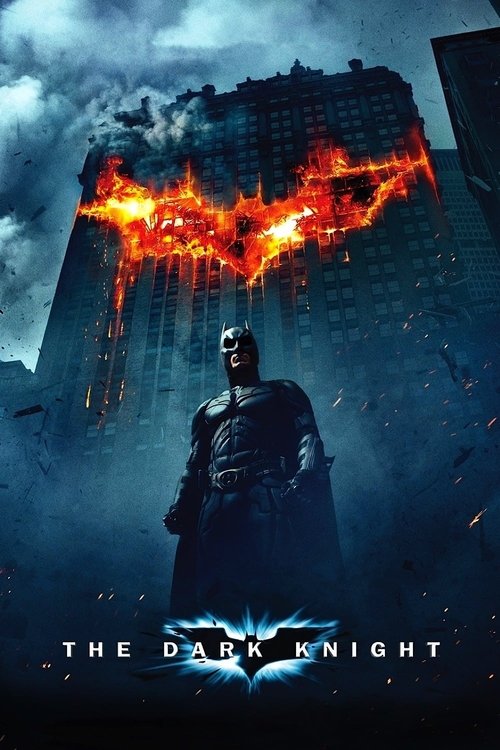
The Dark Knight
2008 · Christopher Nolan
The director whose every release is treated as a referendum on theatrical cinema itself: Oppenheimer's IMAX-70mm pilgrimage culture, the Barbenheimer phenomenon, and now The Odyssey selling out screenings a full year in advance. Naming him signals you believe in the big screen; arguing about him (cold characters, muddy sound mixing) is its own cottage industry.
For when you want a blockbuster that respects your intelligence — big-screen adrenaline plus ideas to argue about afterward. The go-to when you're craving intensity but not gore.
What it's about
Batman, police lieutenant Jim Gordon, and crusading district attorney Harvey Dent form an alliance to finally break Gotham's mob — and it's working. Then the mob, desperate, turns to a criminal who wants nothing they want: the Joker, an agent of pure chaos who sets out to prove that everyone, given the right push, will abandon their principles. What starts as a war on crime becomes a series of impossible moral choices.
The experience
Relentless — a two-and-a-half-hour vise that plays more like a crime thriller than a comic-book movie, punctuated by set pieces that still make audiences hold their breath. It's dark, propulsive, and genuinely about something.
Performances
Heath Ledger's Joker is one of the defining screen performances of its era — funny, terrifying, and unpredictable in every scene — and it won him a posthumous Academy Award. Aaron Eckhart and Gary Oldman do quieter, essential work holding the moral drama together.
The craft
Nolan shot key sequences on IMAX cameras — a first for a major feature — and favored practical stunts, real locations, and a flipped 18-wheeler over digital effects. Hans Zimmer and James Newton Howard's score, with its rising single-note dread for the Joker, is half the tension. This is the definition of a big-screen, big-speakers film.
Why it matters
The most successful film of 2008 and the movie that redefined what a superhero film could be — grave, grounded, prestige-scaled — reshaping a decade of blockbuster ambition and awards conversation.
Snapshot
A billionaire vigilante and a nihilist criminal mastermind collide in a moral crucible that exhausts every institution Gotham has constructed to protect itself. Christopher Nolan's second Batman film is not principally a superhero picture but a crime epic in which the genre's iconography becomes the vehicle for post-9/11 anxieties about surveillance, civil liberties, and the ethics of extralegal power. Anchored by Heath Ledger's posthumously celebrated Joker — a performance that displaced previous franchise characterizations so completely it became the cultural reference point — The Dark Knight became the most commercially successful film of 2008 and a turning point for what studio blockbusters were permitted to attempt.
Industry & production
Warner Bros. Pictures and Legendary Pictures co-financed the production at a reported budget of approximately $185 million, a substantial escalation over Batman Begins (2005) that reflected both the expanded scope of locations and Nolan's consolidated leverage following that film's success. The production was headquartered in Chicago, which doubled for Gotham City with a literalness that previous franchise installments had studiously avoided: Wacker Drive, the Chicago Board of Trade, and Lower Wacker Drive appear on screen as recognizable geography, not a designer's abstraction. A second unit operated in London and, crucially, a full production unit traveled to Hong Kong to photograph a sequence in which Batman extracts the corrupt financier Lau — the first time a major studio production had been granted access to shoot an action sequence in that city's urban core.
Heath Ledger completed his performance before his death on January 22, 2008, six months before the film's release on July 18. The production and Warner Bros. handled his absence with considerable discretion; Nolan has stated that Ledger had delivered all his material and that the editorial process was not materially altered by his death. The film carries a dedication to Ledger and to Conway Wickliffe, a stunt crew member killed on a second-unit shoot in Dartford, England. The combination of Ledger's death and the film's subsequent phenomenon status made it, from the moment of release, impossible to separate as an aesthetic object from its biographical circumstances.
Production designer Nathan Crowley (a long-standing Nolan collaborator) worked to extend the tactile Chicago realism into every surface, stripping the Batsuit toward functional austerity, redesigning vehicles toward engineering plausibility — the Batpod, an asymmetric motorcycle that ejects from the Tumbler's undercarriage, was built as a practical machine and ridden by stunt performers.
Technology
The Dark Knight represents one of the earliest and most consequential deployments of large-format IMAX 70mm cameras in a mainstream narrative feature. Cinematographer Wally Pfister, working closely with IMAX Corporation, integrated the cameras for specific sequences — the opening bank heist, the Joker's ambush of the police convoy, the Hong Kong rooftop extraction, and others — while shooting the remainder of the film in standard 35mm anamorphic. Approximately twenty-eight minutes of the theatrical release was presented in the expanded IMAX aspect ratio, an almost square frame (approximately 1.43:1) that would open dramatically on IMAX screens while letterboxing on standard prints. This oscillation between formats was itself a compositional tool: the anamorphic sequences feel constricted by comparison, and Nolan and Pfister exploited this contrast deliberately.
The IMAX cameras of the period were large, loud, and mechanically unforgiving — they could not be handheld in any conventional sense and required specialized rigging. That Pfister achieved fluid, kinetic imagery with them reflects an engineering achievement as much as an aesthetic one. The decision to use the format for action and urban spectacle, rather than for landscape photography (its more common prior application in documentary and large-format presentation), was genuinely novel and influenced the subsequent adoption of IMAX cameras by other tentpole productions.
Practical effects were prioritized throughout. The signature sequence in which Gotham's largest truck is flipped longitudinally on Lower Wacker Drive was achieved with a full-scale semi-trailer rig and a pneumatic launcher — a practical stunt of considerable complexity. The demolition of Gotham General Hospital was filmed at the former Brach's candy factory on Chicago's west side, a decommissioned industrial structure whose implosion was staged in coordination with practical pyrotechnics for the camera and was not recreated digitally. These choices were not merely aesthetic preferences but constituted a directorial philosophy about the relationship between audience perception and physical event.
Technique
Cinematography
Pfister's work oscillates between two registers. In IMAX, images are architecturally vast: the Joker's silhouette against a burning Gotham skyline, or the geometry of skyscraper facades seen from altitude, exploit the format's near-square expanse to make the human figure feel small inside systems of power and built environment. In the anamorphic material, the wider letterbox is used more conventionally, with a controlled, deliberately unglamorous palette — Gotham is gray, silver, navy, the yellow of sodium streetlamps. Both formats share an avoidance of expressive lighting in the Hollywood sense; Pfister lights for source plausibility rather than mood, in a lineage from Gordon Willis and the American New Wave procedural.
Editing
Lee Smith's editing is calibrated to the rhythm of tension rather than the rhythm of impact. The Joker sequences in particular are cut against expectation: Ledger is frequently held in medium shot or wide shot, the editing refusing the accelerating close-up cuts that would conventionally amplify danger. The magic trick with the pencil — a performance that introduces the character to Gotham's mob bosses — unfolds in a single master shot interrupted by a sharp cut to reaction; the violence is heard before it is seen, then shown briefly, then the scene moves on. This restraint is systematic and produces a distinctive unease.
Mise-en-scène / staging
Nolan stages action for spatial legibility above all else. The tunnel chase, the convoy ambush, and the hospital approach are blocked so that the audience always understands the geography of threat — where the Joker is, where Batman is, what the path between them requires. This is not the kinetic impressionism of contemporary action filmmaking but something closer to classical Hollywood staging scaled to urban exteriors. Scenes of dialogue are frequently set in motion — characters walk through police precincts, crime scenes, boardrooms — giving exposition a physical energy and allowing Nolan to articulate power through staging: who leads, who follows, who stops first.
Sound
Hans Zimmer, working alone after sharing credit with James Newton Howard on Batman Begins, built the score around a two-note ascending motif for the Joker — less a theme than an ambient threat. The sound design, overseen by Richard King, integrates the score into the texture of the film to an unusual degree: the Joker's theme functions as sound design as much as music, appearing beneath traffic, beneath silence, beneath crowd noise. The result is a picture whose sonic environment never fully settles. Batman's own theme, inherited from the collaboration with Howard, is used sparingly; the Joker's musical presence crowds it out.
Performance
Ledger's Joker is the performance around which all critical discourse about the film has accreted, and the attention is warranted: it is a systematic deconstruction of the character's prior screen iterations (particularly Jack Nicholson's 1989 performance) through a physicality — the tongue-probing the cheek, the hair-toss, the flat mid-American vocal register — that refuses showmanship in favor of unpredictability. Christian Bale's Batman, by design more opaque than charismatic, functions as the moral center whose coherence the Joker is constructed to assault. Aaron Eckhart's Harvey Dent is given an arc of tragic proportions that the film's runtime nearly accommodates; his transformation into Two-Face is the film's second tragedy, somewhat overtaken by Ledger's dominance but structurally essential to the picture's moral argument.
Narrative & dramatic mode
The Dark Knight is structured as a crime procedural that progressively removes the procedural's institutional supports. The first act presents a functioning tripartite alliance — Batman, Gordon, Dent — as a plausible, if legally extravagant, mechanism for dismantling organized crime. The Joker's function is to demonstrate that this alliance is held together not by law or institution but by the moral integrity of individuals, and that individuals break. The film moves through a series of dilemmas, each designed to force a choice between utilitarian harm-minimization and deontological principle. The ferry boat sequence — two vessels, each holding a detonator that will destroy the other — is an explicit trolley problem staged as cinema.
The screenplay, by Christopher and Jonathan Nolan from a story developed with David S. Goyer, draws extensively on Alan Moore and Brian Bolland's The Killing Joke (1988) for its conception of the Joker as chaos made ideological, and on Jeph Loeb and Tim Sale's The Long Halloween (1996–97) for Harvey Dent's prosecutorial centrality and fall. The film does not adapt either work literally but synthesizes their thematic contributions into an original plot architecture.
Genre & cycle
The Dark Knight occupies a generic position that is generative of its critical standing: it is a superhero film that appropriates the formal conventions of the crime thriller — specifically the procedural tradition running from The French Connection (1971) through Michael Mann's work — to such an extent that the superhero elements can appear incidental. Mann's Heat (1995) is the most consistently cited anterior text: the professional criminal confronting a professional lawman across a moral symmetry, the procedural grain of the city as system. Nolan has acknowledged Mann's influence, and it is audible in the staging of the convoy ambush and visible in the film's relationship to Chicago as location rather than set.
The film arrived at a moment — 2008 — when the modern superhero cycle launched by X-Men (2000) and Spider-Man (2002) had established its commercial viability but not its cultural respectability. The Dark Knight was the argument, accepted by critics and awards bodies more broadly than any predecessor, that the genre could sustain moral complexity at the highest level of craft.
Authorship & method
Nolan operates as a hyphenate producer-director in the tradition of the major-studio auteur, controlling pre-production, photography, post-production, and release strategy through a partnership with his producer Emma Thomas and the Legendary Pictures arrangement. His method privileges pre-visualization through storyboard and shot list, large-format practical photography, location shooting over stage work where possible, and a strong ideological preference for in-camera effects. He has spoken in various interviews about his suspicion of digital intermediates and his commitment to photochemical processes, though he works with the range of tools that large-scale production requires.
Wally Pfister served as director of photography across Nolan's feature work through The Dark Knight Rises (2012), representing one of the more sustained cinematographer-director partnerships of the era. Pfister's contribution to the IMAX deployment strategy and to the film's tonal consistency across formats is irreducible from the picture's visual identity.
Lee Smith, Nolan's editor from Batman Begins through Oppenheimer, is responsible for the rhythmic restraint that distinguishes the film's action sequences. Hans Zimmer's continued collaboration with Nolan has produced a body of work in which score and sound design are unusually integrated, a method that the Dark Knight soundtrack represents at its most radical. Jonathan Nolan's contribution to the screenplay — he wrote a first draft — imports structural devices from his own fiction, including the moral paradox as narrative engine.
Movement / national cinema
Nolan is a British-born filmmaker who trained at Cambridge and began his feature career with low-budget British productions (Following, 1998) before relocating to the American studio system. The Dark Knight is a British-American co-production in its financing and crew composition, but it is thematically and geographically American in a way that few British-made studio films attempt. Chicago is not disguised; the film's civic institutions — the police department, the district attorney's office, the financial system — are recognizably those of an American city under pressure. The post-9/11 subtext that critics identified in the film — surveillance, rendition, the ethics of extraordinary measures in extremis — is specifically inflected by the American political context of the George W. Bush administration's second term.
Era / period
The film was released July 18, 2008, at the end of a period of extended American public debate about the legal and moral frameworks of the War on Terror. Nolan and the Nolan brothers have been careful not to reduce the film to allegory, but the correspondence between the Joker's challenge to institutional norms and the period's political anxieties — the sonar surveillance system Lucius Fox agrees to deploy and then dismantles, Batman's willingness to cross into Hong Kong jurisdiction without sanction — was widely observed by critics at the time. The film thinks seriously about these questions rather than using them as atmosphere.
It also arrived as the superhero blockbuster was consolidating its industrial dominance, the same year as Iron Man (which launched the Marvel Cinematic Universe). Where the MCU developed a tonal and structural consistency oriented toward franchise seriality, The Dark Knight remained a closed aesthetic statement — a trilogy that does not extend and is not designed to.
Themes
The film's central argument concerns the conditions under which order is possible, and the price extracted from individuals who attempt to sustain it. Batman's utility depends on his willingness to do what legal institutions cannot; the Joker's argument is that this willingness, once established, has no principled limit. Harvey Dent's collapse from idealist to murderer is the Joker's proof of concept, and the film's final decision — to lie about Dent's crimes in order to preserve the moral authority of his prosecutorial record — is the story's darkest conclusion, a founding myth built on a lie.
The surveillance subplot is handled with unusual seriousness: the sonar system that converts every Gotham phone into a listening device is presented as genuinely necessary for the film's climactic rescue and genuinely monstrous as a governance tool. Its destruction by Fox is offered as a moral recovery that the film does not fully endorse as sufficient — the deed was done.
Reception, canon & influence
The Dark Knight opened to approximately $158 million in its domestic opening weekend, a record at the time, and ultimately grossed in excess of one billion dollars worldwide, only the fourth film in history to reach that threshold. The critical response was exceptional for a superhero production: the film holds a 94% approval rating on Rotten Tomatoes and received almost uniformly serious treatment from major critics rather than the genre-bracketed praise typically offered to studio event pictures.
At the 81st Academy Awards, Heath Ledger received a posthumous Academy Award for Best Supporting Actor — the first such posthumous acting award since Peter Finch's in 1977. The film was also nominated for Best Cinematography, Best Film Editing, Best Art Direction, Best Sound Editing, Best Sound Mixing, Best Visual Effects, and Best Makeup, winning several technical awards. Its failure to receive a Best Picture nomination despite its critical standing was widely cited as evidence that the Academy's five-nominee limitation was excluding significant work, and the Academy expanded the Best Picture category to a maximum of ten nominees beginning with the 82nd ceremony — a structural change directly attributable, by widespread account, to The Dark Knight's exclusion.
Influences on the film: Michael Mann's Heat is the acknowledged template for the professional-against-professional architecture and the procedural urban milieu. Alan Moore's The Killing Joke provides the ideological Joker; Loeb and Sale's The Long Halloween provides Dent. The American crime films of the 1970s — The French Connection, Sidney Lumet's Serpico and Prince of the City — inform the film's relationship between institution and individual. The operational aesthetic of the opening heist sequence reflects the influence of Michael Rymer's Animal Kingdom and other procedural crime films of the period, though the connection is less documented than the Mann lineage.
Legacy: The film's influence on subsequent studio production is extensive and not always salutary. The phrase "dark and gritty" entered the vocabulary of studio development as a desideratum, producing a generation of superhero films that replicated the visual palette without the thematic seriousness. DC Films' subsequent cycle — Man of Steel (2013), Batman v Superman: Dawn of Justice (2016) — attempted to extend the Nolan template at franchise scale, with contested results. Todd Phillips's Joker (2019), an origin-story riff drawing on Ledger's performance and Taxi Driver as joint ancestors, earned its own posthumous-performance narrative and demonstrated the character's continued capacity to generate serious critical engagement. Matt Reeves's The Batman (2022) can be read as a second attempt to locate the Dark Knight in crime-film territory, this time via neo-noir rather than procedural thriller.
More broadly, The Dark Knight established that a superhero film could be the year's most significant cultural object rather than merely its most commercially successful. Whether this represents an expansion of cinema's possibilities or the assimilation of cinema's serious traditions into franchise infrastructure remains, in 2026, an open and productive critical question.
A Deleuzian reading
Start with the pencil.
The full Deleuzian reading of The Dark Knight →
Reception
No reappraisal needed — it landed in 2008 as an instant phenomenon and has only calcified into canon since. Its infamous Best Picture snub caused such an outcry that the Academy expanded the category the very next year, a change still informally called 'The Dark Knight rule.'
How The Dark Knight was received, from release to now →
Influences: the films it descends from and the films it influenced
- Heat (1995) — Mann's staging of the armored-car heist and the Pacino/De Niro diner scene directly blueprints TDK's bank-robbery choreography and the Batman/Joker interrogation geometry: two opposed ideological forces mapped spatially across a table, the scene's architecture making the philosophical opposition physical.
- Collateral (2004) — Mann's source-plausible digital night-city photography and the philosophical hitman who reveals institutional rot to an unwilling civilian proxy directly prefigure the Joker's function—a figure who does not want money or power but forces the city's systems to expose their own corruption.
- Manhunter (1986) — Mann's procedural detective who must psychologically inhabit the criminal's worldview to function establishes the moral-contamination logic that Batman enacts when he deploys mass surveillance: the investigator becomes the thing he pursues.
- The Godfather (1972) — Gordon Willis's low-key source-plausible cinematography—deep shadow fills, available-light logic that refuses expressive fill—is the direct ancestor of Pfister's unglamorous procedural palette in both IMAX and anamorphic material, especially in the interior Gotham scenes.
- Chinatown (1974) — The moral-dilemma architecture in which every correct decision by the protagonist worsens outcomes and every institution—police, law, finance—is depicted as structurally corrupted rather than infiltrated by a single bad actor; Harvey Dent's fall replicates Jake Gittes's catastrophic competence.
- Se7en (1995) — The philosophical killer who constructs a scenario forcing the hero to violate their own moral code in the final act; Fincher's editing restraint—holding John Doe in medium shot, refusing the accelerating close-up—is the direct template for Lee Smith's Joker scenes.
- The French Connection (1971) — Friedkin's practical stunt-driven urban action (the elevated train chase staged at grade with a real moving car) establishes the formal precedent for filming large-scale vehicle action as a real physical event; the practical truck flip on Lower Wacker Drive is a direct heir.
- Dog Day Afternoon (1975) — The criminal as involuntary media spectacle who manipulates public narrative in real time; Lumet's procedural mapping of police, media, and government as three mutually undercutting institutional systems is the template for TDK's institutional-erosion structure.
- Batman Begins (2005) — Established the full-scale practical vehicle stunt philosophy (the functional Tumbler driven on real streets), the crime-procedural hybridization of superhero genre, and the unglamorous Chicago-as-Gotham documentary geography that TDK expands into its IMAX sequences.
- Insomnia (2002) — The fullest statement of the Nolan-Pfister anamorphic grammar initiated in Insomnia: textural ambient score (Zimmer/Howard), spatial-ambiguity staging in interrogation sequences, and the structuring of a crime investigation around a morally compromised investigator (Harvey Dent as Dormer's tragic inheritor) are all carried forward at maximum industrial scale.
- The Departed (2006) — Harvey Dent's arc as the institutional hero whose corruption is the film's hidden structural engine mirrors The Departed's Sullivan — the mole disguised as the system's champion — while Nolan extends the parallel-cutting between law and criminal in a prestige ensemble and refuses heroic closure for its surviving protagonist.
- The Empire Strikes Back (1980) — Nolan structured his middle installment as a deliberate franchise-redefining exercise in tonal darkness and narrative irresolution — Batman fugitive, Harvey Dent destroyed, the hero unable to claim victory — directly modeling the cliffhanger-as-artistic-statement that Empire pioneered as a template for the serious-sequel form.
- The Town (2010) — Affleck directly borrows TDK's bank-robbery staging precision—professional criminals moving with tactical spatial legibility, the camera placed to show spatial relationships rather than cut for impact—applying the Mann/Nolan procedural action template to a Boston crime film.
- Zero Dark Thirty (2012) — Bigelow extends TDK's post-9/11 surveillance-ethics and extralegal institutional power into documentary procedural form; Greig Fraser's source-plausible cinematography applies the unglamorous unglamorous available-light palette to interrogation and raid sequences in the same moral register as TDK's Joker scenes.
- Captain America: The Winter Soldier (2014) — The Russo Brothers apply TDK's surveillance-ethics and institutional erosion (HYDRA embedded within S.H.I.E.L.D.) as the primary dramatic engine of a superhero film, and borrow the spatial legibility of TDK's action choreography—the elevator fight and freeway sequence use fixed-geography staging rather than editorial fragmentation.
- Sicario (2015) — Jóhann Jóhannsson's score functions as ambient threat architecture—low-register drones that register as environmental sound before resolving as music—in direct lineage of Zimmer's Joker motif; Deakins' source-plausible cinematography and the moral witness trapped inside extralegal machinery she cannot stop extend TDK's institutional-erosion form.
- Logan (2017) — Mangold deconstructs the superhero's prior franchise iterations by applying Western crime genre logic; Jackman's performance explicitly displaces his own previous characterization in the same manner Ledger displaced every prior Joker, treating the character's history as material to be exhausted rather than honored.
- Dunkirk (2017) — Nolan's direct extension of practical IMAX 70mm large-format photography—shooting fully in IMAX rather than oscillating formats—and Zimmer's score-as-sound-design (the Shepard-tone ticking clock as continuous ambient threat motif) is the technical and aesthetic evolution of TDK's dual-format and sonic-threat grammar.
- The Dark Knight Rises (2012) — Established IMAX integration across six sequences (~28 minutes) and Lee Smith's long-form sequence-editing rhythm; TDKR scales both — to ~72 minutes of IMAX and longer continuous action passages — while inheriting the prestige-superhero template of moral seriousness anchored in practical location work rather than studio simulation.
- Black Panther (2018) — Nolan demonstrated that the superhero genre could sustain tragic performance and sustained moral philosophy sufficient for awards consideration; the Academy's expansion of Best Picture to ten nominees — triggered in part by this film's exclusion — created the specific institutional aperture through which Black Panther's nomination passed.
- Skyfall (2012) — Supplies the blueprint for Silva — a theatrical villain whose capture and incarceration are themselves the plan — reconceiving the blockbuster antagonist as architect of his own captivity.
- Mission: Impossible - Ghost Protocol (2011) — Pioneered originating blockbuster set-pieces on IMAX 65mm with an expanding aspect ratio for select sequences — the exact large-format strategy GP adopts for its marquee scenes.
- The Hunger Games: Catching Fire (2013) — Pioneers narrative IMAX with mid-film aspect-ratio expansion for marquee sequences; Catching Fire borrows this device wholesale, opening up to IMAX 1.43 for the arena.
- Avengers: Infinity War (2018) — Built its climax on crosscutting between escalating parallel threats orchestrated by a villain whose plan drives the narrative, foregrounding the antagonist's design over the heroes'.
- Zodiac (2007) — Fincher's concurrent procedural shares TDK's institutional-frustration architecture and source-plausible digital cinematography (Harris Savides); both treat the criminal's unknowability as a formal organizing principle rather than a solvable narrative problem, and both refuse the catharsis of capture.
- No Country for Old Men (2007) — The Coens' editing restraint—violence occurs off-screen or without score, the killer is never framed with accelerating urgency—and the philosophical antagonist as post-institutional force align precisely with TDK's thesis that ideological evil cannot be contained by procedural law; released simultaneously, both films reframe the crime genre around this thesis.
- Iron Man (2008) — Released the same year, it shares the project of anchoring a comic-book film in an adult, morally serious lead performance rather than juvenile spectacle.
- Iron Man 2 (2010) — Parallel contemporary model for the serialized, consequence-driven superhero sequel with an immersive-method antagonist, against which Iron Man 2's franchise-first tradeoffs were measured.
- Man of Steel (2013) — Model for the IMAX-scale, morally agonized blockbuster and Zimmer's minimalist motif-over-melody scoring approach (sustained drones, ostinato dread) that Zimmer carries directly into the Krypton and 'Flight' cues.
- Vikram Vedha (2017) — An antagonist who poses moral-dilemma 'riddles' forcing the hero into impossible choices, destabilizing the cop/criminal moral binary exactly as Vedha's questions do to Vikram.
- Batman: The Dark Knight Returns, Part 1 (2012) — Arrives from the same Miller-derived source to interrogate vigilante legitimacy and treats the media/press as an institutional actor, the shared thematic-formal ancestry in live action.
Similar films
- Batman Begins (2005) — influence & lineage · same viewing thread
- Logan (2017) — influence & lineage · same viewing thread
- Dunkirk (2017) — influence & lineage
- The Dark Knight Rises (2012) — same viewing thread
- The Batman (2022) — same viewing thread
- Batman: The Dark Knight Returns, Part 2 (2013) — same viewing thread
- Batman: The Dark Knight Returns, Part 1 (2012) — same viewing thread
- Batman: Mask of the Phantasm (1993) — same viewing thread
All the films related to The Dark Knight →
Watch it with: curated runs of related films
- The Superhero Movie Grows Up — Watch these as one arc — Raimi's warmth into Nolan's gravity into Logan's elegy and The Batman's rain-soaked noir — the two decades the comic-book film reached for real weight.
Film essays and courses that include it
- The Blockbuster Blueprint: From Epic to Universe
- Sequel Logic: The Engineering of the Franchise Saga
- Power and Its Price: The Arc of the Superhero Film
- The Hand That Punishes: Vigilante Justice in Cinema
- The Speck That Moves the World: Action Cinema's Grandest Form
- Commanded Vision: The Auteur Epic
- The Shadow That Outlived the Light
- The Tilt That Says Something Is Wrong
- The Wall of Dread
- The Watchmaker's Wager