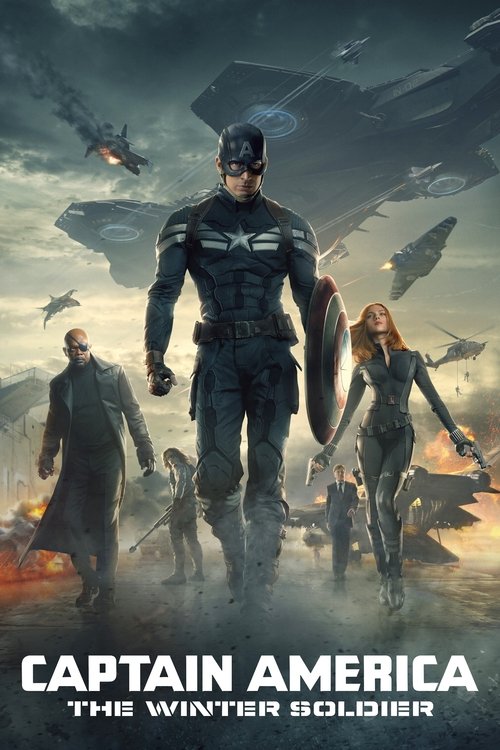
Captain America: The Winter Soldier
2014 · Joe Russo
When you want a big, satisfying action night that also has a brain — popcorn viewing with real stakes and a political edge. Works even if you don't care about superhero movies.
What it's about
Steve Rogers, the super-soldier thawed out of the 1940s, is quietly adjusting to modern Washington and working missions for the intelligence agency S.H.I.E.L.D. When a colleague is attacked, he's pulled into a conspiracy that reaches inside the agency itself — in a world of drones, mass surveillance, and pre-emptive targeting that sits uneasily with his old-fashioned ideas of what protecting people means. He goes on the run with the Black Widow, hunted by a mysterious assassin.
The experience
Tense and propulsive, closer to a paranoid conspiracy thriller than a standard superhero picture — trust erodes scene by scene, and the fights are hard-hitting, close-quarters, and surprisingly grounded. It's a blockbuster that keeps a knot in your stomach.
Performances
Chris Evans grounds the whole thing with unfashionable sincerity, Scarlett Johansson gets her best material as a spy questioning her own compromises, and Robert Redford lends the intelligence-establishment scenes real gravity — casting that deliberately echoes the great 1970s conspiracy thrillers he starred in.
The craft
The action is the standout: brutal, legible, practical-feeling set pieces — an elevator, a highway, a besieged car — staged with a clarity rare in franchise filmmaking. The surveillance-state plotting gives the spectacle actual weight, and it rewards the biggest screen and loudest speakers you have.
Why it matters
Widely considered the film that raised the ceiling for the Marvel Cinematic Universe, proving a franchise entry could borrow the register of the 1970s political thriller, and it made the Russo brothers the architects of the series' biggest films.
Snapshot
Captain America: The Winter Soldier is the ninth film of the Marvel Cinematic Universe and the second solo outing for Steve Rogers, but it is best understood as the moment the franchise deliberately changed register. Where Captain America: The First Avenger (2011) was a sepia-toned wartime adventure, The Winter Soldier relocates its un-thawed hero into a contemporary Washington of drones, data, and pre-emptive killing, and stages a 1970s-style conspiracy thriller inside a superhero tentpole. The plot turns on the discovery that S.H.I.E.L.D.—the surveillance apparatus that has anchored the MCU since Iron Man (2008)—has been hollowed out from within by the fascist science cult HYDRA, and that its flagship security program, Project Insight, is in fact a machine for the algorithmic assassination of future dissidents. Directed by the brothers Anthony and Joe Russo (the prompt's single-director credit notwithstanding) and written by Christopher Markus and Stephen McFeely, the film paired hand-to-hand action of unusual concreteness with a topical anxiety about state overreach, and was widely received as one of the strongest entries in the series. Its consequences—dissolving S.H.I.E.L.D., elevating the Russos to stewardship of the franchise's largest films—rippled across the MCU for the rest of the decade.
Industry & production
The film was produced by Marvel Studios under Kevin Feige and released by Walt Disney Studios Motion Pictures in the spring of 2014, the opening salvo of the MCU's "Phase Two" calendar that also delivered Guardians of the Galaxy later that year. It arrived at a moment when Marvel had proven the team-up model with The Avengers (2012) and was testing how far individual chapters could stray tonally from the house style without breaking continuity. The decisive industrial gamble was the hiring of Anthony and Joe Russo, who had no blockbuster pedigree: their reputation rested on feature comedies (Welcome to Collinwood, You, Me and Dupree) and, more pertinently, on television, where they had directed and shaped the comic rhythm of Arrested Development and Community. Entrusting a nine-figure action picture to comedy directors was counterintuitive, and the wager became one of the studio's most consequential bets, since it led directly to the Russos taking Captain America: Civil War (2016) and both Avengers: Infinity War (2018) and Endgame (2019). Returning screenwriters Markus and McFeely provided continuity with The First Avenger. The budget sat in the range typical of a Marvel tentpole of the period, and the film was a major commercial success, finishing among the year's top earners worldwide; precise grosses are best confirmed against the studio record rather than asserted here.
Technology
The Winter Soldier was captured digitally—consistent with cinematographer Trent Opaloch's practice on the Arri Alexa platform—and finished through a digital intermediate, the standard pipeline for a studio action film of 2014. Visual effects were distributed across major houses, with Industrial Light & Magic among the principal vendors, and the work concentrates on a handful of large set-pieces: the climactic destruction of three S.H.I.E.L.D. helicarriers, Falcon's Exo-7 wingpack, and the Winter Soldier's cybernetic arm. The production's notable methodological choice was to keep as much physical as possible. Falcon's wings were built as a practical rig for close work and extended in CGI for flight; the Winter Soldier's metal arm combined a practical sleeve with digital plating; and the marquee fights were shot largely in-camera with stunt performers before any augmentation. The result is a film whose technological spectacle is anchored to bodies and props, so that the digital layers read as extensions of tangible action rather than as the action itself.
Technique
Cinematography
Trent Opaloch's photography favours a cooler, more documentary palette than the burnished look of the first film, suiting the Beltway-thriller mood. The action coverage leans on handheld and shaky framings deliberately—often tight on the combatants, with the camera reacting to blows rather than anticipating them—to lend the fights a sense of impact and improvisation. The visual idiom borrows openly from the surveillance imagery of the conspiracy thriller: screens, satellite feeds, server rooms, and the cold geometry of the Triskelion headquarters.
Editing
The film was cut by Jeffrey Ford and Mary Jo Markey, the latter a frequent collaborator of J. J. Abrams. Their work is most discussed in relation to the close-quarters combat, where rapid cutting is balanced against held wide shots so that the choreography remains legible—a contrast with the over-diced action editing common to the period. The elevator confrontation, in which Rogers realizes he is surrounded by compromised agents, is frequently cited as a model of escalating tension built through editing rhythm and spatial clarity.
Mise-en-scène / staging
The staging programmatically grounds a fantastical premise in recognizable institutional spaces: federal offices, a freeway causeway, a Smithsonian exhibit on Captain America's own history, an apartment building. Set-pieces are built around concrete geography—the ambush on Nick Fury's vehicle, the rooftop and overpass pursuit, the helicarrier interiors—so that the audience can track who is where. The production design opposes the sleek, panoptic architecture of S.H.I.E.L.D./HYDRA against the worn, lived-in spaces the heroes retreat to.
Sound
Henry Jackman's score breaks sharply with the traditional symphonic heroics of the franchise. The Winter Soldier is announced by a harsh, distorted electronic motif—an abrasive, mechanical sting that functions as the assassin's signature and externalizes his dehumanization. Jackman largely set aside Alan Silvestri's First Avenger march, a choice some commentators criticized as discarding a strong leitmotif; the trade was a sound-world that matched the film's colder, more paranoid tone. Sound design throughout emphasizes the percussive, metal-on-metal physicality of the fights and the low institutional hum of the surveillance machinery.
Performance
Chris Evans deepens Steve Rogers from earnest icon into a man whose loyalty to an institution is being betrayed, playing moral conviction as something tested rather than assumed. Scarlett Johansson's Natasha Romanoff is given her most substantial MCU showcase to that point, a spy whose layered identities mirror the film's themes of trust and disclosure. Sebastian Stan plays the Winter Soldier with near-silent, blank-eyed menace, the tragedy legible only in flickers; Anthony Mackie introduces Sam Wilson with relaxed warmth that humanizes the ensemble. The casting coup is Robert Redford as Alexander Pierce, whose presence is itself an act of intertextual authorship (see Authorship). Samuel L. Jackson's Nick Fury, Frank Grillo's Rumlow, and Toby Jones's reprised Arnim Zola fill out a deep bench.
Narrative & dramatic mode
The dramatic mode is the paranoid conspiracy thriller grafted onto the superhero adventure. The narrative withholds, then reveals, an institutional rot: the discovery that the protective state is the threat. Its engine is epistemic—who can be trusted, what is real, which authority is legitimate—rather than purely physical, and its turns (Fury's apparent death, the Zola exposition, Pierce's exposure, Bucky's identity) are structured as the peeling-back of a hidden order. The personal tragedy of Bucky Barnes, the brainwashed friend weaponized against Rogers, supplies the emotional through-line that keeps the political plot from running cold, and the film's refusal to resolve that relationship—Bucky escapes, unrecovered—gives the ending an unusual open wound for a tentpole.
Genre & cycle
Within the superhero cycle, The Winter Soldier belongs to a maturation phase in which the MCU began hybridizing its house genre with adjacent ones—heist (Ant-Man), space opera (Guardians), and here the political thriller. It is among the clearest demonstrations that a costumed-hero franchise could metabolize the codes of another genre wholesale rather than gesturing at them. The film sits at the intersection of the comic-book movie and the espionage thriller, and its success helped license later "genre-first" superhero projects across studios.
Authorship & method
The defining authorial gesture is the Russo brothers' importation of 1970s American conspiracy cinema into the Marvel template. The filmmakers and producers repeatedly invoked the paranoid thrillers of that decade—Three Days of the Condor, All the President's Men, The Parallax View, Marathon Man—as touchstones, and they made the homage explicit by casting Robert Redford, the star of Condor and All the President's Men, as the film's corrupt insider. Redford's body of work functions as a built-in citation: the audience's memory of him as the hunted everyman of 1970s political cinema is inverted to make him the architect of the surveillance conspiracy. The Russos' television-honed command of ensemble rhythm and tonal modulation served the dense plotting well. They worked with cinematographer Trent Opaloch, composer Henry Jackman, editors Jeffrey Ford and Mary Jo Markey, and writers Christopher Markus and Stephen McFeely, the last providing scripting continuity with the character's earlier film. The narrative core—the Winter Soldier as Bucky Barnes—derives from Ed Brubaker's celebrated Captain America comics run (with artist Steve Epting) beginning in 2005, which controversially resurrected a character whose death had long been treated as permanent.
Movement / national cinema
This is mainstream American studio filmmaking at the franchise scale—an artifact of the Hollywood tentpole system and the MCU's serialized, interlocking model rather than of any art movement. Its genealogy is nonetheless specifically American: it descends from the New Hollywood political thriller of the post-Watergate 1970s, a national-cinema lineage of institutional distrust that the film consciously revives for a post-9/11, post-Snowden audience.
Era / period
Released in April 2014, the film is steeped in the security anxieties of its moment. It followed within a year of Edward Snowden's 2013 disclosures about mass NSA surveillance, and its central conceit—a program that mines data to identify and pre-emptively eliminate future threats—reads as a direct dramatization of debates over drone warfare, targeted killing, and bulk surveillance then dominating American political discourse. The film captures the early-2010s superhero boom at the point where the form turned self-reflexive about the power of the institutions its heroes serve.
Themes
The governing theme is the tension between freedom and security, and the film comes down hard on the side of the former: Rogers explicitly rejects the logic of pre-emptive control, framing safety bought through surveillance as indistinguishable from tyranny. Project Insight literalizes the slippery slope from protection to oppression. Around this run the linked motifs of institutional betrayal (the protective apparatus is the predator), the loss and reclamation of identity (Bucky stripped of self and weaponized; Natasha's layered personas), and the costs of loyalty when the institution one serves proves illegitimate. The HYDRA-inside-S.H.I.E.L.D. reveal dramatizes a corrosive thesis—that authoritarianism can grow within, and disguised as, the security state.
Reception, canon & influence
Critically, The Winter Soldier was warmly received and is routinely ranked among the strongest MCU films, praised in particular for its grounded action, its political ambition, and the legibility of its set-pieces against the genre's tendency toward weightless spectacle; the elevator fight and freeway ambush became reference points for choreographed studio action. Its principal influences-on are the 1970s paranoid thrillers named above and Ed Brubaker's comics arc, fused with the contemporary surveillance discourse of the Snowden era.
Its forward influence was unusually large for a single chapter. By destroying S.H.I.E.L.D., the film forced a structural rewrite of the MCU's connective tissue, with immediate consequences for the Agents of S.H.I.E.L.D. television series and the franchise's broader architecture. It seeded the ideological fracture—security versus liberty, oversight versus autonomy—that Captain America: Civil War would split the Avengers along two years later. Most consequentially, it elevated the Russo brothers from untested hires to the directors of the franchise's culminating crossovers, Infinity War and Endgame. More diffusely, its proof that a comic-book tentpole could fully inhabit another genre's grammar encouraged the genre-hybrid experiments that defined the MCU's middle period and shaped competing superhero films' appetite for grounded, politically inflected action.
A Deleuzian reading
Watch the elevator again.
The full Deleuzian reading of Captain America: The Winter Soldier →
Reception
Landed in 2014 as the shock of the MCU — the mid-franchise entry that critics suddenly took seriously as 'a real movie' — and a decade on it's still the default answer when anyone asks which Marvel film actually holds up.
How Captain America: The Winter Soldier was received, from release to now →
Influences: the films it descends from and the films it influenced
- Three Days of the Condor (1975) — The template the Russos cribbed directly: a lone operative discovering the intelligence agency itself is the threat, with Redford as the hunted everyman — the casting of him as the villain is a literal inversion of this film's protagonist.
- The Parallax View (1974) — Source of the cold institutional-conspiracy mood — wide, architecturally menacing compositions that dwarf the individual inside corporate/government interiors, echoed in the Triskelion and the Lemurian Star bridge sequences.
- All the President's Men (1976) — Procedural paranoia built from data and surveillance rather than action; the film's reveal of HYDRA-via-algorithm (Zola's prediction engine) reworks the methodical 'follow the information' structure, and Redford's casting cites his role here.
- Marathon Man (1976) — Named touchstone for the ordinary-body-in-extremis chase grammar — visceral, ground-level pursuit where an unprepared protagonist is run down through public urban space, model for the freeway ambush.
- The French Connection (1971) — Origin of the documentary-grade, handheld, weighty vehicular set-piece staged in real traffic; the Nick Fury freeway ambush inherits its tactile crunch and refusal of weightless spectacle.
- The Bourne Ultimatum (2007) — Immediate stylistic parent — handheld surveillance-thriller aesthetic and rapid-cut hand-to-hand combat, though Winter Soldier deliberately corrects Bourne's incoherence toward legible geography in the elevator fight.
- Captain America: The First Avenger (2011) — Provides the scripting continuity (Markus & McFeely) and the Bucky/Steve relationship whose betrayal the sequel weaponizes; the period-serial earnestness is the baseline the sequel ruptures.
- Captain America (Brubaker run) (2005) — The direct narrative source — Brubaker and Epting's comics arc that resurrected Bucky as the brainwashed Winter Soldier, supplying the central plot and its noir-espionage register.
- The Conversation (1974) — Foundational surveillance-imagery grammar — the watcher implicated by his own technology — feeding the film's recurring motif of cameras, satellites, and listening systems as instruments of dread.
- The Dark Knight (2008) — The Russo Brothers apply TDK's surveillance-ethics and institutional erosion (HYDRA embedded within S.H.I.E.L.D.) as the primary dramatic engine of a superhero film, and borrow the spatial legibility of TDK's action choreography—the elevator fight and freeway sequence use fixed-geography staging rather than editorial fragmentation.
- Iron Man 2 (2010) — Inherits and refines the serialized-crossover, Feige-governed house style while deliberately re-centering a single coherent story — a corrective to Iron Man 2's universe-building overload.
- Captain America: Civil War (2016) — Direct continuation by the same directors: splits the Avengers along the exact security-versus-liberty fracture this film opened, and extends the legible, ground-grounded ensemble-action staging (the airport battle).
- Avengers: Infinity War (2018) — The Russos' elevation to franchise capstone flows directly from this film; it scales up their television-honed ensemble-rhythm and tonal-modulation method to a massive crossover cast.
- Avengers: Endgame (2019) — Carries forward the Russos' command of institutional stakes and Steve/Bucky emotional throughline established here, paying off the loyalty motif the conspiracy plot foregrounded.
- Black Panther (2018) — Inherits Winter Soldier's proof that an MCU tentpole can fully inhabit another genre's grammar — here political-succession drama — and its appetite for grounded, ideologically inflected stakes over weightless spectacle.
- The Falcon and the Winter Soldier (2021) — Extends this film's grounded-geopolitical register and surveillance-state anxiety into long-form, directly continuing the Sam/Bucky pairing and the institutional-legitimacy theme.
- Black Widow (2021) — It established the MCU's grounded 1970s-conspiracy spy register and Natasha's espionage characterization, the in-house genre grammar and continuity Black Widow directly extends.
- Captain America: Brave New World (2025) — Establishes the template Onah copies wholesale: transplanting the 1970s conspiracy-thriller grammar — a rotted institution exposed from within, handheld two-shots, an assassin turned against the hero — into the superhero form, right down to reusing Sam Wilson as the audience's grounded eyes.
- Logan (2017) — Parallel project to graft a non-superhero genre (the elegiac Western/road movie) onto comic-book material with tactile, weighty, consequence-bearing violence — the same de-spectacularizing impulse.
- Mission: Impossible — Rogue Nation (2015) — Contemporary spy-thriller pursuing the same legible, practically-grounded set-piece construction and rogue-agency-versus-the-state plotting, prizing geographic clarity in action over digital incoherence.
- Skyfall (2012) — Adjacent reinvention of a franchise tentpole through surveillance-era anxiety and a betraying insider, pairing institutional-grounding mise-en-scène with an aging-hero meditation.
- The Amazing Spider-Man 2 (2014) — The Marvel Studios shared-universe assembly method — seeding connective mythology inside a self-contained plot — is exactly the model ASM2's Kurtzman/Orci screenplay tried to reverse-engineer.
Similar films
- Captain America: The First Avenger (2011) — influence & lineage
- Avengers: Endgame (2019) — influence & lineage
- Avengers: Infinity War (2018) — influence & lineage
- Black Panther (2018) — influence & lineage
- Skyfall (2012) — influence & lineage · same viewing thread
- Captain America: Brave New World (2025) — same viewing thread
- Iron Man 2 (2010) — same viewing thread
- Thunderbolts* (2025) — same viewing thread
All the films related to Captain America: The Winter Soldier →
Watch it with: curated runs of related films
- Rogue Heroes, Rigged Systems — A run of slick, propulsive 21st-century spectacle — spies, super-soldiers, sci-fi survivors, and dystopian rebels all squaring off against some vast machine or shadowy apparatus — best watched back-to-back when you want momentum, style, and a lone figure taking on the whole board.