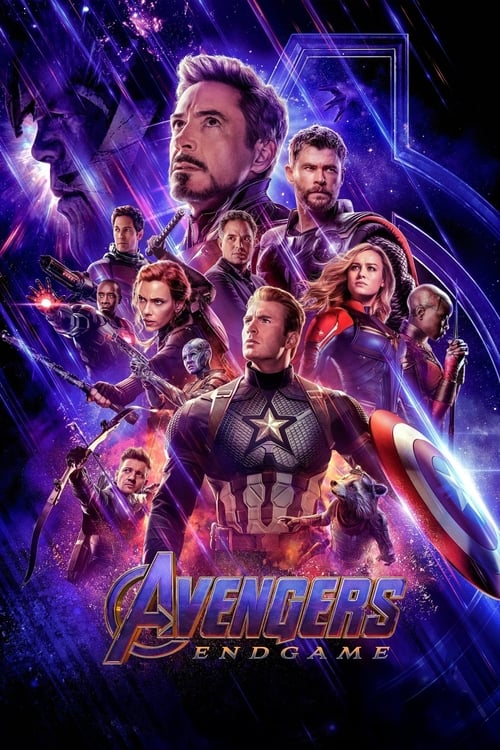
Avengers: Endgame
2019 · Joe Russo
For when you want event-movie catharsis — the payoff night after a long journey with these characters. Best saved for when you've seen what came before and want closure with your popcorn.
What it's about
Half of all life in the universe has been wiped out, and the heroes who failed to stop it are left to live with the loss. Scattered, grieving, and out of options, the surviving Avengers reunite around one desperate long-shot plan to undo what Thanos did — whatever it costs them. It's the closing chapter of a story told across more than twenty films.
The experience
Surprisingly mournful for a blockbuster — it sits with grief for a long stretch before building to a finale of staggering scale. Three hours that feel like a farewell party: funny, sad, and engineered to make a theater cheer and cry in the same scene.
Performances
Robert Downey Jr. brings eleven years of Tony Stark to a rich, weathered close — the emotional spine of the whole film.
The craft
Markus and McFeely's script juggles a huge ensemble and a decade of continuity with real wit, folding the franchise's own history into the plot. The scale of the final act is genuinely enormous — this is a film made for the biggest screen and best sound you can find.
Why it matters
One of the highest-grossing films ever made and a genuine global cultural moment — the conclusion of the twenty-two-film Infinity Saga and the high-water mark of the shared-universe era.
Snapshot
Avengers: Endgame is the twenty-second feature in the Marvel Cinematic Universe and the direct conclusion to 2018's Avengers: Infinity War, with which it was conceived and partly shot as a single production. Directed by Anthony and Joe Russo (the credited brief here names Joe, but the film is the work of the directing partnership) from a screenplay by Christopher Markus and Stephen McFeely, it resolves the eleven-year, twenty-two-film arc Marvel Studios came to call the "Infinity Saga." The premise is elegiac before it is heroic: half of all life has been erased by Thanos, and the surviving Avengers, scattered and defeated, attempt to reverse the loss. The film's central conceit — a "time heist" that sends the heroes back through their own franchise's earlier installments — makes Endgame unusual among blockbusters as a work explicitly about its own accumulated history. At roughly three hours, it is a culmination engineered to function less as a standalone movie than as a payoff structure for a decade of serialized investment, and it was received and consumed as exactly that.
Industry & production
Endgame is a landmark of the studio-franchise model that Marvel Studios, under Kevin Feige, had refined across the 2010s. It was produced by Marvel Studios and distributed by Walt Disney Studios, the relationship cemented by Disney's 2009 acquisition of Marvel Entertainment. The film was shot back-to-back with Infinity War across an extended production largely based at Pinewood Atlanta Studios in Georgia, a hub Marvel had used repeatedly and whose tax incentives made the state a center of American tentpole production. Shooting the two films in overlapping campaigns allowed the studio to amortize sets, cast availability, and crew across what was effectively one mega-production split into two releases.
The budget was among the largest in film history to that point; Marvel and Disney have not released a single authoritative figure, and reported numbers vary, so precise costs should be treated cautiously. Commercially, the film was a phenomenon: it became, during its theatrical run, the highest-grossing film worldwide, surpassing Avatar before Avatar's later re-release reclaimed the top position. Its opening weekend set records across many markets. These figures are widely documented, though exact rankings have shifted with subsequent re-releases, and any specific dollar claim should be checked against current tallies rather than asserted from memory.
The production was also a case study in secrecy management — Marvel's by-then-standard practice of distributing partial scripts, shooting decoy scenes, and tightly controlling marketing to protect plot reveals from a fan culture primed to spoil them.
Technology
Endgame was photographed digitally on the Arri Alexa 65, the large-format sensor camera that had become Marvel's house standard for its scale and resolution, paired with Panavision large-format optics. The choice reflects the franchise's commitment to a clean, high-resolution image with latitude for the extensive visual-effects compositing the film required.
That visual-effects work is the film's defining technological dimension. Endgame was among the most VFX-intensive films ever made at the time, with thousands of effects shots distributed across a roster of major houses including Industrial Light & Magic, Weta Digital, DNEG, Framestore, Cinesite, Digital Domain, and others. Two achievements stand out. The first is the digital de-aging and age-shifting of performers — most prominently in the time-travel sequences and in the rendering of an elderly Captain America in the film's coda — extending techniques Marvel had developed across earlier films. The second is the performance-captured rendering of Thanos, played by Josh Brolin, whose facial performance was translated to a fully digital character; the work built on the facial-capture pipelines (notably ILM's and Digital Domain's systems) that had matured across the MCU and films like Infinity War. The "Smart Hulk" — Mark Ruffalo's performance captured and mapped onto a digital body retaining Banner's intellect and Hulk's form — represents a further refinement of the studio's character-creation toolset.
Technique
Cinematography
Trent Opaloch, who had shot the Russos' two Captain America films and Infinity War, returns as director of photography, lending visual continuity to the saga's final movement. Opaloch's approach favors clean, legible coverage built to serve geography and emotion across enormous ensembles rather than an authorial visual signature. The film's first act, set in the desolate aftermath of the Snap, is markedly more muted and naturalistic than the climaxes Marvel is known for — subdued palettes, quieter compositions, and a stillness that registers grief. The final battle, by contrast, is a maximalist set-piece, much of it a digital environment, where the cinematography's task is orientation amid chaos. The most-discussed image — the assembled heroes arrayed for the climactic charge — is constructed for iconographic clarity, a tableau designed to read instantly as the payoff of a decade.
Editing
Edited by Jeffrey Ford and Matthew Schmidt, Endgame is, structurally, the franchise's most ambitious editing problem: a three-hour film that must service dozens of characters, braid multiple simultaneous time-travel missions, and integrate footage and recreations from earlier MCU films. The "time heist" mid-section intercuts parallel missions while layering callbacks — sometimes literal reconstructions — of scenes from The Avengers (2012), Thor: The Dark World, Guardians of the Galaxy, and others, demanding that the cutting honor both the new action and the audience's memory of the old. The pacing is deliberately unhurried in its first hour, an unusual choice for the genre, trusting that earned investment can carry long stretches of low-spectacle character work before the spectacle arrives.
Mise-en-scène / staging
The film's staging is organized around reunion and assembly. Early scenes isolate characters in spaces that externalize their defeat — Stark adrift in space, a depleted compound, Thor's squalid retreat. The production design must also reconstruct the look of earlier MCU eras for the time-travel sequences, a self-referential design task that turns the franchise's own back catalog into locations. The climactic battle stages its emotional beats through blocking — the lineup of the resurrected, the relay of the Infinity Gauntlet across the field — using physical arrangement to make a sprawling digital melee legible and to deliver fan-service reunions as choreographed reveals.
Sound
Alan Silvestri's score is central to the film's architecture. Silvestri, who composed The Avengers (2012) and Infinity War, returns the franchise's principal Avengers theme to thematic prominence, deploying it as a leitmotif of assembly and resolve that pays off most forcefully in the climactic battle. The sound design balances the franchise's expected sonic spectacle against the quieter first act, where restraint and near-silence carry the weight of loss.
Performance
Endgame is built as a valedictory showcase for its founding cast, and the performances are pitched accordingly. Robert Downey Jr.'s Tony Stark and Chris Evans's Steve Rogers are given the fullest dramatic arcs — Stark's toward sacrifice, Rogers's toward release — and both are staged as departures, the actors and characters exiting the saga together. Chris Hemsworth's Thor is reconceived as a figure of comic depression and trauma, a tonal risk the performance largely carries. Scarlett Johansson's Natasha Romanoff and Jeremy Renner's Clint Barton anchor the film's most somber mission. Across the ensemble, the performances function in a register of legacy — actors playing roles they had inhabited for years, the accumulated history of the casting itself becoming part of the emotional text. Josh Brolin's Thanos, delivered through performance capture, remains the saga's most fully realized digital antagonist.
Narrative & dramatic mode
Structurally, Endgame departs from blockbuster convention. Its first act is a sustained study of failure and mourning, including an early, decisive confrontation with Thanos that pointedly does not deliver catharsis, followed by a five-year time jump that lets grief settle into the world's texture. The dramatic mode is elegiac and serialized: the film assumes deep prior knowledge and converts that knowledge into emotional currency. The middle section adopts a heist structure — assemble the team, plan the job, execute parallel missions — overlaid on a time-travel premise that the script treats with self-aware humor, having characters explicitly debunk the "rules" of movie time travel. The result is a narrative organized around recursion and return rather than forward propulsion: the climax of a saga staged partly by revisiting that saga's own past.
Genre & cycle
The film sits at the apex of the superhero blockbuster cycle that dominated American studio filmmaking from the late 2000s through the 2010s, and specifically within the "cinematic universe" model that Marvel pioneered and competitors imitated. Endgame is the culmination event of that cycle — the "team-up of team-ups" — and as such it is as much a serial-television finale in feature form as it is a conventional film. It hybridizes genres freely: science-fiction time-travel, war-film battle spectacle, comedy, and elegy. Its closest structural kin are not other movies but the season- and series-finale conventions of long-form serialized storytelling, imported into the multiplex at unprecedented scale.
Authorship & method
Anthony and Joe Russo had moved from television comedy (Community, Arrested Development) into the MCU with Captain America: The Winter Soldier (2014), and their authorship is best understood as a craft of management and tone rather than a visual signature: the orchestration of enormous ensembles, tonal modulation between gravity and humor, and the legible staging of complex action. Their indispensable collaborators form a stable unit: screenwriters Christopher Markus and Stephen McFeely, who scripted multiple Captain America films and both Avengers finales and who shaped the saga's overarching dramatic logic; cinematographer Trent Opaloch; composer Alan Silvestri; and editors Jeffrey Ford and Matthew Schmidt. Above all of them sits producer Kevin Feige, whose role as architect of the MCU makes the question of Endgame's authorship genuinely a producer's-cinema question — the film is the product of a studio system designed for continuity, with the Russos and Markus/McFeely as its most trusted executors. Marvel's collaborative, iterative production method — heavy previsualization, reshoots, and editorial reworking — is itself part of the authorship picture.
Movement / national cinema
Endgame is a quintessential product of twenty-first-century Hollywood's globalized franchise economy. It is American studio cinema in origin but engineered for, and dependent upon, a worldwide theatrical market — particularly the international box office, where a substantial share of its grosses originated. As such it belongs less to a national-cinema tradition than to the transnational blockbuster as a form: a film financed, marketed, and released as a global event, designed for simultaneous worldwide play. Its production drew on an internationally distributed visual-effects industry spanning the United States, the United Kingdom, New Zealand, Canada, and elsewhere, underscoring that the modern tentpole is a globally assembled object.
Era / period
The film is a defining artifact of the 2010s, the decade in which the franchise blockbuster consolidated its dominance over the Hollywood economy and the cinematic-universe model became the industry's organizing strategy. Released in April 2019, Endgame arrived at the high-water mark of theatrical event cinema, mere months before the streaming-driven disruptions and the pandemic-era exhibition crisis that would reshape the business. In retrospect it reads as a closing monument of a particular moment: the last great pre-pandemic theatrical phenomenon, and the peak of the serialized-franchise confidence that the years following would complicate.
Themes
Beneath the spectacle, Endgame is preoccupied with loss, grief, and the limits of restoration. Its premise — undoing a catastrophe — is shadowed by the recognition that what is restored is not the same as what was lost; the five-year gap means the world cannot simply revert. Sacrifice is the film's moral center, dramatized through Stark's and Romanoff's deaths and Rogers's choice to live a private life. Time and memory are both subject and structure: the time-heist literalizes the theme of confronting one's past, sending characters into their own histories to reckon with parents, former selves, and prior failures. Legacy and succession run throughout — the passing of mantles, the closing of arcs — making the film, finally, a meditation on endings and what it means to conclude.
Reception, canon & influence
Endgame was met with broadly positive critical reception and an extraordinary popular response, widely praised as a satisfying, emotionally weighted capstone to an unprecedented serial undertaking, with the most common reservations concerning its length and its near-total reliance on prior films for coherence. It became, during its run, the highest-grossing film in the world, a commercial fact more historically significant than any critical verdict; specific figures and rankings have shifted with re-releases and should be confirmed against current records rather than asserted.
Its influences run backward through the entirety of the MCU — Endgame is, almost uniquely, a film whose primary intertext is its own franchise, recycling and recontextualizing scenes and characters from twenty-one preceding films. Beyond Marvel, it draws on the broad traditions of the time-travel narrative and the ensemble war film, and on the serialized payoff logic of long-form genre storytelling. Its forward legacy is double-edged. On one hand it represents the commercial zenith of the shared-universe model and the ultimate proof of its concept. On the other, it functions as a difficult act to follow: the saga's definitive conclusion left subsequent Marvel projects without the accumulated stakes Endgame had spent a decade building, and the broader industry's continued pursuit of the cinematic-universe strategy in the years after met diminishing returns. Endgame thus stands as both the apotheosis and, arguably, the closing argument of a particular era of franchise filmmaking — the moment the model achieved everything it had promised, and the high point against which what followed would be measured.
A Deleuzian reading
Twenty minutes in, the Avengers track down a weakened Thanos, overpower him, and Thor takes his head off.
The full Deleuzian reading of Avengers: Endgame →
Reception
Received in 2019 as a genuine cultural event — sold-out opening weekends, audience-reaction videos going viral — and it briefly dethroned Avatar as the highest-grossing film ever. Now it's widely seen as the MCU's peak, the ending of an era the franchise has spent the years since trying (and mostly failing) to recapture.
How Avengers: Endgame was received, from release to now →
Influences: the films it descends from and the films it influenced
- The Avengers (2012) — Established the rotating 'assembly tableau' hero shot and the protocol for cutting an oversized ensemble into legible spatial beats during a single converging battle — the grammar Endgame's finale scales up.
- Captain America: The Winter Soldier (2014) — The Russos' own grounded, geographically legible action staging (clear eyelines, mid-shot coverage over chaos) originates here and becomes their managerial signature carried into Endgame.
- Captain America: Civil War (2016) — The airport fight's choreography of a dozen powered bodies in one readable frame is the direct rehearsal for Endgame's final-battle tableau, using the same paired-matchup-within-a-melee logic.
- Avengers: Infinity War (2018) — Its parallel intercutting across simultaneous geographic fronts (Titan, Wakanda, space) is the structural blueprint Endgame inverts, and editors Ford/Schmidt carry the cross-front rhythm directly over.
- Back to the Future Part II (1989) — Pioneered the time-travel device of re-entering and re-shooting scenes from a prior installment, with characters dodging their own earlier selves — exactly Endgame's 'time heist' revisiting of 2012's New York.
- Ocean's Eleven (2001) — Supplies the heist-caper architecture Endgame's second act borrows wholesale: splitting an ensemble into specialist sub-teams assigned to parallel objectives, intercut toward a synchronized payoff.
- Star Wars: Return of the Jedi (1983) — Model for the valedictory saga-finale built on John Williams' recurring leitmotifs resolving across films — the scoring logic Silvestri's Avengers theme deploys to cue accumulated emotional debts.
- The Lord of the Rings: The Return of the King (2003) — Demonstrated the multi-strand epic finale: elegiac, valedictory closure achieved by intercutting converging battlefronts and stacking multiple emotional 'endings' — the template for Endgame's extended denouement.
- The Curious Case of Benjamin Button (2008) — Digital Domain's photoreal facial reconstruction and age-transformation here is the foundational technique Endgame's de-aging of Stark and Rogers technically descends from.
- Avatar (2009) — Established full performance-capture with a head-mounted facial rig driving a CG character's expressions — the pipeline that lets Josh Brolin's Thanos register subtle acting choices.
- Rise of the Planet of the Apes (2011) — Andy Serkis's Caesar proved on-set facial performance capture in live-action lighting, the direct precedent for Thanos as a fully digital yet performance-driven antagonist.
- The Longest Day (1962) — A producer's-cinema (Zanuck as architect, multiple directors as executors) ensemble war film that converges a vast star roster on one assault — the production model Feige's MCU and Endgame's battle inherit.
- Spider-Man: No Way Home (2021) — Extends Endgame's recursion-and-return payoff logic, staging an assembly tableau that imports actors from prior franchise eras for legacy-callback emotional release.
- The Flash (2023) — Directly mimics Endgame's time-travel-heist structure and its digital recreation of legacy actors, while demonstrating the diminishing-returns endpoint of the model Endgame perfected.
- Spider-Man: Far From Home (2019) — Hands FFH its load-bearing grief-and-succession premise — Tony Stark's death and the 'who inherits the mantle' question the film processes as a direct serialized network-node follow-on.
- The Irishman (2019) — Released the same year using markerless de-aging on lead actors across decades, a contrasting application of the identical facial-rejuvenation problem Endgame solved with younger-double plates.
- Star Wars: The Rise of Skywalker (2019) — A nine-film saga finale leaning on digital resurrection of a departed performer and leitmotif-driven valediction — the same closing-argument apparatus deployed for a rival serialized universe.
- Ready Player One (2018) — Fuses a performance-captured digital antagonist (Thanos) with a nostalgia-IP crossover spectacle, sharing RPO's reliance on accumulated franchise reference as emotional payoff.
- No Time to Die (2021) — Part of the same blockbuster turn toward consequence and finality, letting central characters die to close serialized arcs — the wider culture the dossier credits Bond with joining.
- Zack Snyder's Justice League (2021) — Sibling superhero team-up built on the same resurrection-and-reassembly narrative engine and culminating iconographic hero-line-up tableau, though pitched toward levity rather than Snyder's operatic gravity.
- Guardians of the Galaxy Vol. 3 (2023) — The trilogy/franchise-valediction craft of cashing years of continuity for an emotional farewell, the late-MCU mode Vol. 3 works in.
Similar films
- Avatar (2009) — influence & lineage · same viewing thread
- Avengers: Infinity War (2018) — influence & lineage
- The Avengers (2012) — influence & lineage
- Spider-Man: No Way Home (2021) — influence & lineage
- Captain America: The Winter Soldier (2014) — influence & lineage
- The Lord of the Rings: The Return of the King (2003) — influence & lineage · same viewing thread
- The Odyssey (2026) — same viewing thread
- Avengers: Age of Ultron (2015) — shared sensibility
All the films related to Avengers: Endgame →
Watch it with: curated runs of related films
- Studio-Sized Mythmaking — A run of blockbuster quest epics — fellowships forged, dark lords faced, and long roads home — that rhyme on scale, world-building, and the pull of a saga you can lose a weekend inside.