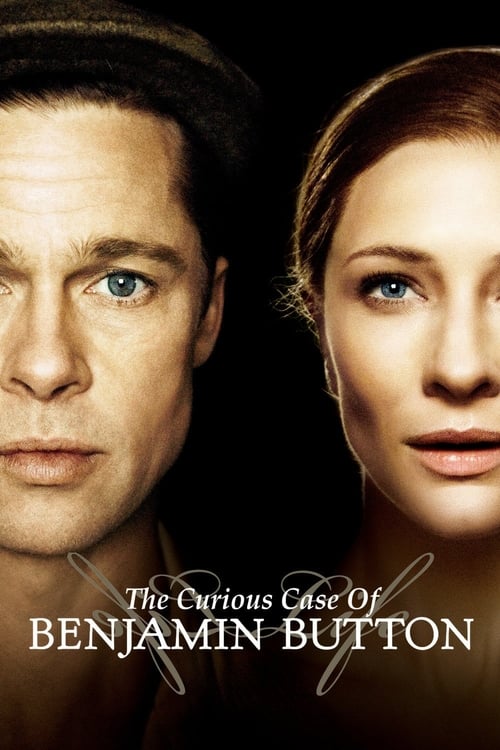
The Curious Case of Benjamin Button
2008 · David Fincher
The Killer and his Netflix marriage keep the "master craftsman in a streaming cage" discourse alive; every rumored project (the Chinatown prequel series, a Squid Game English remake rumor cycle) trends instantly.
For a slow evening when you want to feel time passing — a meditative, romantic epic to sink into, and a good cry of the mortality-and-lost-love kind rather than the tissue-box weepie kind. Patience required, and rewarded.
What it's about
Benjamin Button is born in New Orleans at the end of the First World War as a tiny old man, and ages backward from there. Raised in a nursing home where death is a neighbor, he sails out into a century of adventures — tugboats, wars, love affairs — but the spine of it all is Daisy, a dancer he meets when she's a child and he only looks ancient. Their lives keep crossing at the wrong ages, moving toward the brief window where they might finally match.
The experience
Stately, wistful, and quietly devastating — nearly three hours that drift like a long remembered life, trading big dramatic peaks for an accumulating ache about time and the people it takes. It sneaks up on you; the last stretch lands hard.
Performances
Brad Pitt gives one of his most restrained performances, playing a man watching life from the outside at every age, and Cate Blanchett gives Daisy a whole arc from careless youth to hard-won grace — she carries the film's heartbreak.
The craft
The reverse-aging effect remains a landmark: Pitt's performance mapped onto digitally built elderly faces so seamlessly you stop seeing the trick, inside David Fincher's burnished, exacting frames and Eric Roth's century-spanning script from a Fitzgerald short story. Its craft swept the technical conversation of its year for good reason.
Why it matters
A milestone in digital character effects that pushed the industry toward believable de-aging and performance capture, and the film that showed Fincher — until then the dark-thriller guy — working in an openly romantic, elegiac register.
Snapshot
David Fincher's The Curious Case of Benjamin Button is a life-spanning fantasy-romance built around a single impossible premise: a man born aged and infirm who grows younger as the decades pass, dying an infant. Adapted by Eric Roth from a slender 1922 F. Scott Fitzgerald short story — and freely, the film retains little beyond the conceit and the name — it relocates the tale from Fitzgerald's Baltimore to New Orleans and stretches it across most of the twentieth century, from the end of the First World War to the eve of Hurricane Katrina. Brad Pitt plays Benjamin and Cate Blanchett plays Daisy, the dancer whose life crosses his at the wrong angles until, briefly, the two meet in the middle. Produced on a large scale by Paramount and Warner Bros. and released on Christmas Day 2008, it became a commercial success and an awards-season heavyweight, earning thirteen Academy Award nominations and winning three (Visual Effects, Art Direction, Makeup). It occupies an unusual place in Fincher's filmography — his most openly sentimental and least abrasive work — and a genuine landmark in the history of digital character effects.
Industry & production
The film had one of the longer development histories in modern studio cinema; the rights and various screenplay drafts circulated for years, with a succession of directors and writers attached before the project cohered. Robin Swicord contributed an early adaptation and shares story credit with Eric Roth, whose shooting screenplay gives the film its final shape. Roth's involvement is central to how the picture reads: as the screenwriter of Forrest Gump (1994), he brought a nearly identical architecture — a naïf carried through decades of American history, a framing narration, a Southern setting, a patient episodic sweep — and the resemblance would become the single most repeated line in the film's critical reception.
Fincher came aboard after Zodiac (2007), reuniting with Brad Pitt for their third collaboration following Seven (1995) and Fight Club (1999). Production centered on New Orleans and Louisiana, making the film part of the wave of major productions drawn to the state by tax incentives — and, pointedly, shooting in a city still recovering from the 2005 flood that the story's frame narrative invokes. The reported budget sat in the region of $150 million, a figure inflated by the visual-effects work at its core; the film went on to gross well over $300 million worldwide, a strong result for a serious-minded, 166-minute prestige drama. Distribution was split between Paramount and Warner Bros., a co-financing arrangement typical of the era's risk-sharing on expensive event pictures.
Technology
Benjamin Button is remembered first as a technological achievement, and rightly so. The film's central problem was that its protagonist spends its opening stretch as a fully aged man with Brad Pitt's face — a task beyond conventional makeup, which cannot convincingly shrink an actor or render the translucency of very old skin in close-up over a feature's length. The solution, executed by Digital Domain under visual-effects supervisor Eric Barba, was to build a photorealistic, computer-generated Benjamin head and place it on the bodies of smaller, older performers who acted the scenes on set wearing blue hoods.
The head was not motion-captured in the scene. Instead, Pitt performed the old-Benjamin material separately in dedicated "emotion capture" sessions, his facial performance recorded and analyzed against the Facial Action Coding System (FACS) so that expressions could be reconstructed on the digital model. The pipeline drew on academic research in facial capture and rendering — including the Contour system for high-resolution facial scanning and Light Stage work associated with Paul Debevec's group at USC's Institute for Creative Technologies, which captured how Pitt's skin reflected light from every angle. The result was among the first digital human faces to carry sustained dramatic weight in close-up without collapsing into the "uncanny valley." That the illusion largely holds — audiences and reviewers alike accepted the aged Benjamin as Pitt — was the film's most consequential accomplishment, and it won the Academy Award for Visual Effects. On the question of image acquisition, the film continued Fincher's move away from photochemical origination toward digital tools begun on Zodiac, though the decisive innovation lay in the effects pipeline rather than the camera; I would not assert specific camera details beyond that without firmer grounding.
Technique
Cinematography
Benjamin Button marked the feature breakthrough of Claudio Miranda, who had worked in Fincher's camera and lighting departments and here served as director of photography. The images are burnished and controlled, favoring soft, sourced light, deep amber and sepia registers for the New Orleans past, and a cooler palette for the Katrina-era frame. Miranda's work earned an Academy Award nomination and helped launch a career that would peak four years later with his Oscar for Life of Pi (2012). The photography's restraint is deliberate: because so much of the frame had to integrate with digital face replacement and period reconstruction, the lighting is designed to be consistent and legible, allowing the effects to sit inside a believable photographic world rather than announce themselves.
Editing
The film was cut by Kirk Baxter and Angus Wall, Fincher's editing team, whose measured, unhurried rhythm shapes the picture's elegiac tone. The editing manages a difficult braided structure — a deathbed present tense, a read-aloud diary, and a chronological life story — while sustaining a slow, tidal pace across nearly three hours. Baxter and Wall would go on to win consecutive Academy Awards for Fincher's next two films, The Social Network and The Girl with the Dragon Tattoo; their patience here is the foundation of the film's mood.
Mise-en-scène / staging
Production designer Donald Graham Burt (with set decorator Victor Zolfo) won the film's Academy Award for Art Direction, and the design is one of its true pleasures: Queenie's nursing home, a period New Orleans of streetcars and boarding houses, a Murmansk hotel in wartime, a tugboat, mid-century apartments. The staging is unshowy and observational, letting decades pass through changes in décor, costume, and light. Jacqueline West's costumes track the same long chronology and the inverse arcs of the two leads — Daisy blooming as Benjamin sheds age.
Sound
The film's sonic signature is Alexandre Desplat's score, delicate and clockwork-like, built on waltzing, music-box figures that suit a story governed by a clock that runs backward. The sound design is quiet and enveloping, foregrounding ticking, water, wind, and the hush of sickrooms; the recurring motif of the reversed station clock, and the Katrina winds rising outside the hospital window, tie the aural world to the film's preoccupation with time running the wrong way.
Performance
Brad Pitt gives a deliberately still, watchful performance, an unusual acting problem given that his younger self was often a digital construct and his oldest self a composite. Cate Blanchett carries the film's emotional variability as Daisy, moving from imperious youth to frailty. Taraji P. Henson, as Queenie, the Black caretaker who raises the abandoned Benjamin, earned a Supporting Actress nomination and provides much of the film's warmth. The deep cast includes Tilda Swinton as Elizabeth Abbott, Benjamin's wartime lover; Julia Ormond as Daisy's daughter Caroline in the frame; Jared Harris as the tugboat captain; Jason Flemyng as Benjamin's father; and, in an early role, Mahershala Ali as Tizzy.
Narrative & dramatic mode
The film's mode is framed, episodic melodrama in a picaresque key. Its outer frame places an elderly, dying Daisy in a New Orleans hospital in August 2005 as Katrina approaches; her daughter reads aloud from Benjamin's diary, and the life story unspools in flashback and voiceover. Within that structure the narrative is loosely picaresque — a series of encounters, departures, and returns (the nursing home, the tugboat, Murmansk, the war, the postwar reunion) rather than a tightly causal plot. Its governing figure is the reverse arc: Benjamin and Daisy travel toward each other from opposite ends of life, achieving alignment only in a narrow window before diverging again, he into infancy, she into old age. The film also indulges a famous digression on contingency — the chain of small accidents that determines whether a woman is struck by a taxi — that states its fatalistic, time-haunted worldview outright. The dramatic register is unabashedly romantic and elegiac, closer to fable than to Fincher's characteristic thrillers.
Genre & cycle
Benjamin Button sits at the intersection of fantasy, prestige romance, and the "high-concept life story." Its magical-realist premise — one impossible rule imposed on an otherwise naturalistic world — links it to a small cycle of films about love pulled out of temporal sync or lives stretched across history: Forrest Gump most obviously, but also Tim Burton's Big Fish (2003), The Time Traveler's Wife (2009), and the later Cloud Atlas (2012). Within Fincher's own body of work it is the outlier — his one full-hearted romantic epic, standing apart from the procedurals, thrillers, and social dramas that define him.
Authorship & method
The film is a Fincher picture in craft and a Roth picture in structure, and the tension between the two is part of its texture. Fincher's method — exacting, technically maximalist, famous for many takes and total control of the frame — is here turned toward emotional and effects-driven ends rather than menace. His key collaborators form a recognizable authorial unit: cinematographer Claudio Miranda, rising from within Fincher's crew; editors Kirk Baxter and Angus Wall, who would define the rhythm of Fincher's subsequent work; and the Digital Domain team led by Eric Barba, whose effects are inseparable from the film's authorship. Composer Alexandre Desplat, then in the midst of his emergence as a leading Hollywood scorer, supplies the film's tender counterweight to Fincher's precision. Screenwriter Eric Roth provides the humane, history-spanning template; production designer Donald Graham Burt provides its physical world. The film is thus a case where a director's control is exercised over a screenplay written in another sensibility entirely.
Movement / national cinema
This is mainstream American prestige cinema at its most ambitious — a studio-financed awards contender in the tradition of the sweeping life-story epic. Fincher belongs to the generation of American directors who came up through music videos and commercials (in his case at Propaganda Films) before moving to features, and Benjamin Button shows both that background's visual polish and a deliberate reach toward the classical, novelistic Hollywood picture. It is also, tellingly, a New Orleans film made in the aftermath of Katrina, part of the surge of production the state's incentives drew and quietly bound to the city's recent trauma through its frame.
Era / period
The film is a document of a specific late-2000s moment on two fronts. Industrially, it arrived just as digital visual effects crossed a threshold in rendering human faces, and just as Hollywood's shift from film to digital acquisition was accelerating — Fincher among its most visible advocates. Culturally, its Katrina frame roots it in mid-decade American memory. It also belongs to a late-2000s vein of large, contemplative studio dramas about mortality and time that the industry would increasingly struggle to finance in the following decade.
Themes
The film's overriding subject is time and its irreversibility — made literal by Benjamin's condition and emblematized by the backward-running station clock built by a grieving clockmaker in memory of a son killed in the war. Around that spine cluster its other concerns: mortality and impermanence, and the impossibility of holding onto anyone or anything; the asymmetry of love, two people able to meet only in passing; parenthood, abandonment, and the makeshift family that raises the discarded infant Benjamin; memory and the diary as a hedge against forgetting; and chance and contingency, the sense that a life is a chain of accidents. Water and rivers recur as figures for time's one-way flow, and the whole is suffused with a melancholy acceptance of loss as the price of having lived.
Reception, canon & influence
Critical reception was broadly favorable but genuinely divided in a characteristic way. Admirers — Roger Ebert prominent among them — found the film moving, beautifully made, and emotionally resonant; its thirteen Academy Award nominations, including Best Picture, Best Director (Fincher's first directing nomination), Best Actor, and Best Adapted Screenplay, registered the industry's high regard. A persistent counter-current, however, judged the film emotionally cold beneath its technical splendor — an "empty" marvel — overlong at nearly three hours, and too derivative of Forrest Gump, given Roth's near-repetition of that film's design. It won three Oscars (Visual Effects, Art Direction, Makeup) but lost Best Picture to Slumdog Millionaire, and its critical standing has settled as respected rather than beloved, more often cited for its craft than embraced as a classic.
Looking backward, the film's influences are clear: Fitzgerald's premise, Roth's own Forrest Gump, and the broader tradition of the framed, life-spanning literary epic. Looking forward, its most durable legacy is technological. The digital-human pipeline Digital Domain built here — high-resolution facial capture, FACS-based reconstruction, Light Stage-informed skin rendering — advanced the state of the art in ways that fed directly into the following years' work on de-aging and synthetic performers, from Tron: Legacy (2010), which reunited Miranda and Digital Domain on a digitally youthened Jeff Bridges, through the de-aging experiments of Gemini Man and The Irishman and the now-routine facial rejuvenation of the franchise era. In the history of visual effects, Benjamin Button is regularly named as a pivotal moment when a fully computer-generated human face first carried sustained dramatic weight — a distinction that has outlasted the debate over whether the film around it beats with a heart or only ticks like its backward clock.
A Deleuzian reading
There's a station clock in this film whose hands turn the wrong way, and Alexandre Desplat's score keeps borrowing its tick: small waltzing music-box figures, a mechanism wound backward.
The full Deleuzian reading of The Curious Case of Benjamin Button →
Reception
In 2008 it was the Oscar juggernaut — 13 nominations, the most of its year — that critics respected more than loved, dogged by 'Forrest Gump in reverse' snark. Now it sits as Fincher's most divisive film, routinely ranked last in his filmography yet periodically defended as his most openly emotional work.
How The Curious Case of Benjamin Button was received, from release to now →
How to watch The Curious Case of Benjamin Button: what to notice on a first viewing
- Watch how little Pitt's face does while others talk. Pitt plays Benjamin still and watchful. He listens, observes, and rarely pushes a scene. The century, the wars, the tugboat, Murmansk, all move across him while he holds his stillness. He is what the reading calls a seer: a man who looks and endures instead of acting, so the world does the moving.
- Listen for Desplat's music-box waltz and the ticking under it. The score keeps returning to small clockwork figures, wound and running. Around it the sound design favors ticking, water, wind, and the hush of sickrooms. The soundtrack keeps a clock running under the story so you feel time passing rather than being told about it.
- Notice the deep amber and sepia of the New Orleans past. Miranda lights the period material soft and sourced, warm and burnished, and cools the palette down for the 2005 hospital frame. The two temperatures alternate all film. Color tells you which clock you are on before anyone speaks, warm memory against a cold present.
- Watch Daisy's clothes bloom while Benjamin's body sheds age. Jacqueline West dresses Blanchett forward through youth into frailty and Pitt backward out of old age. The two wardrobes travel in opposite directions across the same decades. Costume alone plots the reverse arc, two people crossing once and then moving apart.
- Count the departures and returns: nursing home, tugboat, Murmansk, home. Benjamin leaves and comes back, again and again. The trips change nothing causally. The story is a chain of encounters rather than a machine where one event forces the next. The shape is a stroll, not a plot, which is why the film asks for patience instead of suspense.
The whole guide to watching The Curious Case of Benjamin Button, with the keys for a rewatch →
Influences: the films it descends from and the films it influenced
- Forrest Gump (1994) — Eric Roth reuses his own screenplay design here — a passive, watchful protagonist braided through decades of 20th-century American history via VFX period insertion and a framed retrospective voice.
- Titanic (1997) — Digital Domain's photoreal compositing pipeline and framed-flashback period-disaster melodrama are the direct institutional inheritance the Button effects team built upon.
- Jurassic Park (1993) — ILM first proved a fully computer-generated creature could hold sustained photoreal screen presence, the precondition for trusting a wholly digital human face to carry drama.
- The Lord of the Rings: The Two Towers (2002) — Andy Serkis and WETA translated a live actor's facial performance onto a digital character, pioneering the emotion-capture-drives-CG-face method Button industrialized with FACS.
- Death Becomes Her (1992) — Early digital manipulation of the aging and decaying human body — seamlessly grafting altered anatomy onto live actors — is the ancestral gag Button turns into dramatic reverse-aging.
- Zelig (1983) — Constructs a single fabricated life-history by technically inserting one figure across decades of period-styled footage, the mock-biographical conceit underneath Button's framed picaresque.
- Big Fish (2003) — Deathbed-framed tall-tale structure with magical-realist Americana — a life recounted as fable to a dying relative — is the framed melodramatic-romance register Button adopts.
- The Green Mile (1999) — Fincher deploys the same retrospective-confession framing device and dual-temperature palette—warm amber period-past sequences contrasted against a cool contemporary nursing-home frame—as structural spine for an episodic literary adaptation of a fantastic premise, inheriting Darabont's approach to rendering the miraculous within classical Hollywood visual grammar at epic running time.
- Meet Joe Black (1998) — Brad Pitt's becalmed, near-affectless performance again anchoring an extreme-length, amber-toned metaphysical fable about a life measured against death — the seed's star-performance gambit revisited.
- Pirates of the Caribbean: Dead Man's Chest (2006) — Digitally reconstructed a lead actor's performing face frame-by-frame, extending the digital-character-as-nuanced-lead case Davy Jones advanced.
- Tron: Legacy (2010) — Eric Barba and Digital Domain reused Button's FACS-plus-Light-Stage facial pipeline to digitally youthen Jeff Bridges, the first direct reapplication of the technology.
- The Social Network (2010) — Extends Button's digital face-replacement by grafting Armie Hammer's performed face onto a body double to create the Winklevoss twins within the same Fincher effects unit.
- The Irishman (2019) — ILM's markerless de-aging carries a lead across decades of a single performance, the mature realization of Button's ambition to sculpt age digitally onto a real actor.
- Gemini Man (2019) — Deploys a fully computer-generated young Will Smith as a dramatic co-lead in extended dialogue, pushing Button's synthetic-performer line to a wholly CG speaking protagonist.
- Rogue One: A Star Wars Story (2016) — Recreates a deceased actor's face entirely in CG for a substantial speaking role, inheriting Button's premise that a synthetic human face can bear sustained dramatic weight.
- Life of Pi (2012) — Claudio Miranda's Oscar-winning cinematography extends the lighting-for-digital-integration craft he forged shooting Button's effects-heavy period frames.
- Blade Runner 2049 (2017) — Converges both Button lineages — Claudio Miranda's cinematography and a CG facial reconstruction of a returning character built to hold an emotional close-up.
- Alita: Battle Angel (2019) — WETA and Digital Domain drive a fully CG lead face with FACS-based emotion capture calibrated to carry a feature-length emotional performance, the endpoint of Button's method.
- Avengers: Endgame (2019) — Digital Domain's photoreal facial reconstruction and age-transformation here is the foundational technique Endgame's de-aging of Stark and Rogers technically descends from.
- Captain America: The First Avenger (2011) — Pioneered the Lola VFX digital body-replacement technique that produces 'skinny Steve' — seamlessly shrinking/altering an actor's physique across full-motion shots rather than relying on doubles or prosthetics.
- Zodiac (2007) — Fincher's immediately prior film establishes the digital-acquisition workflow and the Kirk Baxter/Angus Wall editorial rhythm carried directly into Button's construction.
Similar films
- Zodiac (2007) — influence & lineage · often watched together
- Titanic (1997) — influence & lineage
- Forrest Gump (1994) — influence & lineage
- The Social Network (2010) — influence & lineage
- Big Fish (2003) — influence & lineage
- Life of Pi (2012) — influence & lineage · often watched together
- Blade Runner 2049 (2017) — influence & lineage · often watched together
- The Father (2020) — often watched together
All the films related to The Curious Case of Benjamin Button →