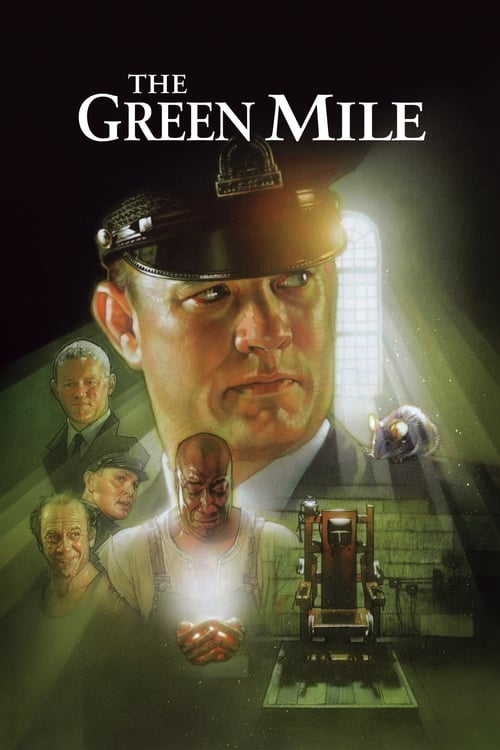
The Green Mile
1999 · Frank Darabont
For when you want a big, old-fashioned story that goes for the heart without irony — and when you're ready for a good, honest cry. Emotionally heavy but deeply humane.
What it's about
On death row in a Louisiana prison in 1935, head guard Paul Edgecomb runs his cell block with weary decency — until John Coffey arrives, a mountain of a man convicted of a terrible crime who is gentle as a child and seems to carry an impossible, miraculous gift. As Paul comes to understand what Coffey can do, he's forced to reckon with what the state is about to do to him. Told as an old man's memory, it's a supernatural fable about guilt, mercy, and institutional cruelty.
The experience
A long, unhurried, openly emotional epic — three hours that earn their length by making you live among these men. It's tender and terrifying by turns, and it will wring tears out of almost anyone.
Performances
Michael Clarke Duncan is unforgettable as Coffey — immense physical presence carrying bottomless gentleness and sorrow, a role that earned him an Oscar nomination. Tom Hanks anchors it all with quiet, troubled decency.
The craft
Frank Darabont adapts Stephen King's serialized novel with patience most studio films wouldn't dare, letting scenes breathe until the dread or grace fully arrives. The period detail is rich, the ensemble is deep, and the execution scenes are staged with unflinching, terrible weight.
Why it matters
Made Michael Clarke Duncan a star, earned four Academy Award nominations, and stands with its director's earlier prison drama as the template for the humanist Stephen King adaptation.
Snapshot
Frank Darabont's second Stephen King adaptation is an unabashedly mythic prison drama that wraps an execution narrative inside a supernatural parable. Set on the death row of a Louisiana state penitentiary in 1935 and filtered through the retrospective voice of a guilt-haunted old man, The Green Mile insists that America's deepest crime is not murder but the institutional execution of the innocent and miraculous. At 189 minutes, it is one of the longest studio releases of its era — a deliberate epic that refuses to compress King's serial novel into efficient thriller mechanics. The film made Michael Clarke Duncan a household name, earned four Academy Award nominations, and remains the defining artifact of Darabont's humanist Hollywood project.
Industry & production
The Green Mile originated as a serialized novel published by New American Library (Signet Books) in six monthly installments from January through August 1996 — a conscious revival of the Victorian part-issue format that King has attributed to Charles Dickens. The serialization was commercially unusual in the American publishing landscape of the 1990s, and its success (each volume routinely reached the bestseller lists) ensured that the completed omnibus had unusual cultural visibility before any film deal was struck. Frank Darabont acquired the rights through his production banner, Darkwoods Productions, and Castle Rock Entertainment — the same studio entity that had produced The Shawshank Redemption — came aboard as co-producer, cementing the institutional relationship between Darabont, Castle Rock, and the King catalog. Warner Bros. handled distribution.
Darabont elected to write the screenplay himself, as he had with Shawshank, treating the six-volume novel as a unified text rather than cannibalizing it for plot points. The adaptation retains the framing device of elderly Paul Edgecomb narrating from a 1990s nursing home, the episodic rhythm of the original installments, and the novel's unhurried moral logic. The casting of Tom Hanks in the lead was, commercially speaking, a near-guarantee of awards attention: Hanks had won back-to-back Best Actor Oscars in 1994 and 1995 and was at the height of his cultural authority. Michael Clarke Duncan, a former bodyguard who had been brought to Hollywood's attention through a small role in Armageddon (1998), was cast as John Coffey after a famously rigorous search; his size, warmth, and screen presence were considered essential to making the role's impossible requirements believable. The supporting ensemble — David Morse, Bonnie Hunt, James Cromwell, Sam Rockwell, Doug Hutchison, Michael Jeter, Barry Pepper, Patricia Clarkson — represents one of the more carefully assembled company casts of the decade. Dabbs Greer, in his eighties, played the aged Paul Edgecomb in the framing sequences in what became a valedictory late-career appearance.
Production proceeded through 1999 with a December release designed to position the film squarely in awards season. The budget, running time, and star power marked it as one of the studio system's prestige efforts of a particularly competitive year.
Technology
The Green Mile belongs to a transitional moment in Hollywood's relationship with digital effects: CGI was capable of convincing creature work but had not yet displaced practical approaches. The production's most technically demanding element was Mr. Jingles, Eduard Delacroix's pet mouse, who required a combination of trained real mice, animatronic puppets, and digital compositing to survive scenes that called for apparently impossible behavior — scurrying across the death row corridor at speeds no camera could cleanly follow, responding to actors on cue across dozens of setups. The visual effects team worked to ensure the mouse's performance read as emotionally continuous across its different physical instantiations, a challenge that in retrospect foreshadowed the kind of seamless creature integration that would become standard in the following decade.
John Coffey's healing sequences presented a different technical challenge: the production required a visual language for supernatural power that felt earned rather than cartoonish. The glowing "exhalation" of disease from Coffey's mouth — rendered as a luminous swarm of particles — was achieved through a combination of in-camera lighting effects and post-production compositing. The filmmakers aimed for an effect that connoted contamination and release simultaneously, something that could read as both miraculous and terrible. By the standards of 1999 CGI the effect is not seamlessly photorealistic, but it is appropriately strange, serving the story's theological register.
The film's sound design carried particular technological weight in the electric chair sequences, where Darabont chose to render the executions without flinching. The aural texture of those scenes — current, smell, the physiological devastation of the condemned — demanded work at the boundary of what standards and practices would permit in a mainstream release. The film earned Academy Award nominations for both Best Sound and Best Sound Editing, reflecting industry recognition of the craft invested in making those sequences land.
Technique
Cinematography
David Tattersall, the British cinematographer who would subsequently become closely associated with the Star Wars prequel trilogy, shot the film with a palette calibrated to the story's doubled temporality. The 1935 death row sequences are rendered in warm amber and deep shadow — incandescent, period-approximate lighting that creates a world simultaneously intimate and suffocating. The corridor of E Block, with its famous green linoleum floor, is shot as a liminal space: long and narrow, its vanishing point always slightly off-center, emphasizing the condemned walk as both journey and inevitable terminus. The nursing home framing is cooler and grayer, institutional in a different register, the color temperature dropping to signal modernity's particular bleakness. Tattersall's use of close-up is especially considered in the performance scenes: Coffey's face, which must contain multitudes, is given the full resources of carefully controlled focus and lighting.
Editing
Richard Francis-Bruce, who had edited The Shawshank Redemption, returned to cut The Green Mile — a continuity that gives the two films a structural kinship. Francis-Bruce's approach to the 189-minute runtime is deliberately unrushed. Rather than treating the film's length as a problem to be managed, he allows scenes to breathe, favouring held moments over cutting-on-action efficiency. The rhythm is closer to literary fiction than to genre thriller, which is in keeping with King's serial novel. The transitions between framing narrative and 1935 sequences are handled classically, using the elderly Paul's narration as connective tissue.
Mise-en-scène / staging
The production design of E Block is the film's most sustained physical achievement. The death row set was built to period specification and dressed to suggest both the mundane operations of institutional life and its permanent shadow. The "green mile" corridor functions throughout as a spatial metaphor made architectural: its straight line, its regular cell doors, its single terminus in the execution chamber. Darabont stages the healing scenes with careful attention to physical geometry — Coffey must be positioned both as supplicant and as something larger than the humans around him, simultaneously vulnerable and otherworldly. The execution sequences use the staging conventions of ritual (the march, the strapping, the cloth mask) against which Coffey's passivity accumulates its moral charge.
Sound
Thomas Newman's score is the connective tissue of the film's emotional architecture — a characteristic Newman mode of minimalist arpeggios, sympathetic strings, and carefully placed silence. Newman had scored The Shawshank Redemption and brought to The Green Mile a similarly spare approach to underscoring: the music tends to hover below the narrative rather than dictating its emotional beat. The film's sound design operates in productive tension with this restraint; the healing sequences in particular use sound as the primary carrier of the supernatural register, with Coffey's exhalations given an aural texture that the score then responds to.
Performance
Tom Hanks's Paul Edgecomb is a study in a certain kind of American masculine authority: competent, decent, slow to anger, but finally helpless before the systems he administers. Hanks underplays throughout, which is the correct choice — the film needs Paul to be a witness rather than a protagonist in the conventional sense. The performance was notably not recognized by the Academy, a decision widely remarked upon at the time.
Michael Clarke Duncan's John Coffey is the film's moral center and its most difficult performance problem: a figure who must read as simultaneously child-like and ancient, innocently terrified and cosmically knowing. Duncan achieves this through physical restraint — his enormous frame held still, his voice gentle — counterpointed with moments of overwhelming grief. The performance earned him a Best Supporting Actor nomination, and it remains the role for which he is primarily remembered.
Sam Rockwell's "Wild Bill" Wharton operates at the film's other emotional extreme: all feral unpredictability and performative menace, Rockwell's early major villain turn established a register he would continue to develop. Doug Hutchison's Percy Wetmore is a more precise kind of evil — petty, cowardly, institutional — and Hutchison plays him with a queasy accuracy that makes the character more disturbing than Wharton's overt violence.
Narrative & dramatic mode
The Green Mile is structured as a retrospective confession. Elderly Paul Edgecomb, having lived to an impossible age as the cost of Coffey's miraculous touch, narrates his 1935 death row experience to fellow nursing home resident Elaine (Eve Brent). The framing device converts the film into an act of moral testimony: everything we see is mediated through Paul's guilt and wonder, his sixty-year effort to make sense of what he witnessed and participated in. This positions the narrative firmly in the tradition of the frame tale — a form with deep roots in English literature and particularly in King's own work — and gives the film's melodramatic moments a retrospective weight that pure present-tense narration would struggle to achieve.
The episodic structure, inherited directly from the serialized novel, organizes the film around discrete units: the arrival of Eduard Delacroix and Mr. Jingles, the incident with Percy Wetmore, the healing of Melinda Moores, the revelation of Coffey's history. Each episode enlarges the world of E Block while progressively clarifying the film's central moral burden — that Paul, a good man doing a terrible job, will execute someone he knows to be innocent. The genre conventions of the prison drama (claustrophobic space, rigid hierarchy, the executed as measure of society's humanity) are activated and then suspended: this is a prison film in which the condemned is not guilty, a procedural in which the procedure is the crime.
Genre & cycle
The Green Mile belongs to several overlapping cycles. It is a death-penalty drama in a decade that saw sustained Hollywood interest in capital punishment — Dead Man Walking (1995), The Chamber (1996), Last Dance (1996), The Hurricane (1999) — a cycle that participated in the larger cultural debate over the death penalty that accelerated through the 1990s as DNA exoneration cases multiplied. It is a Stephen King prestige adaptation, a category that The Shawshank Redemption had effectively invented as a viable studio product distinct from the King horror brand. And it is a supernatural drama in the loose tradition of films that embed miraculous events within otherwise naturalistic period reconstructions.
The film's use of the Christ-figure allegory — Coffey's initials, his healing through touch, his voluntary submission to execution for humanity's sins, his question "Why do you want to send me back to darkness?" — places it within a distinctly American tradition of religious folk narrative. It is not, however, simply allegory: the racial politics of the story (a Black man executed by a white institution for a crime he did not commit, his supernatural gift exploited by those who are also killing him) run beneath the surface with persistent pressure, though critics have debated the degree to which the film fully reckons with those politics or deflects them through the supernatural framing.
Authorship & method
Frank Darabont is one of the rare cases of an American director who has built an authorial identity almost entirely from adaptations of a single author's work. His three King adaptations — The Shawshank Redemption (1994), The Green Mile (1999), The Mist (2007) — constitute a coherent body of work in which King's interest in ordinary men facing extraordinary moral pressure becomes a vehicle for Darabont's own investment in American decency and its institutional betrayal. Darabont's method is resolutely literary: he writes the screenplays himself, he shoots in sequence where possible, and he allows his source material's pacing to dictate his films' rhythms rather than compressing for genre efficiency.
Thomas Newman's returning presence as composer extends the Shawshank continuity and suggests something like a repertory relationship: Newman's minimalist scoring strategy is so precisely calibrated to Darabont's tempo that it is difficult to imagine the films with other collaborators. Richard Francis-Bruce's editing represents a similar continuity. David Tattersall was the principal departure from Shawshank's creative team; his subsequent work on the Star Wars prequels gives his contribution to The Green Mile a somewhat anomalous quality in his career, though the period craftwork is impeccable.
Movement / national cinema
The Green Mile is mainstream Hollywood filmmaking of the late studio system in its full prestige mode. It participates in no avant-garde or national cinema movement, though it inherits the conventions of the classical Hollywood social problem film (the wrongful execution picture has lineage running from I Am a Fugitive from a Chain Gang in 1932 through I Want to Live! in 1958). Its Southern Gothic setting — the swampy heat, the period racism, the folk religious texture — connects it loosely to a tradition of American literary fiction that runs through Faulkner, Flannery O'Connor, and Carson McCullers, a tradition King himself has consciously engaged.
Era / period
The film arrives at the end of one of Hollywood's most competitive years. 1999 saw American Beauty, The Insider, The Talented Mr. Ripley, Being John Malkovich, and Magnolia, among others, competing for the prestige space that The Green Mile also occupied. The late-1990s prestige drama cycle, in retrospect, represented the last sustained moment in which mid-budget adult drama could command genuine studio resources and wide theatrical distribution before the franchise consolidation of the 2000s. The Green Mile's 189-minute runtime, its October-December release strategy, its ensemble casting and literary source — all are period-specific markers of a production designed for the awards conversation and for an audience that still sought in mainstream cinema something like literary experience.
Themes
The film organizes itself around several interlocking thematic concerns. The first is institutional evil: Percy Wetmore demonstrates how bureaucratic sadism is enabled not by exceptional monsters but by petty authoritarians protected by family connections, while Warden Moores's complicity in Coffey's execution demonstrates how decent administrators participate in injustice through inaction. The second is the burden of witness: Paul's immortality is not presented as a gift but as a punishment for having watched and not stopped, a sentence of continuing to outlive everyone he loves. This gives the film's theological machinery a tragic rather than consolatory function; the miracle does not save, it condemns.
The racial dimension of the story — a Black man in 1930s Louisiana, falsely accused of the rape and murder of two white girls, executed by a white institution — is the film's most historically charged element. Darabont and King embed this within the supernatural framework in ways that have generated debate: some critics have argued that making Coffey a magical figure with divine gifts displaces the racial critique onto metaphysics, while others have suggested that the very impossibility of his situation (innocent, miraculous, doomed) captures something true about the position of Black Americans in the Jim Crow South. The film does not explicitly adjudicate this, which is itself a choice.
Reception, canon & influence
Critical reception at release was generally warm but not unanimous. The film's length and emotional intensity drew admiring notices from reviewers who responded to its ambition and to Duncan's performance; others found its sentimentality manipulative and its Christian symbolism heavy-handed. The Academy nominated it for four awards — Best Picture, Best Supporting Actor (Duncan), Best Sound, and Best Sound Editing — but it did not win in any category, and Hanks's absence from the Best Actor field was widely noted as a significant omission.
Influences on the film run through several traditions. The gentle giant archetype — the powerful, innocent man whose death reveals humanity's capacity for cruelty — connects directly to John Steinbeck's Of Mice and Men (1937), a text King has acknowledged. The wrongful-execution prison drama draws on the classical Hollywood social problem film, particularly I Am a Fugitive from a Chain Gang and Brute Force (1947). One Flew Over the Cuckoo's Nest (1975) provides a template for the charismatic institutional inmate whose presence exposes the corruption of those in authority. Darabont's own The Shawshank Redemption is an evident formal and tonal predecessor, establishing the template of the King adaptation as melodramatic humanism anchored by an authoritative male narrator-protagonist.
Legacy is multiple. The film remains among the highest-rated films on audience aggregators, suggesting a popular attachment that outlasted its critical moment — a testament to the effectiveness of its emotional mechanics even when those mechanics are visible. Michael Clarke Duncan's performance, and his career more broadly, cannot be understood apart from this film; it was, tragically, his defining role, given his early death in 2012. The Green Mile also consolidated the Darabont-King prestige adaptation as a recognizable mode: when Darabont made The Mist in 2007, audiences and critics evaluated it explicitly in relation to Shawshank and The Green Mile, demonstrating the degree to which the three films had come to constitute a coherent authorial project.
The film's influence on subsequent prison drama and supernatural melodrama is harder to trace with precision. It did not spawn direct imitations in the way that some genre films do. What it contributed, more diffusely, was a demonstration that King's non-horror work could support films of genuine ambition and scale — a precedent relevant to later serious King adaptations, and to the ongoing negotiation between popular fiction and prestige cinema that continues to shape Hollywood's relationship with literary source material.
A Deleuzian reading
Start with the floor.
The full Deleuzian reading of The Green Mile →
Reception
A box-office hit with four Oscar nominations (including Best Picture) in 1999, though critics grumbled about its three-hour runtime and sentimentality — audiences never wavered, and it's since settled in as one of the most beloved crowd-pleasers of its era.
How The Green Mile was received, from release to now →
Influences: the films it descends from and the films it influenced
- The Shawshank Redemption (1994) — Darabont's own prior King adaptation established the retrospective-confession narrative frame—an innocent man's prison years narrated by an older survivor—the warm incandescent palette of institutional confinement, and the ensemble staging of guard-and-condemned relationships that The Green Mile inherits and expands at twice the running time.
- A Man Escaped (1956) — Bresson's cell-drama deploys hyper-attentive sound design—keys, doors, guards' footsteps, the grain of confinement—as the primary carrier of moral meaning, establishing the template for using institutional acoustics as dramatic language that Darabont's E Block sound team directly inherits.
- Paths of Glory (1957) — Kubrick's long tracking shots through military prison corridors framing judicial murder as spatial inevitability—soldiers marching their ordained route from cell to courtyard to execution wall—directly inform Darabont's liminal-corridor cinematography of the green mile walk and the visual grammar of condemned-man procession.
- The Elephant Man (1980) — Lynch's staging of a physically monstrous but spiritually sanctified figure within a period institutional setting—John Hurt performing grace through stillness and withheld expression—establishes the performance template that Darabont and Michael Clarke Duncan inherit for John Coffey: the gentle giant whose suffering must register without naturalistic psychological interiority.
- Carrie (1976) — De Palma's King adaptation established the film language for rendering King's supernatural gifts within a naturalistic dramatic frame—making telekinesis cinematically legible without horror-genre stylization—through practical staging combined with optical effects that Darabont's visual effects team inherits for Coffey's healing exhalations.
- Stand by Me (1986) — Reiner's King adaptation established the precise structural device of an adult narrator retrospectively confessing the formative moral trauma of his youth—including the narrator directly addressing the camera at narrative open and close—which Darabont deploys verbatim for elderly Paul Edgecomb's nursing-home framing sequences.
- The Natural (1984) — Levinson's film established the warm amber period-American cinematography as the visual register for secular christ-figure mythology, and the slow classically composed staging of miraculous acts in naturalistic period reconstruction—including iconographic light emanating from the figure's body—that Darabont inherits for Coffey's healing sequences.
- Of Mice and Men (1992) — Sinise constructs the same dramatic and moral architecture—a physically massive, cognitively limited man whose supernatural goodness makes his institutional destruction a moral obscenity—with John Malkovich's Lennie Small providing a direct performance template for Duncan's John Coffey: physical vastness expressing interior tenderness, condemned by a society that cannot accommodate innocence at that scale.
- Dead Man Walking (1995) — Robbins established the contemporary template for death-penalty procedural staging—the countdown structure of final days, the witness-perspective positioning during execution, the intimate guard-condemned relationship as moral fulcrum—that Darabont adopts for the E Block execution sequences, substituting supernatural redemption for Robbins's secular grace.
- Man Facing Southeast (1987) — Christ-figure with a healing gift confined inside institutional enclosure, his miraculous nature exposing the cruelty of the system that must ultimately destroy him.
- The Mist (2007) — Darabont's later King adaptation deploys the same practical-digital hybrid creature methodology—performers supplemented by CGI for impossible behaviors—and the same confined-ensemble staging in a single institutional space, converting the liminal corridor from metaphor of inevitable death to metaphor of encroaching unknown while retaining the episodic revelation structure.
- The Curious Case of Benjamin Button (2008) — Fincher deploys the same retrospective-confession framing device and dual-temperature palette—warm amber period-past sequences contrasted against a cool contemporary nursing-home frame—as structural spine for an episodic literary adaptation of a fantastic premise, inheriting Darabont's approach to rendering the miraculous within classical Hollywood visual grammar at epic running time.
- Life of Pi (2012) — Lee extends the practical-digital hybrid creature challenge—sustaining the photorealistic presence of an impossible animal across sustained close-proximity performance with a single human actor—and wraps it in the same retrospective-confession frame with a simultaneously miraculous and deniable supernatural register, the film's concluding question about which story is true directly echoing the ambiguous ontology of John Coffey's gift.
- Miracle in Cell No. 7 (2013) — Establishes the death-row single-block ensemble in which a gentle, wrongly-condemned innocent works quiet 'miracles' that soften his jailers into a surrogate family — the carceral-melodrama staging this film transplants to a Korean cell.
- Beloved (1998) — Released one year prior, Demme's film deploys the same supernatural-realism register in a period American Southern setting—a spirit rendered through practical-digital effects within a naturalistic dramatic frame—and the same retrospective-confession structure organizing a traumatic past through its present consequences, establishing a direct co-contemporary precedent for Darabont's approach to grounding the miraculous in period realism.
- Magnolia (1999) — Released the same year, Anderson's film similarly employs an episodic-serial-structure derived from interlocking novelistic source material, literary-pacing with extended scene duration that refuses conventional three-act compression, and a supernatural-realism register resolved through biblical intervention—making both films a 1999 argument for the Hollywood epic as the proper container for novelistic ambition.
- Dancer in the Dark (2000) — Von Trier engages the identical subject—institutional execution of an innocent miraculous figure who refuses to save herself with truth—but deploys Dogme-adjacent handheld intimacy and fragmented sound design as a formal counterargument to Darabont's classical composition, making these two films a pointed aesthetic dialogue about the ethics of rendering judicial murder with beauty.
- Monster's Ball (2001) — Forster adopts the southern death-row procedural setting, execution-as-moral-confrontation dramatic structure, and witness-perspective staging of the condemned man's final hours—but strips supernatural elements entirely, testing whether the institutional execution of the guilty can carry equivalent moral weight without the guarantee of miraculous innocence.
Similar films
- The Shawshank Redemption (1994) — influence & lineage · same viewing thread
- Dead Man Walking (1995) — influence & lineage · same viewing thread
- The Elephant Man (1980) — influence & lineage
- 12 Years a Slave (2013) — same viewing thread · often watched together
- Unforgiven (1992) — same viewing thread · often watched together
- Just Mercy (2019) — same viewing thread
- Sing Sing (2024) — same viewing thread
- The Hurricane (1999) — same viewing thread
All the films related to The Green Mile →
Watch it with: curated runs of related films
- Judgment and Mercy — Watch these together for the way each puts a life on the scales — a jury room, a death-row block, a slave plantation, a gunfighter's conscience — and asks what mercy costs the people handing down the verdict.