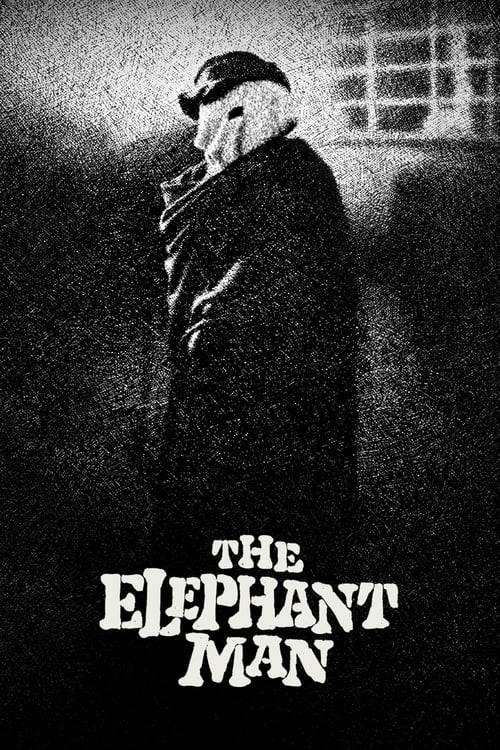
The Elephant Man
1980 · David Lynch
His January 2025 death was a global grief event that revealed how central he'd become to young cinephile identity; "Fix your hearts or die" and the daily weather reports became memorial memes. The reference point for everything called "Lynchian."
For when you need a good cry and want to come out of a film feeling more human — emotionally heavy but profoundly kind. A film to watch when you want your compassion exercised, not your nerves.
What it's about
In Victorian London, a surgeon discovers John Merrick — a severely deformed man exhibited as a sideshow 'freak' by a brutal handler — and brings him to live at a hospital. Behind the disfigurement is a gentle, intelligent, deeply feeling man, and the film follows his fragile entry into a society that can't decide whether it wants to embrace him or gawk at him.
The experience
Tender and devastating in equal measure, with an undertow of nightmare — it moves between Victorian drama and something stranger and more haunted. It will very likely make you cry, and it earns every tear.
Performances
John Hurt gives one of cinema's great performances from beneath total prosthetic makeup — every gesture and halting word radiates a soul — while Anthony Hopkins plays the surgeon with a quiet, self-questioning decency.
The craft
Freddie Francis's high-contrast black-and-white photography makes industrial London feel both real and dreamlike, and the makeup work was so groundbreaking it prompted the Academy to create its makeup award. The sound design hums with machinery and breath — it's a film you feel as much as watch.
Why it matters
An eight-time Oscar nominee that proved David Lynch could bring his strange, humane vision into mainstream studio filmmaking, and it remains a touchstone for how movies portray disability and dignity.
Snapshot
David Lynch's second feature is a Victorian-set drama about Joseph Merrick — called John Merrick in the film — a man so severely deformed by neurofibromatosis (the precise diagnosis remains disputed by medical historians) that he was exhibited as a circus curiosity in 1880s London. Shot in high-contrast black and white, the film follows surgeon Frederick Treves, who removes Merrick from the freak show operated by the brutal Bytes and installs him at the London Hospital, where Merrick becomes an object of fascinated charity among Edwardian high society. Lynch fuses rigorous period reconstruction with expressionist nightmare imagery, producing a film simultaneously grounded in documented history and saturated with the oneiric dread that would become his signature. The result remains one of the few major studio productions of the sound era to achieve genuine strangeness while landing eight Academy Award nominations.
Industry & production
The Elephant Man originated with producers Jonathan Sanger and Stuart Cornfeld, who brought the project to Mel Brooks's production company, Brooksfilms. Brooks, already an established comedy filmmaker, recognized both the material's seriousness and the commercial risk of attaching his name; he deliberately kept his producing credit low-profile to prevent audiences expecting farce. Brooksfilms financed the film in partnership with Paramount Pictures, which handled North American distribution.
Lynch was not the project's first choice. Several directors were considered before Brooks, reportedly after seeing a screening of Lynch's cult midnight film Eraserhead (1977), became convinced that Lynch's feel for industrial texture, bodily horror, and expressionist atmosphere was precisely what the material required. Lynch was invited to develop the script alongside Christopher De Vore and Eric Bergren, who had already completed an earlier draft. The final screenplay draws on two published sources: Sir Frederick Treves's own memoir, "The Elephant Man and Other Reminiscences" (1923), and Ashley Montagu's humanistic study "The Elephant Man: A Study in Human Dignity" (1971). Lynch reshaped the material toward his own preoccupations — the film's prologue and closing passages, in particular, are departures from the documented record into poetic, nearly wordless imagery.
Principal photography took place largely at Lee International Studios and on location in London. The budget was modest by major-studio standards of the era, and the production's British base gave it access to craft departments with deep experience in period reconstruction. The film was released in autumn 1980 to immediate critical attention.
Technology
The film's most discussed technical achievement is Christopher Tucker's prosthetic makeup for John Hurt. Tucker spent months researching casts and measurements taken from the actual Merrick — the London Hospital Museum held Merrick's skeleton and plaster casts — to design a prosthetic suit that accurately approximated the documented severity of Merrick's condition. The application process required approximately seven hours each shooting day. Hurt endured this regime throughout the production, and the physical and psychological demands it placed on him shaped both his performance and the production schedule.
The choice to shoot in black and white was unusual for a major studio release in 1980. The decision was aesthetic and historical rather than budgetary: black and white evoked both the photographic record of the Victorian period and the visual grammar of the German Expressionist films that Lynch and cinematographer Freddie Francis drew on as touchstones. The monochrome image also served a practical function — it absorbed the visible seams and tonal discontinuities in Tucker's prosthetics far more forgivingly than color would have.
The absence of a Best Makeup category at the Academy Awards in 1981 meant Tucker's work went entirely unrecognised by the Oscars. This conspicuous gap helped prompt the Academy to introduce the Academy Award for Best Makeup and Hairstyling, first presented at the 1982 ceremony.
Technique
Cinematography
Freddie Francis, one of the most decorated British cinematographers of the postwar era, was a natural collaborator for this project. Francis had shot Jack Clayton's Room at the Top (1959) and Karel Reisz's Sons and Lovers (1960), winning an Oscar for the latter; he had also directed numerous genre pictures for Hammer and Amicus, which gave him fluency with horror's visual vocabulary. For The Elephant Man, Francis used high-contrast lighting that pushes deep shadows into near-black. His compositions are frequently symmetrical or architecturally rigid when depicting the hospital's institutional spaces, contrasting with the cramped, smoke-filled frames of the freak-show sequences. Steam — from Victorian industry, from breathing in cold air, from unseen machinery — recurs as a visual motif that simultaneously connotes period authenticity and Lynchian unease. Francis and Lynch would collaborate again on The Straight Story (1999), though to markedly different tonal ends.
Editing
The film's editing creates an unusual rhythm that sits between classical continuity and something more oblique. The prologue — a hallucinatory montage of stampeding elephants, screaming women, and industrial close-ups that suggests Merrick's traumatic prenatal origin myth — is assembled in a manner closer to avant-garde film than to studio drama, establishing at the outset that the film will not entirely obey conventional exposition. Thereafter the editing becomes more conventionally narrative, but Lynch and his editor consistently resist cathartic release at moments where other films would grant it, creating a sustained, unresolved quality.
Mise-en-scène / staging
Lynch's staging frequently positions Merrick at the margins of the frame or within architectural frames-within-frames — doorways, stage curtains, hospital windows — that literalise his experience of being perpetually on display. The scene in which Merrick meets the actress Madge Kendal (Anne Bancroft) and recites Romeo and Juliet is staged with a formal symmetry that briefly grants him the dignity of a drawing-room setting; the camera holds long enough for the viewer to adjust, to see past the prosthetics, which is precisely the point. Lynch's use of fog, steam, and low-key lighting throughout gives the Victorian streets a quality closer to expressionist allegory than to heritage-film realism.
Sound
Alan Splet, Lynch's key sound collaborator from Eraserhead onward, designed a soundscape that is among the film's most distinctive features. Merrick's labored breathing — a constant, wet, effortful sound — is present in nearly every scene involving Hurt, establishing an aural embodiment of physical suffering that operates independently of the visual. The film opens on the sounds of industrial machinery before any image appears: the rhythmic clang and hiss of Victorian industry introduces the world Merrick inhabits before we see it. Splet's work grounds even the film's most expressionistic sequences in a kind of heavy, physical sonic reality.
Performance
John Hurt's performance is a sustained technical and interpretive feat. Working for seven hours daily in prosthetics that prevented normal facial expression, Hurt built Merrick's inner life through voice, eye movement, posture, and the precise management of gesture. The performance avoids sentimentality — Merrick is not a simple innocent but a complex, occasionally wry, sometimes fearful man — while never allowing the audience to forget the vulnerability of his situation. Anthony Hopkins as Treves contributes an equally intelligent piece of work: his Treves is genuinely uncertain about his own motives, and Hopkins holds that ambiguity through the film's final act when Treves explicitly voices his doubt about whether he has exploited Merrick differently from Bytes. Supporting performances from John Gielgud, Wendy Hiller, and Anne Bancroft bring period authority without caricature.
Narrative & dramatic mode
The film operates on a double protagonist structure in which Treves functions as the primary point-of-view character — our guide into Merrick's world — while Merrick himself is simultaneously subject and object: the person we come to know and the spectacle we are always in some sense watching. This reflexive structure is among the film's most sophisticated achievements. Lynch and his writers are alert to the film's own potential to replicate the voyeurism it critiques. The narrative does not resolve this tension so much as hold it open; the penultimate sequences, in which Merrick attends the theater and is received by London society, are simultaneously moving and discomfiting, a kind of freak show with better manners.
The film's mode is melodrama in the nineteenth-century sense: a drama of moral legibility in which surfaces obscure rather than reveal inner truth. It is also, in its closing minutes, something approaching elegy: the image of Merrick choosing to sleep lying down — knowing this will likely kill him, wanting once to experience ordinary sleep — is handled with a restraint that amplifies rather than diminishes its emotion.
Genre & cycle
The Elephant Man fits within several overlapping cycles. It belongs to the British heritage drama in its period setting, craft attention, and literary source material, though it deliberately resists the comfort and decorative pleasures of that genre. It belongs to the "freak show" or "outsider" film, a cycle with roots in Tod Browning's Freaks (1932), a film Lynch has acknowledged. It is also, in its industrial imagery and its preoccupation with bodily disfigurement and social exclusion, a horror-adjacent work — not categorized as horror but using the genre's tools to create unease in an ostensibly humanistic drama.
Authorship & method
Lynch came to the project as a self-described outsider to mainstream cinema. Eraserhead had been made over five years on a shoestring, and The Elephant Man was his first experience with a professional studio structure. He has described the Brooksfilms environment as protective — Brooks and Sanger gave him significant creative latitude — while acknowledging that the script arrived substantially pre-developed. Lynch's contribution was primarily visual and tonal: the expressionist framing, the emphasis on industrial sound and imagery, the dreamlike prologue and epilogue, and the decision to trust the audience's capacity for discomfort.
Freddie Francis's cinematographic intelligence was essential to translating Lynch's instincts into achievable studio photography. The composer — the record is clear that a score was commissioned, though the precise credit for the orchestral and thematic work deserves careful attribution — contributes music that sits beneath the action without underlining it sentimentally. Stuart Craig's production design reconstructed Victorian London with period accuracy while serving the film's expressionist rather than naturalistic ends. Alan Splet's sound work, carried over directly from the Eraserhead collaboration, remained arguably the most distinctively Lynchian element of the production — the film sounds unlike anything else being made in mainstream cinema at the time.
Movement / national cinema
The film is a British-American co-production that aligns more naturally with British cinema's traditions than with Hollywood's. Its period setting, its theatrical casting (Gielgud, Hiller, Bancroft), its location shooting in London, and its craft ethos place it within the lineage of quality British drama. At the same time, Lynch's American sensibility and Paramount's distribution muscle gave it a scale and reach beyond the typical British art film of the period. It sits awkwardly but productively at the junction of these two traditions.
Era / period
The film was produced in the late New Hollywood twilight, a moment when the major studios were simultaneously consolidating blockbuster logic — Jaws (1975) and Star Wars (1977) had transformed the industrial model — and still willing, sporadically, to finance challenging prestige productions. The Elephant Man belongs to the latter category: a film that the studio system of 1985 would have been unlikely to greenlight in this form. Its eight Oscar nominations reflect the awards establishment's recognition of work that clearly exceeded commercial calculation.
Themes
The film's governing theme is the disjunction between surface and interiority — the insistence that Merrick's deformed exterior contains a person of intelligence, sensitivity, and spiritual depth. This is stated explicitly but also complicated: the film acknowledges that well-meaning society's fascination with Merrick may not be categorically different from the freak show's exploitation, only more elegant. Related themes include the Victorian construction of monstrosity and normalcy; the ethics of medical authority (Treves's power over Merrick is total even when kindly intended); the function of Christian charity and its limits; and the nature of spectatorship itself. Lynch inflects these with his characteristic interest in the dreamlike, the industrial, and the bodily: Merrick's world is one of physical pain, mechanical noise, and the constant effort of existing in a body that society cannot accommodate.
Reception, canon & influence
Influences on the film (backward): The German Expressionist tradition — F.W. Murnau, Fritz Lang, and particularly the use of deep shadow and architectural distortion — is visible throughout. Tod Browning's Freaks (1932) is the most direct antecedent in the "freak film" tradition, and Lynch has acknowledged its importance. Victorian literature's preoccupation with the hidden self (Stevenson's Jekyll and Hyde, Wilde's Dorian Gray) provides a broader cultural context. Treves's own memoir supplied both factual grounding and an unreliable narrator's framing that Lynch found useful.
Critical reception: The film received nearly unanimous critical praise upon release and eight Academy Award nominations, including Best Picture, Best Director, Best Actor (Hurt), and Best Adapted Screenplay. It won none — a result that surprised many observers, particularly given Hurt's widely admired performance and the technical achievement of Tucker's makeup. The Academy's failure to have a makeup category contributed directly to the establishment of that award.
Legacy (forward): The Elephant Man established Lynch as a filmmaker capable of operating within studio structures while maintaining an idiosyncratic vision. It opened the door to Dune (1984), a production that would prove far more contested. The film's influence on the "outsider" drama is substantial: Tim Burton's Edward Scissorhands (1990) is in visible dialogue with it, sharing the deformed protagonist, the suburban cruelty framed as social comedy, and the pathos of a being incapable of full integration. The prosthetics work by Tucker and the production's collaboration with the London Hospital established a precedent for research-based makeup design. More broadly, the film demonstrated to a generation of filmmakers that Hollywood genre infrastructure could be recruited for work that was formally and thematically serious — a demonstration that Lynch's subsequent career would repeatedly test, and occasionally break.
A Deleuzian reading
Treves walks into Bytes's tent to look at the freak, and Lynch refuses to let us look with him.
The full Deleuzian reading of The Elephant Man →
Reception
A hit and a critical success on release — eight Oscar nominations — but it won none, and the snub of its extraordinary makeup work caused such an outcry that the Academy created the Best Makeup category the following year. Today it's cherished as the great outlier in Lynch's filmography: his most tender, accessible film.
How The Elephant Man was received, from release to now →
Influences: the films it descends from and the films it influenced
- Freaks (1932) — Browning's use of actual sideshow performers established the freak-show cycle's foundational ethical double-bind — staging real deformity as sympathetic drama rather than pure spectacle — which Lynch inherits and complicates when the London Hospital bourgeoisie replace Bytes's carnival tent as Merrick's exhibitors, implicating respectable society in the same gaze.
- The Cabinet of Dr. Caligari (1920) — Wiene's high-contrast shadow painting — figures half-consumed by darkness, environments built at expressionist angles — provided the specific visual grammar that Freddie Francis and Lynch cited by name as a direct touchstone for the film's monochrome cinematography and its use of deep shadow as psychological atmosphere rather than mere period texture.
- Nosferatu (1922) — Murnau's shadow-geometry for the monstrous figure — placed in doorways and at frame margins so silhouette and half-glimpse precede full exposure — is the specific staging device Lynch deploys when first revealing Merrick, withholding the complete image until the audience's dread is fully primed and complicity established.
- Metropolis (1927) — Lang's coding of industrial steam, pistons, and churning machinery as expressionist visual Hell — a technological sublime that annihilates the human body — supplies the direct visual vocabulary for Lynch's Victorian-industrial steam motif, where fog and condensation carry the same dread charge across both the soundscape and the mise-en-scène.
- Frankenstein (1931) — Jack Pierce's multi-piece prosthetic design for Karloff first posed the craft problem The Elephant Man inherits: how to build audience sympathy for a figure whose face is structurally blocked from conventional emotional legibility, forcing the actor to reroute feeling entirely through posture, eyes, and vocal grain.
- The Hunchback of Notre Dame (1939) — Laughton's performance under petrified Quasimodo prosthetics pioneered the specific discipline of channeling grief, longing, and tenderness through bodily posture and vocal timbre alone when facial musculature is blocked — the same performance methodology John Hurt applied throughout Christopher Tucker's seven-hour daily application.
- Eraserhead (1977) — Lynch's debut established the specific industrial ambient soundscape — layered hums, mechanical hiss, and diegetic drones functioning as psychological pressure — and the body-horror close-up grammar that The Elephant Man transplants into a studio period picture, proving the method could survive contact with Paramount distribution and an eight-Oscar campaign.
- The Miracle Worker (1962) — Austere black-and-white treatment of disability that asserts full personhood through halting, hard-won speech — the black-and-white-realism and language-as-threshold-of-the-human lineage.
- Great Expectations (1946) — Freddie Francis shoots Victorian London in black and white with hard key and crushed blacks while Lynch's steam-and-machinery track replaces conventional scoring — the Lean–Green grammar of effects-as-score transplanted into a horror register.
- Oliver Twist (1948) — Reunites the two traditions this film codified: Christopher Tucker's appliance-built face in the Freeborn line, and Freddie Francis's black-and-white chiaroscuro over a studio-built Victorian London of crushed blacks and obstructed doorways.
- Blue Velvet (1986) — Lynch extends The Elephant Man's reflexive voyeurism — the film's awareness of its own audience paying to look at Merrick — into suburban neo-noir: Jeffrey's hidden-closet spectatorship directly inherits the ethical discomfort Lynch generates when respectable London society crowds around Merrick's hospital bed, implicating the viewer in the gaze the film simultaneously critiques.
- Edward Scissorhands (1990) — Burton extends the freak-show-cycle structure — prosthetic outsider accepted, instrumentalised, then expelled by a community that initially performs charity — into American suburban gothic; Depp's negotiation of blade-prosthetics to convey tenderness descends directly from Hurt's method of projecting emotion through physical constraint, substituting scissors for tumorous mass.
- The Straight Story (1999) — The only other Lynch-Francis collaboration applies their shared cinematographic method — Francis's precision with natural light, landscape framing, and tonal restraint — to open American pastoral rather than Victorian industrial fog, demonstrating that the visual relationship between this director and cinematographer is a repeatable craft instrument capable of producing antithetical emotional registers.
- The Shape of Water (2017) — Del Toro's Creature — sympathetic monster housed in a government laboratory coded with expressionist steam and green-tiled institutional architecture that mirrors Lynch's hospital — extends the horror-adjacent tradition of filming a being whose visible exterior triggers revulsion while the narrative insists on rich interiority the audience must be methodically taught to read past the surface.
- The Green Mile (1999) — Lynch's staging of a physically monstrous but spiritually sanctified figure within a period institutional setting—John Hurt performing grace through stillness and withheld expression—establishes the performance template that Darabont and Michael Clarke Duncan inherit for John Coffey: the gentle giant whose suffering must register without naturalistic psychological interiority.
- Platoon (1986) — Earlier cinematic deployment of Barber's Adagio for Strings as the score of doomed innocence, the audiovisual gesture Platoon canonized over Elias's death.
- My Left Foot: The Story of Christy Brown (1989) — Established the 'dignity of the constrained body' biopic in which a severely disabled protagonist is built through full-body physical performance (John Hurt) and refused pathos — the direct template for Day-Lewis's disability-embodiment.
- Glory (1989) — Freddie Francis's own prior showcase of backlit smoke, industrial haze silhouettes and low-key Victorian atmosphere — the horror-DP command of shadow he carried into Glory.
- Awakenings (1990) — Models the humane clinical two-hander of a physician and an 'incurable' case, insisting on the patient's full interior personhood against the medical gaze — the doctor-patient dignity Awakenings takes as its moral center.
- Mask (1985) — Eric Stoltz performs under prosthetics replicating Rocky Dennis's craniodiaphyseal dysplasia in a contemporary biographical drama, extending The Elephant Man's central craft question — how an actor registers interiority through a non-normative face — and sharing its double-protagonist architecture of disabled subject paired with an interpreting parental champion.
- The Fly (1986) — Chris Walas's progressive prosthetic transformation system — staged across the runtime to chart human dissolution in visible increments — applies body-horror mechanics to produce a character study of interiority eroding under physical change, the same horror-adjacent sympathetic-protagonist structure Lynch uses but driven by science-fiction metamorphosis rather than Victorian pathology.
- My Left Foot (1989) — Day-Lewis maintained full physical constraint of cerebral palsy throughout the entire production — refusing to exit character between takes, requiring crew to push his wheelchair — replicating The Elephant Man's biographical double-protagonist structure and its craft problem of performing emotion through involuntary bodily limitation rather than prosthetic enclosure.
Similar films
- Eraserhead (1977) — influence & lineage · often watched together
- Blue Velvet (1986) — influence & lineage · often watched together
- The Shape of Water (2017) — influence & lineage
- Edward Scissorhands (1990) — influence & lineage · often watched together
- The Cabinet of Dr. Caligari (1920) — influence & lineage · often watched together
- 12 Years a Slave (2013) — often watched together
- Being John Malkovich (1999) — often watched together
- Urchin (2025) — often watched together
All the films related to The Elephant Man →