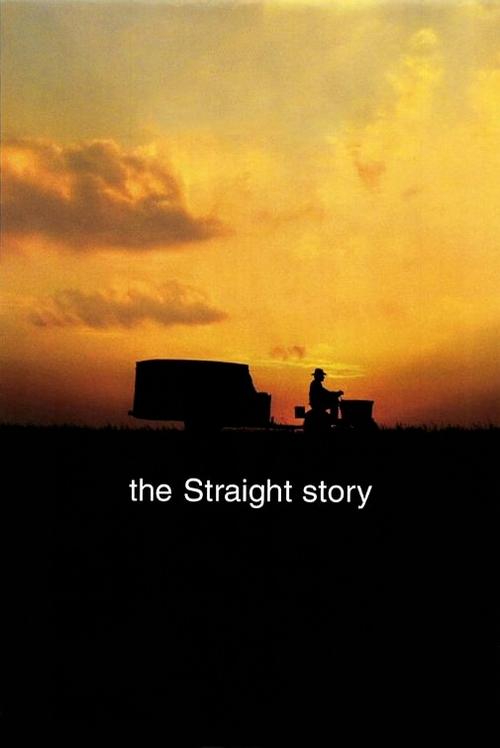
The Straight Story
1999 · David Lynch
His January 2025 death was a global grief event that revealed how central he'd become to young cinephile identity; "Fix your hearts or die" and the daily weather reports became memorial memes. The reference point for everything called "Lynchian."
For a gentle night when you want to feel something clean and true — about family, aging, and forgiveness. Pure comfort, but the kind that can leave you in tears.
What it's about
Alvin Straight, a 73-year-old widowed farmer in Iowa, hears that his estranged brother in Wisconsin has had a stroke. He wants to make peace while there's still time — but he has no car and no license, so he drives the three hundred miles on a riding lawnmower, at five miles an hour, camping along the road. Based on a true story.
The experience
Slow in the best sense: patient, tender, and quietly funny, moving at the speed of its hero and finding grace in every roadside encounter. It sneaks up on you — by the end the simplest gestures carry enormous weight.
Performances
Richard Farnsworth, a former stuntman in his late seventies and terminally ill during filming, gives a performance of extraordinary dignity and weathered warmth — it earned him an Oscar nomination for Best Actor.
The craft
David Lynch tells it, as the title promises, straight: unhurried widescreen views of Midwestern farmland, an aching Angelo Badalamenti score, and a rhythm that makes patience itself the point. The famously strange director's most tender film, and the landscapes reward a big screen.
Why it matters
The great outlier in Lynch's career — proof that his feeling for small-town America was love, not just menace — and it's become a touchstone for films about aging and reconciliation.
Snapshot
The Straight Story is David Lynch's account of a true American errand: in 1994 Alvin Straight, a 73-year-old widower from Laurens, Iowa, learned that his estranged brother had suffered a stroke and set out to reconcile with him in Mount Zion, Wisconsin—a journey of some three hundred miles made, for want of a driver's license, on a riding lawnmower at roughly five miles an hour. Lynch, working from a screenplay by John Roach and his longtime editor-producer Mary Sweeney, turned this newspaper-worthy oddity into a plain-spoken, elegiac road film. The title carries the pun the whole project rests on: it is the story of a man named Straight, told straight. Richard Farnsworth, a former stuntman then in his late seventies and terminally ill, plays Alvin; the performance earned him an Academy Award nomination for Best Actor. Rated G and distributed in the United States by Walt Disney Pictures, the film is routinely described as the most anomalous entry in Lynch's catalog—and, by Lynch himself, as among his most sincere works.
Industry & production
The film sits at an unusual industrial crossroads. Its creative core was thoroughly Lynchian—Asymmetrical Productions, Lynch's own outfit, alongside the French financiers (Canal+/Le Studio Canal+ and Les Films Alain Sarde) who had long underwritten his idiosyncratic projects—yet its American theatrical release came through Walt Disney Pictures, an arrangement that made "David Lynch's Disney movie" an inevitable and only half-joking press hook. The material originated with Mary Sweeney and John Roach, who were drawn to Alvin Straight's story from the news; Sweeney's Wisconsin roots gave the Upper Midwest setting a personal grounding. Sweeney served as producer and editor as well as co-writer, making the film in several respects her project as much as Lynch's.
Production famously followed the actual route. The company shot largely in continuity along the roads Alvin traveled through Iowa and into Wisconsin, an approach that lent the landscapes their documentary specificity and allowed the shoot itself to enact the film's slow forward crawl. The film premiered in competition at the 1999 Cannes Film Festival, an art-cinema imprimatur that sat comfortably beside its populist G rating. Precise budget and box-office figures are not something I can state with confidence here; the film is generally understood to have been a modest commercial performer buoyed by strong reviews and Farnsworth's awards run, but I won't attach numbers to that impression.
Technology
Technologically the film is deliberately unshowy. It was shot photochemically on 35mm by Freddie Francis using traditional lighting and camera craft rather than any novel apparatus, and its "special effects" are essentially meteorological and agricultural—weather, harvest light, and the machinery of the mower and combines. What technology matters here is diegetic and thematic: the 1966-vintage John Deere riding mower and its small trailer are the film's central mechanical objects, and the plot literally turns on obsolete, low-horsepower technology as a moral condition. Alvin's refusal (and inability) to travel by car, and his insistence on a machine that moves at walking pace, make the film's pace a function of period hardware. The production's technical conservatism is itself a statement in a year when Hollywood was accelerating toward digital spectacle.
Technique
Cinematography
Freddie Francis—an Oscar-winning cinematographer who had earlier shot The Elephant Man and Dune for Lynch, and for whom this was one of his last films—gives The Straight Story a serene, wide-gauge classicism. The signature images are of open country: fields of corn and grain rendered in warm, low-angled Midwestern light, frequently viewed in expansive wide shots and occasional overhead compositions that abstract the farmland into pattern and texture. Francis repeatedly cuts the human scale of the story against the immensity of the plains, so that Alvin and his mower become a small, patient mark moving across a vast horizontal field. The camera tends to hold, glide slowly, or observe from a distance rather than chase; the recurring motif of grain being harvested and skies darkening toward night gives the imagery a cyclical, seasonal weight appropriate to a film about the end of a life.
Editing
Mary Sweeney's editing is the film's temporal signature. Where Lynch's other work is often built on rupture and disorientation, here the cutting is measured and unhurried, willing to let a shot of the road, the sky, or Alvin's face run past the point of conventional utility. The episodic structure—Alvin's series of roadside encounters—is stitched together with an even, becalmed rhythm that mirrors the mower's five-mile-an-hour progress. The result asks the audience to slow to the protagonist's tempo, an act of formal patience that is inseparable from the film's meaning.
Mise-en-scène / staging
The staging favors the vernacular textures of small-town and rural America: front porches, grain elevators, roadside taverns, gravel shoulders, campfires. Interiors are modest and lived-in; the film's compositions place Alvin within, rather than against, this world. Lynch stages the many encounters as discrete two-hander scenes, often built around characters seated together—at a fire, on a porch, at a bar—which turns the film into a sequence of conversations and confessions rather than incidents. This chamber-like staging within an epic landscape is the film's central formal tension.
Sound
Sound design leans on the ambient—wind, insects, distant machinery, the low chug of the mower's engine—to establish the enveloping quiet of the countryside. Lynch's career-long attentiveness to atmospheric sound is present but redirected toward tranquility rather than dread. Anchoring it is Angelo Badalamenti's score, discussed below, whose recurring guitar-and-strings theme functions almost as the film's pulse.
Performance
The film is, above all, a performance vehicle for Richard Farnsworth. His Alvin is spare, weathered, and unsentimental—a portrait built from stillness, dry humor, and the visible effort of an aging body. The pathos is heightened by an offscreen fact widely reported around the film: Farnsworth was gravely ill during production, and he died the following year; his physical frailty reads as truth on screen. Sissy Spacek plays Alvin's daughter Rose with a halting speech pattern and a fierce, wounded tenderness, avoiding caricature in a role that could easily have tipped into it. Harry Dean Stanton—a Lynch regular—appears only at the very end as the brother Lyle, in a scene whose emotional weight depends almost entirely on what two old faces can convey without exposition. The supporting encounters (a runaway, cyclists, a fellow World War II veteran, feuding twin mechanics, a priest) are played in a naturalistic register that keeps the film grounded.
Narrative & dramatic mode
Structurally the film is a picaresque road narrative with a single, simple through-line—get to the brother before it is too late—elaborated by episodic wayside meetings. Its dramatic mode is confessional and reconciliatory: the encounters function less as obstacles than as occasions for Alvin to dispense or receive wisdom, and for the film to disclose his past in fragments (his war experience, his drinking, his estrangement from Lyle). The most concentrated of these, a nighttime exchange between two aging veterans in which Alvin admits to a wartime act that has haunted him, exemplifies the film's method of revealing character through quiet testimony rather than flashback or action. The narrative withholds the actual reunion until the final moments and refuses to over-dramatize it, trusting the accumulated journey to supply the feeling.
Genre & cycle
The film belongs to the American road movie, but it inverts nearly every convention of the form. The road movie is typically a genre of speed, youth, escape, and open-ended freedom; The Straight Story is slow, old, homeward-facing, and morally purposeful. It also draws on the pastoral and on the "true story" prestige mode. Within Lynch's own body of work it stands beside films like The Elephant Man as one of his excursions into humane, classically legible storytelling, and against the surreal cycles of Eraserhead, Blue Velvet, and the Twin Peaks universe. Its G rating and heartland sincerity make it a genuine outlier not only in Lynch's filmography but among prestige auteur cinema of the late 1990s.
Authorship & method
The film's authorship is genuinely shared. Lynch directs, but the writing and shaping came substantially from Mary Sweeney (co-writer, producer, editor), his longtime collaborator and partner, and John Roach, who together developed the true-story material. Lynch's contribution is often described—including by himself—as an experiment in restraint: applying his intense sensitivity to place, sound, and faces to a story with no darkness beneath the surface, or rather one in which the darkness (mortality, guilt, estrangement) is met openly rather than buried in the uncanny.
His key collaborators are, tellingly, the same figures who defined his more famous work redirected to gentler ends. Freddie Francis, the veteran British cinematographer and himself a noted director, brought decades of classical craft. Angelo Badalamenti, Lynch's regular composer since Blue Velvet and Twin Peaks, supplied a score of unusual tenderness—an aching, folk-inflected theme carried by guitar and strings that trades his signature ominous swells for warmth and melancholy. Sweeney's editing set the film's contemplative tempo. The through-line across these collaborations is that Lynch achieved his most atypical film not by changing his team but by turning its established sensibility toward sincerity.
Movement / national cinema
The Straight Story is a deeply American film in subject and setting—a portrait of the rural Midwest, its taciturn people and its harvested horizons—yet it was financed substantially by French capital and validated at Cannes, situating it within the international art-cinema economy that sustained American auteurs in the period. It belongs to no formal movement; if anything it stands within a personal tradition of American regionalist filmmaking attentive to landscape and the vernacular, filtered through an auteurist prestige apparatus. Lynch's standing as an artist beloved in France is part of the context that made a slow, G-rated character study by a cult director commercially and critically viable.
Era / period
Released in 1999, the film arrived at the close of a decade—and a century—increasingly defined by digital acceleration and franchise spectacle, and its analog patience reads partly as a rebuke to that moment. It also belongs to a late-1990s vogue for humane "true story" cinema. Internally, the film is steeped in a longer American past: Alvin's generation is the World War II generation, and the film's emotional substrata—wartime memory, agrarian labor, small-town endurance—reach back across the twentieth century even as the story unfolds in the mid-1990s present.
Themes
Its governing themes are reconciliation and forgiveness—between brothers, between a father and the past, between a man and his own mortality. Mortality suffuses the film: Alvin's failing body, the urgency of the errand, the sense that this is a last journey. Patience and time are both subject and form; the film argues, through its very pace, for the moral value of slowness and perseverance. Family and its long silences, the weight of pride, and the possibility of grace late in life recur throughout. Alongside these runs a quiet strain of the spiritual—wonder at the night sky, humility, the confession of old sins—rendered without dogma. Underlying everything is a vision of the American heartland as a place of decency and hard-won wisdom, a landscape the film treats with unironic reverence.
Reception, canon & influence
Critically the film was widely and warmly received, frequently singled out as a surprise from a director associated with the disturbing and the surreal, and praised for its restraint, its landscapes, and above all Farnsworth's performance. That performance became the centerpiece of its awards profile: Farnsworth's Best Actor nomination at the Academy Awards was noted for his advanced age, making him one of the oldest nominees in the category's history. The film's Cannes competition slot cemented its art-cinema standing. (Specific citation of every critics'-group award would risk overstatement, so I'll note the awards attention centered on Farnsworth and leave the fuller ledger there.)
Its influences run backward into the classical American road movie and the pastoral, and into Lynch and Francis's own earlier collaboration on humane, black-and-white-hearted material like The Elephant Man; the "true story" prestige tradition shaped its mode. Its forward legacy is twofold. Within Lynch scholarship it is essential evidence that his authorship is not reducible to the grotesque—proof that the same sensibility for place, sound, and the human face could produce tenderness. More broadly it stands as a durable model of the anti-road-movie: the road film emptied of speed and rebellion and refilled with reconciliation and age, a template later filmmakers of the slow, humane journey narrative can be measured against. The film also acquired a poignant afterlife through Farnsworth's death in 2000, which retrospectively fused actor and role into one of American cinema's more moving late performances.
A Deleuzian reading
A man on a riding lawnmower, towing a small trailer, crawling across a field of cut grain.
The full Deleuzian reading of The Straight Story →
Reception
In 1999 the headline was the cognitive dissonance: David Lynch making a G-rated Disney movie played like a lovely curveball. Since his death in January 2025 it's been fully reappraised as one of his most moving films — the 'sincere Lynch' people now hold up as the key to everything else he made.
How The Straight Story was received, from release to now →
How to watch The Straight Story: what to notice on a first viewing
- Notice the overhead shots that turn farmland into pattern. Freddie Francis repeatedly shoots the fields from above, abstracting rows and stubble into texture, with Alvin a small moving mark across them. The scale keeps reminding you how small a person is against the land he must cross.
- Watch how long shots run past the point of need. Mary Sweeney's editing lets ordinary shots of road, sky, or a face run well past where films normally cut away. The slow rhythm forces you to match Alvin's five-mile-an-hour pace instead of a plot's.
- Listen for wind, insects, and the mower's steady engine chug. Ambient countryside noise fills most scenes, with Angelo Badalamenti's guitar-and-strings theme entering only at chosen moments. The quiet keeps the land present as a constant, not just a backdrop to the errand.
- Watch each encounter staged as two people seated together. Almost every stranger Alvin meets ends up across from him at a fire, a porch, or a bar. The chamber-sized scenes turn a road movie into a string of conversations instead of incidents.
The whole guide to watching The Straight Story, with the keys for a rewatch →
Influences: the films it descends from and the films it influenced
- The Elephant Man (1980) — First Lynch–Freddie Francis pairing, establishing the template of Francis's monochrome classical lighting used to dignify a fragile body and turn Lynchian intensity toward humanist tenderness rather than the grotesque.
- Blue Velvet (1986) — Originated the Lynch–Badalamenti scoring method of aching, string-and-mood cues; The Straight Story inverts that ominous swell into folk-guitar warmth using the identical collaborative process.
- Sons and Lovers (1960) — Freddie Francis's Oscar-winning CinemaScope black-and-white here forged the wide-gauge landscape classicism—horizon-anchored framing of open country—he later brings to the Iowa/Wisconsin plains.
- The Innocents (1961) — Francis's deep-focus CinemaScope staging of figures small within vast space is the compositional grammar reprised in the film's tractor-in-the-fields long shots.
- Wild Strawberries (1957) — Supplies the picaresque-road-as-confessional structure: an aged man's slow physical journey organized as episodic reckoning with estrangement, guilt, and approaching death.
- Umberto D. (1952) — Neorealist patience with an elderly protagonist—observation over melodrama, letting mundane duration carry dignity—models the film's refusal to sentimentalize old age.
- The Grapes of Wrath (1940) — Ford's populist framing of the American road as regional national landscape, humane faces set against dust and distance, underwrites the film's Midwestern regionalism.
- Easy Rider (1969) — The canonical speed-and-rebellion road-movie template that The Straight Story deliberately empties and rebukes—same open-road iconography stripped of counterculture velocity.
- Two-Lane Blacktop (1971) — Existential machine-as-journey minimalism, the vehicle itself as the film's organizing metronome, precedes the lawnmower's role as both engine and clock.
- Rain Man (1988) — A road movie of behavioral patience across naturalistic vernacular American landscape, scored without sentimental underlining — the stillness-vs-mobile-coverage and non-sentimental scoring Rain Man modeled.
- About Schmidt (2002) — Extends the aging-man solo road trip as a vehicle for belated reckoning, deadpan Midwestern regionalism observed without irony toward the destination-as-reconciliation.
- Nebraska (2013) — Directly echoes the model: a stubborn elderly father's slow overland journey through the Plains, shot in stark monochrome, resolving an estranged parent-child bond.
- The Rider (2017) — Non-professional casting and regional landscape realism, measured cutting that lets weathered real faces and prairie light hold the frame in the Farnsworth manner.
- Nomadland (2020) — The anti-road-movie perfected—travel emptied of rebellion and refilled with grief, mortality, and non-actor testimony over vast Western vistas.
- Lucky (2017) — Built around Harry Dean Stanton's valedictory late performance that fuses actor and role in the face of death, the same actor-mortality collapse Farnsworth's passing gave this film.
- Old Joy (2006) — Measured slow-cutting and ambient quiet turn a small journey between two men into a chamber study of drift and regret—minimalist regional Americana descended from this template.
- Meek's Cutoff (2010) — Patience-as-form pushed to endurance: the overland journey pared to duration, hardship, and landscape, cutting withheld to make waiting the subject.
- The Station Agent (2003) — Lynch's patient road movie of a solitary old man crossing landscape at machine-pace — slow rhythm, diegetic engine sound over score, dignity granted to an unhurried obsessive — is the closest formal precedent for the train-walker's tempo.
- The Blue Trail (2025) — Models the slow vehicular pilgrimage of an aged protagonist across landscape, pairing deadpan tenderness with patient widescreen vistas.
- Into the Wild (2007) — An elegiac American road movie built from real rural locations and reverent, unhurried landscape framing, proving the road-picture could be contemplative and mortality-haunted rather than kinetic.
- Days of Heaven (1978) — Magic-hour wide-gauge pastoral of the American plains—ambient natural sound and landscape as co-protagonist—shares the film's contemplative attention to sky, grass, and light.
- Paris, Texas (1984) — Slow humane traversal of the American interior toward familial reconciliation, roots-music score and unhurried cutting privileging silence over incident.
- Kikujiro (1999) — A quiet episodic road film built on patient static compositions and withheld sentiment, reaching catharsis only obliquely — the same restraint Kitano applies to the man-and-boy trip.
- Perfect Days (2023) — Lynch's patient, unironic portrait of an old man's simple journey — slice-of-life tenderness and durational calm centered on an elderly protagonist's small resolve.
- A Man Called Otto (2022) — A restrained elderly-grief drama whose patient, unironic sentiment toward an old man reckoning with mortality is the tonal-modulation Otto aims for beneath its comedy.
- Hit the Road (2021) — A road movie that trades incident for duration and static wide compositions of a lone vehicle in vast landscape, matching Hit the Road's confinement-vs-vastness framing and withheld pacing.
Similar films
- Nebraska (2013) — influence & lineage
- Paris, Texas (1984) — influence & lineage
- Blue Velvet (1986) — influence & lineage
- The Elephant Man (1980) — influence & lineage
- Days of Heaven (1978) — influence & lineage
- The Grapes of Wrath (1940) — influence & lineage · often watched together
- Wild Strawberries (1957) — influence & lineage · often watched together
- Umberto D. (1952) — influence & lineage · often watched together
All the films related to The Straight Story →
Watch it with: curated runs of related films
- Unlikely Companions, Gentle Roads — Watch these together for the way a mismatched pair — a yakuza and a lost boy, an old man on a lawnmower bound for his brother, a runaway kid and a grizzled uncle, two frontier drifters with a stolen cup of milk — becomes a whole small world; they rhyme on tenderness carried at walking pace.