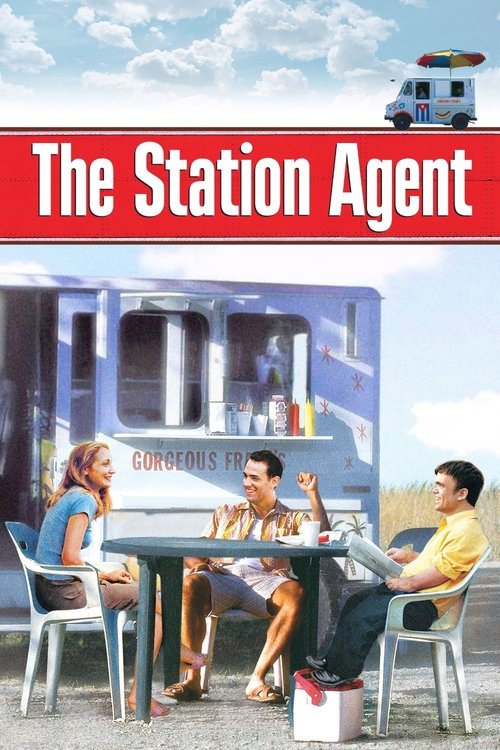
The Station Agent
2003 · Tom McCarthy
For a quiet night when you're feeling a little alone and want a film that's kind without being sappy — pure comfort, the cinematic equivalent of sitting on a porch with good company. Zero challenge, all warmth.
What it's about
A reserved man with dwarfism who loves trains inherits a disused railroad depot in tiny Newfoundland, New Jersey, and moves in hoping to be left alone. Solitude doesn't take: a relentlessly chatty hot-dog-truck vendor parks outside his door, and a grieving painter nearly runs him over — twice. What follows is the slow, reluctant formation of a friendship among three people who each carry a private loss.
The experience
Gentle, unhurried, and quietly funny — the film ambles at walking pace and lets silences do the talking. It sneaks up on you; by the end you feel like you've made three friends, and the emotion lands harder for never being forced.
Performances
Peter Dinklage, in the role that made his name, does wonders with stillness and reserve — he makes silence expressive. Bobby Cannavale is irresistible as the motormouth who won't take the hint, and Patricia Clarkson gives grief a rumpled, funny, human face.
The craft
Tom McCarthy's debut script trusts small moments — walking the rails, sharing coffee, saying nothing — and the direction has an actor's patience for behavior over plot. Rural New Jersey is shot with an off-season hush that makes the whole film feel like a held breath.
Why it matters
A signature Sundance discovery of its year, it launched McCarthy as a filmmaker and proved Dinklage was a leading man years before television caught on. It remains a touchstone for small-scale American indies about ordinary connection.
Snapshot
The Station Agent is the feature directing debut of Tom McCarthy, a working character actor who turned to writing and directing with a small, unhurried chamber piece about three lonely people who fall into an unlikely friendship in rural New Jersey. Finbar McBride (Peter Dinklage), a reserved man with dwarfism who loves trains, inherits a disused railroad depot in the hamlet of Newfoundland and moves there seeking solitude; he is instead drawn out by Joe (Bobby Cannavale), a gregarious hot-dog-truck vendor minding his father's stand, and Olivia (Patricia Clarkson), a painter unraveling after the death of her young son. The film premiered at the 2003 Sundance Film Festival, where it became one of the festival's signature discoveries, and was released theatrically by Miramax. Its lasting significance is twofold: it announced McCarthy as a distinctive humanist filmmaker who would go on to make The Visitor, Win Win, and the Oscar-winning Spotlight, and it gave Peter Dinklage the leading role that established him as a major actor years before Game of Thrones. It remains a touchstone of early-2000s American independent cinema's quiet, performance-driven mode.
Industry & production
The Station Agent belongs to the post-Sundance, Miramax-era ecosystem of American independent film, in which modestly budgeted character pieces could find theatrical distribution through specialty divisions and festival validation. It was produced under the SenArt Films banner, with producers including Robert May and Mary Jane Skalski; the budget was small even by independent standards (widely reported in the very-low-six-figures-to-around-half-a-million range, though I would treat any single precise figure with caution). The shoot took place on location in New Jersey, including the Newfoundland/Dover rail corridor that gives the film its setting and its actual disused depot.
The film's industrial story is essentially a festival success story. It debuted at Sundance in January 2003 and was acquired by Miramax (then the dominant force in prestige independent distribution). Its modest scale was inseparable from its method: a short schedule, a small cast, real locations, and a script built around three actors rather than spectacle. The economics of such a film depended less on opening-weekend grosses than on critical goodwill, awards-season visibility, and platform release. On those terms it performed well above expectations for a debut of its size, earning a long, word-of-mouth-driven run rather than a wide opening.
Technology
This is a film of deliberately modest technological means, and that modesty is part of its aesthetic. It was shot photochemically on film in the early-2000s window before digital capture became standard for low-budget work; the look is grainless and naturalistic rather than showy, and I would not over-specify the gauge beyond noting it was a film-originated production. There are no visual effects of consequence, no elaborate camera rigs, and no reliance on the digital-intermediate color pipelines that were only then becoming common. The technology that matters here is, fittingly, the technology within the story — the railroad. Trains, depots, timetables, and the amateur practice of "railfanning" (trackside train-watching and filming) are the film's central machinery, and McCarthy treats this analog, nineteenth-century infrastructure as both subject and metaphor: obsolete, patient, and quietly beautiful. The film's interest in old rail technology mirrors its interest in unhurried human connection.
Technique
Cinematography
The cinematography, by Oliver Bokelberg, is governed by a single organizing problem that few films have confronted so directly: how to photograph a protagonist of short stature without either condescending to him or sensationalizing his body. Bokelberg and McCarthy solve this largely through eye-level framing that takes Finbar's sightline as the camera's default, so that the world is composed at his scale rather than looming over him. The visual scheme is restrained and observational — natural light, available-light interiors, unfussy compositions that let the New Jersey landscape (woods, tracks, the small-town main drag) register as a real place rather than a quaint backdrop. Long lenses and patient holds give scenes room to breathe, and the recurring motif of Finbar walking the tracks, often framed in wide shot, visually states the film's themes of solitude and forward motion. The restraint is purposeful: the camera watches rather than editorializes, which is the same posture the film asks its characters (and its audience) to adopt toward Finbar.
Editing
Cut by Tom McArdle — who would become McCarthy's regular editor across subsequent features — the film's editing is unhurried and rhythmically attuned to performance and silence. Scenes are allowed to run past the point a more conventional comedy or drama would cut, trusting reaction shots, pauses, and the discomfort of small talk to carry meaning. The cutting privileges the texture of waiting: trains arriving, conversations stalling, three people slowly acclimating to one another. This patient rhythm is the film's signature, and it is an editorial achievement as much as a directorial one — the comedy and the melancholy both live in timing.
Mise-en-scène / staging
The film's mise-en-scène is anchored in real, lived-in locations: the cramped depot Finbar makes his home, Joe's hot-dog truck parked by the roadside, the diner, the small-town library, the tracks themselves. Staging repeatedly dramatizes scale and stares — the way strangers, children, and shopkeepers look at Finbar — and McCarthy blocks these encounters to register the social weight of being constantly watched without milking them. Conversely, the friendship scenes are staged with an easy informality (sitting trackside, drinking, walking) that visually equalizes the three leads. Props carry thematic load: trains and train memorabilia for Finbar, the hot-dog cart for Joe, paintings and a car for Olivia, each a vessel for solitude or grief.
Sound
Stephen Trask — best known for the Hedwig and the Angry Inch songbook — composed a gentle, predominantly acoustic score that avoids underlining emotion, used sparingly to mark the growth of the central friendship. Equally important is the film's location sound design: the rumble and horn of passing trains, the ambient quiet of the rural setting, the dead air of awkward conversation. Silence is a structural element here; the film's sound world is built to make solitude audible and to let comic and painful beats land without musical cueing.
Performance
Performance is the film's true medium, and its three leads form one of the finest small ensembles of the decade. Peter Dinklage plays Finbar with a contained, watchful dignity, building a character almost entirely out of guardedness and small thaws; he resists both sentimentality and self-pity, making Finbar's reticence feel like hard-won self-protection rather than a screenwriting device. Bobby Cannavale's Joe is his exuberant counterweight — needy, warm, comically relentless — and the friendship reads as genuine because Cannavale plays the loneliness underneath the chatter. Patricia Clarkson, as Olivia, gives the film its register of raw grief, her distractedness and sudden warmth conveying a woman barely holding together. The interplay among the three — and supporting turns including Michelle Williams as a small-town librarian and Raven Goodwin as a curious young train enthusiast — is the substance of the film.
Narrative & dramatic mode
The screenplay is a character-driven, episodic drama in a minor key, structured not around plot mechanics but around the gradual, halting formation of a found family. Its dramatic mode blends understated comedy with genuine pathos — closer to the deadpan humanism of certain American and European chamber dramas than to either broad comedy or melodrama. There is little conventional incident; the "events" are conversations, walks, a film night for local children, small ruptures and reconciliations. The film withholds backstory and exposition, revealing its characters through behavior. Its arc is internal: Finbar's movement from chosen isolation toward reluctant connection, mirrored by Joe's and Olivia's own loneliness. The tone management is the achievement — the film is frequently funny and frequently sad within the same scene, never tipping into the maudlin.
Genre & cycle
The Station Agent sits within the American independent "small-town outsiders find each other" tradition — the indie character study or "dramedy" that flourished in the Sundance-Miramax years. It is a film of the early-2000s cycle of low-budget, dialogue-driven ensemble pieces that prized authenticity of place and performance over genre machinery. It can be read alongside other quietly humane indies of its moment that treated loneliness, grief, and unlikely friendship with deadpan tenderness. It is notable within its cycle for centering a disabled protagonist without making disability a "problem-of-the-week" subject; the film is about a person who happens to have dwarfism, and about the way the world treats him, rather than a message movie.
Authorship & method
The Station Agent is a strikingly assured debut for Tom McCarthy, who wrote and directed it. McCarthy came to filmmaking as an actor (his on-screen work includes roles in films and, later, a memorable turn as a fabulist journalist in the final season of The Wire), and that background informs his method: he writes for actors, casts precisely, and directs through performance and patience rather than visual flourish. The film inaugurates a recognizable McCarthy authorship — empathetic, observational dramas about outsiders and unlikely bonds — that continues through The Visitor (2007) and Win Win (2011) and culminates, in a very different register, with Spotlight (2015), which won the Academy Award for Best Picture. (His misfire The Cobbler belongs to the same career but is the exception that proves the humanist rule.)
Crucially, McCarthy wrote the role of Finbar with Peter Dinklage in mind, and the collaboration is foundational to both careers. Among key collaborators: cinematographer Oliver Bokelberg, whose naturalistic, eye-level shooting solves the film's central representational challenge; editor Tom McArdle, who establishes the patient rhythm that becomes a McCarthy hallmark and who continued to cut the director's later work; and composer Stephen Trask, whose restrained acoustic score honors the film's quiet. The producing team at SenArt Films, including Mary Jane Skalski and Robert May, enabled the low-budget, location-based production model.
Movement / national cinema
The film is a product of American independent cinema in its post-1990s, festival-driven phase — the world of Sundance premieres and specialty distribution. It does not belong to a formal movement so much as to a sensibility: the humanist, performance-first strain of US indie filmmaking that valued small stories told with naturalism and restraint. In its patience, its attention to ordinary loneliness, and its refusal of plot-heavy resolution, it shows affinities with European art-cinema traditions of the everyday, even as its setting, idiom, and comic timing are distinctly American.
Era / period
The Station Agent is a contemporary-set film of the early 2000s, and it is very much of that moment in the independent-film economy: the last stretch before digital capture, streaming, and the contraction of the specialty-distribution business reshaped how such films were made and seen. It arrived when a debut could still break out through a single festival and a theatrical platform release sustained by reviews and word of mouth. Its rural New Jersey setting is deliberately timeless and slightly out of step with the contemporary world — old trains, a defunct depot, a town where little happens — which suits the film's interest in people who feel left behind by the pace of modern life.
Themes
The film's central theme is the tension between chosen solitude and the human need for connection. Finbar has built a life designed to minimize contact, both because he prefers trains to people and as armor against a world that stares; the film traces how friendship breaches that defense without erasing his right to privacy. Loneliness and grief run through all three protagonists — Finbar's self-imposed isolation, Joe's restless need to be liked, Olivia's devastation after losing her child. Closely related is the film's quiet but pointed treatment of disability and the gaze: McCarthy stages the everyday indignity of being constantly looked at, objectified, photographed, or condescended to, and makes the audience aware of its own potential complicity, while insisting on Finbar's full interiority. Found family — the idea that belonging can be built among strangers — is the film's redemptive counterweight. Trains supply the governing metaphor: things that move on a fixed track, arrive and depart on schedule, and reward patient watching.
Reception, canon & influence
Critically, The Station Agent was warmly and widely praised, particularly for its screenplay and its central performances; it emerged from Sundance 2003 as one of the festival's most-liked films and carried that goodwill through its theatrical release. It won the festival's Audience Award in the dramatic competition and the Waldo Salt Screenwriting Award for McCarthy, and the screenplay went on to further recognition, including a BAFTA award for original screenplay; the cast and film drew assorted Independent Spirit and other awards-season nominations. (I'd flag that the exact roster of wins versus nominations across the season is easy to garble, so the headline facts — Sundance acclaim, screenplay honors, ensemble praise — are the safe ground.)
Influences on the film are best located in McCarthy's actor's sensibility and in the broader lineage of understated, character-driven independent drama rather than in any single named precursor; the film's debt is to a tradition of humanist, location-based, performance-first storytelling rather than to a specific stylistic model, and McCarthy has generally framed the project as character- and casting-driven.
Its influence forward is considerable for so small a film. Most directly, it launched Peter Dinklage as a leading actor, demonstrating that a performer with dwarfism could carry a film as a fully realized romantic and dramatic protagonist — a precedent whose importance grew as Dinklage became a star. It established Tom McCarthy's career and the humanist-indie template he would refine through to Spotlight. And it helped consolidate, within the Sundance-era indie canon, a model for the quiet ensemble dramedy that prizes empathy, restraint, and place. More than two decades on, it is remembered as a near-perfect small film and a case study in how to build something moving out of three lonely people, a depot, and the trains that pass.
A Deleuzian reading
Start with the image the whole film is built to honor: a small man standing trackside with a camcorder, perfectly still, while a freight train tears past him filling the frame.
The full Deleuzian reading of The Station Agent →
Reception
A tiny Sundance darling in 2003 — it won the Audience Award and left Park City as the year's feel-good indie — and it's since settled into 'quiet comfort classic' status, now doubling as the film cinephiles point to as proof Peter Dinklage was a leading man years before Game of Thrones.
How The Station Agent was received, from release to now →
Influences: the films it descends from and the films it influenced
- Tokyo Story (1953) — The film's low, eye-level framing and patient hold on figures in repose descend directly from Ozu's tatami-height camera and contemplative cutting, which let stillness register loneliness without dialogue.
- Stranger Than Paradise (1984) — McCarthy inherits Jarmusch's deadpan episodic minimalism — long static takes of marginal people in unglamorous American spaces, finding comedy and pathos in the dead air between sparse lines.
- Paris, Texas (1984) — The solitary man read against a flat American landscape, shot in available-light naturalism with the figure dwarfed by the horizon, is the Wenders/Müller compositional grammar Bokelberg adapts to a walking train-tracker.
- Local Hero (1983) — Forsyth's template — an outsider lands in a fixed small place and is slowly absorbed by an eccentric community — supplies the gentle tonal blend of melancholy and dry comedy McCarthy builds the depot around.
- Smoke (1995) — A cast of lonely urbanites converging on one humble fixed location (the cigar shop) to form a chosen family, structured as conversation-driven vignettes, prefigures the depot-and-coffee-cart ensemble architecture.
- The Straight Story (1999) — Lynch's patient road movie of a solitary old man crossing landscape at machine-pace — slow rhythm, diegetic engine sound over score, dignity granted to an unhurried obsessive — is the closest formal precedent for the train-walker's tempo.
- You Can Count on Me (2000) — Lonergan's screenplay-first, performance-driven indie — restrained naturalism, lonely people circling unlikely intimacy, comedy emerging from precisely written behavior — is the immediate Sundance-era model McCarthy refines.
- Trees Lounge (1996) — Buscemi's actor-turned-director method — casting precisely, directing through behavior, anchoring an ensemble to a single watering-hole location — is the same craft path McCarthy walks from acting into a location-bound character study.
- The Visitor (2007) — McCarthy and editor Tom McArdle reprise the exact formula — a closed-off solitary man cracked open by unlikely outsiders, paced in patient observational beats with a restrained acoustic score.
- Win Win (2011) — The humanist tonal blend of comedy and moral ache, built from a small ensemble in a real working-class locale and cut to McArdle's signature unhurried rhythm, directly extends the Station Agent method.
- Spotlight (2015) — Transposed to a procedural, it keeps the core McCarthy craft — eye-level restraint, no visual flourish, an ensemble directed entirely through understated performance and silence over score.
- The Ballad of Wallis Island (2025) — Chamber piece of a withdrawn man and persistent unlikely intruders in a single fixed rural location, modeling the triangulated comedy of reluctant companionship.
- Lars and the Real Girl (2007) — Shares the tightrope tonal blend — a small community quietly extending grace to a socially isolated outsider — played straight and warm rather than for ridicule, the same empathy-first register.
- Old Joy (2006) — Reichardt's minimalist two-hander runs on the same engine: diegetic silence, available-light naturalism, slow rhythm, and male solitude expressed through what goes unspoken between companions.
- Wendy and Lucy (2008) — A solitary figure in unglamorous American margins, shot in long-take available light with sparse-to-absent score, extends the same restraint-as-empathy aesthetic to economic isolation.
- Sideways (2004) — Payne's contemporaneous character study braids comedy and loneliness through lonely men bonding over a shared ritual (wine as the trains are here), the same dramedy-of-restraint the indie canon consolidated in 2003–04.
- Little Miss Sunshine (2006) — The Sundance ensemble dramedy of misfits — empathy, episodic structure, comedy that never punches down at its outsiders — is the broader template The Station Agent helped codify and this film popularized.
- Elling (2001) — A character-led comedy of social isolates who form an improbable family, built on contrasting physicality and the slow accretion of small episodic encounters rather than incident.
Similar films
- You Can Count on Me (2000) — influence & lineage
- Paris, Texas (1984) — influence & lineage · same viewing thread
- Train Dreams (2025) — same viewing thread
- Noi the Albino (2003) — same viewing thread
- Dogville (2003) — shared sensibility
- The Banshees of Inisherin (2022) — shared sensibility
- Small Things Like These (2024) — shared sensibility
- Ghostlight (2024) — shared sensibility
All the films related to The Station Agent →
Watch it with: curated runs of related films
- Quiet Lives at the World's Edge — Watch these when you want a life pared down to essentials — someone walking out of society to start from zero, or simply living out their days at the margins.