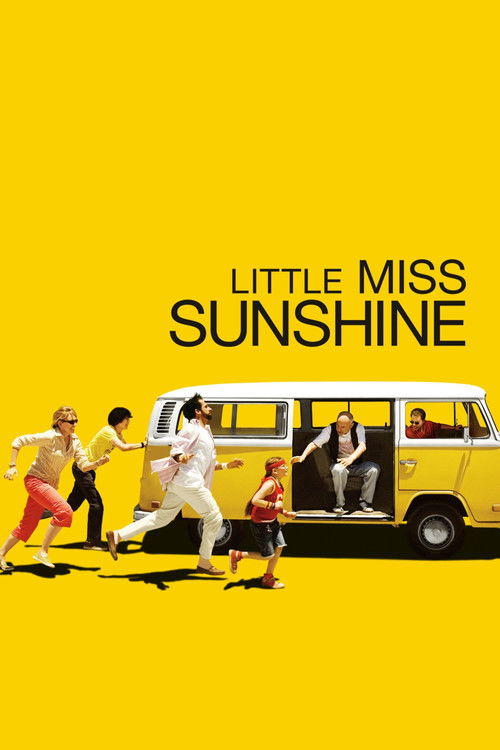
Little Miss Sunshine
2006 · Valerie Faris
For when you need a laugh and a small cry at once — comfort viewing about people falling apart, perfect with other humans in the room. The go-to when someone says 'something funny but with heart.'
What it's about
The Hoover family of Albuquerque — a failing motivational speaker, his fraying wife, a suicidal scholar uncle, a teenage son sworn to silence, a foul-mouthed grandfather, and seven-year-old Olive — cram into a dying yellow VW bus and drive to California so Olive can compete in a kids' beauty pageant. Every mile shakes something loose, and the trip becomes a test of what this family actually owes each other.
The experience
Funny and sad in the same breath — deadpan comedy of family friction that keeps sneaking up on you with real tenderness. By the end it's the rare crowd-pleaser that earns its catharsis.
Performances
Alan Arkin won an Oscar as the heroin-snorting, fiercely loving grandfather; Steve Carell is a revelation in a quiet dramatic turn; Abigail Breslin's Olive is completely unaffected; Paul Dano says almost nothing and steals scenes anyway.
The craft
Michael Arndt's Oscar-winning debut screenplay is a machine of setups and payoffs that never feels mechanical, and directors Jonathan Dayton and Valerie Faris shoot the sun-bleached highway West with an eye for both absurdity and grace. The battered yellow bus becomes a running gag and a symbol without anyone underlining it.
Why it matters
A Sundance sensation turned mainstream Oscar winner, it fixed the template for the bittersweet indie family dramedy and proved small ensemble films could cross over big.
Snapshot
Little Miss Sunshine is a road-trip ensemble comedy that became, against considerable odds, one of the defining American independent films of its decade — a Sundance acquisition that crossed over into mainstream success and an Academy Award winner that helped fix the template for the bittersweet, indie-inflected family dramedy. Directed by the husband-and-wife team of Jonathan Dayton and Valerie Faris (the assignment credits Faris alone; the film is in fact a co-direction, and the pair are inseparable from its authorship) from a debut screenplay by Michael Arndt, it follows the dysfunctional Hoover family of Albuquerque as they cram into a failing yellow Volkswagen Microbus and drive to Redondo Beach so that young Olive can compete in a children's beauty pageant. What begins as a comedy of friction — a household of strivers and depressives forced into close quarters — resolves into a quietly subversive parable about the American ideology of winning and losing. Its lasting image, the family clambering uninvited onto a pageant stage to dance alongside Olive's deliberately inappropriate routine, became one of the most cited closing sequences in 2000s American film. The picture earned four Oscar nominations, winning Best Original Screenplay and Best Supporting Actor (Alan Arkin), and turned an roughly $8 million production into a substantial international hit.
Industry & production
The film's production history is, in many respects, its own underdog narrative. Michael Arndt, a former assistant to Matthew Broderick, wrote the spec script in the early 2000s; it circulated in Hollywood for years and was optioned and developed at Focus Features before the project lapsed and was revived under the producing banner Big Beach, with Marc Turtletaub and David Friendly among the principal producers. Turtletaub's personal financing was a significant factor in the film getting made at all, since the property had spent a long stretch in development limbo. The budget was modest — reported figures cluster around $8 million — and the shoot, on location across the Southwest, was correspondingly tight, completed in roughly a month.
The film's commercial breakthrough came at the 2006 Sundance Film Festival, where it premiered to enthusiastic response and triggered a competitive bidding war. Fox Searchlight Pictures acquired worldwide rights in a deal widely reported at around $10.5 million — at the time one of the largest acquisitions in the festival's history, and a figure exceeding the film's own production cost. Searchlight, then at the height of its run as the industry's premier specialty distributor, platformed the release through the summer of 2006, and the film became a sustained word-of-mouth success, eventually grossing roughly $100 million worldwide against its small budget. Exact box-office tallies vary by source, but the broad outcome — a multiple of well over ten times its cost — is firmly established. The Sundance sale and subsequent performance are frequently invoked as a high-water mark for the mid-2000s specialty-distribution economy, the model that Searchlight, Miramax, and Focus rode before the contraction of the indie market later in the decade.
Technology
Little Miss Sunshine is not a technologically forward film, and that restraint is part of its identity. It was shot on 35mm film — the standard for studio-specialty production in 2006, before the digital transition reshaped low-budget filmmaking — and it relies on conventional location shooting rather than visual effects or stylized digital manipulation. The most "technological" aspect of the production is in fact its anti-technological texture: the failing VW Microbus, with its broken clutch requiring a running push-start and its stuck horn, is a practical comic device, and the film leans on the analog physical comedy of a machine that will not behave. There is no meaningful body of evidence that the film innovated at the level of capture, post-production, or exhibition technology; its achievement lies in craft and performance rather than apparatus, and it would be a fabrication to claim otherwise.
Technique
Cinematography
Tim Suhrstedt's photography is unshowy and functional in the best sense, built around the constraints of staging an ensemble inside a cramped van and across the flat, sun-bleached geography of the American Southwest. The visual scheme favors warm, saturated daylight and the horizontal expanse of highway, a palette anchored by the bright yellow of the bus against desert and asphalt. Suhrstedt frequently composes for the group, holding multiple Hoovers in frame to keep the family's collective dysfunction legible in a single image, and the interior van sequences make a virtue of confinement, packing bodies and faces into tight, comic arrangements. The look is naturalistic and character-serving rather than self-consciously beautiful — a deliberate choice that keeps attention on performance and on the absurdist rhythm of the journey.
Editing
Pamela Martin's editing is central to the film's tonal control, which is its most difficult technical feat: the picture pivots constantly between broad comedy and genuine grief, and the cutting modulates these shifts without whiplash. Martin paces the road movie around its set-piece disasters — the clutch, a death, a heartbreaking discovery of color-blindness — and builds the climactic pageant sequence with a crosscutting structure that escalates discomfort before releasing it into communal absurdity. The film's reputation for landing emotional turns cleanly within a comic frame owes a great deal to the editorial architecture; Martin's work was recognized within the industry as a key contribution to the film's success.
Mise-en-scène / staging
The film's staging is organized around enclosure and escape. The VW bus is the dominant set — a mobile pressure-cooker that forces six incompatible people into proximity — and the directors stage the family's conflicts within and around it with a strong sense of physical comedy and spatial logic. The motivational-poster aesthetic of Richard's "Nine Steps" self-help world, the antiseptic blandness of roadside diners and hospitals, and finally the grotesque, over-sexualized spectacle of the children's pageant all function as a visual argument: the production design contrasts the family's shabby authenticity against the glossy, hollow surfaces of American success culture.
Sound
The film's musical identity is unusually distinctive. The score combines original composition by Mychael Danna with the music of the Denver-based band DeVotchKa, whose Eastern-European-inflected, accordion-and-strings sound gives the road sequences their wistful, slightly melancholic lift; the band's "Till the End of Time" is closely associated with the film. Against this plaintive score, the climax detonates a pointed needle-drop — Rick James's "Super Freak," to which Olive performs the burlesque routine taught to her by her late grandfather — and the collision of innocent child and adult source music is the engine of the scene's transgressive comedy. The sound design otherwise privileges the practical: the labored mechanics of the bus, the stuck horn, the silences of a household that has stopped communicating.
Performance
The ensemble is the film's foundation, and its casting is frequently cited as a model of comic chemistry. Greg Kinnear plays Richard, the failing motivational speaker whose entire worldview is staked on the binary of winners and losers; Toni Collette grounds the film as Sheryl, the exhausted mother holding the family together; Steve Carell — cast against his then-emerging comic persona — delivers a restrained, wounded turn as Frank, a suicidal Proust scholar; Paul Dano plays the teenage Dwayne, who has taken a Nietzsche-inspired vow of silence; and Abigail Breslin, as Olive, supplies the unguarded sincerity around which the satire pivots. Alan Arkin, as the heroin-using, foul-mouthed Grandpa Edwin, won the Academy Award for Best Supporting Actor, and Breslin's nomination for Best Supporting Actress made her one of the youngest nominees in the category's history. The performances are calibrated so that each character is both a comic type and a genuinely felt person — the precise balance the film needs to keep its satire from curdling into cruelty.
Narrative & dramatic mode
Structurally, the film is a classical road movie: a journey with a fixed destination and a ticking clock (the pageant deadline) that licenses a string of episodic incidents, each stripping away one of the family's illusions. Arndt's screenplay distributes a clear thematic burden across the ensemble — every Hoover is defined by a relationship to ambition, achievement, or failure — and then systematically dismantles each character's defining hope: Richard's book deal collapses, Dwayne's dream of flight school is destroyed by a colorblindness diagnosis, Frank confronts his professional and romantic humiliation, and Grandpa dies en route. The dramatic mode is tragicomic in the truest sense: the narrative repeatedly stages catastrophe and then finds, in the family's stubborn solidarity, a form of comic grace. The much-admired ending inverts the competition itself — the family rejects the pageant's values by embracing Olive's "failure" so completely that disqualification becomes triumph.
Genre & cycle
The film sits at the intersection of the road movie, the ensemble family comedy, and the Sundance "indie dramedy" — the mode of small-scale, character-driven, tonally mixed American independent film that flourished in the late 1990s and 2000s. It belongs to a recognizable cycle of quirky, melancholic family comedies associated with that period and with Fox Searchlight in particular; it is frequently grouped, in critical retrospectives, with films like The Royal Tenenbaums, Garden State, and Juno (the last of which Searchlight released the following year) as exemplars of a sensibility that married deadpan eccentricity to earned sentiment. Its enormous commercial success also made it something of a genre touchstone, and the "dysfunctional family piles into a vehicle" premise became common enough afterward that the film is sometimes blamed for the subsequent commodification of indie whimsy — a charge that says more about its imitators than about the picture itself.
Authorship & method
The film is the work of a tightly bound creative partnership. Jonathan Dayton and Valerie Faris, married collaborators who had built a substantial reputation directing music videos (for acts including the Smashing Pumpkins and Red Hot Chili Peppers) and commercials, made Little Miss Sunshine as their feature debut, and their method — co-directing as a genuine two-person unit — is integral to the film's even-handed treatment of its ensemble. Their background in the compressed, performance-forward form of the music video arguably informs the film's economy and its confidence with tonal juxtaposition. Michael Arndt, the screenwriter, won the Academy Award for Best Original Screenplay for what was his first produced script; his subsequent career (including major studio work on Toy Story 3 and Star Wars: The Force Awakens) was launched directly by this film. The key collaborators already named — cinematographer Tim Suhrstedt, editor Pamela Martin, composer Mychael Danna, and the band DeVotchKa — constitute the craft core, and the film is notable for how seamlessly these contributions serve a unified directorial vision rather than calling attention to themselves.
Movement / national cinema
Little Miss Sunshine is a thoroughly American film, both in its production context — the Sundance/Searchlight specialty ecosystem — and in its subject. It is not affiliated with a formal movement in the manner of a national new wave; rather, it is best understood as a product of the American independent infrastructure of its moment, the festival-to-specialty-distributor pipeline that defined "indie film" as both an aesthetic and an industrial category in the 2000s. Its concerns are pointedly national: the film is, at its core, an interrogation of American success mythology, and its satire of self-help culture, competitive striving, and the spectacle of child beauty pageants is legible as a critique specific to the United States.
Era / period
Released in 2006, the film is contemporary to its setting and very much of its moment. It arrived at the peak of the specialty-distribution boom, just before the financial and industry shifts of the late 2000s began to erode that model, and it now reads partly as a high point of a system that would soon contract. Culturally, its skepticism toward relentless positivity and motivational hucksterism resonated with a mid-decade American mood, and its critique of the pageant industry tapped a subject of period anxiety. The film carries no period-piece dimension; its texture is the everyday America of the early-21st-century highway.
Themes
The film's governing theme is the tyranny of the winner/loser binary and the cost it exacts on ordinary people. Richard's "Nine Steps to Success" program is the explicit articulation of an ideology that the entire narrative sets out to discredit — the belief that life sorts cleanly into winners and losers and that worth is measured by achievement. Each character embodies a wound inflicted by that ideology, and the film's emotional argument is that family love is precisely the thing that operates outside it. Secondary themes braid through this spine: the corruption of childhood innocence by adult vanity (crystallized in the grotesquerie of the pageant), the dignity available in failure, suicide and depression treated with unusual frankness for a comedy, and the redemptive power of collective absurdity. The closing dance is the thematic statement made flesh — a family choosing solidarity and self-invented joy over the validation of a rigged competition.
Reception, canon & influence
Critically, the film was warmly received from its Sundance premiere onward and built into one of the most beloved American releases of 2006. Its awards profile cemented its standing: four Academy Award nominations including Best Picture, with wins for Arndt's screenplay and Arkin's supporting performance, plus a Best Supporting Actress nomination for the young Breslin; it also won the Independent Spirit Award for Best Feature and a Screen Actors Guild ensemble award, recognition that underscored the centrality of its cast.
Looking backward, the film draws on a deep lineage of American road movies and dysfunctional-family comedies, and its tonal mixture of deadpan eccentricity and bruised sincerity connects it to the earlier-2000s indie sensibility exemplified by Wes Anderson and others — though it wears those influences lightly and is not derivative of any single antecedent. Looking forward, its impact is substantial: its commercial success validated the bittersweet indie dramedy as a viable crossover form and contributed to a cycle of similarly toned films through the later 2000s; it launched the screenwriting career of Michael Arndt and the feature-directing careers of Dayton and Faris (who would go on to Ruby Sparks and Battle of the Sexes); and it marked a pivot point for Steve Carell toward dramatic credibility. Its final sequence has become a widely referenced and parodied piece of 2000s cinema, and the yellow VW bus endures as an instantly recognizable cultural icon. If the film has a contested legacy, it is that its very success helped make "quirky indie" a marketable formula, spawning imitators that diluted the sincerity the original earned — but that influence, however double-edged, is itself a measure of how thoroughly Little Miss Sunshine shaped the films that followed.
A Deleuzian reading
Start with the van.
The full Deleuzian reading of Little Miss Sunshine →
Reception
It arrived as the ultimate Sundance fairy tale — a record-setting $10.5M acquisition, $100M gross, a Best Picture nomination — then spent a decade being treated as the poster child for formulaic 'quirky indie.' Lately the pendulum has swung back: people rewatch it and admit the thing just works.
How Little Miss Sunshine was received, from release to now →
Influences: the films it descends from and the films it influenced
- Five Easy Pieces (1970) — Established the BBS-era American road movie built on a reluctant return to a fractured family, handheld location naturalism, and a class-wounded protagonist — the template of using a journey to force estranged relatives into the same frame that Sunshine's van inherits.
- Harold and Maude (1971) — Pioneered the tragicomic mode that fuses deadpan death-obsessed dark comedy with earnest life-affirmation, carried by a single artist's song cycle as emotional throughline — the exact tonal-modulation tightrope Sunshine walks between farce and grief.
- Paper Moon (1973) — Pairs a precocious child with a disreputable older man on a cross-country drive shot in warm Americana naturalism, making the kid the moral center against the adult's failures — the direct ancestor of the Olive-and-Grandpa dynamic.
- National Lampoon's Vacation (1983) — Codified the family-in-a-failing-vehicle road comedy where mechanical breakdowns and roadside disasters externalize the family's dysfunction; the push-start VW bus as rolling pressure-cooker is a structural heir to the Wagon Queen Family Truckster.
- Election (1999) — Built tragicomedy out of satirizing America's winner/loser ideology through characters' grim striving — the same nine-steps-to-success self-help logic that Sunshine skewers through Richard's 'refuse to be a loser' program.
- The Royal Tenenbaums (2001) — Defined the early-2000s indie sensibility of an ensemble of failed prodigies framed in deliberate group compositions, nursing winner-to-loser wounds — the deadpan-eccentric register Sunshine borrows but plays with more bruised sincerity.
- About Schmidt (2002) — The closest structural ancestor: a bittersweet road trip in an unwieldy recreational vehicle across flyover-country naturalism, an aging man reckoning with his own failure, modulating humiliation into quiet grace.
- Napoleon Dynamite (2004) — Mid-2000s indie sibling sharing dry southwest-desert naturalism and, crucially, the climactic awkward talent-stage performance staged as cathartic communal set piece — the same logic as Olive's pageant dance.
- Muriel's Wedding (1994) — Reunites Toni Collette in the tragicomedy-of-the-ordinary ensemble mode — an unglamorous family whose broad comedy is anchored by real ache, the template Muriel helped set.
- Juno (2007) — The direct beneficiary of Sunshine's box-office validation: a Fox Searchlight quirky-yet-sincere family dramedy that pairs deadpan one-liners with earned emotional payoff, riding the exact crossover lane Sunshine opened a year earlier.
- The Savages (2007) — Extends the bruised-sincerity dysfunctional-family dramedy into the aging-parent crisis, mining squabbling-sibling chemistry for tragicomedy in the same register Sunshine made bankable.
- Sunshine Cleaning (2008) — A near-spinoff from the same Big Beach producers and reusing Alan Arkin as the gruff grandfather, it transplants Sunshine's warm-loser, hard-luck-family-striving DNA into a small-business tragicomedy.
- (500) Days of Summer (2009) — A music-video-trained director, like Dayton and Faris, importing compressed visual wit and a structuring needle-drop soundtrack into the indie dramedy — extending Sunshine's lineage of commercial-craft directors bringing economy to bittersweet comedy.
- Ruby Sparks (2012) — The directors themselves extending their two-person co-directing method and signature tonal modulation — sliding from whimsical comedy into genuine unease — onto a new ensemble.
- Nebraska (2013) — A descendant cross-country road movie about an old man chasing a worthless 'prize,' staging a reluctant family reunion against plains naturalism and turning delusion-versus-disappointment into tragicomedy.
- Captain Fantastic (2016) — Directly inherits the family-in-a-bus cross-country structure that climaxes in a public set-piece performance, with an ensemble of kids measured against a competitive 'normal' world and a pointed winner/loser-of-life theme.
- Toy Story 3 (2010) — Michael Arndt's screenplay architecture — a precise ensemble racing a deadline toward a climax that earns devastation through comedy — is the same structure he builds for TS3.
- The Mitchells vs. the Machines (2021) — Provides the dysfunctional-family-in-a-failing-vehicle road-movie chassis whose forced-proximity reconciliation arc Mitchells structurally mirrors.
- Sideways (2004) — The contemporaneous tragicomic road movie of middle-aged losers that proved a bittersweet, defeat-centered indie dramedy could cross over to wide audiences and awards — the commercial proof-of-concept Sunshine then broke open.
- Garden State (2004) — A sibling product of the same Searchlight-era crossover wave, using a curated needle-drop soundtrack and a bittersweet-dramedy tone to convert quirk into sincerity — the indie-music-supervision aesthetic Sunshine shares via DeVotchKa.
- The Full Monty (1997) — Builds the underdog-ensemble toward a deliberately unglamorous amateur performance whose comic awkwardness becomes collective redemption — the same payoff structure as the closing strip.
- The Station Agent (2003) — The Sundance ensemble dramedy of misfits — empathy, episodic structure, comedy that never punches down at its outsiders — is the broader template The Station Agent helped codify and this film popularized.
- CODA (2021) — Family-melodrama-meets-coming-of-age that reconciles its ensemble through a performance-as-liberation climax, the crowd-pleasing structural template CODA refines.
- The Castle (1997) — Sibling in the loving-dysfunctional-family-vs-the-world comedy, where family solidarity is the emotional payload delivered through comic realism rather than sentiment — the 'we look after our own' core of The Castle.
- Together (2000) — Deploys the same ensemble-mosaic tragicomedy resolving in a communal set-piece finale — a dysfunctional group's individual-versus-collective tensions dissolved into a shared, absurd act of solidarity.
- Hunt for the Wilderpeople (2016) — The dysfunctional-family indie road tragicomedy whose deadpan-warm register and quirky-outsiders-versus-the-system tone Wilderpeople exports to a wider festival audience.
Similar films
- Nebraska (2013) — influence & lineage · same viewing thread
- Juno (2007) — influence & lineage
- Sideways (2004) — influence & lineage
- Paper Moon (1973) — influence & lineage · same viewing thread
- O Brother, Where Art Thou? (2000) — same viewing thread
- Minari (2021) — often watched together
- Hit the Road (2021) — shared sensibility
- Cars (2006) — shared sensibility
All the films related to Little Miss Sunshine →
Watch it with: curated runs of related films
- Misfits on the American Backroads — A run of journeys across the American map, each hauling someone who doesn't fit — a con man and his maybe-daughter, a losing family in a yellow bus, two outlaws outrunning the century, and a pair of lovers who eat people — watch them near each other and the road itself starts to feel like the family.