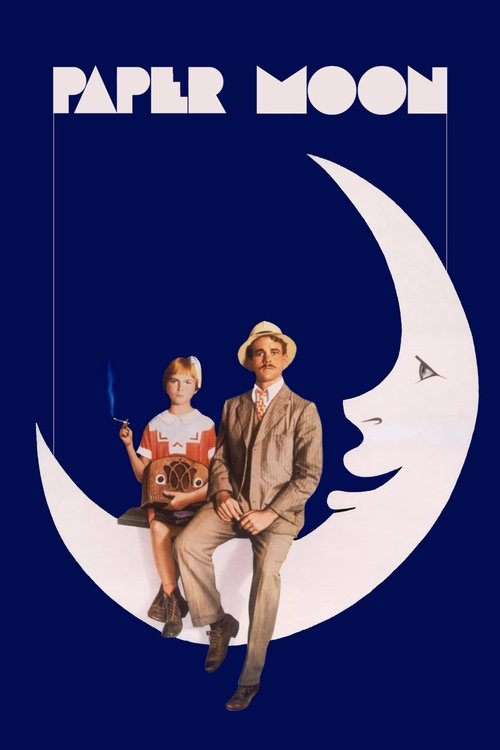
Paper Moon
1973 · Peter Bogdanovich
For a cozy night when you want charm with a little grit — something funny and touching the whole household can watch, that still has enough bite to stay with you.
What it's about
In the Depression-era Midwest, small-time con man Moses Pray gets stuck transporting Addie, a sharp-tongued orphaned nine-year-old who may or may not be his daughter. Driving the flatlands of Kansas and Missouri in a battered car, they fleece widows and Bible customers — and Addie turns out to be better at the grift than he is. What starts as an errand becomes a stubborn, prickly partnership.
The experience
Warm, wry, and quick on its feet — a road movie that's genuinely funny scene to scene while a real ache about family and belonging builds underneath. The two leads' bickering is the engine, and it never gets sappy.
Performances
Tatum O'Neal, at ten years old, gives one of the great child performances ever filmed — flinty, hilarious, never cute — and won an Oscar for it, playing opposite her real father Ryan O'Neal, whose exasperated con man is the perfect foil.
The craft
Shot in crisp black and white that makes the Depression plains look both bleak and beautiful, with long unbroken takes that let the father-daughter sparring play out in real time. Bogdanovich builds the whole film from the textures of 1930s America — radios, hymns, dusty main streets.
Why it matters
A high point of 1970s New Hollywood's love affair with old Hollywood, it made Tatum O'Neal the youngest competitive Oscar winner in history and remains the gold standard for con-artist road movies.
Snapshot
Paper Moon is Peter Bogdanovich's Depression-era road picture, a black-and-white comedy-drama about a small-time confidence man and the orphaned girl who may or may not be his daughter, traveling the flatlands of Kansas and Missouri in a battered car, fleecing the bereaved and the credulous. Adapted by Alvin Sargent from Joe David Brown's 1971 novel Addie Pray, it arrived as the third film in Bogdanovich's remarkable early-1970s run — after The Last Picture Show (1971) and What's Up, Doc? (1972) — and consolidated his reputation as New Hollywood's most devoted classicist, a filmmaker who made new films out of an encyclopedic love of old ones. Its enduring fame rests partly on Tatum O'Neal, who at ten became the youngest performer to win a competitive Academy Award, playing opposite her real father, Ryan O'Neal. The film fuses screwball comedy timing with a melancholy, dusty realism, and remains one of the period's most admired evocations of the 1930s.
Industry & production
Paper Moon was a Paramount release, produced through Bogdanovich's own banner (the Directors Company, the short-lived arrangement Paramount struck with Bogdanovich, Francis Ford Coppola, and William Friedkin to give proven young directors autonomy). The film was among the few projects the Directors Company actually completed before the arrangement dissolved, and its commercial success was the venture's clearest vindication.
The picture came at the crest of Bogdanovich's industry standing. Coming off two hits, he had unusual leverage, and he used it on a film that ran against commercial logic in at least one conspicuous way: he insisted on black-and-white photography at a moment when studios regarded monochrome as poison at the box office. That choice — which he had already fought for and won on The Last Picture Show — is the production's defining executive decision, and it shaped everything downstream.
Casting Ryan O'Neal, a bankable star fresh from Love Story and What's Up, Doc?, gave the project marquee security; casting his untrained young daughter Tatum in the central role was the gamble. The decision to use a real father-daughter pair lent the film a documentary undercurrent of familiarity and friction that no amount of rehearsal could have manufactured. Production was carried out largely on location in Kansas and Missouri, with Bogdanovich seeking out genuine period-appropriate towns and landscapes rather than building the Depression on a backlot.
Technology
The film's most consequential technological choice was its return to black-and-white at a time when the format had become an aesthetic statement rather than a default. Working with cinematographer László Kovács, Bogdanovich pursued a hard, high-contrast monochrome that recalls Depression-era photojournalism — the Farm Security Administration images of Dorothea Lange and Walker Evans are the obvious lodestars. Kovács reportedly used red filtration to darken skies and deepen the tonal separation of clouds against the flat Kansas horizon, a technique long associated with classical landscape cinematography.
Otherwise the film is technologically conservative by design. It eschews the zoom-heavy, fragmented visual grammar that much of early-1970s cinema embraced, favoring instead deep-focus compositions and lenses that keep foreground and far distance simultaneously legible — an approach rooted in the 1940s rather than the 1970s. The technology served the homage: the apparatus is deployed to make 1973 look and feel like the cinema of the era it depicts.
Technique
Cinematography
Kovács's photography is the film's signature achievement. The visual scheme is built on deep focus and wide-angle staging, with figures held in long, often static compositions against enormous skies and the dead-level geometry of the Plains. The deep-focus aesthetic is a direct inheritance from Gregg Toland's work for Welles and Ford, and Bogdanovich — who knew both directors and had interviewed them — wears the influence openly. Interiors are frequently lit for source-like naturalism, with the camera placed low or at a child's height to register Addie's vantage. The black-and-white renders the period not as nostalgia-tinted but as austere, sun-flattened, and economically bleak; the photography is among the most frequently praised elements in the critical record.
Editing
Editing was by Verna Fields, one of the era's most respected cutters (she would shortly cut Jaws). The film's cutting style is notably restrained, consistent with Bogdanovich's preference — absorbed from Howard Hawks and John Ford — for playing scenes in extended master shots rather than dicing them into coverage. Several sequences unfold in long, sustained takes that let the verbal sparring between Moses and Addie develop in real time, with comic and emotional rhythm carried by performance and blocking rather than by the cut. The editing thus works largely by self-effacement: its discipline is in what it declines to fragment.
Mise-en-scène / staging
Production design was by Polly Platt, Bogdanovich's longtime collaborator (and former wife), whose contribution to his early films is now widely regarded as central. Platt's period detailing — storefronts, hotel rooms, roadside diners, the cluttered specifics of itinerant Depression life — grounds the comedy in material reality. The staging favors the two-shot: Moses and Addie are constantly framed together in the car, across tables, side by side, the composition itself dramatizing the partnership the plot is negotiating. Bogdanovich blocks for the long take, choreographing movement within the frame so that a single setup can carry an entire scene's worth of shifting power between the con man and the child who keeps outsmarting him.
Sound
The film carries no original orchestral score. Instead, Bogdanovich scored it entirely with period-authentic source music — popular songs of the early-to-mid 1930s and radio broadcasts of the era heard diegetically through the car radio and hotel sets. This strategy, which he had used before, dissolves the boundary between score and world: the music belongs to the characters' time and space rather than commenting on it from outside. The recurring use of vintage recordings reinforces the documentary texture and the period immersion, and it ties to the title, drawn from the 1933 standard "It's Only a Paper Moon" (Harold Arlen, E. Y. Harburg, and Billy Rose). The dialogue mix foregrounds the rapid, overlapping verbal exchanges in the screwball tradition.
Performance
Performance is where the film's reputation lives. Tatum O'Neal's Addie Loggins is a study in deadpan precocity — a child who negotiates, calculates, and emotionally manipulates with the gravity of an adult while remaining recognizably a hurt and abandoned kid. Her win for Best Supporting Actress made her, as the record well documents, the youngest competitive Oscar winner. Ryan O'Neal plays Moses Pray as a vain, transparently second-rate grifter whose bluster Addie repeatedly punctures; the real-life father-daughter dynamic gives the antagonism an unforced authenticity. Madeline Kahn, as the carnival "exotic dancer" Miss Trixie Delight, delivers a comic turn of brittle vanity and sudden pathos that earned her an Academy Award nomination, and P. J. Johnson, as Trixie's adolescent maid Imogene, supplies a sharp foil for Addie. The ensemble is calibrated to the screwball register without sacrificing the underlying sadness.
Narrative & dramatic mode
The narrative is episodic and picaresque — a road structure in which the central relationship, rather than a goal-driven plot, supplies the through-line. The dramatic engine is the unresolved question of paternity and the slow, grudging formation of a genuine bond beneath a relationship that both parties insist is merely transactional. The film operates in a dual register: scene to scene it is comedy, built on cons, schemes, and verbal one-upmanship; cumulatively it is a drama about abandonment, belonging, and the improvised family of two people with nowhere else to go. The famous ambiguity — whether Moses is truly Addie's father — is never resolved, and the film's emotional logic depends on its remaining open. The ending refuses sentimental closure even as it affirms that the pair belong together.
Genre & cycle
Paper Moon sits at the intersection of several traditions. It is a con-artist comedy, a road movie, and a Depression picture, and it deliberately revives the screwball-comedy cadence of the 1930s — the rapid-fire dialogue, the battle-of-wits between mismatched partners — while grafting it onto a more melancholy New Hollywood sensibility. It belongs to the early-1970s vogue for Depression-era and period-Americana subjects (a cycle that includes Bonnie and Clyde a few years earlier and The Sting, released the same year). Within Bogdanovich's own filmography it forms, with The Last Picture Show, a loose pair of black-and-white period studies of hard American places. Its genre identity is fundamentally retrospective: it is a 1970s film built out of 1930s forms.
Authorship & method
Bogdanovich's authorship is inseparable from his cinephilia. A former critic and programmer who conducted landmark interviews with John Ford, Howard Hawks, Orson Welles, and Alfred Hitchcock, he made films as acts of informed homage, importing classical technique — the long take, deep focus, the master shot, source scoring — directly into the New Hollywood moment. Paper Moon is among the purest expressions of that method.
His key collaborators were essential to the result. László Kovács (cinematographer) supplied the FSA-inflected monochrome that defines the film's look. Polly Platt (production design) built the persuasive material world of the Depression and was, across this period, a creative partner whose influence on Bogdanovich's visual sensibility is now broadly acknowledged. Verna Fields (editor) shaped the restrained, take-respecting rhythm. Alvin Sargent (screenwriter) adapted Joe David Brown's novel Addie Pray, sharpening its episodes into a screwball-tinged structure and earning an Academy Award nomination for the screenplay. The title itself is the subject of a frequently repeated anecdote: Orson Welles is said to have urged Bogdanovich to abandon "Addie Pray" in favor of "Paper Moon," reportedly remarking that the title alone was so good the film should simply be released as it. The story is part of the film's lore; readers should treat the exact wording as anecdotal rather than documented verbatim.
Movement / national cinema
The film is a product of the New Hollywood / Hollywood Renaissance, the late-1960s-through-1970s period in which a generation of cinephile directors gained unusual creative control within the studio system. Bogdanovich's position within that movement is distinctive: where contemporaries like Coppola, Scorsese, and Altman pushed toward formal rupture and contemporary subject matter, Bogdanovich pushed backward, toward the conservation and revival of classical American film grammar. Paper Moon is thus a New Hollywood film in its industrial freedom and its melancholy undertow, but an Old Hollywood film in its technique — a tension that is central to its character and to its place in American cinema of the decade.
Era / period
The film is set during the Great Depression of the 1930s (the action falls in the mid-1930s American Midwest), and its entire aesthetic apparatus — monochrome photography, period source music, FSA-style imagery, the flat exhausted landscapes — is bent toward reconstructing that moment. The Depression is not merely backdrop but the precondition of the plot: Moses's cons (selling deluxe Bibles to recently widowed women, claiming their late husbands had ordered them; running short-change schemes; bootlegging) are economic improvisations born of scarcity, and Addie's orphanhood and self-reliance are products of the same hard world. The film treats the period with neither glamour nor heavy editorializing; the hardship is ambient, present in the texture rather than underlined.
Themes
The film's central theme is the construction of family by choice and necessity rather than blood — the question of paternity is deliberately left unanswered precisely so that belonging can be shown to rest on shared experience rather than biology. Closely bound to this is the theme of the con itself: deception is the medium of the characters' livelihood, and the film draws a quiet parallel between the cons they run on others and the emotional negotiations they run on each other, with truth and performance constantly blurred. Other recurring concerns include childhood as a site of unsentimental competence (Addie is frequently the more capable adult), the precarity and freedom of itinerant life, and the dignity and desperation of people surviving at the economic margin. Beneath the comedy runs a persistent strain of loss and abandonment that the ending acknowledges without resolving.
Reception, canon & influence
Paper Moon was a critical and commercial success on release and is generally regarded as one of the high points of Bogdanovich's career, alongside The Last Picture Show. Its most celebrated outcome was Tatum O'Neal's Academy Award for Best Supporting Actress, a milestone as the youngest competitive winner; Madeline Kahn (Supporting Actress) and Alvin Sargent (Adapted Screenplay) also received nominations, and the film's craft — particularly Kovács's cinematography — drew wide praise. (Detailed contemporaneous box-office figures vary across sources and are not restated here.)
Influences on the film (backward): the picture is built out of classical American cinema — the deep-focus realism of Toland, Welles, and Ford; the rapid screwball comedy of Hawks, Capra, and the 1930s studios; and, in its imagery, the Depression documentary photography of the FSA. Bogdanovich's direct relationships with Ford, Hawks, and Welles make these lineages unusually traceable; the film is, in a real sense, the work of a critic-historian putting his influences into practice.
Legacy (forward): Paper Moon helped sustain the early-1970s appetite for Depression-era Americana and demonstrated, alongside The Last Picture Show, that black-and-white could be a viable and prestigious choice in the color era — an example later filmmakers cited when arguing for monochrome. Its central dynamic — a hardened adult and a preternaturally capable child forming a reluctant, criminally-tinged surrogate family on the road — became a durable template echoed in numerous later films and, eventually, in a short-lived television adaptation. Within the larger story of Bogdanovich's career, it stands as the last film of his early triumphant streak before his commercial fortunes turned, and it has retained its critical standing as one of the most accomplished period films of the New Hollywood era. Its reputation today rests on the rare balance it strikes: a genuinely funny film that is also, quietly, about loneliness and the need to be claimed by someone.
A Deleuzian reading
A child sits across a kitchen table from a grown man and does arithmetic out loud until he sweats.
The full Deleuzian reading of Paper Moon →
Reception
A genuine hit in 1973 — the capstone of Bogdanovich's astonishing hot streak after The Last Picture Show and What's Up, Doc? — and its stock has only risen as his later career cratered, making it feel like a golden moment preserved in amber.
How Paper Moon was received, from release to now →
Influences: the films it descends from and the films it influenced
- The Grapes of Wrath (1940) — Toland's deep-focus monochrome translates FSA Dust Bowl photography into Depression realism — the exact look Kovács reconstructs, and a debt made direct by Bogdanovich's filmed interviews with Ford.
- Citizen Kane (1941) — Toland's staging-in-depth and long takes hold foreground and deep background in simultaneous sharp focus, the compositional grammar Paper Moon adopts; Welles personally pushed Bogdanovich toward the title.
- Bringing Up Baby (1938) — Overlapping, rapid-fire screwball verbal sparring between mismatched partners — the comic rhythm Bogdanovich studied in his Hawks interviews and imports into the Moze/Addie exchanges.
- It Happened One Night (1934) — Establishes the Depression road picaresque pairing a worldly hustler with an unyielding innocent across episodic stops, the structural template Sargent's adaptation sharpens.
- Sullivan's Travels (1941) — Fuses fast studio screwball with documentary-grade Depression hardship imagery, modeling the tonal balance of comedy over genuine poverty that Paper Moon sustains.
- Bonnie and Clyde (1967) — Revives FSA Depression iconography and the rural-crime road structure for New Hollywood, proving period Americana and petty grifting could carry a contemporary picture.
- The Last Picture Show (1971) — Bogdanovich's own immediate precursor: monochrome period reconstruction, diegetic source scoring, and deep-focus master-shot method that Paper Moon refines into a tighter screwball register.
- What's Up, Doc? (1972) — The immediate follow-up that extends Bogdanovich's period-fidelity classical reconstruction with the same curatorial method, again pairing O'Neal with Madeline Kahn.
- The Kid (1921) — Directly revives The Kid's grift structure, in which the con only functions because the accomplice is a child, and shoots it in black-and-white with heavy red filtration and deep-focus wides to reproduce the tonal separation of period orthochromatic stock.
- Days of Heaven (1978) — Almendros builds period imagery directly from FSA and painterly Depression-era photography, continuing the documentary-photograph sourcing of the film's monochrome look in color.
- Manhattan (1979) — Gordon Willis's prestige black-and-white in the color era leans on the precedent Paper Moon and The Last Picture Show set for monochrome as a deliberate artistic, not nostalgic, choice.
- Raging Bull (1980) — Chapman's black-and-white photography invokes the same argument Bogdanovich made commercially viable: monochrome as a prestige formal device amid an all-color industry.
- Rushmore (1998) — Builds a comic world on deadpan precocious-child performance and flat, frontal two-shot staging, a self-acknowledged inheritance of Bogdanovich's classical compositional manner.
- True Grit (2010) — Sends a hardened adult and a relentlessly capable, deadpan-articulate child across a period landscape, extending the criminally-tinged surrogate bond with an unresolved parting.
- Nebraska (2013) — Papamichael's black-and-white road picture pairs a reluctant parent and child across plains Americana, reprising both the monochrome-as-prestige choice and the picaresque structure.
- The Florida Project (2017) — Stages an episodic picaresque around a precocious, deadpan child improvising amid Americana poverty, carrying forward the child's-eye-view comedy played against quiet hardship.
- One Battle After Another (2025) — The father-daughter con-artist picaresque in which the relationship's emotional authenticity is produced by shared pressure and mutual need rather than sentiment provides the structural and tonal model for Vineland's father-daughter dynamic: affection discovered through the mechanics of a shared scam.
- Catch Me If You Can (2002) — Fuses the con-artist procedural with a wounded-child surrogate-family bond, the period Americana con as a screen for paternal longing — Spielberg's emotional engine here.
- Central Station (1998) — The itinerant con-artist and orphaned child whose mutual exploitation thaws into reluctant kinship — the specific redemption-arc mechanism driving Dora's transformation.
- The Grifters (1990) — The Depression-era parent/child con team running short cons prefigures the Lilly–Roy dynamic, where the grifter bond and the parental bond are corrosively entangled.
- Kikujiro (1999) — Con-man-and-orphan road movie whose picaresque episode-by-episode structure and prickly surrogate-father bond softening across the journey directly prefigure Kitano-and-the-boy.
- American Graffiti (1973) — Replaces orchestral score with wall-to-wall diegetic period source music drawn from the radio of its era — the same source-scoring strategy Paper Moon uses with 1930s broadcasts and records.
- Badlands (1973) — Deploys an affectless, deadpan child-narrator voice across an episodic road picaresque, paralleling the precocious flat-affect performance Bogdanovich draws from Tatum O'Neal.
- Alice Doesn't Live Here Anymore (1974) — Pairs an adult with a wisecracking, preternaturally sharp child on an episodic Americana road trip, extending the reluctant-surrogate-family-on-the-move dynamic.
- The Sting (1973) — Released the same year, Bogdanovich used high-contrast photography deliberately evoking period still photography and newsprint illustration to construct Depression-era nostalgia through visual texture—a parallel strategy to The Sting's sepia-warmed palette; both films belong to the same 1972–74 Hollywood Depression-nostalgia wave and use the period grifter as folk-hero protagonist.
- Alice in the Cities (1974) — The uneasy near-twin: a black-and-white road film built on the same con of an adult and a sharp-tongued child thrown together, the dyad's reluctant tenderness becoming the engine the plot otherwise lacks.
- Gloria (1980) — Pairs a hard-bitten adult with a precocious child on the run, the mismatched-protector-and-kid two-hander dynamic Gloria reworks under threat of death.
Similar films
- Nebraska (2013) — influence & lineage · same viewing thread
- The Grapes of Wrath (1940) — influence & lineage
- The Last Picture Show (1971) — influence & lineage
- The Florida Project (2017) — influence & lineage
- O Brother, Where Art Thou? (2000) — same viewing thread
- Little Miss Sunshine (2006) — same viewing thread
- Butch Cassidy and the Sundance Kid (1969) — same viewing thread
- Bones and All (2022) — same viewing thread
All the films related to Paper Moon →
Watch it with: curated runs of related films
- Misfits on the American Backroads — A run of journeys across the American map, each hauling someone who doesn't fit — a con man and his maybe-daughter, a losing family in a yellow bus, two outlaws outrunning the century, and a pair of lovers who eat people — watch them near each other and the road itself starts to feel like the family.