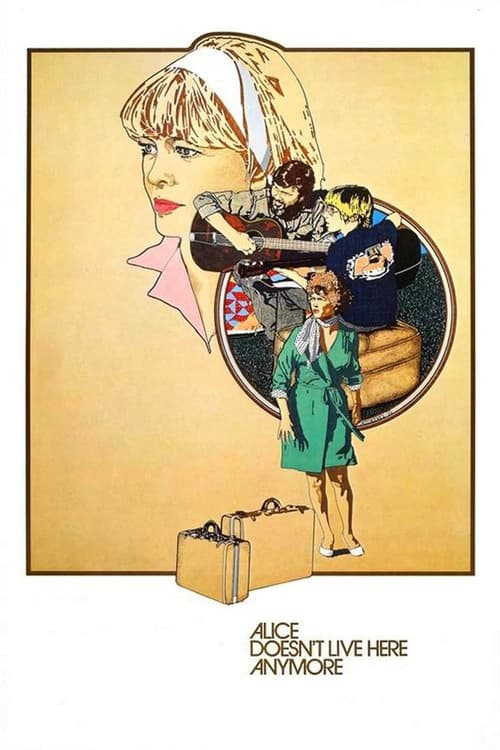
Alice Doesn't Live Here Anymore
1974 · Martin Scorsese
When you want a warm but unsentimental story about starting over — a film for anyone rebuilding a life who could use both a laugh and a little courage. Comfort with grit under its nails.
What it's about
When her blunt, controlling husband dies suddenly, thirty-five-year-old Alice Hyatt packs up her wisecracking eleven-year-old son and leaves small-town New Mexico, chasing the singing career she gave up when she married. Money runs out in Arizona, so she takes a diner waitressing job to survive, navigating dead-end men, a rowdy lunch counter, and the question of whether her second act belongs to her or to whoever comes along next.
The experience
Funny, scrappy, and surprisingly raw — it swings between screwball mother-son bickering, real menace, and moments of tenderness that catch you off guard. It feels lived-in rather than plotted, like riding shotgun on someone's messy fresh start.
Performances
Ellen Burstyn is magnificent — tough, funny, scared, and stubbornly hopeful, a performance that won her the Best Actress Oscar. Diane Ladd nearly steals the diner scenes as a foul-mouthed fellow waitress, and Kris Kristofferson brings an easy, complicated charm.
The craft
Scorsese, fresh off his early gangster breakthrough, proves his range with a rambling, improvisation-flavored road movie built around women's voices — restless camerawork and overlapping diner chatter give it a jolt of energy most domestic dramas never have. The dialogue crackles; the mother-son scenes feel almost eavesdropped.
Why it matters
A landmark of 1970s Hollywood's brief embrace of women's stories — it showed Scorsese could do warmth as well as violence, and its diner world proved so beloved it spun off a long-running TV sitcom.
Snapshot
Alice Doesn't Live Here Anymore occupies a singular position in Martin Scorsese's filmography: the warmest, most domestic, and most consciously "woman's picture" of his major works, made on either side of the explosive male worlds of Mean Streets (1973) and Taxi Driver (1976). It follows Alice Hyatt (Ellen Burstyn), a thirty-five-year-old wife and mother in Socorro, New Mexico, whose blunt, controlling husband dies suddenly in a road accident, leaving her unmoored. With her wisecracking eleven-year-old son Tommy in tow, Alice sets out for Monterey, California, intending to resume a singing career she abandoned at marriage — a flight toward a half-remembered girlhood self. Money runs short before she gets there; she stops in Phoenix, takes a job as a lounge singer, becomes entangled with a violent younger man, and then, fleeing him, lands as a waitress at Mel's diner in Tucson, where she finds an abrasive surrogate family among the other waitresses and, eventually, a gentler romance with a local rancher, David (Kris Kristofferson). The film is at once a road movie, a character study, and an early feminist drama about a woman attempting to author her own life. It is best remembered for Ellen Burstyn's Academy Award–winning performance — she initiated the project and chose Scorsese to direct it — and for spawning the long-running CBS sitcom Alice (1976–1985), an afterlife that has somewhat obscured the film's own restless, observational seriousness.
Industry & production
The project originated not with Scorsese but with its star. Ellen Burstyn, coming off The Last Picture Show (1971) and The Exorcist (1973), had the industry leverage to develop a vehicle for herself, and she actively sought a film centered on a contemporary woman's experience at a moment when the New Hollywood was overwhelmingly preoccupied with men. The screenplay was by Robert Getchell, his first produced feature script. The film was a Warner Bros. production; the studio's involvement is part of what makes the picture notable — a major studio backing a relatively intimate, female-centered drama directed by a then little-known filmmaker.
Burstyn's choice of director is the production's defining decision. Having seen Mean Streets, and reportedly encouraged by Francis Ford Coppola when she asked his advice on promising new talent, she selected the young Scorsese precisely because his work demonstrated vitality and a feel for performance and milieu, even though his sensibility had been formed in male, urban, Italian-American territory utterly unlike Alice's Southwestern world. Scorsese has acknowledged that he took the film in part to prove his range and to learn — to demonstrate he could direct a studio picture and a woman's story. Burstyn retained considerable authority on set, and the collaboration was genuinely shared: she has spoken of the latitude given to actors and of the rehearsal process. Diane Ladd, Harvey Keitel, Kris Kristofferson, Jodie Foster (as the tomboy Audrey), and the young Alfred Lutter (Tommy) filled out the cast; Keitel, Scorsese's regular, plays the menacing Ben. The film was shot largely on location in the Southwest, with Tucson standing in for the diner-and-highway world of the later acts. It was a critical and commercial success on release and proved a career-altering credit for nearly everyone involved.
Technology
Alice Doesn't Live Here Anymore is a conventionally produced mid-1970s 35mm studio film and makes no claim to technological innovation; its interest lies in craft and performance rather than apparatus. The one element worth noting is its bravura opening: a stylized, deliberately artificial flashback to Alice's Depression-era childhood, shot on a soundstage in saturated, golden, almost Technicolor-pastiche light evoking the look of classic Hollywood — a young Alice singing in a heightened, studio-bound nostalgic landscape. This sequence is a self-conscious gesture toward old-Hollywood image-making, set off against the grainy, naturalistic location photography that governs the rest of the film. The contrast is a technique of style rather than of technology, and beyond it the film's means are those standard to the New Hollywood. The record offers no basis for claims of unusual technical methods, and it would be invention to assert otherwise.
Technique
Cinematography
The cinematography is by Kent Wakeford, who had also shot Mean Streets. After the heightened artifice of the prologue, the film settles into a loose, mobile, observational style characteristic of 1970s American realism: handheld and restless when energy demands it, attentive to the unglamorous textures of motels, diners, parking lots, and the wide Southwestern light. Scorsese's developing visual signature is already legible — expressive camera movement, a willingness to let the camera roam around a performance, and an interest in the rhythm of a space — but here it is largely subordinated to the actors and the environments. The palette is sun-bleached and everyday, the framing frequently keeping Alice and Tommy together within the cramped interiors of cars and rented rooms to underline their mutual dependence. The film's look deliberately rejects the romanticized prologue's gloss in favor of a contemporary, lived-in plainness.
Editing
The editing is by Marcia Lucas, one of the period's most accomplished cutters, who would also work on Scorsese's Taxi Driver. The film's rhythm is episodic and character-driven, structured as a journey punctuated by way-stations — the New Mexico home, the road, the Phoenix lounge, the Tucson diner — and the editing allows scenes to run on the duration of behavior and conversation rather than plot mechanics. The cutting privileges performance, holding on actors through the overlapping, semi-improvised exchanges that give the diner scenes their crackle. There is a notable tonal management at work, as the film modulates between comedy and genuine threat (the abrupt eruption of Ben's violence) without whiplash, and the editing's patience with the everyday is part of how the film earns its emotional turns.
Mise-en-scène / staging
Scorsese's staging is rooted in milieu. The film is built from precisely observed working-class and lower-middle-class American spaces — the modest tract house with its bickering domesticity, the seedy glamour of the Phoenix cocktail lounge where Alice sings, and above all Mel and Ruby's diner, a fully realized social world of short-order chaos, waitress camaraderie, and customer traffic. The diner becomes the film's central stage, and Scorsese choreographs it as an ensemble space, full of overlapping action and incidental detail. The car interiors that recur throughout stage the intimacy and friction of the mother-son relationship; the motel rooms register transience and economic precarity. Costume and production design track Alice's shifting self-presentation — from housewife to aspiring chanteuse to uniformed waitress — externalizing her uncertain search for an identity. The staging consistently embeds the drama in the concrete particulars of place and labor.
Sound
The film's soundtrack mixes diegetic performance — Alice's own lounge singing, including standards she performs at the piano — with period popular music, and it foregrounds music as both Alice's abandoned vocation and her means of self-expression. There is no dominant original orchestral score in the manner of a classical melodrama; instead the film leans on songs and source music to establish its contemporary, naturalistic texture. Most distinctive is the soundscape of overlapping, naturalistic dialogue, particularly in the diner and in the rapid-fire exchanges between Alice and Tommy and among the waitresses — a verbal density that owes much to the period's interest in improvisation and to Scorsese's ear for vernacular speech. The aural world is one of cluttered, lived-in American noise.
Performance
Performance is the film's reason for being, and Ellen Burstyn's Alice is among the great American screen performances of the 1970s, justly rewarded with the Academy Award for Best Actress. Burstyn plays Alice as funny, frightened, sardonic, sexually alive, and frequently exasperated — a woman improvising a self in real time, neither idealized victim nor triumphant heroine but a recognizable, contradictory person. The performance refuses sentimentality even as the film moves toward a warmer resolution. The supporting playing is exceptional: Diane Ladd's brassy, profane waitress Flo (an indelible turn that earned her an Oscar nomination) and Valerie Curtin's nervous Vera flesh out the diner's female ensemble; Alfred Lutter's Tommy is one of the least cloying child performances of the era, his bratty, precocious banter with Burstyn forming the film's emotional spine; Harvey Keitel brings real menace to Ben; Kris Kristofferson lends an easy, weathered charm to David; and a very young Jodie Foster is memorable as the runaway tomboy Audrey. The interplay among the performers — loose, overlapping, behaviorally specific — is the film's signal achievement.
Narrative & dramatic mode
The film's dramatic mode is the character-driven, episodic realism of the New Hollywood, organized as a journey of self-discovery rather than a tightly plotted narrative. After the stylized prologue and the sudden, life-detonating death of Alice's husband, the film proceeds as a series of encounters along a road, each testing and revising Alice's notion of who she might become. The structure resists the tidy arc of classical drama: Alice's plan (to sing again in Monterey) is deflected by economic reality, her romantic detour with Ben turns dangerous, and her arrival in Tucson is less a destination than a place she stops. The central relationship is not finally the romance with David but the bond between Alice and Tommy, and the film's recurring mode is the comedy-drama of their combative, loving exchanges. The ending has occasioned much critical debate: Alice's tentative reconciliation with David and her apparent settling in Tucson can be read as a compromise of her independence or as a hard-won, realistic accommodation — a tension the film leaves productively unresolved. Throughout, the dramatic engine is internal: Alice's struggle to reconcile a remembered self, the demands of single motherhood, and the limited options available to a woman of her circumstances.
Genre & cycle
Alice Doesn't Live Here Anymore sits at the intersection of several genres and cycles. It is, most obviously, a modern reworking of the Hollywood "woman's picture" or maternal melodrama — the genre of films centered on a woman's emotional and domestic life — updated with the frankness, economic realism, and ambivalence of the 1970s. Its self-conscious golden-hued prologue explicitly invokes that classical tradition (the influence of The Wizard of Oz and the studio-era musical is often cited) in order to measure the distance between old-Hollywood fantasy and contemporary reality. It is also a road movie, participating in the early-1970s cycle of American films built around journeys across a demystified national landscape. And it belongs, importantly, to the emergent cycle of 1970s films responding to second-wave feminism and the changing status of women — pictures attempting to put a complex, working, single woman at the center of the frame. Within that cycle it is frequently grouped with other films of female self-realization from the decade, and its commercial success is sometimes credited with helping demonstrate the viability of woman-centered subjects. Within Scorsese's own work it stands apart as the great exception to his reputation as a chronicler of male violence and guilt.
Authorship & method
The film raises genuine and interesting questions of authorship. It is, by Scorsese's own account, a film he was hired onto rather than originated — a director-for-hire studio assignment that he used to extend his range — and its initiating creative force was Ellen Burstyn, who developed it, chose the director, and held real authority over the production. The result is a shared authorship in which the star-as-author and the director-as-stylist meet. From Scorsese came the kinetic camera, the feel for milieu and ensemble, the cultivation of overlapping naturalistic performance, and the framing irony of the old-Hollywood prologue; from Burstyn came the conception of the character and the feminist impulse at the film's core; from screenwriter Robert Getchell came the structure and the sharp vernacular dialogue.
Among the collaborators, cinematographer Kent Wakeford carried over the location realism of Mean Streets; editor Marcia Lucas shaped the film's patient, performance-led rhythm and would prove a crucial Scorsese collaborator on Taxi Driver; and Harvey Keitel anchored Scorsese's stock company. The film's method was notably collaborative and partly improvisational: the loose, behaviorally rich scenes — especially the Alice–Tommy exchanges and the diner ensemble — emerged from a rehearsal-and-improvisation process that gave the actors latitude to find their characters' voices, a working method consistent with both Scorsese's practice and the period's ethos. Scorsese has generally been candid that the film is less personal to him than his Italian-American urban pictures, which makes its accomplishment — a wholly convincing portrait of a world far from his own — the more striking, and underscores how much its identity owes to Burstyn.
Movement / national cinema
The film is a product of the New Hollywood (or "Hollywood Renaissance"), the period roughly from the late 1960s through the 1970s in which a generation of young, often film-school-trained directors, backed by studios newly willing to gamble on personal and unconventional projects, reshaped American cinema. It exhibits the movement's hallmarks: location shooting, naturalistic performance and dialogue, morally and tonally ambiguous storytelling, an interest in ordinary and marginal American lives, and a self-aware relationship to the classical Hollywood it both inherited and critiqued. As American national cinema, the film is also significant for its engagement with the social transformations of its moment — particularly the women's movement — and for taking the textures of working-class and lower-middle-class life in the American Southwest as worthy of serious attention. It belongs to the same studio-backed wave of director-driven cinema that produced the era's defining American films, and it demonstrates that the New Hollywood's energies could be turned to domestic and female subjects, not only to crime, war, and male alienation.
Era / period
Alice Doesn't Live Here Anymore is a precise document of the early-to-mid 1970s United States, and specifically of the impact of second-wave feminism on ordinary lives. Alice's predicament — a woman who married young, subordinated her ambitions to a husband, and finds herself, after his death, ill-equipped economically and uncertain of her own identity — dramatizes the very questions the women's movement was raising in the period about female autonomy, work, and selfhood. The film registers the limited options realistically available to such a woman in 1974: the precarious labor of singing in lounges and waiting tables, dependence on men for security, the constant pressure of raising a child alone on little money. Its Southwestern setting — the highways, motels, and diners of New Mexico and Arizona — captures a distinctly American geography of transience and service work. The casual coarseness of the dialogue, the frankness about sex and violence, and the refusal of a fully reassuring resolution are all marks of post-1960s American culture and of a cinema newly permitted to depict such things directly.
Themes
The film's governing theme is a woman's search for selfhood and autonomy — Alice's attempt to recover an identity submerged by marriage and motherhood, and to author a life on her own terms. Bound up with this is the theme of the gap between dream and reality: the golden, idealized childhood self of the prologue, and the abandoned singing career, set against the economic and social constraints that repeatedly redirect Alice's plans. The film explores motherhood as both burden and anchor, the Alice–Tommy relationship dramatizing the difficulty and the sustaining love of single parenthood. It examines the precariousness of women's economic independence and the recurring temptation and danger of dependence on men — Ben's violence and David's gentleness representing the spectrum Alice must navigate. Female solidarity is a quieter but important theme, embodied in the abrasive, genuine friendships of the diner's waitresses. And running beneath it all is an inquiry into compromise — the film's ambivalent ending posing the question of whether a workable, partial freedom is a defeat or a maturity, and refusing to resolve it cleanly.
Reception, canon & influence
Alice Doesn't Live Here Anymore was a substantial critical and commercial success on its 1974 release and was embraced as evidence both of Scorsese's range and of Hollywood's capacity to engage with contemporary women's lives. Its most conspicuous honor was Ellen Burstyn's Academy Award for Best Actress; Diane Ladd received a Best Supporting Actress nomination and Robert Getchell a nomination for the screenplay. The film was widely praised for its performances and its tonal honesty, and it was discussed extensively within contemporary debates about feminism and film — though some feminist critics then and since have questioned whether its romantic resolution undercuts its emancipatory premise, a debate that remains part of the film's critical legacy.
Influences on the film run backward to the classical Hollywood woman's picture and maternal melodrama, explicitly invoked and ironized in the prologue's homage to studio-era style and to The Wizard of Oz; to the road-movie cycle of its own moment; and to the naturalistic, improvisation-friendly performance traditions of 1970s American acting. Scorsese's location realism and ensemble method carried over directly from Mean Streets.
Its influence forward is felt on several fronts. Most visibly, it generated the popular CBS television sitcom Alice (1976–1985), which transplanted the diner setting and characters into long-running comedy and became, for a generation, the property's most familiar form — a rare instance of a serious New Hollywood drama spawning a mainstream sitcom. Within the broader culture, the film is frequently cited as an early and influential mainstream example of a studio film centered on a woman's independence, helping to legitimize female-driven subjects in the commercial cinema of the period. For Scorsese, it stands as the proof of versatility that broadened perceptions of his talent before Taxi Driver. For Ellen Burstyn it remains a career landmark and a touchstone of 1970s feminist film discussion, and the picture retains a secure place in accounts of the New Hollywood and of the era's negotiation between Hollywood tradition and a changing America.
A Deleuzian reading
Before anything else, there is a little girl in a red-dirt yard, singing.
The full Deleuzian reading of Alice Doesn't Live Here Anymore →
Reception
Dismissed by some at the time as Scorsese-for-hire — the 'women's picture' he made between Mean Streets and Taxi Driver — it's since been reclaimed as proof of his range and one of the key New Hollywood films actually centered on a woman's life.
How Alice Doesn't Live Here Anymore was received, from release to now →
Influences: the films it descends from and the films it influenced
- The Wizard of Oz (1939) — The film's golden soundstage prologue directly pastiches its saturated Technicolor studio artifice and red-sky fantasy world as an ironic frame against the naturalism that follows.
- Mildred Pierce (1945) — Supplies the woman's-picture template of a mother forced to support herself and her child through diner/service labor, which Alice de-glamorizes and strips of noir fatalism.
- Imitation of Life (1959) — The lush self-supporting-single-mother maternal melodrama whose glossy studio mise-en-scène the prologue knowingly invokes and ironizes.
- Mean Streets (1973) — Kent Wakeford's handheld location realism, the kinetic camera, and the rehearsal-and-improvisation ensemble method carry over directly into Alice's diner and Tommy scenes.
- Faces (1968) — Establishes the rehearsal-driven, behaviorally raw improvisation that licensed the loose, performance-led scenes between Alice and Tommy.
- Five Easy Pieces (1970) — Models the New Hollywood episodic road structure of drift between vernacular American milieus and an unresolved, non-redemptive ending.
- McCabe & Mrs. Miller (1971) — Pioneers the overlapping, half-audible naturalistic dialogue and dense ambient milieu that Alice adopts in its ensemble diner soundscape.
- Taxi Driver (1976) — Editor Marcia Lucas refines here the patient, performance-led cutting rhythm she developed on Alice, while Harvey Keitel continues the Scorsese stock company.
- An Unmarried Woman (1978) — Extends the mainstream woman's-independence drama through episodic realism and the same debated ambivalence between emancipation and romantic resolution.
- Girlfriends (1978) — Carries forward the low-key, observational handheld treatment of a woman's self-definition outside of marriage, built on behavioral small-scale scenes.
- Norma Rae (1979) — Continues the studio-backed female working-class self-realization film anchored by an Oscar-courting naturalistic lead performance, as Burstyn's was.
- Thelma & Louise (1991) — Fuses the feminist self-determination arc with the open-road episodic structure Alice drew from the road-movie cycle, pushing it toward genre.
- Wendy and Lucy (2008) — Distills the episodic observational realism of a woman adrift between towns, with an unresolved, economically precarious ending and minimal scoring.
- Nomadland (2020) — Extends the observational handheld road portrait of a self-supporting woman, mixing non-professional milieu ensemble with a star performance and open ending.
- Moonstruck (1987) — Proved that a middle-aged woman's romantic reawakening could be built from long, loosely-staged kitchen and diner two-shots with a working-class vernacular soundtrack — the commercial and formal precedent for Cher's Loretta carrying a picture at 41.
- A Woman Under the Influence (1974) — A same-year actor-authored portrait of a woman's psychic crisis built from improvisation, with Gena Rowlands' performance occupying the frame the way Burstyn's does here.
- Wanda (1970) — An observational, handheld portrait of a working-class woman adrift, structured episodically and refusing narrative closure on her self-realization.
- Paper Moon (1973) — Pairs an adult with a wisecracking, preternaturally sharp child on an episodic Americana road trip, extending the reluctant-surrogate-family-on-the-move dynamic.
Similar films
- Five Easy Pieces (1970) — influence & lineage · same viewing thread
- Mean Streets (1973) — influence & lineage
- Taxi Driver (1976) — influence & lineage
- Mildred Pierce (1945) — influence & lineage
- Thelma & Louise (1991) — influence & lineage
- Wanda (1970) — influence & lineage
- Faces (1968) — influence & lineage · same viewing thread
- A Woman Under the Influence (1974) — influence & lineage · same viewing thread
All the films related to Alice Doesn't Live Here Anymore →
Watch it with: curated runs of related films
- New Hollywood Unravelings — Watch these together for the rawest strain of New Hollywood — loose, lived-in character studies of Americans who can't hold the shape their lives demand.