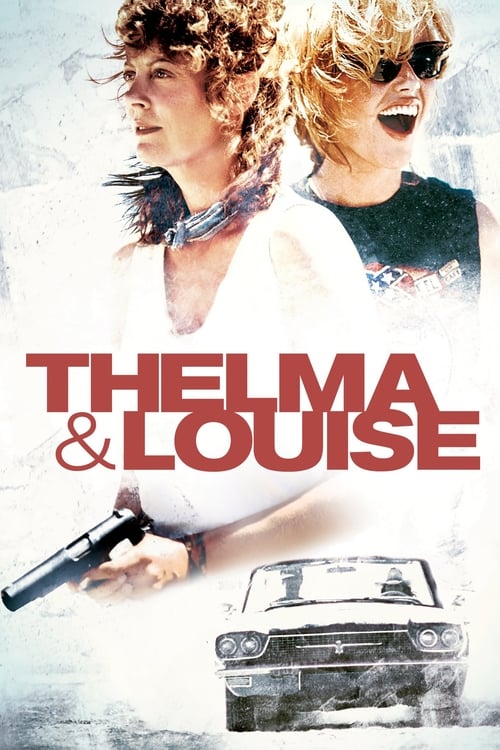
Thelma & Louise
1991 · Ridley Scott
For when you're fed up and want to feel free — a movie to blast with the windows down, or to watch with your best friend when you both need reminding what loyalty looks like. Liberating rather than easy; it will leave you talking.
What it's about
An Arkansas waitress and her meek housewife best friend pack a convertible for a weekend fishing trip, a small rebellion against a dreary boyfriend and a controlling husband. A stop at a roadhouse turns violent when a man assaults Thelma and Louise shoots him, and suddenly two ordinary women are fugitives, driving west with the law closing in and nothing behind them worth turning around for.
The experience
It plays like pure open-road exhilaration with a knot in your stomach — funny, sexy, and windblown one minute, furious the next, with the dread of consequences always riding in the back seat. By the end it hits with real emotional force.
Performances
Geena Davis and Susan Sarandon are the whole engine: Davis transforms scene by scene from giggly and cowed to wild and self-possessed, while Sarandon carries a wary, wounded toughness that hints at everything her character won't say. Their chemistry is one of the great screen friendships.
The craft
Callie Khouri's first produced screenplay won an Oscar for a reason — every character talks like a person and the story never stops moving. Ridley Scott shoots the Southwest like a myth, all dusty golds and monumental skies, and the desert vistas genuinely reward the biggest screen you can find.
Why it matters
It opened as a national argument — magazine covers, op-eds, dinner-table fights about women, guns, and payback — and its two leads became instant icons. Decades on, it's still the reference point for putting women at the center of the American outlaw story.
Snapshot
Thelma & Louise is the rare studio picture that became a cultural event the moment it opened, less a film than a referendum. Directed by Ridley Scott from an original screenplay by first-time writer Callie Khouri, it follows an Arkansas waitress and her timid homemaker friend whose weekend getaway curdles into flight after Louise shoots a man who has tried to rape Thelma in a roadhouse parking lot. What begins as escape becomes a one-way road toward the Grand Canyon and a final, freeze-framed refusal to surrender. The film fused two durable American forms — the outlaw-couple road movie and the buddy picture — and bent both by placing two women at the wheel, a substitution that detonated a national argument about feminism, violence, and who gets to author their own myth. Geena Davis and Susan Sarandon anchored it with performances that calibrated comedy, terror, and tenderness in equal measure, and a young Brad Pitt became a star in a few minutes of screen time. More than thirty years on, the film is firmly canonical: preserved, endlessly cited, and still the reference point whenever American cinema lets women drive off the edge of the frame.
Industry & production
The project originated entirely with Callie Khouri, who had worked as a music-video and commercial producer and wrote the screenplay on spec, reportedly out of frustration with the passive, decorative roles available to women in the films she helped make. The script attracted interest precisely because it was unusual — a female outlaw narrative with the structural rigor of a genre piece — and it moved through development with producer Mimi Polk and Ridley Scott's company Percy Main. Scott initially attached himself as producer and sought a director before deciding to direct it himself, a notable choice given his reputation at the time as a visualist associated with Alien (1979) and Blade Runner (1982) rather than with intimate, character-driven Americana.
The film was produced for and released by Pathé/MGM, with United International and associated distributors handling the rollout; it was made on a moderate budget by early-1990s studio standards, the economy partly a function of its largely exterior, location-based shooting. Casting was widely discussed at the time: a number of established stars were reportedly considered for or circled the two leads before Sarandon (Louise) and Davis (Thelma) were set, a pairing that proved essential to the film's tonal balance. The supporting cast — Harvey Keitel as the sympathetic detective Hal Slocumb, Michael Madsen as Louise's musician boyfriend Jimmy, Christopher McDonald as Thelma's boorish husband Darryl, and Brad Pitt as the drifter J.D. — was assembled with an eye to recognizable character actors against the relative novelty of two women carrying an action-inflected drama. The marketing and the discourse around release were inseparable; the film became a magazine-cover phenomenon, debated on op-ed pages and talk shows in terms that often outran what was actually on screen.
Technology
Thelma & Louise was shot photochemically on 35mm in the anamorphic widescreen format that Scott favored, a choice with real consequences: the 2.35:1 frame lets the American Southwest function as a character, the two women repeatedly dwarfed by mesa, sky, and the receding ribbon of highway. The production was a conventional location shoot of its period, with much of the desert and canyon-country material photographed in Utah standing in for the film's nominal Southwest geography rather than in Arkansas or the literal Grand Canyon. Where the film's technological signature lies is less in any novel apparatus than in the disciplined deployment of mature tools — long-lens and crane work, magic-hour exterior cinematography, and practical car and stunt work for the highway and chase sequences, including the climactic launch of the Thunderbird. The convertible itself, a 1966 Ford Thunderbird, became an icon of the film and of automotive cinema generally. There is no significant optical or digital-effects dimension here; the picture belongs to the last moment before digital intermediates and CGI reshaped how landscape and action were rendered, and its power derives from photographed reality.
Technique
Cinematography
Adrian Biddle, who had shot Aliens (1986) for James Cameron and would become a frequent Scott collaborator, photographed the film, and his work is central to its meaning. The early Arkansas material is comparatively cramped and warm-to-grimy — kitchens, bars, a cluttered suburban house — while the journey west opens the frame into vast, light-saturated horizontals. Biddle and Scott exploit the anamorphic ratio to stage the women small against enormous skies, and they lean on the golden, low-angled light of dawn and dusk so that the desert acquires an almost mythic, painterly glow. As the narrative tightens, compositions grow more iconographic: dust, telephone lines, the open road as vanishing point. The visual rhetoric quietly inverts the Western — the genre's traditional male claim on landscape and freedom is reassigned, and the camera grants the two women the heroic scale usually reserved for gunfighters and cowboys.
Editing
Thom Noble, an Oscar-winning editor (Witness, 1985), cut the film, and the editing manages a difficult tonal modulation: the movie swings between screwball comedy, sudden violence, romance, suspense, and tragedy, often within a single sequence, without losing its forward momentum. The structure is propulsive and essentially linear, a chase that accelerates, with the cross-cutting between the fugitives and Hal's investigation supplying procedural counterpoint and a thread of compassion. The film's most famous edit is its last: the freeze-frame on the Thunderbird suspended over the canyon, followed by a bleaching of the image — an editorial decision that refuses to show the women's deaths and converts an ending into an emblem. It is one of the most analyzed final cuts in modern American cinema precisely because it withholds the literal in favor of the iconic.
Mise-en-scène / staging
Production design and costume trace the heroines' transformation with economy. Thelma begins fussy and overdressed, Louise neat and controlled; over the journey both strip down — sleeves rolled, sunglasses on, hair loosened, jewelry traded away (Louise barters her watch) — until they arrive at a spare, sun-weathered iconography of denim, tank tops, and the open car. Props carry weight: the gun, the Polaroid the women take of themselves early on (which closes the film as a surviving trace), the accumulating signifiers of money and motels. Staging repeatedly places the two together within the frame — side by side in the car, a visual insistence on the partnership as the film's true subject — while men are framed as obstacles, threats, or, in Hal's case, helpless sympathetic observers behind glass and telephone lines.
Sound
The film's soundscape is built on the road: engine, wind, radio, the ambient hum of diners and bars. Hans Zimmer composed the score, relatively restrained and atmospheric, using slide guitar and roots textures that locate the film in a mythic American vernacular without tipping into pastiche. A substantial source-music track of country, rock, and blues does much of the emotional work, situating the women's interior lives against a soundtrack of American popular song. The most celebrated sound moment is musical and diegetically charged — the use of Marianne Faithfull's "The Ballad of Lucy Jordan" over a passage of the women's drive, its lyric of suburban female desperation functioning as a near-explicit gloss on what they are fleeing.
Performance
The film lives or dies on its central duet, and Sarandon and Davis sustain a genuine evolution across its length. Sarandon's Louise is contained, wary, carrying an unspoken past (the film gestures, without spelling out, at a prior trauma in Texas) that explains both her competence and her dread; her performance is built on restraint and sudden, decisive action. Davis's Thelma travels the longer arc — from skittish, infantilized wife to someone who robs a store with eerie poise — and Davis plays the change as liberation laced with recklessness, comic and frightening at once. Around them, Keitel supplies a current of decency, Madsen a bruised tenderness, McDonald a precisely calibrated buffoonery, and Pitt a charismatic menace as the seducer-thief whose theft of the women's money forces the plot's final descent. The chemistry between the leads — affectionate, exasperated, finally unbreakable — is the film's foundation.
Narrative & dramatic mode
Structurally the film is a tragedy in the costume of a genre adventure: an escalating chase whose every reversal closes off the possibility of return, driving toward an end the audience can feel coming long before the canyon appears. Its dramatic engine is irreversibility — the killing in the parking lot cannot be undone, the system the women face cannot imagine them as anything but guilty, and so each apparent escape (the road, J.D., the desert) only narrows the corridor. Within that arc the film modulates tone with unusual daring, letting comedy and lyricism coexist with assault and death; the screenplay's craft lies in making the women's growing freedom and their narrowing options rise together, so that exhilaration and doom become the same motion. The famous ending is the logical culmination of this mode — a refusal of capture that the film insists on framing as self-authorship rather than defeat, the only ending in which the women remain the agents of their own story.
Genre & cycle
The film is a deliberate fusion and revision of two lineages. From the outlaw-couple road movie — You Only Live Once, They Live by Night, Bonnie and Clyde, Badlands — it takes the lovers-on-the-run structure and the moral sympathy for fugitives hunted by a system; from the buddy picture it takes the male-coded pairing of escalating loyalty and reassigns it to two women, an exchange that estranges the form and exposes its gendered assumptions. It is also, slantwise, a Western, claiming the genre's landscape and its grammar of freedom and violence for female protagonists. The picture arrived as Hollywood's appetite for women-centered genre stories was contested, and its commercial and cultural success made it a touchstone for a loose cycle of films about female friendship, agency, and revenge that followed in its wake, even as no exact replica matched its particular alchemy.
Authorship & method
The dossier's authorship question is genuinely double. Callie Khouri's screenplay is the film's originating vision and its conscience — the structure, the voice, the political charge, and the ending are hers, and her Academy Award for the screenplay recognized authorship in the fullest sense; she has spoken consistently of the film as a response to the absence of fully realized women in American movies. Ridley Scott's contribution is the realization: the anamorphic scale, the mythic light, the conversion of an intimate two-hander into landscape epic. The pairing is instructive precisely because Scott was not an obvious choice — a director associated with science-fiction worldbuilding and design who brought a visualist's grandeur to material that might have been shot small. His key collaborators reinforce this: cinematographer Adrian Biddle, editor Thom Noble, and composer Hans Zimmer each lend craft honed on larger genre pictures, applied here to make two women on a highway look like the last free people in America. The result is a film whose meaning emerges from the friction between a woman's script and a man's camera, neither reducible to the other.
Movement / national cinema
Thelma & Louise is a thoroughly American film — in geography, iconography, and argument — made by a British director, and that transatlantic vantage is part of its texture. Scott, like his brother Tony and a generation of British directors who came up through advertising, brought an outsider's eye to American myth, rendering the Southwest with the heightened, almost tourist-sublime clarity of someone who sees its grandeur freshly. The film belongs to no organized movement; it sits instead at the intersection of mainstream Hollywood and the period's emergent conversation about women's authorship and representation in American film, a conversation it did as much to inflame as to reflect. Its national-cinema identity is best understood as American mythology reframed by a European craftsman's gaze.
Era / period
Released in 1991, the film is a document of its moment in ways both incidental and deep. It arrives at the start of a decade in which debates about gender, sexual violence, and women's place in public life were intensifying, and it became a lightning rod for exactly those tensions — read by some as an overdue assertion of female agency and by others as a provocation. Its aesthetic belongs to the last fully photochemical era of studio filmmaking, before digital tools transformed both image and landscape, and its production economy — stars, location shooting, a single original script championed through development — reflects an early-1990s studio model already under pressure. The film's contemporaneity and its instant mythologization are linked: it spoke so directly to its present that it passed almost immediately into the culture's permanent vocabulary.
Themes
At its center is female friendship as the only reliable refuge in a world structured by male power — a bond that deepens precisely as every other support gives way. Around that core the film organizes a set of insistent concerns: sexual violence and the failure of institutions to recognize or redress it; the suffocations of marriage and prescribed femininity, against which the road offers a brutal liberation; agency and self-authorship, the women's gradual seizure of control over a narrative that initially happens to them; and the price of that agency in a system that offers them no survivable place. The film is pointedly ambivalent about freedom — every expansion of the women's autonomy narrows their future — and its ending crystallizes the paradox, presenting self-determination and self-destruction as inseparable. Landscape carries the thematic load throughout, the widening Western horizon standing for a freedom the social world will not grant.
Reception, canon & influence
The film's reception was immediate, intense, and polarized in a way few studio releases provoke: it generated cover stories and op-eds, with critics and commentators arguing fiercely over whether it was a feminist landmark, a man-hating revenge fantasy, or something more ambivalent than either reading allowed. That controversy was inseparable from its success and its endurance; the debate itself became part of the film's meaning. Critical esteem was substantial — the screenplay's originality and the two central performances drew particular praise — and the film was recognized at the Academy Awards, with Callie Khouri winning for Best Original Screenplay and the film earning multiple nominations including for direction and for both lead actresses. (Readers should consult authoritative awards records for the precise slate of nominations and wins.) Over time it has been canonized, including selection for preservation in the United States National Film Registry, and it routinely appears on lists of the most significant American films of its era.
Its influences flow backward to the outlaw-couple tradition — Bonnie and Clyde and Malick's Badlands most often cited — and to the road movie and revisionist Western, traditions it absorbs and turns. Forward, its legacy is unusually concrete: it became the permanent shorthand for women-led road and outlaw narratives, so that virtually every subsequent film pairing women in flight, rebellion, or revenge is measured against it. Its final image entered the visual culture wholesale, endlessly homaged, parodied, and invoked. More diffusely, it sharpened an ongoing industry argument about whether films centered on women could be both commercially viable and culturally serious — an argument it helped win by example, and one to which it is still cited as foundational evidence.
A Deleuzian reading
Start with the last frame, because everyone does.
The full Deleuzian reading of Thelma & Louise →
Reception
In 1991 it was a genuine controversy — think-pieces accused it of 'male-bashing,' and it landed on the cover of Time under the headline 'Why Thelma & Louise Strikes a Nerve.' Now it's settled canon: a National Film Registry pick and the default reference point for women-led studio filmmaking.
How Thelma & Louise was received, from release to now →
Influences: the films it descends from and the films it influenced
- Bonnie and Clyde (1967) — Established the outlaw-couple template of redeeming criminals as doomed folk heroes and arresting the audience on their stylized, slow-motion annihilation — the death-as-romantic-apotheosis ending T&L reworks at the canyon.
- Badlands (1973) — Shot lovers-on-the-run as a magic-hour landscape poem with fugitive figures dwarfed by mythic American space — the exact visual grammar Scott and Biddle adopt to make two women on a highway look monumental.
- Butch Cassidy and the Sundance Kid (1969) — Its buddy two-shot partnership of doomed outlaws charging into death, frozen in the final frame, is the direct precedent for T&L's suspended freeze-frame of flight chosen over capture.
- The Sugarland Express (1974) — Turned a fleeing couple's chase across Texas into anamorphic widescreen emotional epic, sympathizing with fugitives against a pursuing law — the scale-up of an intimate flight into landscape cinema.
- Easy Rider (1969) — Scored the road movie with needle-drop source music and ended freedom abruptly in death, establishing the highway as a corridor of doomed American liberty that T&L genders female.
- Gun Crazy (1950) — Proto outlaw-couple noir built on in-car handheld intimacy and a folie-à-deux fusing love, guns, and flight — the two-hander-in-motion staging T&L inherits.
- Vanishing Point (1971) — Existential desert road movie that climaxes in a driver's willed, defiant crash rather than surrender — the refusal-over-capture ending T&L makes its defining image.
- The Wild Bunch (1969) — Revisionist Western whose aging outlaws choose a suicidal blaze of dignity over a closing frontier — the genre revisionism T&L transposes onto women cornered by a man's world.
- The 400 Blows (1959) — Originated the ambiguous freeze-frame ending that arrests a character mid-flight in unresolved suspension — the precise formal device T&L deploys over the canyon edge.
- Alice Doesn't Live Here Anymore (1974) — Fuses the feminist self-determination arc with the open-road episodic structure Alice drew from the road-movie cycle, pushing it toward genre.
- Il Sorpasso (1962) — Road movie whose comic-liberation momentum accelerates into an iconic terminal-image at speed, echoing Sorpasso's editing strategy of arriving at an unforgettable, fatal overtaking-gone-wrong close.
- Natural Born Killers (1994) — Inherits the lovers-against-a-corrupt-society outlaw frame and cross-country flight while amplifying it into media spectacle — the road-rampage couple as cultural lightning rod.
- Set It Off (1996) — Transposes the women-driven-by-circumstance-into-crime structure onto Black women, ending on a fugitive's fatal stand and the same female-solidarity-against-a-cornering-system charge.
- Monster (2003) — Recasts the Sarandon–Davis female duet as a doomed romance between women driven to violence by male sexual predation, carrying forward the sexual-violence-as-catalyst engine.
- Mad Max: Fury Road (2015) — Feminized desert road-chase epic of women in flight refusing return to captivity, with landscape-as-character and forward-motion-as-liberation descended from T&L's highway iconography.
- Promising Young Woman (2020) — Khouri-lineage avenging-woman narrative built on a sexual-violence reckoning whose heroine chooses self-immolating justice over safety — the tragic-irreversibility ending reborn.
- Queen & Slim (2019) — Black outlaw-couple road movie that explicitly invokes T&L's flight-as-folk-myth, dwarfing fugitives in mythic landscape and ending in martyrdom rather than surrender.
- The Last Duel (2021) — Scott's own female-subjective genre film in which institutional disbelief of a woman's sexual assault account triggers the entire dramatic engine, establishing within his filmography the method of calibrating female performance registers against male-genre expectations that The Last Duel's multi-register performance work directly extends.
- Soulmate (2023) — The contrasting-female-dyad film in which landscape becomes an active character and the 'staying versus leaving' impulse drives the arc between temperamentally opposed women.
- Knockin' on Heaven's Door (1997) — The road movie as terminal flight in a convertible, escalating carpe-diem abandon steered toward a symbolic natural edge — the canyon there, the sea here — as the destination that resolves the mortality.
- True Romance (1993) — Outlaw-couple-on-the-run road romance from Ridley's brother carrying the same anamorphic gloss, extending the doomed-lovers-fleeing-a-corrupt-system structure into the '90s.
Similar films
- Bonnie and Clyde (1967) — influence & lineage
- Mad Max: Fury Road (2015) — influence & lineage
- True Romance (1993) — influence & lineage
- Easy Rider (1969) — influence & lineage
- Butch Cassidy and the Sundance Kid (1969) — influence & lineage
- American Graffiti (1973) — often watched together
- Django Unchained (2012) — shared sensibility
- Pulp Fiction (1994) — shared sensibility
All the films related to Thelma & Louise →