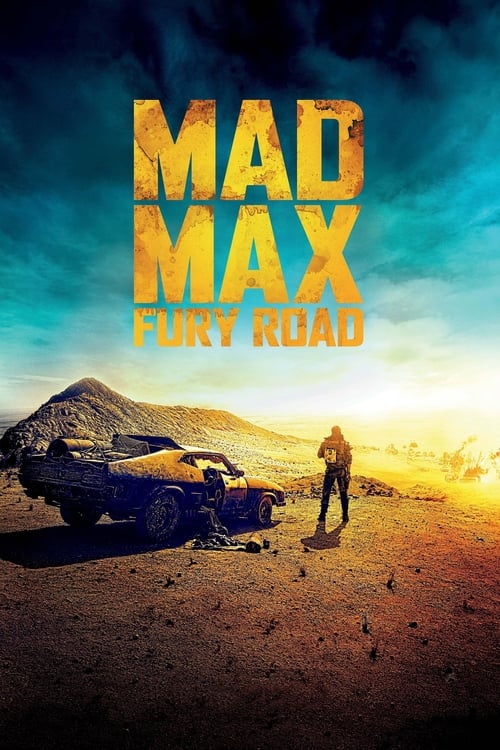
Mad Max: Fury Road
2015 · George Miller
When you want pure adrenaline done with brains — a crank-it-loud, edge-of-the-couch night where you come out the other side grinning and slightly deafened. Comfort food for action fans, at the highest grade available.
What it's about
In a scorched desert wasteland where a warlord hoards the water and the people below him scrabble to survive, a hardened war-rig driver goes off-route with five enslaved women hidden in her tanker. A drifting loner named Max gets dragged into the escape against his will, and the whole armed might of the citadel comes howling after them. It's one long chase — out and, maybe, back.
The experience
Two hours of nearly continuous, white-knuckle momentum that somehow never turns to noise — every beat of character and story is delivered at speed, mid-explosion. It's exhilarating, strangely beautiful, and it leaves you buzzing.
Performances
Charlize Theron's Furiosa is the film's soul — a ferocious, grief-lined performance delivered mostly through her eyes — while Tom Hardy plays Max as a near-wordless animal slowly remembering how to be human.
The craft
George Miller stages real trucks, real stunts, and real desert into action so legible you always know where everyone is at 80 miles an hour — a feat of editing and choreography as much as spectacle. The saturated orange-and-teal photography and an engine-and-drums score make it one of the great big-screen, loud-speakers experiences.
Why it matters
Widely called the definitive action film of its century so far, it reset the bar for practical-stunt spectacle and proved a decades-old franchise could return as a full-blown auteur statement.
Snapshot
A two-hour chase film disguised as a myth. George Miller returns to the post-apocalyptic Australian franchise he founded in 1979 and produces what many critics and scholars consider the definitive action film of the twenty-first century. Set in a scorched wasteland controlled by a water-hoarding warlord, the film follows Imperator Furiosa's attempt to liberate five enslaved women while a reluctant Max Rockatansky is swept along as co-protagonist and eventual ally. The narrative is structurally almost pure kinesis — a near-continuous pursuit east, then west — yet it sustains thematic density, extraordinary visual coherence, and character legibility that most conventionally structured films do not achieve. Fury Road is the rare blockbuster that operates simultaneously as genre spectacle and auteur statement.
Industry & production
Development on a fourth Mad Max film stretched across roughly two decades. Miller had conceived new stories in the franchise by the early 2000s, and production was briefly planned for Broken Hill, New South Wales — the red desert terrain that had anchored Mad Max 2: The Road Warrior (1981). Unprecedented rainfall in that region caused the desert to bloom green and forced an urgent relocation. Shooting ultimately took place predominantly in the Namib Desert of Namibia, near Swakopmund, from 2011 into 2013, with Warner Bros. financing what became one of the most physically ambitious productions in recent Hollywood history.
The shoot was notoriously arduous. Working in extreme heat, across shifting dunes, with a cast and crew of hundreds and a convoy of purpose-built vehicles, Miller orchestrated conditions closer to those of a military logistical operation than a conventional film set. Reported tensions between Tom Hardy and Charlize Theron during production have been widely discussed in subsequent interviews, and Miller has acknowledged the difficulties openly. The film was in post-production for nearly two years before its Cannes premiere in May 2015, where it screened out of competition. That Cannes presentation — the spectacle of a seventy-year-old director returning to a franchise he had not visited since 1985 with a film of this ambition — framed the critical reception decisively.
Technology
Fury Road's production philosophy is grounded in a commitment to practical effects, but it is not a purist rejection of digital tools. The film's approach is integrative: physical stunts, real vehicles, and real locations provide the photographic base, and digital effects augment or extend rather than replace. The vehicles — War Rig, Pole Cats, the Gigahorse — were functional machines, designed and built by Colin Gibson's production department and driven and wrecked for the cameras. Stunt performers were genuinely suspended from poles, genuinely thrown across hoods, genuinely airborne.
Cinematographer John Seale, coaxed out of retirement by Miller, shot on anamorphic lenses, exploiting the format's lateral compression and characteristic lens character to give the desert landscape a mythic scale. Color grading by Eric Whipp and the visual effects team produced the film's signature palette — the scorched orange-gold of daylight sequences and the cold, desaturated blue-teal of the nocturnal passages through the canyon — a dichotomy that carries both aesthetic and symbolic weight. The film was also released in 3D, though Miller intended the flat version as primary; he has discussed designing compositions that work in both formats.
The Doof Warrior — a blind guitarist strapped to a speaker truck, playing a flame-throwing electric guitar to motivate the War Boys — is both a piece of practical production design and a distillation of the film's approach to spectacle: audacious, slightly absurdist, grounded in physical reality.
Technique
Cinematography
John Seale's approach to shooting Fury Road was shaped by a methodology Miller had developed across years of storyboarding: nearly every shot was pre-designed, with the camera's relationship to the subject specified in advance. The defining compositional principle is centering — subjects are held at or near the center of the frame as much as possible, so that the audience's eye does not have to hunt across the widescreen frame during rapid cutting. This apparently simple rule has profound implications: it allows the editing pace to accelerate without sacrificing readability, because the point of visual interest does not shift laterally between cuts. Seale shot mostly on daylight exteriors, using the Namibian sun as a dominant source, and Miller employed second and third unit cameras simultaneously for the sprawling vehicular action sequences. The result is cinematography that feels both epic in scale and precise in its management of visual information.
Editing
Margaret Sixel, Miller's wife, edited Fury Road having not previously cut an action film. She reportedly worked through approximately 480 hours of raw footage over the course of the extended post-production. The result is one of the most rigorously constructed action edits in cinema history: the rhythm is percussive but calibrated, with an internal logic that maps spatial relationships and maintains character clarity even during sequences of near-abstract vehicular chaos. Sixel won the Academy Award for Best Film Editing, and in subsequent discussion Miller acknowledged that an editor without action-film habits may have been exactly what the material required — someone who approached the footage without preconceptions about what an action cut should feel like. The editing also sustains a tonal range across the film, modulating from the kinetic maximum of chase sequences to quieter, almost elegiac passages in the canyon.
Mise-en-scène / staging
Miller conceived the film less as a screenplay than as a visual score, working extensively with comic-book artist and co-writer Brendan McCarthy on storyboards that functioned as the primary structural document. The vehicle convoy is itself a piece of sustained mise-en-scène: each machine in Immortan Joe's pursuit fleet is distinct in silhouette, function, and the sociology it embodies. The War Boys who crew these vehicles are costumed as devotees in a death cult — white-powdered, chrome-mouthed, ecstatic — and their staging consistently emphasizes both menace and tragedy. The Five Wives are introduced in an act of deliberate contrast: pale, dressed in white, moving slowly against the sand and heat. The Doof Warrior's music truck is positioned at the rear of the attacking fleet, a mobile soundtrack for slaughter. These staging choices make the convoy legible as a social world in motion, not merely a collection of obstacles.
Sound
Junkie XL (Tom Holkenborg) composed an orchestral-electronic score that functions as a constant propulsive force, inseparable from the film's editing rhythm. The score is scored for large ensemble with heavy metal guitar and percussion at its foundation, mirroring the film's visual energies. The sound design, which won Academy Awards in both Sound Editing and Sound Mixing categories, treats the vehicular sounds — engine roars, metal impacts, explosions — as musical events integrated with the score rather than separated from it. The Doof Warrior's diegetic guitar is threaded into the non-diegetic soundtrack in ways that deliberately blur the boundary; the film's world is saturated with sound as an instrument of power and terror.
Performance
Tom Hardy's Max Rockatansky speaks remarkably little. Where Mel Gibson's Max in the earlier films was garrulous by comparison, Hardy's interpretation tends toward reactive physicality — grunts, glances, strategic silences. This is a deliberate choice that Miller enforced, and it shifts the dramatic center of gravity entirely toward Charlize Theron's Furiosa. Theron's performance is among the most controlled pieces of physical acting in recent blockbuster filmmaking: Furiosa's one prosthetic arm, her scarred face, the economy of her expressions, the coiled precision of her movements. She registers grief, fury, and exhaustion through bearing and gesture as much as dialogue. Nicholas Hoult's Nux — a War Boy who begins as antagonist and becomes reluctant ally — provides the film's most emotionally available arc and Hoult plays the character's transformation from zealotry to tentative humanity without sentimentality. Hugh Keays-Byrne, who played the original Mad Max's villain Toecutter in 1979, returns as Immortan Joe, performing largely through prosthetics and posture.
Narrative & dramatic mode
The narrative architecture is almost geometrically simple: east (flight), then west (return). There is no subplot, no parallel storyline, no expository prologue beyond Max's brief voiceover and the visual shorthand of Immortan Joe's citadel. Yet within this structure Miller embeds a complete mythic journey, a critique of patriarchal violence as the foundation of social order, and a meditation on whether hope is recoverable in conditions of absolute scarcity.
The film subverts the franchise's own premise. Mad Max has always used its protagonist's name in its title, but Fury Road is Furiosa's film. Max functions as a helper figure in what is structurally her hero's journey, and the film acknowledges this formally in its final images, where she rises to power while Max dissolves back into the anonymous road. The wives — figures initially defined entirely by their captivity and their relationship to Immortan Joe — are gradually individuated through small acts of resistance and assertion. Their chalked declaration, "We are not things," written on the wall of their cell and visible briefly in the film's opening passages, operates as both character statement and political thesis.
Genre & cycle
Fury Road belongs to the post-apocalyptic action genre that Miller's own Mad Max 2: The Road Warrior substantially created in 1981. It also revitalizes the chase film, a form with roots in the silent era (Keaton, Lloyd) that has rarely been pursued at feature length with this degree of formal rigor. The film arrives in 2015 at a moment when franchise cinema is predominantly built around connected universe logics and multi-film narrative arcs; Fury Road is structurally self-contained, requiring no knowledge of the previous three films and refusing to set up a sequel in any explicit way. It can be understood as a corrective intervention in the genre — a demonstration that spectacle and coherence, franchise continuation and auteurist vision, are not mutually exclusive.
The film also participates in what critics identified in 2015 as a cycle of high-budget feminist action — a cycle whose terms were contested almost immediately upon the film's release, when some men's rights commentators called for a boycott on the grounds that it centered a female protagonist. The ensuing debate became part of the film's cultural context and amplified its reception considerably.
Authorship & method
George Miller is the film's presiding intelligence in a thoroughgoing sense: he conceived the story, co-wrote the script, directed, and maintained creative authority across the production's extended development and post-production. His background as a trained medical doctor — he completed his medical degree before making the original Mad Max — informs his documented interest in the physiology of action: the way the body registers threat, the role of adrenaline in perception, the mechanics of shock. His method on Fury Road was to develop the film primarily through storyboarding rather than conventional screenplay, in collaboration with Brendan McCarthy, a British comic-book artist whose visual sensibility and anarchic mythology-building substantially shaped the world's design. Nick Lathouris, an Australian actor who appeared in the original Mad Max, contributed to the screenplay and has been an ongoing creative collaborator on the franchise.
John Seale's contribution as cinematographer cannot be overstated: he had to adapt his considerable experience to a methodology — pre-designed, centered composition at extreme scale — that was specific to Miller's vision. His Namibian work gives the film its particular quality of light: punishing, horizontal, transforming the desert into something between a landscape and a furnace.
Margaret Sixel's editorial work is structurally constitutive of the film. The finished cut is not the application of an editing style to pre-existing material but a creative act that determines the film's rhythm, its tonal range, and ultimately its legibility as narrative.
Junkie XL's score was developed alongside the editing process, with the composer working closely with Miller through post-production. The integration of score and sound design — the blurring of diegetic and non-diegetic sound that the Doof Warrior embodies — is a formal achievement as much as a production one.
Movement / national cinema
Fury Road has a complex relationship with Australian national cinema. Miller is Australian, the franchise began in Australia, and the earlier films — shot in Victoria and New South Wales on minimal budgets — are foundational texts of the Australian New Wave, the internationally noticed commercial and artistic flourishing of Australian filmmaking in the 1970s and 1980s. Fury Road was financed by Warner Bros. and shot in Namibia with an internationally assembled cast and crew. It is in one sense a Hollywood production that has Australian authorship at its center; in another sense it represents the internationalisation that a certain strain of Australian genre filmmaking always harbored. Miller's career trajectory — from low-budget Melbourne productions to Babe (1995), Happy Feet (2006), and the Mad Max franchise's industrial escalation — traces a path from national to global cinema without abandoning the genre roots.
Era / period
The film arrives in the mid-2010s, during the peak consolidation of franchise and connected-universe production models dominated by Marvel Studios. The year 2015 is also the year of Star Wars: The Force Awakens, which returns to another canonical franchise through nostalgia and continuity. Fury Road's relationship to its franchise is different — less a restoration than a reinvention by the original author. It appears at a moment when auteur theory is under pressure within blockbuster production, and its extraordinary critical reception functioned partly as a collective statement about what major-studio filmmaking at scale could still aspire to.
The film also arrives in a decade of sharpening public discourse about gender representation in mainstream cinema, catalyzed in part by social media. Its reception was shaped by this context in ways that earlier franchise sequels rarely experienced.
Themes
The film's dominant thematic concern is captivity and its consequences. Immortan Joe's citadel is a water monopoly enforced by violence; every social relationship in the film's world derives from that scarcity and the power it concentrates. The wives are commodified bodies; the War Boys are soldiers formed by indoctrination into a death cult that promises them redemption through sacrifice; the mothers at the Green Place have been dispossessed of their land; Max himself is briefly enslaved as a blood bag. The film asks what solidarity looks like when everyone is, in different ways, a captive — and answers with a coalition of the differently oppressed.
Hope and the possibility of return are examined with unusual skepticism. The Green Place, the mythic destination toward which Furiosa drives, turns out to be a swamp. The paradise is lost. The film's response to this information — the turn back, the realization that the only future is a fought-for present — is its most resonant dramatic move.
Water, milk, and fuel circulate as symbols of control and sustenance throughout. The film's famous image — the citadel's water released from the pumps, falling in sheets over the reaching hands of the wretched — is an image of revolution as elemental redistribution.
Reception, canon & influence
Critical reception. Fury Road received near-universal critical acclaim on its 2015 release, appearing at or near the top of many year-end and decade-end critical lists. The American Film Institute, numerous critics' circles, and major publications named it among the finest films of the decade. It was nominated for ten Academy Awards and won six: Film Editing, Production Design, Costume Design, Makeup and Hairstyling, Sound Editing, and Sound Mixing. It was nominated for Best Picture and Best Director — relatively rare for an action film — though it did not win in those categories.
Influences on the film. The most direct influence is Miller's own trilogy, particularly Mad Max 2: The Road Warrior, which established the franchise's visual vocabulary of scarce resources, tribal violence, and the lone wanderer. Beyond the franchise, Miller has acknowledged a debt to Buster Keaton — the integration of physical comedy and genuine danger, the body as performing instrument — and to the mythological structure articulated in Joseph Campbell's work. The visual world draws on a tradition of dystopian illustration and heavy metal artwork that Brendan McCarthy's background in comics brought into the design process. The films of Sergio Leone — the mythic hero, the landscape as moral terrain, the use of extreme close-up — resonate in the visual scheme. Miller has also spoken about his admiration for Hayao Miyazaki, whose approach to world-building and female protagonists may have informed aspects of the film's development.
Legacy. Fury Road's influence on subsequent action filmmaking is still diffuse but traceable. Its demonstration that a blockbuster action film could be structured as a sustained chase rather than a three-act plot with multiple subplots, and that coherent spectacle could be achieved through practical work, centered composition, and rhythmic editing, has been absorbed into the discourse around action filmmaking in ways that are difficult to attribute directly but evident in the conversations among filmmakers. The film's Furiosa became one of the central examples in critical discussions of action heroism and gender. Miller returned to the world with Furiosa: A Mad Max Saga (2024), a prequel charting Furiosa's earlier history with Anya Taylor-Joy and Chris Hemsworth; the mere fact of that film's existence testifies to Fury Road's durable commercial and cultural standing. More broadly, Fury Road has entered the pedagogical canon — it is now routinely assigned in film studies courses as a text on action choreography, editing theory, and the intersection of auteurism with franchise cinema.
A Deleuzian reading
A blind man is bolted to a wall of speakers on a moving truck, slung in bungee cords, working an electric guitar that spits fire.
The full Deleuzian reading of Mad Max: Fury Road →
Reception
A rare case of no reappraisal needed: hailed on arrival in 2015 as an instant action classic, it won 6 Oscars and has only climbed since — now routinely topping best-of-the-2010s and best-action-film-ever lists.
How Mad Max: Fury Road was received, from release to now →
Influences: the films it descends from and the films it influenced
- Mad Max 2: The Road Warrior (1981) — Established the centered anamorphic staging of convoy combat — the War Rig's multi-vehicle fleet and its internal social hierarchy directly extend the Humungus gang's vehicle-mounted siege choreography and the diegetic sound grammar of engines, chains, and combustion as compositional material.
- Mad Max Beyond Thunderdome (1985) — Developed the prosthetic-body performance vocabulary and tribal-society world-building that Fury Road refines: Master Blaster's two-body-one-unit construction is the direct formal ancestor of the War Boys' scarified, prosthetically augmented performance aesthetic.
- The General (1926) — Miller explicitly acknowledged Keaton's influence: the film's linear chase along a single rail axis and the performer's body as the primary practical stunt instrument — Max clinging to the hood-mounted chrome pole is structurally identical to Keaton's locomotive acrobatics, with genuine physical danger as the aesthetic.
- The Good, the Bad and the Ugly (1966) — Miller acknowledged Leone as a primary influence: the rhythmic alternation between extreme facial close-up and vast anamorphic desert landscape, with editing beats synchronized to Morricone's score, is the formal template for Seale's close/wide grammar and Holkenborg's score-as-structural-force.
- Stagecoach (1939) — Ford's stagecoach as social microcosm traversing hostile landscape is the structural template for Fury Road's War Rig: a cross-section of society under pressure moving in linear geometry, with civilian passengers requiring protection from mounted attack in choreographed pursuit sequences.
- Nausicaä of the Valley of the Wind (1984) — Miller explicitly cited Miyazaki: the film's female protagonist commanding a military-ecological crisis in a post-collapse world — mythological world-building centered on female agency — directly informs Furiosa's narrative function and the Wives' status as reclaimed actors rather than rescued objects.
- Apocalypse Now (1979) — Walter Murch's sound design — diegetic gunfire, helicopter rotors, and non-diegetic score occupying the same acoustic plane — is the direct precedent for Fury Road's sonic treatment of the Doof Warrior's flamethrower guitar, where environmental sound and underscore become indistinguishable.
- The Wages of Fear (1953) — Clouzot's convoy carrying volatile cargo through hostile terrain as an extended single set piece establishes the linear-chase-geometry template: no third-act destination beyond survival, tension structured entirely through sustained forward motion, mechanical failure, and the lethal social dynamics of a crew under constraint.
- Duel (1971) — Spielberg's stripped chase-film geometry — one road, two vehicles, tension maintained for nearly the full runtime without subplot relief — is the formal minimum that Fury Road scales up: the same refusal to divert from forward momentum, now populated with a social world but preserving the pure chase spine.
- Battleship Potemkin (1925) — The Odessa Steps sequence — cutting to emotional and rhythmic logic rather than temporal continuity — is the theoretical foundation of Fury Road's percussive-action-cut system, where Margaret Sixel cuts to the score's pulse and the body's impact rather than narrative geography.
- The Dark Knight Rises (2012) — Miller built the film's spectacle from practical in-camera stunt work — John Seale shooting real vehicles in real Namibian desert — positioning it explicitly against CGI-dominant blockbuster production; the commercial and critical viability of this argument as a prestige-blockbuster proposition was made by the TDKR model.
- Ronin (1998) — A feature-length argument for practical vehicular stunt work and real physical speed over digital spectacle, the analog-authenticity ethos for which Ronin is the standing reference point.
- Furiosa: A Mad Max Saga (2024) — Imports Fury Road's storyboard-driven production methodology and centered anamorphic grammar into a prequel structure while shifting from physical-stunt minimalism toward digital extension — the craft debt is dialectical: Furiosa must reconstruct through CGI what Fury Road achieved through practical presence.
- Mission: Impossible — Fallout (2018) — Fury Road's demonstration that blockbuster spectacle anchored in practical stunt choreography — the performer's body as primary special effect — is inherited in Fallout's production philosophy, where the HALO jump and helicopter sequence were staged for camera clarity and physical authenticity rather than digital compositing.
- Black Panther (2018) — Miller proved that a fully realized speculative society could be communicated through costume, body modification, and material culture alone without expository dialogue — proved at industrial scale — which Ruth Carter and Hannah Beachler adopted as the organizing principle for Wakandan world-building.
- Atomic Blonde (2017) — Immediately precedes and certifies Theron as a bankable, physically punishing action lead, the standing that lets Atomic Blonde be designed around her sustained, performer-executed combat.
- Masters of the Universe (2026) — Margaret Sixel's center-frame axial cutting — the eye parked on one point so that fast cutting never costs the viewer orientation — codified spatial legibility as an achievable blockbuster standard, and is the editorial doctrine behind Knight's insistence that clarity precedes spectacle.
- Lawrence of Arabia (1962) — Freddie Young's Super Panavision 70 desert photography — horizontal punishing sunlight transforming Wadi Rum into a moral landscape where environment registers ethical stakes — is the direct cinematographic precedent for John Seale's Namibian work, where the Namib simultaneously functions as setting and ethical arena.
- Drive (2011) — Cliff Martinez's electronic score functions identically to Holkenborg's in Fury Road: both are propulsive structural forces rather than diegetic commentary, integrated so thoroughly into the scene's physical space that the boundary between environmental sound and underscore dissolves during action sequences.
- Dunkirk (2017) — Hans Zimmer's score incorporates a ticking pocket watch as a literal diegetic mechanism that bleeds into non-diegetic underscore — the same diegetic/non-diegetic blur Fury Road achieves with the Doof Warrior's amplified guitar, where environmental sound becomes musical structure generating visceral time pressure.
- Sirāt (2025) — Synchronizes image to a percussion-heavy score via cut-to-the-beat editing across a single desert-convoy line of motion, the same rhythmic image/sound lock Sirāt deploys.
- The Raid (2012) — Miller's pre-planning of every action sequence in exhaustive storyboard form and then cutting the film himself over three years mirrors Evans's writer-director-editor integration; both films derive their action clarity from a single creative intelligence controlling choreographic design and editorial rhythm simultaneously, rather than assembling departments afterward.
- Mission: Impossible - Ghost Protocol (2011) — Shares GP's commitment to practical vehicular stunts staged with axial, centered-frame clarity so every collision reads cleanly — legibility as the antidote to incoherent modern action.
- Star Wars: The Force Awakens (2015) — Shares the 2015 practical-effects revival ethos — real stunts, physical vehicles, and in-camera spectacle privileged over CG — that TFA marketed as its central virtue.
- Top Gun: Maverick (2022) — The era's loudest argument for practical, photographed vehicular spectacle over full CG, and for legible chase geometry — the 'authenticity of the real' position Maverick later weaponizes.
- Dune (2021) — Sibling in elevated desert spectacle built on practical effects and real-location dunescapes, prizing tactile in-camera scale over digital backdrops.
- Mission: Impossible - Dead Reckoning Part One (2023) — Co-leads the practical-effects revival with real vehicular carnage cut into an escalating, easy-to-read kinetic rhythm rather than incoherent CG spectacle.
- Dune: Part Two (2024) — The contemporary benchmark for practical desert spectacle and cult-of-personality messianism (the War Boys' worship), a peer in staging fanatical devotion to a charismatic figure across sand.
- Ambulance (2022) — Sibling vehicular-chase-thriller built almost entirely as one extended real-time pursuit, with centered single-moving-object framing and maximalist sound that parallels Ambulance's structure.
Similar films
- The Wages of Fear (1953) — influence & lineage · same viewing thread
- Furiosa: A Mad Max Saga (2024) — influence & lineage
- Sirāt (2025) — influence & lineage
- Dunkirk (2017) — influence & lineage
- Apocalypse Now (1979) — influence & lineage · same viewing thread
- Mad Max 2 (1981) — same viewing thread
- F1 (2025) — shared sensibility
- Fury (2014) — shared sensibility
All the films related to Mad Max: Fury Road →
Watch it with: curated runs of related films
- Into the Heart of Darkness — A run of grueling journeys into hostile country — jungle, ice, desert, occupied forest — where the ordeal strips men down to something primal, hallucinatory, and often unrecoverable.
Film essays and courses that include it
- Impossible Made Visible: One Hundred Years of Engineered Spectacle
- Doing It for Real: A Century of Practical Spectacle
- The Architecture of Ruin: Ninety Years of Dystopian Cinema
- Sand and Silence: A Century of Desert Cinema
- The Speck That Moves the World: Action Cinema's Grandest Form
- Commanded Vision: The Auteur Epic
- The Cut That Stopped Meaning Anything
- The Justice That Solves Nothing