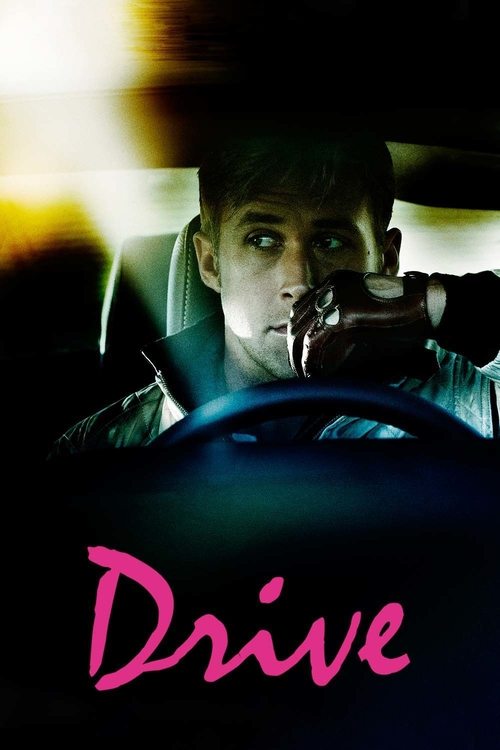
Drive
2011 · Nicolas Winding Refn
For a late night when you want something stylish and moody — a film to put on loud with the lights off, more hypnotic than cozy. Fair warning: it's tender until it's very much not, so don't reach for it if you're squeamish.
What it's about
A Hollywood stunt driver who moonlights as a getaway man lives by a strict, wordless code — until he falls for his neighbor Irene and her young son. When her husband gets out of prison owing dangerous people, the driver agrees to help with one heist to keep the family safe, and the job goes wrong in ways that put everyone he cares about in the crosshairs of organized crime.
The experience
Cool, dreamy, and almost unbearably tense — long stretches of neon-lit quiet and shy glances, punctured by violence so sudden and brutal it makes audiences flinch. It's a romance and a thriller at once, and the mismatch is exactly the point.
Performances
Ryan Gosling builds a whole character out of stillness and a toothpick — his near-silent driver became instantly iconic. Albert Brooks, cast wildly against his comic type as a soft-spoken gangster, is quietly terrifying, and Carey Mulligan makes the romance land with almost no dialogue.
The craft
Nicolas Winding Refn shoots Los Angeles as a nocturnal dreamscape — the opening getaway is a masterclass in patience and geography — and Cliff Martinez's shimmering synth score, plus a handful of perfectly chosen pop songs, does as much storytelling as the script. It absolutely rewards good speakers.
Why it matters
It turned Refn into an international name, cemented Gosling's laconic star persona, and its synth-and-neon aesthetic echoed through movies, TV, and music videos for the rest of the decade.
Snapshot
A stunt driver and freelance getaway man, unnamed throughout, navigates the fringes of Hollywood criminality with near-mythic composure until a doomed robbery drags him into a blood feud he cannot escape without destroying everything he has allowed himself to want. Sparse, violent, suffused with longing, Drive is a genre exercise that transcends its genre—an art-house neo-noir wearing a pulp jacket, indebted equally to Jean-Pierre Melville and the fever dream of 1980s American cinema. It announced Nicolas Winding Refn as an international prestige director and made Ryan Gosling's laconic star persona a cultural touchstone for a decade.
Industry & production
Drive originated with producer Marc Platt, who had acquired the rights to James Sallis's 2005 novella and developed Hossein Amini's screenplay over several years with multiple potential directors attached before the project reached Refn. By the time Refn was hired, he was emerging from a bruising period: his Icelandic Viking film Valhalla Rising (2009) had satisfied critics but left him financially exposed, and he has spoken publicly about near-bankruptcy preceding the project. Ryan Gosling, who was attached as star, personally championed Refn to the producers after an unlikely friendship formed when the two men drove around Los Angeles together—Gosling playing music and Refn growing emotional, a formative session that reportedly shaped the film's entire tonal register.
The production was a relatively lean Hollywood-independent hybrid. Bold Films, Marc Platt Productions, and Odd Lot Entertainment co-produced with a budget in the range of fifteen million dollars—modest by studio standards but sufficient to mount Los Angeles locations, stunt work, and a cast that included Bryan Cranston (still mid-Breaking Bad), Albert Brooks, Ron Perlman, Oscar Isaac, and Carey Mulligan. FilmDistrict handled US distribution. The film shot largely on location across Los Angeles rather than on backlot approximations, integrating its neon-streaked geography into the visual argument.
Technology
Drive was shot digitally, using the RED ONE camera, which cinematographer Newton Thomas Sigel leveraged for its latitude in low-light and its capacity for the deep, saturated neons of nighttime LA. The digital format enabled a fluid, observational quality in the quieter passages and an extreme tonal range that allowed faces to emerge from near-blackness with precision. Visual effects work was minimal; the film's stunts were practical, consistent with Refn's preference for a physical, grounded reality beneath the stylized surface. Sound design was executed in Dolby Digital and mixed with particular attention to the relationship between Martinez's electronic score and ambient urban texture.
Technique
Cinematography
Newton Thomas Sigel (whose prior credits include Three Kings, The Usual Suspects, and work with Bryan Singer) calibrated his approach around two registers that exist in deliberate tension: an intimate, almost surveillance-camera proximity to Gosling's face—held for uncomfortable duration—and a macroscopic sense of the city as vast, indifferent space. The palette runs from the cool blue-grays of daytime interiors to the hypersaturated pinks and purples of the title sequence and the underlit amber and black of night exteriors. Shallow depth of field in close-up isolates the Driver from his environment, reinforcing his quality of radical interiority. The opening chase is orchestrated with unusual restraint—no aggressive handheld, no crash-cutting—instead using clean, readable compositions that track spatial logic with almost procedural clarity, grounding us in craft before the film shifts registers entirely.
Editing
Matthew Newman's editing is among the most discussed formal choices in the film. Cutting rhythms are demonstrably slower than commercial action norms; scenes of emotional negotiation stretch beyond the comfort threshold of conventional pacing, holding on Gosling's face or Mulligan's profile in silences that accumulate meaning. This compression of action against dilation of stillness produces an emotional uncanniness: when violence erupts it does so with the force of something suppressed too long, and its graphic intensity (the elevator scene, the diner hit) is amplified by having been withheld. Newman also modulates the score's entrances and exits with precision, using dead silence before and after the most brutal beats to strip them of genre-thriller cushioning.
Mise-en-scène / staging
Refn stages the Driver as fundamentally a figure of thresholds—doorways, car windows, the boundary between light and shadow. The apartment corridor that connects the Driver to Irene and Benicio becomes the film's emotional geography, a liminal space where proximity and restraint are negotiated. Character blocking frequently positions the Driver slightly outside group configurations, observing rather than participating. Beth Mickle's production design renders the film's LA as half-real, half-myth: Standard motel corridors, pawnshop interiors, and low-rise Koreatown streets are treated with the heightened, almost tactile attention of a dream recalled. The scorpion jacket—a satin bomber of the kind associated with 1980s outlaw cool—functions as a piece of symbolic costuming that ties the Driver to the Grimm-tale parable of the scorpion and the frog embedded in the film's moral logic.
Sound
Cliff Martinez's score is the film's most immediately recognizable achievement. A veteran of Steven Soderbergh's films and a former drummer for the Red Hot Chili Peppers, Martinez constructed an electronic palette dominated by pulsing synthesizers, high arpeggios, and textures that invoke both the Italian crime cinema of the 1970s and the commercial synth-pop of the 1980s without simply quoting either. The original score is interspersed with licensed tracks—most notably Kavinsky and Lovefoxxx's "Nightcall," College's "A Real Hero," and Desire's "Under Your Spell"—that situate the film in an imagined 1983 that never quite was, a retrowave phantasm. The sonic world the film inhabits is inseparable from its emotional register; Martinez's cues swell beneath scenes of near-wordless longing and then cut to silence in violence sequences, inverting the usual genre contract in which action is underscored and pauses are ambient.
Performance
Gosling's performance is an act of radical reduction—a method of character built from withholding rather than display. The Driver speaks perhaps a few hundred words in the entire film, communicates primarily through stillness and glance, and modulates between tenderness and savagery along a spectrum that never announces its transitions. This quality of inwardness, which could read as blankness in lesser calibration, is sustained by intensely controlled physical behavior: the toothpick rotated in the corner of the mouth, the specific tempo of his walk, the way his eyes track before his body moves. Carey Mulligan's Irene achieves a complementary restraint, her performance legible almost entirely through micro-expression and the geometry of her attention. The film's great counterpoint casting is Albert Brooks as Bernie Rose, a smiling, civilized gangster whose avuncular manner masks a casually lethal intelligence. Brooks—known primarily for comic work—delivered here a genuinely menacing characterization that earned substantial critical attention and recognition, drawing on precisely the gap between his persona and the role's violence.
Narrative & dramatic mode
The film operates structurally as a fairy tale encoded within a crime thriller. The Driver is not psychologized in the realist sense: he has no knowable backstory, no explicit interiority, and his name is never given. He is instead a type—the knight errant, the hero who appears, protects, and vanishes—and the film is frank about this archetypal substrate. The scorpion-and-frog fable, referenced explicitly at the midpoint, names the film's tragic logic: a creature cannot act against its nature, and the Driver's capacity for catastrophic violence is inseparable from the integrity that makes him briefly lovable. The narrative is structured around a single doomed heist whose fallout organizes all action in the second and third acts, but the genre mechanics are at every point secondary to the film's interest in mood, longing, and the spectacle of masculine restraint under pressure.
Genre & cycle
Drive participates in a long tradition of the American lone-wolf crime film—the getaway driver as romantic outlaw, the underworld as moral testing ground—while revising those conventions through European art cinema pacing and sensibility. Its most direct genre ancestors are the heist-adjacent neo-noirs of the 1970s and 1980s: Walter Hill's The Driver (1978), which literalized the protagonist-as-occupation conceit; William Friedkin's Thief (1981) via Michael Mann's visual grammar; and the French polar tradition extending from Melville. Within its immediate historical moment, the film arrived amid a revival of LA noir—adjacent to films like Nightcrawler (2014) and The Nice Guys (2016)—and contributed materially to a broader turn toward slow-cinema aesthetics in prestige genre filmmaking. It also seeded or coincided with the commercial resurgence of synthwave and retrowave music culture, whose iconography the film crystallized.
Authorship & method
Nicolas Winding Refn (b. 1970, Copenhagen) trained within Danish cinema before his Pusher trilogy (1996–2005) established his reputation for raw, kinetic genre work inflected with European fatalism. Bronson (2008) introduced his characteristic mode of stylized, near-operatic violence allied to a chameleonic central performance. Drive represents the fullest synthesis of his commercial instincts and auteurist ambitions: a film with the architecture of a thriller and the tempo of art cinema, whose visual language is baroque but disciplined. Refn has spoken about his dyslexia as a formative influence, arguing that it trained him to think in images and emotions rather than words—an aesthetic autobiography legible in Drive's privileging of sensation and silhouette over dialogue and exposition.
Hossein Amini's screenplay substantially transforms Sallis's source novel. Where Sallis wrote in a fragmented, non-linear style suffused with fatalism and literary allusion, Amini produced a more conventionally structured narrative while preserving the Driver's fundamental opacity and the fairy-tale moral undertow. The decision to strip the character of a name—present as an absence throughout—is among the script's most consequential contributions.
Newton Thomas Sigel (cinematographer) brought a rigorous compositional intelligence and digital-format expertise that enabled Refn's tonal extremes. Cliff Martinez (composer) had by this point developed a signature synthetic minimalism through his Soderbergh collaborations; Drive extended and concentrated that language into its most emotionally dense application to date. Matthew Newman (editor) shaped the film's most radical formal choice—its deliberate refusal of commercial pacing norms—in close collaboration with Refn.
Movement / national cinema
Drive is formally a Hollywood independent production, made and set entirely in the United States with an American cast. Yet it is inescapably a European film in its sensibility: its pacing, its relationship to genre as material to be deconstructed rather than deployed, its aesthetic debts to the French polar and Italian giallo, and its director's fundamentally outsider relationship to Hollywood genre all position it within a tradition of European-directed American cinema (alongside Melville's influence on American crime films, Wim Wenders's Paris, Texas, and the work of Paul Verhoeven and Jan de Bont in Hollywood). Refn's Danish origin is not irrelevant—a Scandinavian coolness, a certain Lutheran bleakness beneath the pink neon—but the film belongs to no national cinema in any simple sense. It is more productively understood as an artifact of transnational art-film genre production, a category that has expanded significantly in the twenty-first century.
Era / period
Drive was released in September 2011 and belongs to a specific early-2010s moment in which prestige independent cinema was negotiating between the influence of slow European art cinema (Haneke, Kiarostami, Reygadas) and the commercial pressure of genre. The film's critical and commercial success—it won the Best Director prize at Cannes 2011, a signal institutional endorsement—ratified a mode of genre filmmaking that prioritized aesthetic ambition over generic legibility, helping to open space for subsequent films operating in similar registers. The period is also characterized by Ryan Gosling's particular stardom, which Drive consolidated: an ironic, internally focused masculinity that contrasted with the more expressive Hollywood hero norms of the preceding decade.
Themes
The myth of the cool: Drive interrogates the romantic figure of the taciturn loner by inhabiting it so fully that its costs become visible. The Driver's radical self-containment, initially coded as strength, is revealed as a form of damage—an incapacity for connection that makes him dangerous to everything he approaches.
Violence and tenderness as inseparable: The film refuses to code these as opposites. The same quality of focused attention that makes the Driver tender toward Irene and Benicio produces the extremity of his violence in their defense. Refn and Amini present this not as contradiction but as unity—a single disposition toward care that expresses itself differently under different conditions.
Los Angeles as dreamscape and trap: The LA of Drive is an nocturnal mythology as much as a geography—a city of surfaces and illusions in which movie stunt work and criminal getaway driving are simply two sides of the same performed identity. The Driver is already a figure within Los Angeles's self-mythologizing apparatus; his moonlighting in crime is the hidden underside of the city's image economy.
The fairy tale's moral determinism: The scorpion cannot cross the river without stinging the frog; the Driver cannot protect Irene without ultimately becoming the thing that endangers her. The film offers romantic idealism (the montage of the young family's day together stands among the most tender passages in the film) alongside a tragic structure that forecloses it. This co-presence of longing and fatality is the film's deepest emotional note.
Reception, canon & influence
Critical reception: Drive was received as a major work upon its Cannes premiere, where Refn's Best Director prize reflected something close to consensus enthusiasm. Critics broadly celebrated Gosling's performance, Sigel's cinematography, and Martinez's score; a subset of reviewers expressed ambivalence about the film's relationship to violence—some finding the graphic content a morally unexamined contrast to the romantic-tender material, others reading it as precisely the point. The film appeared on numerous year-end ten-best lists for 2011 and has solidified its canonical standing in the decade since.
Influences on the film (backward): The most direct formal ancestor is Jean-Pierre Melville's Le Samouraï (1967)—the lone professional defined entirely by code and craft, the minimal dialogue, the solitary apartment as existential theater. Walter Hill's The Driver (1978) provides the literal premise and the protagonist-as-occupation conceit. Michael Mann's Thief (1981) offers the visual grammar of neon-lit Chicago crime and the tragic romantic longing of the professional criminal; Thief's influence on Drive's look and emotional register is extensive and acknowledged. Kenneth Anger's experimental film Scorpio Rising (1963) has been cited in relation to the film's use of pop music against violent or transgressive imagery. Terrence Malick's meditative pacing and the use of landscape as emotional correlative are discernible in the film's longer, ambient passages. The Italian giallo tradition—particularly its use of color as expressionism—informs Sigel's palette.
Legacy and forward influence: Drive produced a wave of imitators and successors, few of which matched its precision. Refn's own Only God Forgives (2013), also starring Gosling, doubled down on the slow-cinema register while eliminating the romantic and accessible elements; it was received with substantial critical division. The film's aesthetic—pulsing synth scores, neon-soaked nighttime cinematography, laconic protagonists, slow pacing punctured by sudden extreme violence—has been so widely replicated in both cinema and television that it now functions as a recognizable sub-generic template. Its contribution to the synthwave cultural revival was significant and arguably unprecedented for a feature film: the Kavinsky and College tracks became touchstones for an entire musical and visual subculture. The film's influence on prestige television violence and pacing (the Breaking Bad aesthetic, the first season of True Detective) is often noted though difficult to trace precisely. It remains, as of the mid-2020s, among the most frequently cited films of the 2010s in critical surveys of the decade.
A Deleuzian reading
Watch the elevator.
The full Deleuzian reading of Drive →
Reception
It won Refn Best Director at Cannes and dazzled critics, but opening-weekend audiences expecting a Fast & Furious-style ride were baffled — it pulled a lousy CinemaScore and even sparked a lawsuit over the trailer. Fifteen years on it's unshakeable internet canon, arguably THE cult film of the 2010s.
How Drive was received, from release to now →
Influences: the films it descends from and the films it influenced
- Le Samouraï (1967) — The codebound lone professional defined entirely by function rather than interiority — near-total dialogue elimination, solitary apartment as existential theater — directly models Drive's performance mode of radical reduction; Alain Delon's physical comportment as the only legible text of inner life is the exact technique Gosling inherits.
- The Driver (1978) — The unnamed protagonist-as-occupation conceit (literally titled by job, never named) and the car as pure extension of character rather than tool are the literal structural and premise source; Hill strips the getaway-driver figure of backstory, biography, and motive in the same gesture Refn repeats.
- Thief (1981) — Tangerine Dream's synthesizer score established the electronic score as the genre grammar of neo-noir crime film; Mann's neon-on-wet-asphalt nighttime cinematography — color as expressionism, city light as emotional field — is the direct visual ancestor of Newton Thomas Sigel's palette in Drive, and the professional criminal's simultaneous longing for ordinary life and structural exclusion from it is the emotional architecture both films share.
- Scorpio Rising (1963) — Anger's technique of playing licensed pop tracks (Elvis, Ray Charles, Little Peggy March) with tonal incongruence against transgressive and violent imagery establishes the score-inverts-genre-contract device that Drive's use of Kavinsky's 'Nightcall' and College's 'A Real Hero' against graphic violence directly replicates.
- Badlands (1973) — Slow meditative cutting rhythms applied to a crime-romance genre framework, and a fairy-tale mythologizing of the protagonists (Kit as James Dean surrogate, Holly as wide-eyed narrator) that Drive inherits for its romantic subplot — both films render their criminal leads as legendary archetypes rather than psychological subjects.
- Collateral (2004) — Pioneered high-definition digital neon-palette nighttime Los Angeles cinematography — sodium-vapor and fluorescent light sources rendered as expressionist color fields rather than naturalistic illumination — the specific technical approach Sigel refined and supersaturated for Drive's visual grammar.
- Point Blank (1967) — The lone avenger defined by pure function and absence of interiority — Lee Marvin's performance communicates entirely through physical comportment — along with fragmented editing rhythms that suspend linear causality in favor of experiential duration, establishing the neo-noir time-signature Drive inherits.
- Ghost Dog: The Way of the Samurai (1999) — Jarmusch draws explicitly from Le Samouraï — code-bound lone professional, RZA's hip-hop score played with tonal incongruence against Melville atmosphere — establishing the mode of genre film as art-cinema translation of the samurai-professional archetype that Drive occupies from the same ancestor; both films treat the hired killer's code as a tragic anachronism in a contemporary criminal ecology.
- No Country for Old Men (2007) — The silence-before-violence editing rhythm — extended ambient quiet before sudden, abrupt explosive action with no musical escalation — and the antagonist as implacable near-supernatural professional share Drive's neo-noir temporal grammar; both films use the withholding of conventional thriller pacing as the primary source of dread.
- Heat (1995) — The face-to-face staging of professionals across a table — spare dialogue, mutual recognition, emotional economy — as the fullest expression of character is a formal device Drive inherits; Mann's alternation between operatic violence and ambient urban longing establishes the emotional rhythm Refn uses to structure the Driver's double life.
- Taxi Driver (1976) — Refn built the film's neon-soaked urban nightscape directly from Chapman's Taxi Driver palette — practical sodium-vapor and neon sources, available-light night interiors — while replicating Scorsese's strategy of slow-motion overcranking to aestheticize the silent driver-protagonist's sudden violent eruptions.
- Fireworks (1997) — Refn runs Cliff Martinez's electronic score continuously through sudden acts of violence without scoring around them, replicates Kitano's body-over-dialogue mode in Gosling's near-mute Driver, and uses elliptical cuts that remove the decisive moment of each violent act.
- Only God Forgives (2013) — Refn doubles down on Drive's Bangkok-neon palette, slow-cinema register, and Gosling's performance of radical reduction while stripping away the accessible romantic narrative entirely, making the formal system — threshold staging, silence-before-violence, electronic score — the explicit subject of the film rather than its vehicle.
- Blade Runner 2049 (2017) — Inherits Drive's slow-cutting rhythms, digital neon palette (Roger Deakins extending Sigel's expressionist approach), and synthesizer-dominant score (Zimmer and Wallfisch) while extending the lone-protagonist-as-function motif into science fiction; the film consolidates and scales the aesthetic template Drive codified into prestige studio cinema.
- Mandy (2018) — Neon-saturated cinematography, Jóhann Jóhannsson's synthesizer score, and silence-before-violence punctuation absorb Drive's aesthetic system into psychedelic horror register; the vengeance narrative's mythic fairy-tale structure — ordinary man transformed into singular avenger — is the same narrative archetype Drive uses, taken to expressionist extreme.
- John Wick (2014) — Sets the immediate neo-noir aesthetic precedent: a taciturn minimalist protagonist framed in saturated neon-and-shadow palettes over a synth/electronic score, sudden bursts of brutal violence punctuating stillness.
- Atomic Blonde (2017) — Supplies the neon color-blocked palette and synth-pop surface as load-bearing style, where licensed/period electronic music and saturated magenta-cyan lighting are dramaturgy, not decoration — Jonathan Sela's lookbook precedent.
- Good Time (2017) — Its neon-drenched, synth-scored art-house recasting of pulp crime — pairing a heartthrob's minimalist reinvention with pop-electronic scoring — is the immediate stylistic precedent for the neon-and-synth indie thriller wave Good Time crowned.
- The American (2010) — A lone professional in European exile — radical dialogue reduction, shallow depth of field in available-light cinematography, art-cinema pacing left intact within genre thriller structure — produced the year before Drive from overlapping aesthetic logic; both films apply the transnational-art-film movement's formal registers to the American genre of the professional criminal.
- Killing Them Softly (2012) — Slow-cutting rhythms, silence-before-violence punctuation, and a laconic protagonist defined by professional code rather than personal history apply Drive's neo-noir temporal logic to American crime; Greig Fraser's neon-and-darkness palette and the film's digressive ambient passages treat genre convention as a surface to be stylized through art-cinema duration.
- The Man from Nowhere (2010) — Both films, released within months of each other, independently converge on silence and ambient sound as the primary register of masculine interiority — substituting score and exposition with environmental sound to externalize a surrogate-protector's affect, parallel formal solutions to the same problem.
- Headhunters (2011) — Electronic-string hybrid score as primary emotional architecture (Cliff Martinez's timbral logic running parallel to Jeppe Kaas's), compositional power framing with deliberate stillness to encode protagonist threat, and production-design class contrast between the protagonist's actual world and the aspirational milieu he inhabits.
- Mad Max: Fury Road (2015) — Cliff Martinez's electronic score functions identically to Holkenborg's in Fury Road: both are propulsive structural forces rather than diegetic commentary, integrated so thoroughly into the scene's physical space that the boundary between environmental sound and underscore dissolves during action sequences.
- Baby Driver (2017) — Refn's taciturn near-nonverbal driver inherits the same driver-as-cipher grammar as Hill's, and his use of Kavinsky and Chromatics as punctuating non-diegetic interludes represents a contemporaneous alternative solution to the music-action integration problem Baby Driver solves differently.
- The Neon Demon (2016) — Same Refn–Cliff Martinez collaboration: neon-soaked anamorphic compositions scored by pulsing synthesizer and ambient-amplified silences in place of dialogue.
- A Bittersweet Life (2005) — Parallel descendant of the Melvillian lone professional — a near-silent driver, neon-and-reflection surfaces, and a melancholic synth/pop score doing the emotional work the face withholds.
- Oblivion (2013) — Shares the early-2010s synth-score vogue (Cliff Martinez) that M83 and Trapanese extend, using pulsing electronic music to lend cool, surface-driven images emotional weight.
- Jack Reacher (2012) — A contemporary neo-1970s exercise in the minimalist near-silent drifter and coiled stillness, leaning on practical driving — the same lone-avenger archetype rendered with parallel formal restraint.
- Nightcrawler (2014) — The neon-noir revival's cool, synth-scored L.A. nocturne and reticent-predator framing that situates Bloom's nightscape within the same contemporary neon-noir movement.
- Night in Paradise (2020) — Parallel revival of the Melvillian laconic killer through a spare electronic score, suppressed-stillness lead performance and pools of silence ruptured by abrupt violence — the same sound design ethos Mowg's score serves.
Similar films
- The Driver (1978) — influence & lineage · same viewing thread
- Only God Forgives (2013) — influence & lineage
- Heat (1995) — influence & lineage
- Taxi Driver (1976) — often watched together
- The Girl with the Dragon Tattoo (2011) — often watched together
- Nightcrawler (2014) — shared sensibility
- Drive My Car (2021) — shared sensibility
- Mulholland Drive (2001) — shared sensibility
All the films related to Drive →
Watch it with: curated runs of related films
- Undercover and Underworld — A run of cops, criminals, and the moles planted between them — watch these back-to-back for how loyalty curdles into betrayal across one corrupt city after another, from the Boston docks to Hong Kong to Marseille-by-way-of-New-York.